
For bilingual canopy tent printing Hong Kong, approve the final English and Traditional Chinese wording first, then set a consistent hierarchy across roof valances and sidewalls. Review both languages at output scale and expected viewing distance so that resizing or line breaks do not weaken the message or introduce unapproved wording.
Message hierarchy for bilingual canopy tent printing Hong Kong
Begin by deciding what the canopy must achieve at a glance, then lock the visual hierarchy before artwork starts. For bilingual canopy tent printing Hong Kong, teams should agree which message is primary (organisation name, event title or call-to-action) and how English and Traditional Chinese will be prioritised on each panel. Pick a consistent order per face — do not mix orders on the same side. If you rely on symbols (arrows, icons), specify how they pair with both language lines.
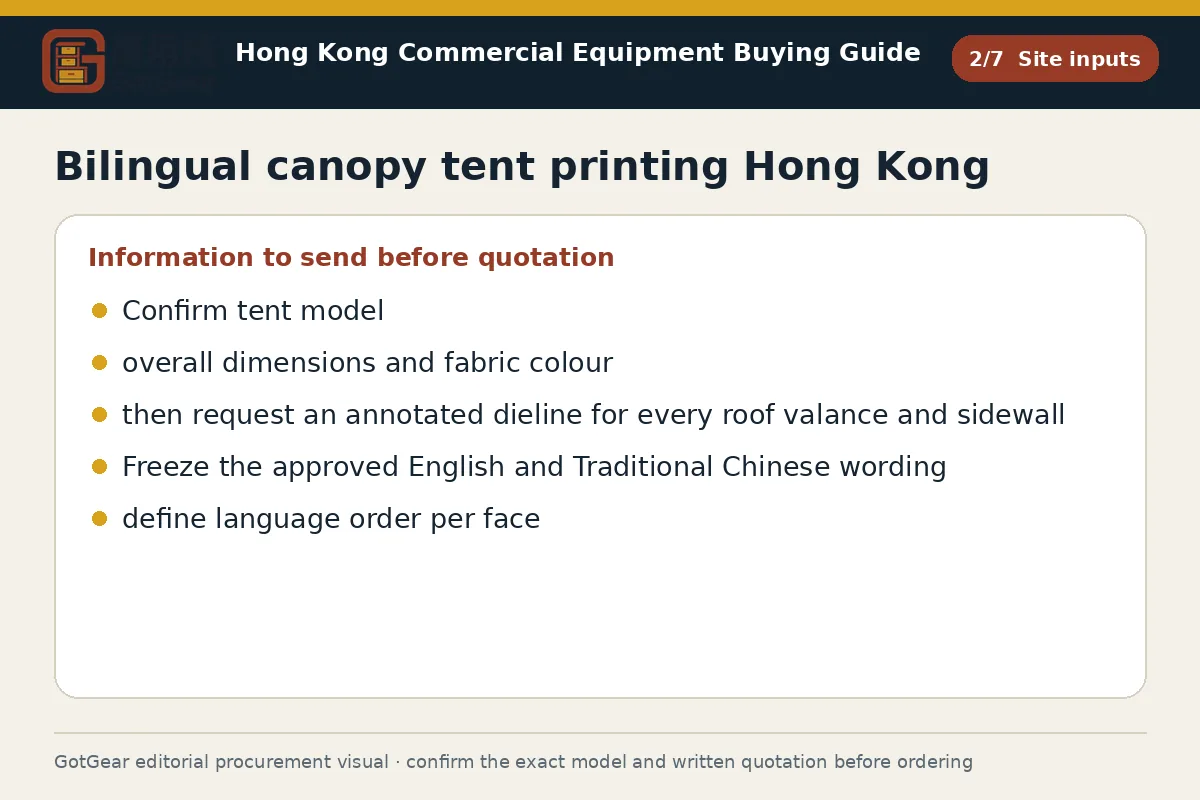
Translate that thinking into a panel plan. Identify front-of-house valances, any media-facing roof edges and sidewalls used for wayfinding. Request from suppliers an annotated dieline showing printable areas, stitch lines and scallops, and confirm safe areas where text will not be distorted by seams or tent legs. Record approach directions and typical sightlines at the venue so key messages land on the most visible faces. Where a property manager restricts overt promotions, note any wording or size limits in your brief. In your enquiry, include: tent model and size; fabric colour; required Pantone references (if any); language order per face; which faces carry the core mark; and which carry secondary information (dates, booth code, URL). Ask for a panel-by-panel proof checklist so nothing is omitted during prepress.
Translation and stakeholder approval for bilingual canopy tent printing Hong Kong
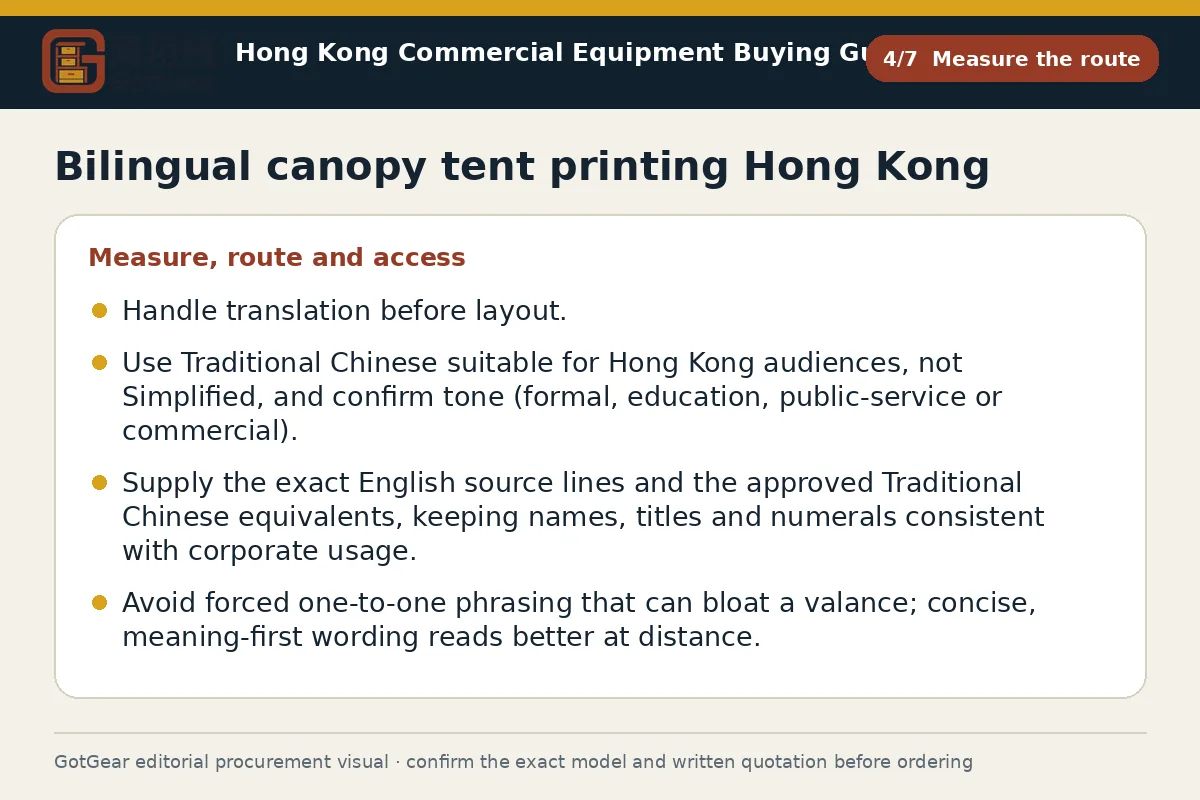
Handle translation before layout. Use Traditional Chinese suitable for Hong Kong audiences, not Simplified, and confirm tone (formal, education, public-service or commercial). Supply the exact English source lines and the approved Traditional Chinese equivalents, keeping names, titles and numerals consistent with corporate usage. Avoid forced one-to-one phrasing that can bloat a valance; concise, meaning-first wording reads better at distance. For telephone numbers, URLs and QR captions, define whether punctuation and casing differ by language, and capture that in the brief.
Define who signs off what. Name the approver for each language (communications, legal, school principal, event owner) and the final visual proof approver. Control revisions with a simple version code on the bilingual text sheet and on every proof. Require the supplier to freeze wording after “text-locked” approval and only accept tracked changes thereafter. Ask for a proof that shows both languages together at panel scale, with cut/seam guides visible. Request that all placed text be converted to outlines and that linked images are embedded in the press PDF to avoid font substitution. The supplier’s written quotation and the model’s specifications prevail over examples; ensure they restate panel count, print method and fabric type alongside proof references.
What should buyers compare for bilingual canopy tent printing Hong Kong?
| Criterion | Straightforward requirement | More complex requirement | Evidence to provide |
|---|---|---|---|
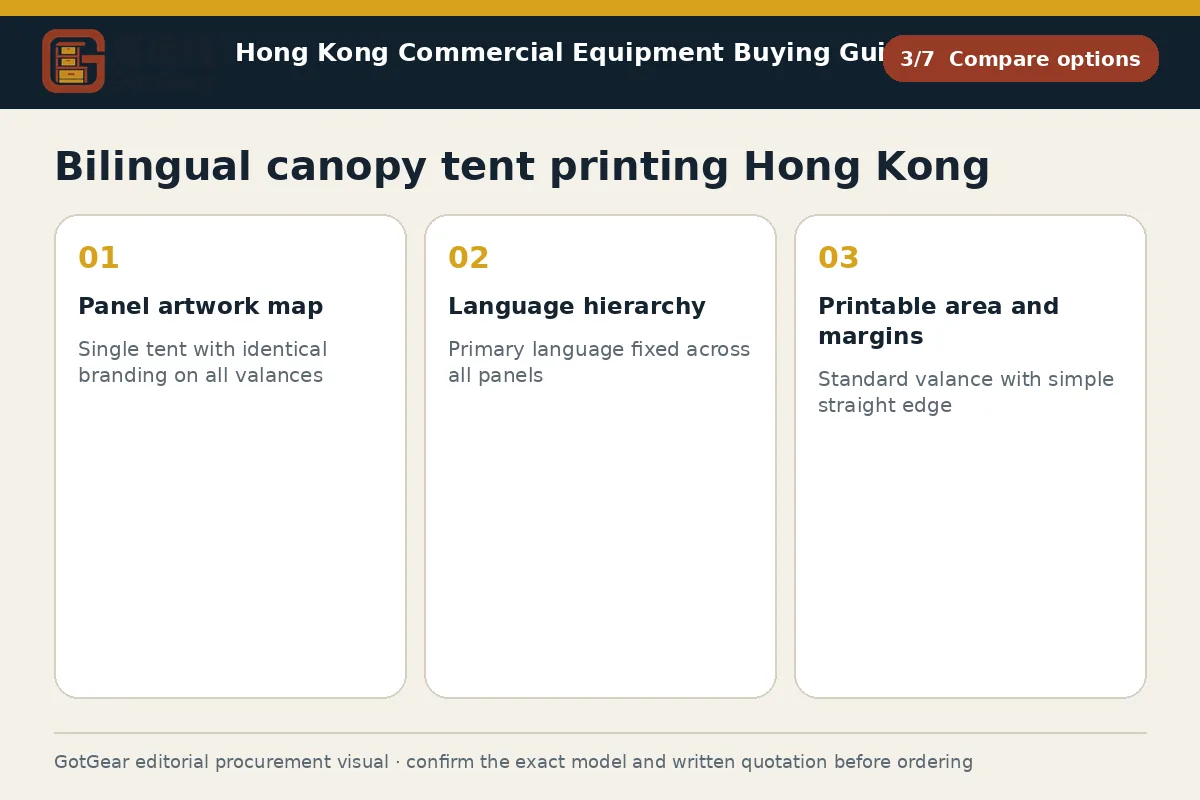
| Panel artwork map | Single tent with identical branding on all valances | Different messages per face and mixed sidewall types | Provide annotated dieline marking language order for each panel and any blank faces |
| Language hierarchy | Primary language fixed across all panels | Alternating dominance front/back with consistent left/right order | State which language is first per face and the exact size/weight/colour rules |
| Printable area and margins | Standard valance with simple straight edge | Scalloped edges, zips, windows and grommets near text | Supply printable W×H, seam/scallop positions and safe-area distances from edges |
| Colour specification | Logo in one spot colour on white fabric | Multiple brand colours on coloured fabric requiring close matching | List Pantone targets, base fabric colour and whether on-fabric swatches are required |
| Proofing and approvals | Single bilingual proof approved by one contact | Panel-by-panel proofs with multi-stakeholder sign-offs | Name approvers per language and final visual; require 100% scale proof references |
This framework helps buyers create comparable written enquiries. Final model specifications, availability, delivery and commercial terms must be confirmed in a formal quotation.
Text expansion and spacing in bilingual canopy tent printing Hong Kong
Different scripts occupy space differently. English headlines may need more width; Traditional Chinese characters are visually denser and need breathing room around strokes. Set rules that preserve legibility for both: consistent hierarchy (size/weight/colour), generous line spacing and clear separation between languages. As an example starting point to test on your site, many buyers trial a 70–100 mm cap height for primary valance text intended to be read across a small courtyard; confirm with your supplier after reviewing the actual tent size, viewing distance and typeface. Keep a clean margin from scallops, stitch lines and leg pockets so that no strokes are clipped.
Ask the printer for the exact printable width and height of each roof valance and sidewall, the position of seams and zips, and their recommended bleed and safe-area distances. Confirm whether the print method (e.g. dye-sub or UV) and fabric thickness may soften fine strokes; request the minimum recommended line weight for small Traditional Chinese characters and thin English serifs. If you specify brand colours, provide Pantone references and accept a production tolerance only if you have seen fabric swatches. Note that humid conditions can affect handling; request guidance on packing so folded panels do not imprint against fresh ink. Where sidewalls include doors or windows, provide layout constraints early so text does not intersect openings.
Viewing-distance proofing for bilingual canopy tent printing Hong Kong
Prove readability at output scale rather than on a monitor. Ask for 100% scale PDFs for each panel, then print tiled sections of the longest lines and any complex Traditional Chinese phrases. Tape them to a wall at the intended height, stand back at the expected viewing distances, and check legibility, line breaks and language order. Evaluate under daylight and under the lighting you expect at the venue. If using QR codes, test on fabric-like paper at the shortest planned scanning distance; as an example, teams often trial larger modules for outdoor use, but confirm sizing with your supplier and event manager.
Before production, request a full set of annotated proofs showing seam intersections, scallops and grommet or Velcro positions so no characters land on hardware. For events in managed venues, ask whether the organiser requires fire-retardancy documentation for the chosen model; if so, request the manufacturer’s fabric specification sheet and any available certificate for your files. Pre-shipment, ask for photos of each finished panel laid flat and one assembled mock-up shot so you can spot orientation errors. On receipt, inspect print alignment across adjoining panels, colour consistency between roof and sidewalls, absence of banding, and exact match to the signed bilingual proof. Record any variance immediately against the packing list and proof reference.
Bilingual canopy tent printing Hong Kong decision checklist
Confirm tent model, overall dimensions and fabric colour, then request an annotated dieline for every roof valance and sidewall. Freeze the approved English and Traditional Chinese wording, define language order per face, and nominate sign-off owners. Provide Pantone targets and request printable area, seam and safe-area measurements. Set initial type sizes and spacing, then run a full-scale distance test and adjust before production. Ask for a panel-by-panel proof showing cut lines and hardware positions. Compare quotations by print method, fabric weight, sidewall count, colour-matching approach and proofing rounds included. Book building access and loading windows, noting any goods-lift size limits. Before shipment, request photos and any venue-required fabric documents; on receipt, check colour consistency, orientation and conformity to the signed proof. The model specification and written quotation govern.
- Operating use, quantity and expected frequency
- Dimensions, capacity, material and accessory requirements
- Delivery address, floor, goods lift and loading window
- Required documents, acceptance checks and after-sales arrangements
Key points for bilingual canopy tent printing Hong Kong
Hong Kong projects commonly face tight assembly spaces, goods-lift limits and short loading windows, so panel orientation and handling order should be planned with the management office. Many venues expect bilingual information; agree English and Traditional Chinese wording early to prevent last-minute swaps that delay approvals. Outdoor use is hot and humid, so allow time for panels to dry fully before packing. Some public or institutional venues may ask for fabric specifications or fire-retardancy evidence depending on the model and event. This summary is practical guidance, not legal advice—always confirm venue and supplier requirements in writing.
Questions about bilingual canopy tent printing Hong Kong
Should English or Traditional Chinese come first on the valances?
Keep one consistent order across all faces so readers don’t hesitate. Choose based on primary audience and venue norms, then apply the same hierarchy, size and weight to equivalent lines. If you expect mixed traffic, consider alternating front/back dominance while keeping left/right consistent. Confirm your decision with the organiser or management office before proof sign-off to avoid rework.
What text sizes work on canopy valances and sidewalls?
Set sizes from viewing distance, not from screen impressions. As a trial starting point, teams often test 70–100 mm cap height for primary valance lines in compact courtyards, with generous spacing for Traditional Chinese. Always validate at output scale with your chosen typeface and fabric, then adjust. The supplier’s recommended limits and your signed proof should prevail over examples.
How do we ensure brand colours reproduce reliably on fabric?
Specify Pantone targets and request the printer’s colour process and tolerance statement, then approve on-fabric swatches where time allows. Fabric and print method can shift tone versus coated paper. Share ambient-light conditions for the event so expectations are realistic. Only accept colour variations documented in the quotation and confirm any critical hues on the actual substrate before production.
Do we need certificates for the printed canopy at public events?
Some venues request fabric specifications or fire-retardancy evidence depending on the model and event type. Ask the organiser or property manager what documentation is acceptable, then request those documents from the manufacturer via your supplier. Requirements vary, so do not assume overseas certificates apply. Keep proof references aligned with your approved artwork in case on-site checks occur.
Continue with closely related procurement topics
These pages share equipment, operating or decision-stage signals with this guide.
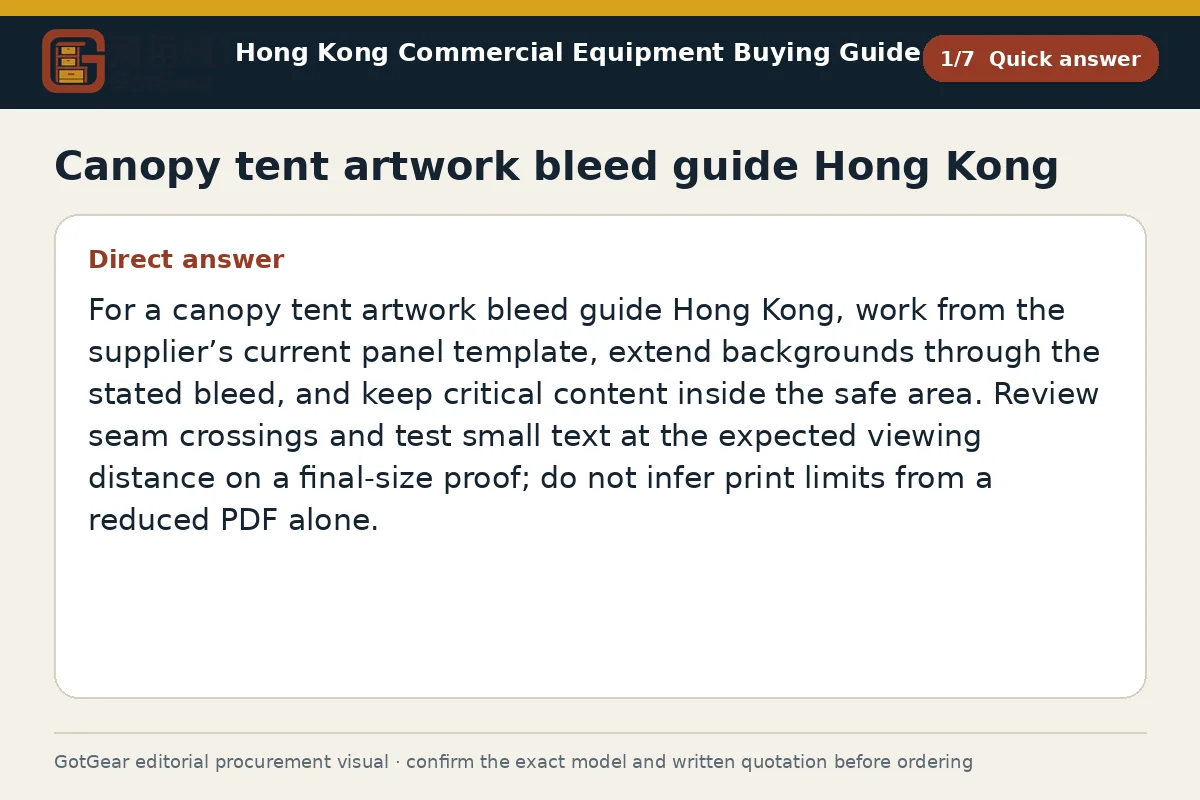
Canopy tent artwork bleed guide Hong Kong
Refer to the GotGear canopy tent artwork bleed guide Hong Kong to set bleed and safe areas. Also review canopy tent seam artwork Hong Kong and test custom canopy small text printing Hong Kong on a final-size proof.
Read the guide
Custom canopy Pantone colour matching Hong Kong
GotGear explains how to prepare files and request proofs for custom canopy Pantone colour matching Hong Kong. It also covers custom canopy gradient printing Hong Kong and custom canopy photo resolution printing Hong Kong.
Read the guide
Canopy tent rooftop anchoring Hong Kong
GotGear offers guidance on approval, structural input, exposure, ground conditions and permitted fixing methods for canopy tent rooftop anchoring Hong Kong. It also covers measures for canopy tent anchoring on sand Hong Kong.
Read the guide
Printed gazebo sidewall door layout Hong Kong
Use this checklist to finalise door positions and visitor flow for printed gazebo sidewall door layout Hong Kong and to plan canopy sidewall cable access Hong Kong. Keep artwork clear of openings during setup with GotGear.
Read the guideRelated topic indexOpen more English procurement pages1 topics
Browse additional equipment families, applications and procurement questions relevant to a wider buying brief.