
For a custom pop up canopy RFQ Hong Kong, prepare dimensions, configuration, quantities, use location, access constraints, artwork files, approval responsibilities and required response fields. Ask bidders to state assumptions and exclusions so offers can be compared without presuming availability, production timing or delivery capability.
Dimensions and configuration for custom pop up canopy RFQ Hong Kong
Start by fixing the physical footprint and frame geometry so suppliers quote like-for-like. In your custom pop up canopy RFQ Hong Kong, specify the assembled width and depth, peak and eave heights, plus the number of telescopic leg stop positions. State whether the site demands a square or rectangular plan and whether multiple units must join with gutters. As an example starting point, buyers often review 3 × 3 m, 3 × 4.5 m and 3 × 6 m formats, but the responsible supplier and venue must confirm suitability in writing.
Define the roof as printed or plain, one-piece or panelled, and the wall set: none, half, or full walls; solid, windowed, or mesh; and how walls fix (zips, Velcro, keder). Note door needs, window placement and privacy zones; add a printed gazebo sidewall door layout Hong Kong note if you need zipped access, roll-ups or service flaps. Ask for folded-frame bundle dimensions and weight for lift and corridor checks, and whether a trolley is included. Record ballast expectations for each venue because pegs are often prohibited; request example starting ballast guidance from the bidder while reserving that the venue, engineer or insurer’s written instruction prevails. If canopies must align with existing branding sightlines, include valance height and print orientation references for consistency.
Artwork roles: Custom pop up canopy RFQ Hong Kong and branded gazebo procurement specification Hong Kong
Clarify who owns brand assets, who adapts them, and who signs off proofs. In your branded gazebo procurement specification Hong Kong, state whether your marketing team or the supplier prepares print-ready artwork, and who approves bilingual Chinese/English copy. Provide vector logos (AI/EPS/PDF), linked fonts or outlines, and Pantone Coated references; use a custom canopy Pantone colour matching Hong Kong note when precise colour criticality applies. Confirm whether proofing is soft-proof only, or if you also require printed fabric swatches as an example starting point.
Request the supplier’s production dielines for each roof and wall panel, with stitch lines and eyelet/no-print keep-out zones. Cite a canopy tent artwork bleed guide Hong Kong in your pack so panels extend adequately into seams and hems. If photography is included, specify minimum artwork resolution and how gradients or large solids are handled on textile. Identify whether frame colour is raw aluminium, anodised or powder-coated and who signs off any RAL/Pantone approximations. State how many rounds of amends are included, how corrections are tracked, and the final approver’s name and role to avoid disputes. Require dated approval emails to be referenced on the purchase order and on the supplier’s production file label.
What should buyers compare for custom pop up canopy RFQ Hong Kong?
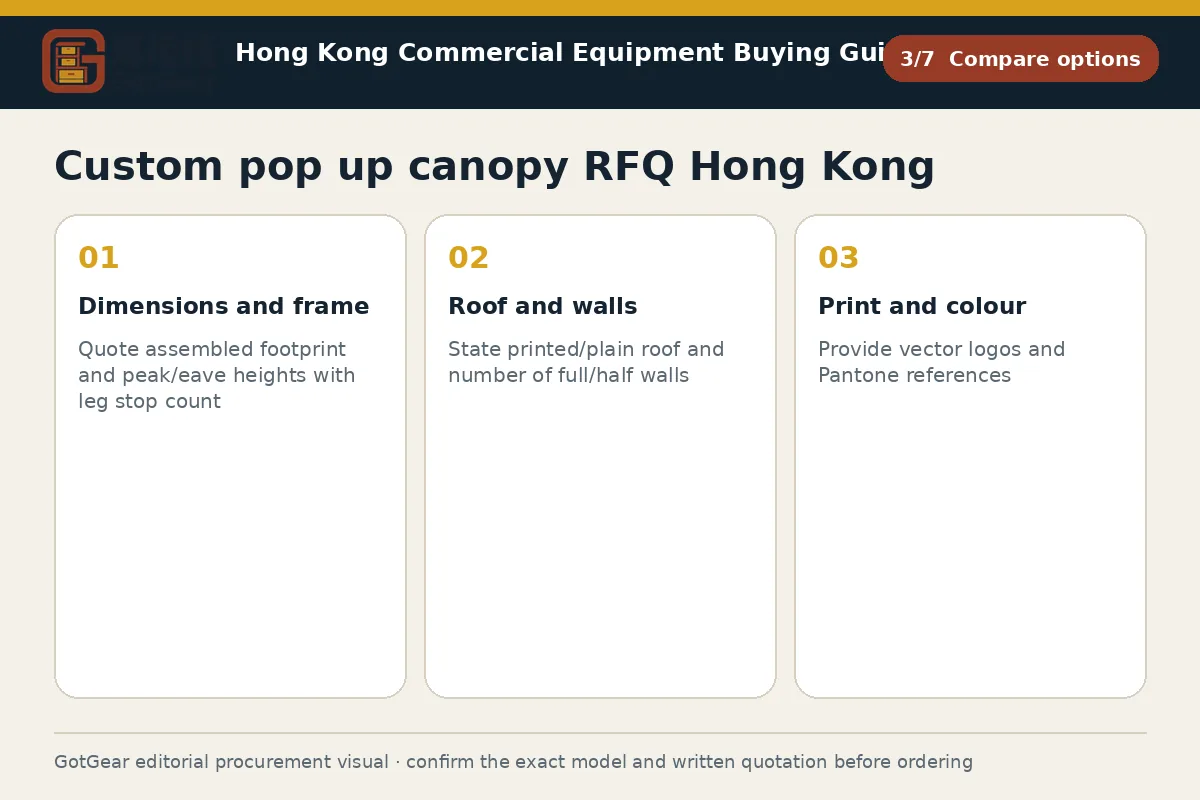
| Criterion | Straightforward requirement | More complex requirement | Evidence to provide |
|---|---|---|---|
| Dimensions and frame | Quote assembled footprint and peak/eave heights with leg stop count | Add alloy grade, tube size and wall thickness with hinge/footplate types | Drawing with measurements; frame spec sheet; folded-bundle size/weight |
| Roof and walls | State printed/plain roof and number of full/half walls | Define window/mesh panels, door zips, gutters and inter-connect kits | Panel list with fabric type/coating; seam/fastening details; photos or line art |
| Print and colour | Provide vector logos and Pantone references | Require dielines, bleed/keep-out zones and fabric swatch if colour-critical | Artwork files; signed proof; colour notes and approved swatch photo/reference |
| Accessories and ballast | List stakes, straps, carry bags and basic weights | Specify venue-approved ballast method and any training or demo on handover | Accessory list with quantities; example ballast plan subject to venue approval |
| Logistics and access | Request delivery to named floor/room and basic unpacking | Add loading-bay booking, lift limits, carton labelling and photo handover | Address, contact, access notes; packed dims/weights; delivery booking evidence |
This framework helps buyers create comparable written enquiries. Final model specifications, availability, delivery and commercial terms must be confirmed in a formal quotation.
Quote-comparison fields in custom pop up canopy RFQ Hong Kong
Set out a comparison matrix so quotations answer the same fields. Ask bidders to list the frame alloy grade, tube section and wall thickness, hinge type, footplate material, and the number of leg stops. Request roof and wall fabric types, example starting GSM, coating description, and whether seams are taped. State the print process (e.g., dye-sublimation vs. screen) and what UV-fastness and water-resistance performance the manufacturer will declare in writing. Clarify whether spares—connectors, sliders, or roof canopies—can be ordered later and request their part references.
Have suppliers itemise the scope for the frame, printed roof, each wall, accessories, packaging, and delivery to your named floor and room. Require weights and packed dimensions per set for access planning; list inclusions, exclusions and assumptions line by line. If public-event use is possible, ask for the fabric’s fire-retardant statement and test-report reference where required by the venue, insurer or authority. Request example starting production and transit times, clearly marked as subject to artwork approval and building access constraints. State the inspection on receipt you will carry out (panel count, stitching quality, print alignment, frame operation) and that the model specification and formal written quotation prevail over any verbal comment or brochure claims.
Site, quantity and timing inputs for custom pop up canopy RFQ Hong Kong
Record the deployment site, quantity and time constraints for each location. Note outdoor or indoor use, exposure to wind and rain, and storage humidity. Provide the delivery address with goods-lift size, doorway width, corridor turns and any stairs; if the estate requires management-office booking, include contact details and loading-bay time windows. Use an outdoor tent unloading access planning Hong Kong note where access is tight or time-limited. For multi-campus projects, set out a drop schedule and whether you need itemised cartons per site or department.
Detail event dates, artwork deadlines, and contingency days as example starting buffers, subject to final confirmation by your supplier and venue. State your ballast plan preference—weights, water tanks or anchors—subject to venue, engineer or insurer approval, and whether installation training or a handover demonstration is required. Include bilingual signage or safety notices if your audience is mixed, and who approves translations. Specify labelling for cartons and frames, storage expectations after wet use (air-dry before bagging), and whether photographic receipt-of-goods records are required. Make clear who signs delivery notes, where canopies may be staged for inspection, and the contact chain for any short shipment or print query.
Custom pop up canopy RFQ Hong Kong decision checklist
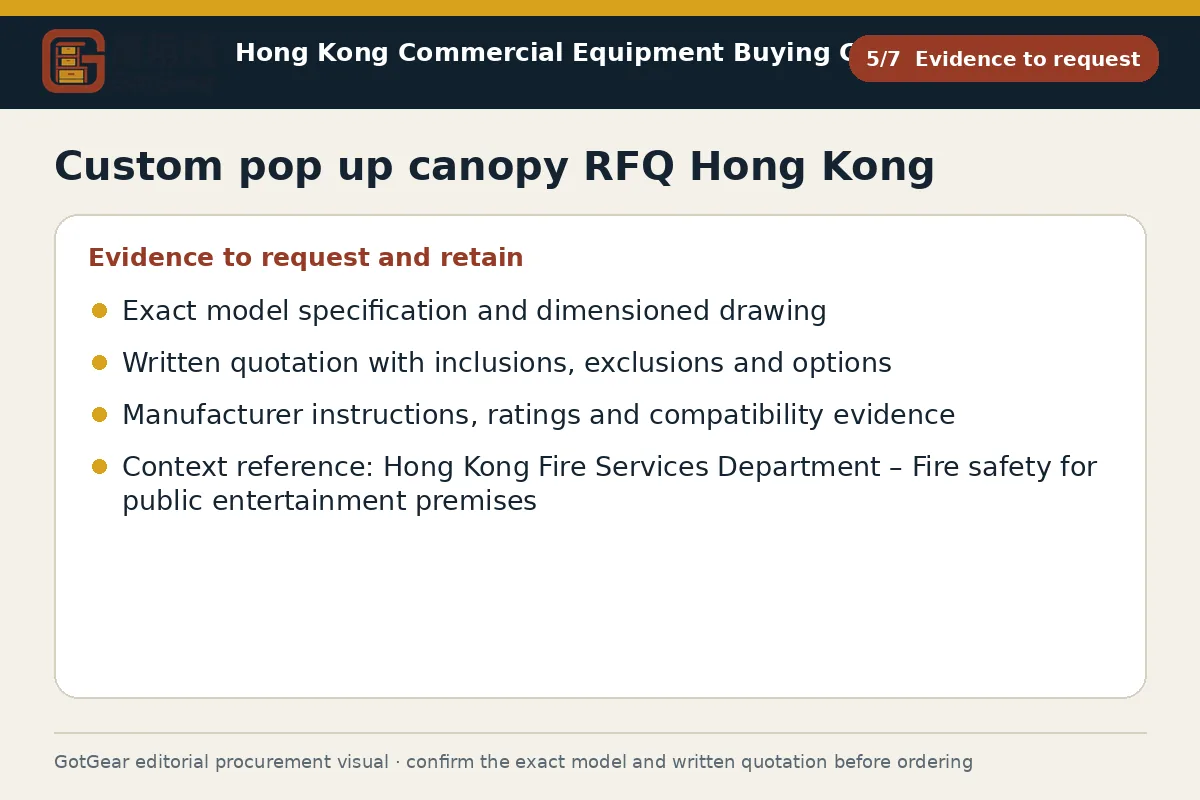
Before issue, confirm the footprint, peak and eave heights, frame alloy and wall configuration, plus whether multiple units must connect and gutter. Lock down Pantone references, bilingual copy and who signs the final fabric proof. Specify roof and wall fabrics, print method, seam and fixing details, and the sidewall door layout. Document lift, doorway and corridor sizes, loading-bay booking, delivery contact and floor drop. Ask bidders to itemise components and service scope, state assumptions and provide packed dimensions, weights and fire-retardant statements where your venue or insurer may require them. On receipt, count panels, test the frame, check print alignment and stitching, confirm accessories, and photograph any issues immediately. The model specification and formal written quotation govern.
- Operating use, quantity and expected frequency
- Dimensions, capacity, material and accessory requirements
- Delivery address, floor, goods lift and loading window
- Required documents, acceptance checks and after-sales arrangements
Key points for custom pop up canopy RFQ Hong Kong, branded gazebo procurement specification Hong Kong
Hong Kong sites often combine narrow lift cars, tight turn corridors and short loading windows controlled by the management office. Book the loading bay, confirm lift dimensions and maximum trolley size, and state if delivery must pass security gates or operate within designated hours. For outdoor use, plan for humidity, sudden rain and typhoon-season contingencies, with a ballast method acceptable to the venue. Public events may require prior documentation or notifications; confirm any fire-retardant expectations with the venue, organiser, insurer or authority in writing. Access, timing and safety conditions should be documented in the RFQ so suppliers cost realistic logistics.
Questions about custom pop up canopy RFQ Hong Kong
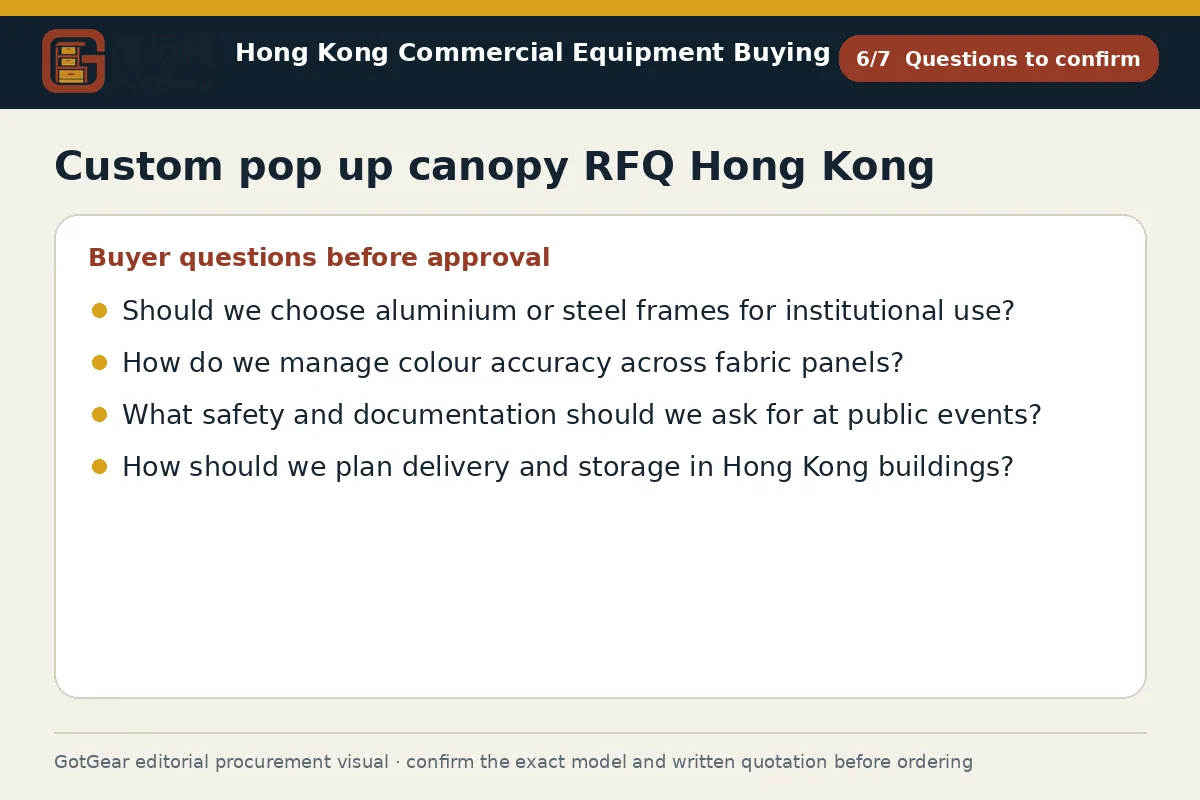
Should we choose aluminium or steel frames for institutional use?
Choose based on weight, corrosion resistance and duty cycle. Aluminium is lighter and typically resists corrosion better near coastal air; steel can feel stiffer but may need coatings. Ask suppliers to declare alloy grade, tube section and protective finishes, then match to your handling staff, storage location and expected frequency of deployment, confirmed in your written specification and quotation.
How do we manage colour accuracy across fabric panels?
Provide vector artwork with Pantone references and request a print swatch when colour is critical. Textile print differs from paper, so confirm acceptable variance and which proof (soft, hard, or fabric) controls production. State in writing who approves the final fabric proof and whether colour alignment across roof and walls is essential for your brand.
What safety and documentation should we ask for at public events?
Request the fabric’s fire-retardant statement and test-report reference if your venue, organiser, insurer or authority expects it. Also confirm ballast or anchoring instructions, safe-use guidelines and any wind or rain limitations declared by the manufacturer. Venue rules vary, so rely on written acceptance from the venue or competent party rather than assumptions.
How should we plan delivery and storage in Hong Kong buildings?
State lift dimensions, corridor turns, stair thresholds and booking rules for the management office, plus any restricted hours. Ask for packed dimensions and a trolley if needed. After events, air-dry the canopy before bagging to reduce mildew in humid conditions. These are example practices; confirm final arrangements with building management and your selected supplier.
Continue with closely related procurement topics
These pages share equipment, operating or decision-stage signals with this guide.
Folding tent delivery inspection checklist Hong Kong
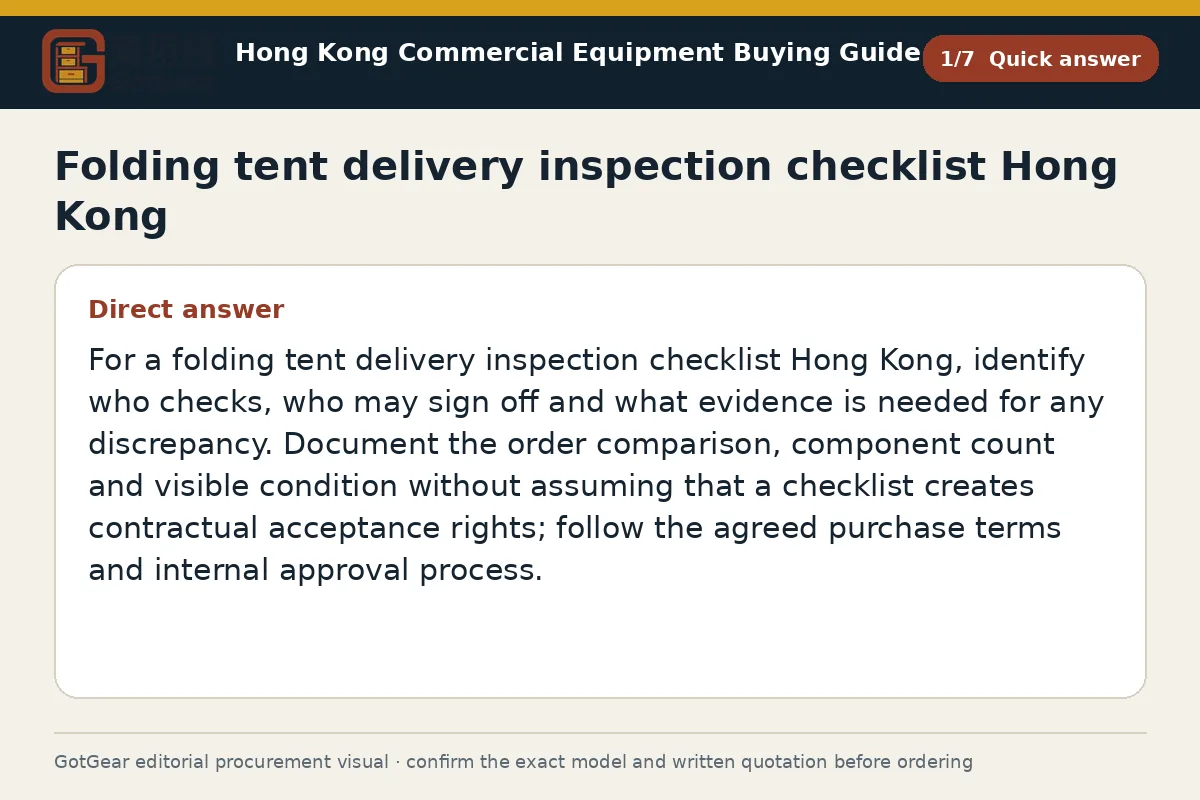
GotGear offers a folding tent delivery inspection checklist Hong Kong and a canopy tent event acceptance checklist Hong Kong, documenting item codes, quantities, condition, photos, and site handover and acceptance.
Read the guide
Custom canopy Pantone colour matching Hong Kong
GotGear explains how to prepare files and request proofs for custom canopy Pantone colour matching Hong Kong. It also covers custom canopy gradient printing Hong Kong and custom canopy photo resolution printing Hong Kong.
Read the guide
Canopy tent weights for concrete Hong Kong
See the GotGear guide to canopy tent weights for concrete Hong Kong, pop up gazebo weights for tiled floor Hong Kong and canopy tent ground anchors for grass Hong Kong. Check venue approval and installation requirements.
Read the guide
Canopy tent artwork bleed guide Hong Kong
Refer to the GotGear canopy tent artwork bleed guide Hong Kong to set bleed and safe areas. Also review canopy tent seam artwork Hong Kong and test custom canopy small text printing Hong Kong on a final-size proof.
Read the guideRelated topic indexOpen more English procurement pages1 topics
Browse additional equipment families, applications and procurement questions relevant to a wider buying brief.