
For a canopy tent artwork bleed guide Hong Kong, work from the supplier’s current panel template, extend backgrounds through the stated bleed, and keep critical content inside the safe area. Review seam crossings and test small text at the expected viewing distance on a final-size proof; do not infer print limits from a reduced PDF alone.
Bleed and safe areas in a canopy tent artwork bleed guide Hong Kong
A canopy tent artwork bleed guide for Hong Kong should begin with the actual panel templates issued for the confirmed frame model. Ask the supplier to state the current template version, panel identifiers (roof peaks, valances, walls, doors, half-walls), and finishing method (stitched hems, hook-and-loop, keder), because these affect trim, bleed and safe areas. Confirm whether the background must flood through hems and pocket folds, and whether any reinforcement patches or hardware plates will cover print. For procurement clarity, request that the written quotation lists the live (safe) area and bleed for each panel separately, not just for the roof as a whole.
Before final layout, measure site realities that affect visibility and panel choice: typical viewer height, average viewing distance along a corridor or pavement, and any management office rules on bilingual presentation. Where delivery is to an industrial building, record goods-lift width and ceiling height; some teams will bring wall panels upstairs for sign-off before the frame arrives. As an example starting point only, many dye-sub canopies cite 20–50 mm bleed and a safe area offset similar to seam widths; confirm exact figures in writing for your model. Keep faces, logos and delicate script within the stated safe area, and treat corners and roof vertices as non-critical zones due to fabric stretch and tensioning variability.
Seams in canopy tent artwork bleed guide Hong Kong and canopy tent seam artwork Hong Kong
Stitched joins, reinforcement tapes and roof darts introduce unavoidable visual breaks, so plan artwork to respect the seam map. Request the supplier’s seam widths and the expected placement tolerance at key joins. Where a logo must span two stitched panels, allow quiet space either side of the seam and avoid fine outlines that rely on perfect registration. Roof peaks often include multiple darts radiating from the apex; keep high-detail graphics clear of the vertex, and use continuous background colour or patterning that forgives small shifts. This is the practical heart of canopy tent seam artwork Hong Kong. Buyers should request these details in writing.
For walls, note zipper doors, windows and hook-and-loop header strips that can nibble into print. Ask for a panel-by-panel finishing schedule indicating stitch direction, tape colour and any translucent light blockers that may affect tone. When preparing multi-panel graphics, provide vector artwork with explicit panel crops and a labelled seam overlay so prepress can check alignment. As an example starting point only, allow 40–60 mm clearance from stitched seams for critical elements, then confirm the supplier’s model tolerance before proof approval. On receipt, inspect at full pitch: check that seam crossings land where expected, and photograph any misalignment against the approved proof for discussion.
What should buyers compare for canopy tent artwork bleed guide Hong Kong?
| Criterion | Straightforward requirement | More complex requirement | Evidence to provide |
|---|---|---|---|
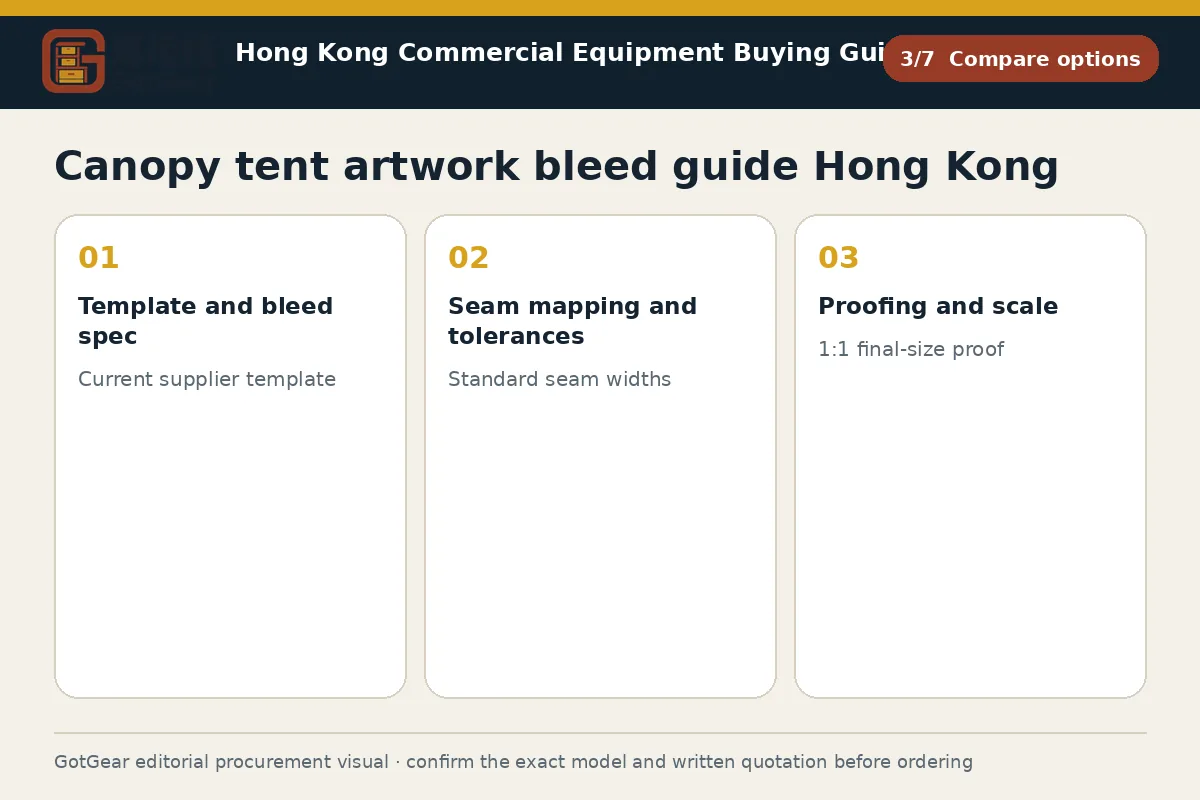
| Template and bleed spec | Current supplier template | Panel bleed, hems, occlusions | Template version, panel IDs, mm |
| Seam mapping and tolerances | Standard seam widths | Alignment and placement tolerances | Seam map, mm range, stitch order |
| Proofing and scale | 1:1 final-size proof | Tiled hard proof with seams shown | Signed, dated, annotated proof |
| Colour and fabric | Dye-sub polyester profile | Pantone callouts with swatch check | Fabric chip, lighting notes |
| Legibility and small text | Minimum cap height by distance | Mixed scripts, QR and curved seams | Field photos, measured distance |
This framework helps buyers create comparable written enquiries. Final model specifications, availability, delivery and commercial terms must be confirmed in a formal quotation.
Proof checks from the canopy tent artwork bleed guide Hong Kong
Proofing is where artwork, measurements and finishing details converge. Insist on a final-size, panel-by-panel proof that shows trim, bleed, safe areas and all seams, darts and hardware cut-outs. The document should include a scale bar and labelled dimensions so your team can confirm size on screen or in a tiled print. Ask that colours are called out by name or Pantone reference where fabric and process allow, and that bilingual text is set exactly as approved by your brand or institution. Compare the proof back to the written quotation to ensure each panel, finishing note and accessory (e.g., doors, half-walls) is represented.
Run a content audit before signing: check that logos do not cross high-stress corners, that faces and product shots avoid folds, and that background graphics extend fully through bleed. Where your venue or management office requires pre-event review, submit the labelled proof with panel IDs and expected setup photos. If timing is tight due to loading windows, agree in writing whether a printed fabric swatch or strike-off is possible, or whether approval will rely on calibrated on-screen proof with caveats. Keep all approvals dated and signed; the model specifications and formal written quotation prevail if there is any ambiguity after delivery.
Viewing-distance checks for canopy tent artwork bleed guide Hong Kong and custom canopy small text printing Hong Kong
Legibility depends on viewing distance, fabric texture and lighting. Conduct a field test using final-size output: tile-print key areas at 100% scale, mount them at the intended height, and step back to the measured distance. As an example starting point only, many teams target roughly 1 mm of cap-height per 0.3–0.5 m of viewing distance for bold sans-serif text; fine serifs, outlines and reversed text may need more. Document the measured distance and capture daylight photos to share with stakeholders ahead of sign-off. This practical step underpins confident custom canopy small text printing Hong Kong, which buyers can rely on at busy events.
Account for script complexity and bilingual layouts. Traditional Chinese at small sizes benefits from generous stroke weight, modest tracking, and high contrast with the background; avoid placing small characters over seams, darts or textured hems. If using QR codes, verify the quiet zone remains inside the safe area and away from curved seams or valance scallops. Humidity and glare can soften perceived detail outdoors, so test under similar conditions where possible. On receipt, inspect small text at the height and distance recorded in your brief, not at arm’s length. If legibility falls short of the approved proof, photograph the issue with a tape measure in frame and escalate promptly.
Canopy tent artwork bleed guide Hong Kong decision checklist
Start by confirming the exact canopy model and requesting the latest panel templates that show trim, bleed, safe areas and all seams. Ask the quotation to list bleed and live-area dimensions per panel, fabric type, finishing, and any hardware occlusions. Record site constraints: viewer distance, mounting height, bilingual needs, and any management-office approvals. Prepare vector artwork with labelled panel crops and a seam overlay. Request a final-size proof with scale bars and Pantone callouts where applicable. Run a viewing-distance test with tiled prints, capturing photos and measurements. Compare proof to quotation, then obtain dated sign-off from stakeholders. On delivery, pitch the canopy, verify seam alignment, colour and legibility against the approved proof, and document any variances for resolution.
- Operating use, quantity and expected frequency
- Dimensions, capacity, material and accessory requirements
- Delivery address, floor, goods lift and loading window
- Required documents, acceptance checks and after-sales arrangements
Key points for canopy tent artwork bleed guide Hong Kong, canopy tent seam artwork Hong Kong, custom canopy small text printing Hong Kong
Hong Kong venues and industrial buildings can impose practical constraints on canopy artwork planning. Property-management offices may ask for bilingual visuals and advance approval of branding on outdoor roofs and walls, particularly for schools and institutions. Tight goods-lifts and loading windows make full-size fabric proofs difficult, so many teams rely on annotated, final-size PDFs and tiled printouts. Humidity, sudden rain and strong daylight can reduce perceived sharpness; test small text and QR codes at real viewing distances before sign-off. Always confirm venue and supplier requirements in writing, as site rules vary.
Questions about canopy tent artwork bleed guide Hong Kong
How much bleed should we set on each canopy panel?
Use the supplier’s panel template, as bleed depends on hem depth and stitching. As an example starting point only, many dye-sub roofs and walls cite 20–50 mm per edge, but reinforcement patches can change this. Request written confirmation per panel in the quotation and proof, and keep critical content well inside the stated safe area to accommodate tolerances.
Can we run a logo across a roof seam without it looking broken?
It is possible but risky; seams, darts and stretch cause alignment drift. Keep fine outlines and small type off joins, and allow quiet space around elements that cross. As an example starting point only, offset critical edges 40–60 mm from stitched seams. Ask for a seam map and placement tolerances in writing before you approve the proof.
Will small text remain readable on textured polyester at events?
Choose bold, simple fonts with strong contrast, and test at final size and distance. As an example starting point only, plan about 1 mm cap height per 0.3–0.5 m viewing distance for sans-serif text, then confirm via tiled prints. Humidity, glare and fabric texture can soften detail, so avoid thin strokes, reverses and outlines for essential wording.
What should we provide for bilingual artwork sign-off in Hong Kong?
Submit a final-size proof showing panel IDs, seams and safe areas, with Traditional Chinese and English exactly as approved by your institution or brand. Identify primary and secondary languages, reading order and any font licensing limits. Where venues request pre-event review, attach daylight photos from a viewing-distance test to demonstrate legibility at height.
Continue with closely related procurement topics
These pages share equipment, operating or decision-stage signals with this guide.
Custom canopy Pantone colour matching Hong Kong
GotGear explains how to prepare files and request proofs for custom canopy Pantone colour matching Hong Kong. It also covers custom canopy gradient printing Hong Kong and custom canopy photo resolution printing Hong Kong.
Read the guide
Bilingual canopy tent printing Hong Kong
GotGear checklist for bilingual canopy tent printing Hong Kong helps you approve English and Traditional Chinese wording, set valance and sidewall hierarchy, and check text expansion, spacing and legibility at viewing distance.
Read the guide
Canopy tent weight distribution per leg Hong Kong
GotGear guide to canopy tent weight distribution per leg Hong Kong shows how to check each fixing and how to reassess canopy tent sidewalls wind anchoring Hong Kong and linked canopy tent anchoring Hong Kong after layout changes.
Read the guide
Printed gazebo sidewall door layout Hong Kong
Use this checklist to finalise door positions and visitor flow for printed gazebo sidewall door layout Hong Kong and to plan canopy sidewall cable access Hong Kong. Keep artwork clear of openings during setup with GotGear.
Read the guide