
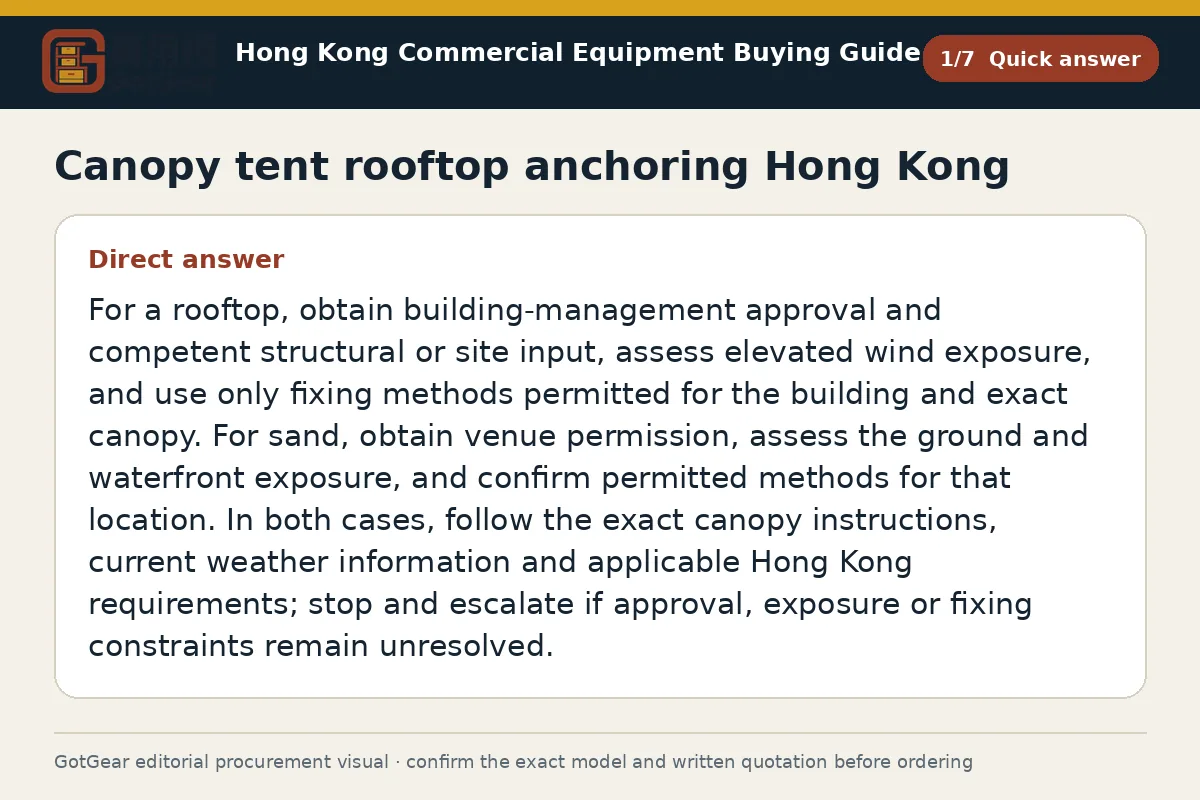
For a rooftop, obtain building-management approval and competent structural or site input, assess elevated wind exposure, and use only fixing methods permitted for the building and exact canopy. For sand, obtain venue permission, assess the ground and waterfront exposure, and confirm permitted methods for that location. In both cases, follow the exact canopy instructions, current weather information and applicable Hong Kong requirements; stop and escalate if approval, exposure or fixing constraints remain unresolved.
Canopy tent rooftop anchoring Hong Kong — Rooftop approvals, exposure and fixing constraints
Treat rooftops as a distinct route. Begin by confirming who controls access and permissions for the building, then request written limits on fixings and load placement. Where rooftop anchoring of canopy tents in Hong Kong is required, record roof finish (membrane, tiles, concrete), parapet height and the setback you can maintain, nearest plant or skylights, and any no‑go areas. Note goods‑lift size, doorway clearances and rated load so folded frames, ballast and mats can be moved safely. Ask suppliers to quote the exact canopy model, roof‑surface protection, ballast type, unit mass per leg and footprint, plus tie‑down strap rating. Where helpful, refer to canopy tent weights for concrete to frame the ballast discussion with your responsible supplier or manufacturer.
Elevated sites attract stronger gusts; require a written go/stop plan aligned with the specific canopy instruction sheet and current weather information. Example starting point only: agree a provisional parapet setback, such as 1.5 m, then confirm in writing with the building manager. In quotations, compare total ballast mass, weight‑per‑leg distribution, attachment method to the frame (not fabric), protective mats, and manpower for load‑in within the building’s approved window. On delivery, inspect weights for cracks, securing hardware, straps and labels; confirm bilingual (English/Chinese) method statements match the agreed layout. Do not drill or clamp without explicit written clearance and competent input for that roof and model; non‑penetrating solutions are usually preferred but must still be verified on site.
Canopy tent rooftop anchoring Hong Kong — Building approval, elevated exposure and fixing constraints
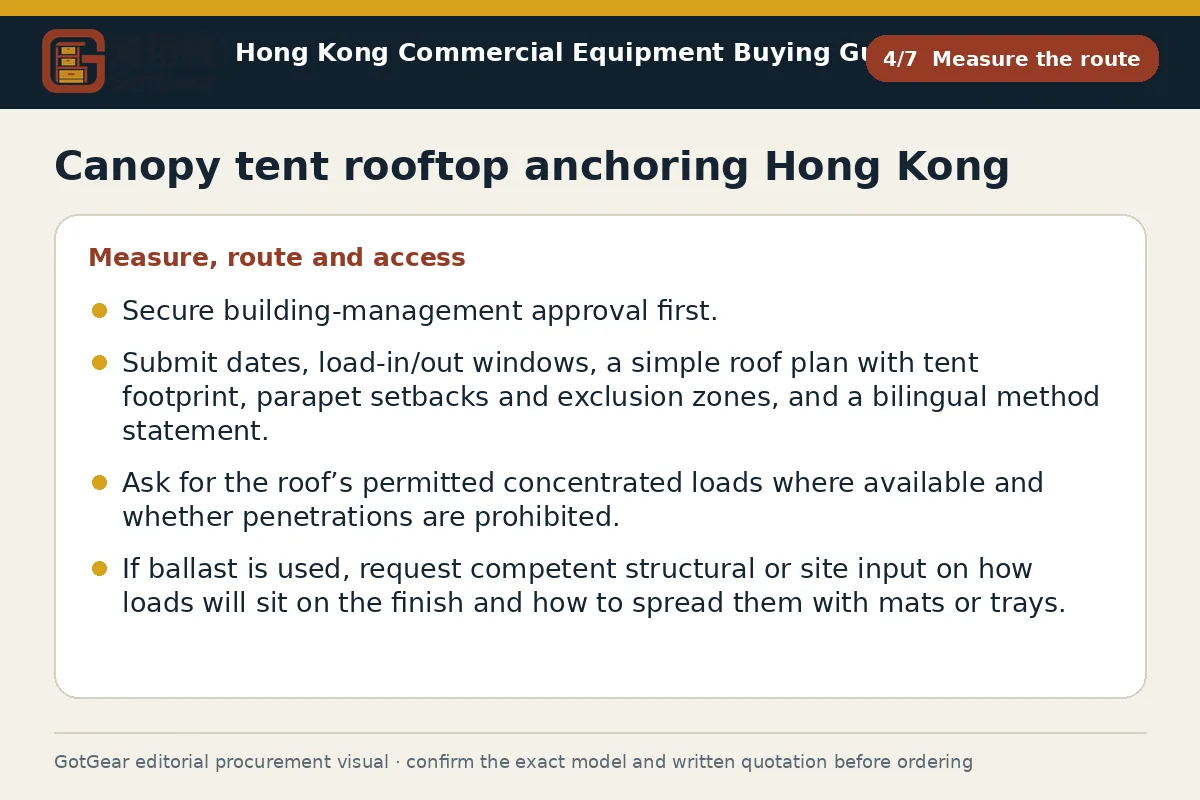
Obtain building management approval first. Submit the proposed dates, load-in and load-out windows, a simple roof plan showing the tent footprint, parapet setbacks and exclusion zones, and a bilingual method statement. Ask for the roof’s permitted concentrated loads where available and whether penetrations are prohibited. If ballast is to be used, request competent structural or site input on how loads will sit on the roof finish and how to spread them with mats or trays. Make weight distribution explicit: for work in Hong Kong, canopy tent weight distribution per leg should be stated in kilograms per leg and confirmed against the manufacturer’s anchoring guidance for that exact frame and roof surface.
Rooftops are exposed to accelerated, turbulent wind. As an example starting point only, propose a provisional stop-work level for steady wind and for gusts, then confirm the final thresholds with the building manager, a competent adviser and the canopy instructions before event day. Capture edge distances, access routes, lift capacity and any areas with fall hazards or fragile surfaces. Specify approved attachment points on the frame; never attach to fabric or to joints not rated for anchoring. Require quotations to state ballast type, total mass, strap and connector ratings and protective mat dimensions, plus evidence that ballast can be safely moved through the goods lift and the doorways available. On site, keep exclusion perimeters clear, tag ballast to legs and maintain a weather watch with authority-approved sources.
What should buyers compare for canopy tent rooftop anchoring Hong Kong?
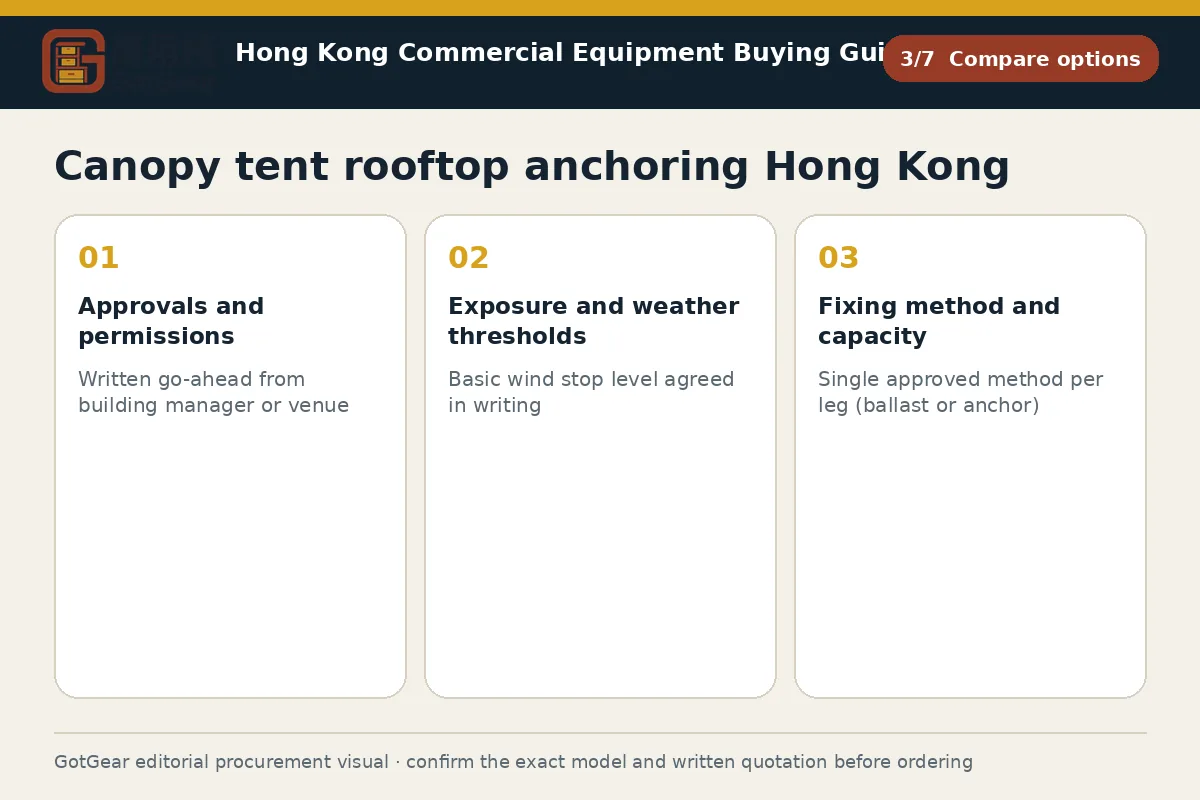
| Criterion | Straightforward requirement | More complex requirement | Evidence to provide |
|---|---|---|---|
| Approvals and permissions | Written go-ahead from building manager or venue | Conditions with specified setbacks, no-go areas and supervision | Email/letter with dates, areas, fixings allowed, contacts |
| Exposure and weather thresholds | Basic wind stop level agreed in writing | Rooftop/waterfront gust and tide considerations with escalation path | Thresholds, sources used, on-site lead name and phone |
| Fixing method and capacity | Single approved method per leg (ballast or anchor) | Combined fixings with rated pull-out/ballast equivalence per leg | Manufacturer confirmation, capacity per leg, attachment details |
| Access and logistics | Simple goods-lift fit or direct sand access | Multiple transfers, tight lifts, timed loading windows | Dimensions, weights, routes, window times and manpower |
| Documentation and language | Bilingual method statement on one page | Method statement plus risk/egress plan if required by venue | PDFs in English/Chinese, site plan, approval emails, contacts |
This framework helps buyers create comparable written enquiries. Final model specifications, availability, delivery and commercial terms must be confirmed in a formal quotation.
Canopy tent rooftop anchoring Hong Kong and canopy tent anchoring on sand Hong Kong: Approvals and fixing constraints
Treat beaches and sand lots as a different path from rooftops. For canopy tent anchoring on sand Hong Kong, confirm who issues venue permission and obtain their written rules on stakes, screw anchors, deadman bags and protected zones. Walk the site at low and mid tide, note lifeguard or promenade operations, public thoroughfares, and any underground services signage. Dig a small test pit to gauge sand depth and compaction; ask the supplier to propose anchor type, embed depth and quantity per leg for your canopy model. Example starting point only: screw anchors in the 600–1,000 mm class may be proposed, but the final selection and depth must be confirmed in writing by the manufacturer and permitted by the venue.
Corrosive salt and humid conditions demand suitably finished hardware and webbing; ask for galvanised or equivalent corrosion-resistance details where appropriate, and a rinsing/inspection plan after use. In quotes, compare anchor type and rated pull capacity, guyline length and angle, number of anchors per leg, protective sleeves for guylines, and clearly marked exclusion zones. Confirm access constraints such as approved vehicle paths, hand-carry distances from drop-off to sand, and the manpower/time allowed by the venue. Ensure bilingual safety signage and cordons are included where public footfall is expected.
Canopy tent rooftop anchoring Hong Kong — Venue permission, waterfront exposure and fixing constraints
Obtain venue permission with a scaled plan showing canopy location, offsets from the waterline, public paths and lifesaving facilities, plus routes for emergency access. Where the venue asks for it, include a bilingual risk assessment and a simple emergency egress drawing; see temporary event canopy emergency exit layout Hong Kong for planning considerations. Waterfronts funnel and accelerate winds; request a supplier proposal that addresses orientation to prevailing winds, double-guying on windward legs, and rapid takedown procedures aligned to venue expectations.
Fixing constraints may prohibit stakes in dunes or drilling near seawalls. Ask for permitted methods such as screw anchors, buried deadman bags or weighted bases for promenade paving, with mats to prevent surface damage and illuminated guyline markers for dusk operations. In procurement documents, require the manufacturer’s statement that the proposed fixings are suitable for your canopy model on sand or paving, plus the minimum anchor pull-out or ballast equivalent per leg. Reference folding tent anchoring checklist Hong Kong to assemble a clear enquiry. Confirm loading windows, public-area marshals, and post-event reinstatement, including sand backfill and waste removal. Keep a written weather-trigger plan for thunderstorms, monsoon rain and typhoon signals, and appoint an on-site lead to stop and escalate if thresholds are met.
Canopy tent rooftop anchoring Hong Kong decision checklist
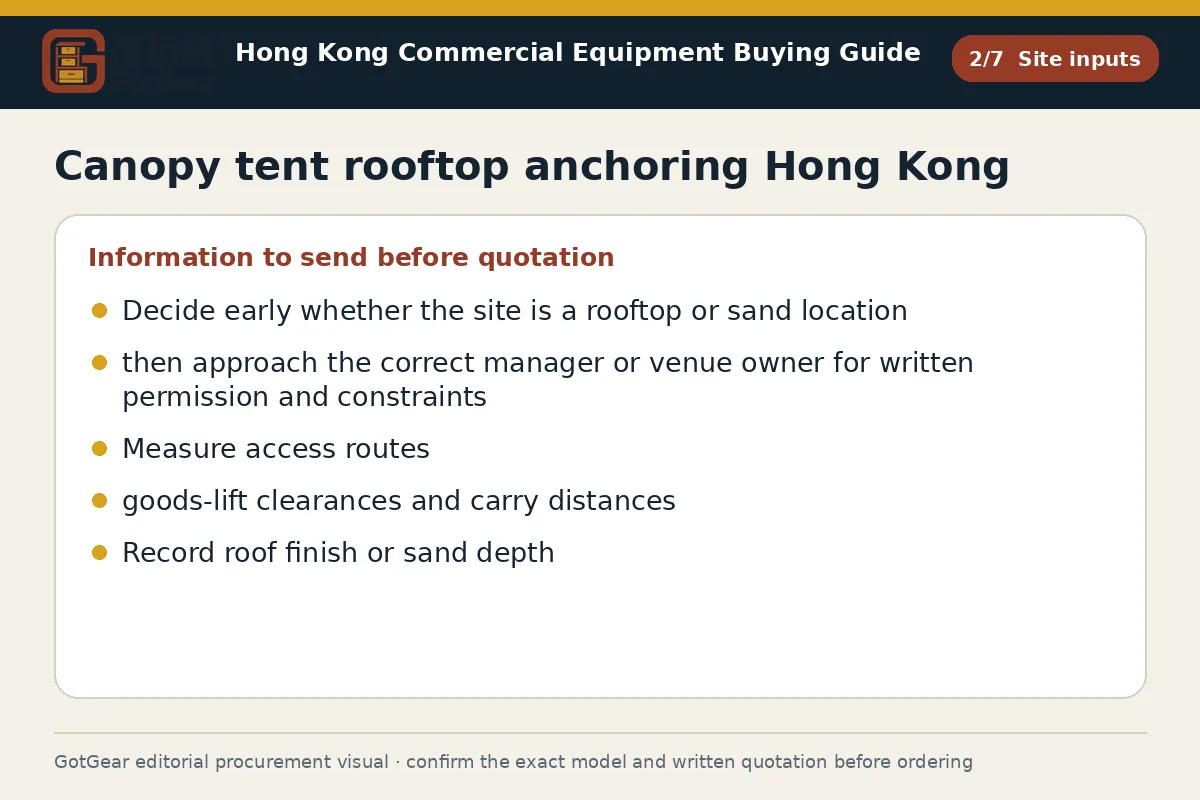
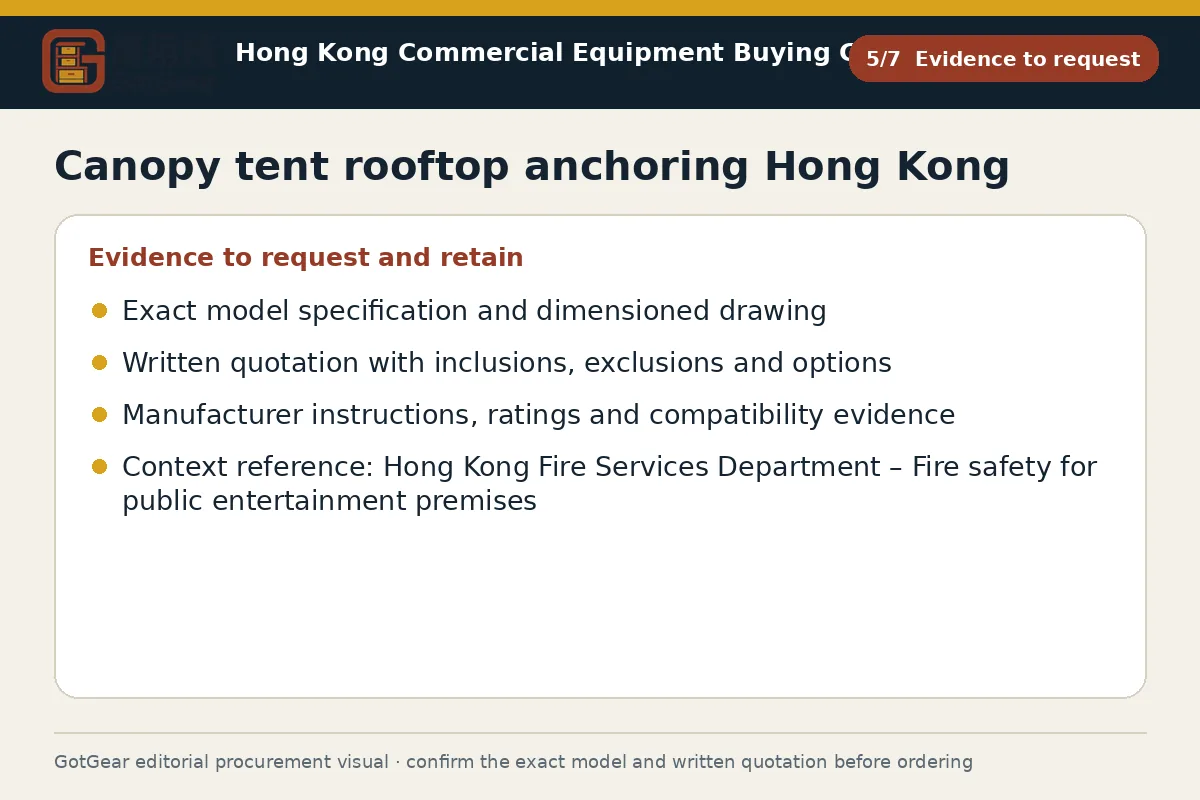
Decide early whether the site is a rooftop or sand location, then approach the correct manager or venue owner for written permission and constraints. Measure access routes, goods-lift clearances and carry distances. Record roof finish or sand depth, parapet or waterline setbacks, and nearby hazards. Request quotations that state the canopy model, per-leg anchoring method and capacity, strap ratings, protective mats, and a bilingual method statement. Ask the manufacturer to confirm suitability of the proposed fixings for that exact frame and surface. Compare weather thresholds, manpower and loading-window commitments. On receipt, inspect frames, anchors or ballast, straps and labels; confirm documents match the agreed layout. Use GotGear to structure a precise written enquiry and to compare specifications, then keep copies of all approvals on site.
- Operating use, quantity and expected frequency
- Dimensions, capacity, material and accessory requirements
- Delivery address, floor, goods lift and loading window
- Required documents, acceptance checks and after-sales arrangements
Key points for canopy tent rooftop anchoring Hong Kong, canopy tent anchoring on sand Hong Kong
Hong Kong rooftops and waterfronts combine tight access, bilingual approvals and fast-changing weather. Building-management offices often control goods-lift use, door clearances and load-in windows; a plan that fits the building’s lift size and permitted roof loads is essential. Waterfront venues can impose tide, ecology and public-safety constraints, and winds are often higher and more turbulent at elevation or beside the harbour. Treat rooftop and sand sites as separate approval routes. Use authority weather sources, venue instructions and the exact canopy manual to set thresholds. This page gives planning guidance; your written venue, building and manufacturer directions always prevail.
Questions about canopy tent rooftop anchoring Hong Kong
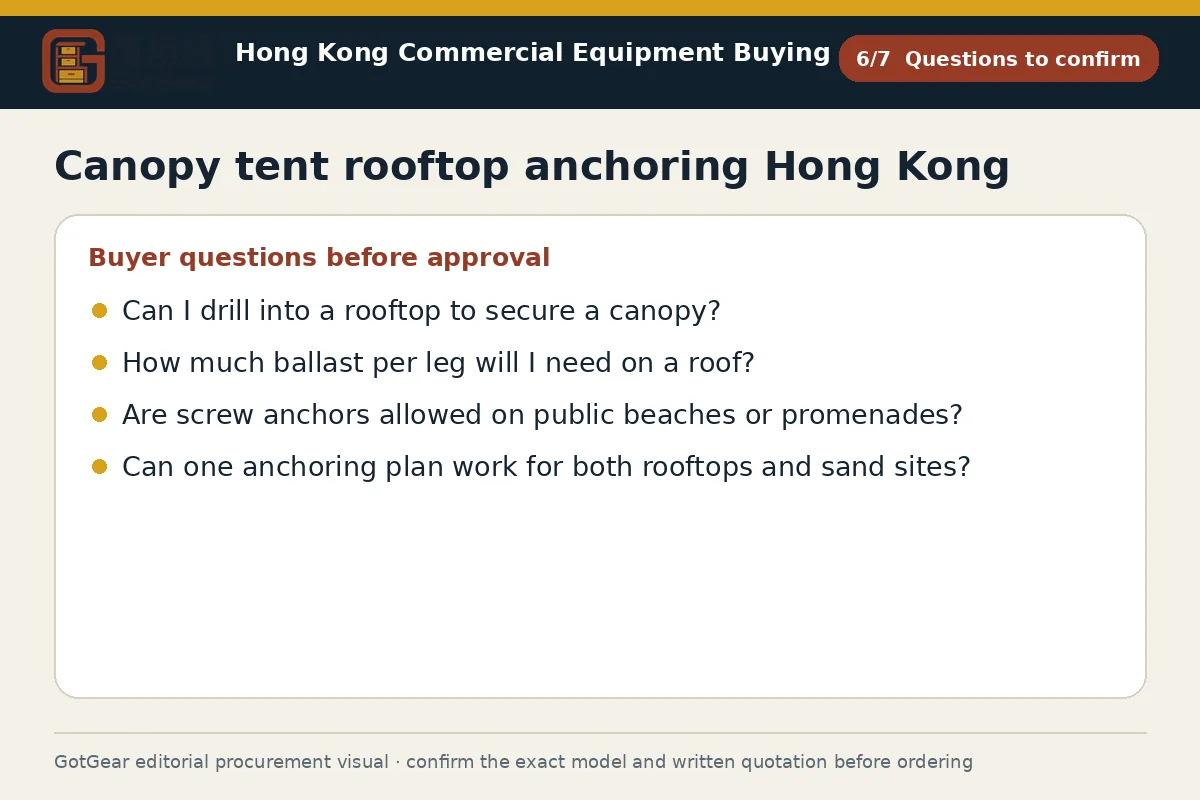
Can I drill into a rooftop to secure a canopy?
Only if the building manager explicitly permits it and a competent person confirms the method for that roof and canopy model. Many Hong Kong buildings prefer non-penetrating ballast with mats to protect finishes. Obtain written approvals and method statements in advance; never assume that previous permissions or another site’s approach will be accepted.
How much ballast per leg will I need on a roof?
It depends on your canopy model, the level of exposure and the building’s load limits. Ask the manufacturer for a per-leg ballast chart and confirm the required ballast with the building manager. As an example and only as a starting point, you might consider 30–60 kg per leg, but the written model specification and the site approval take precedence. For context when framing your enquiry, see canopy tent weights for concrete surfaces in Hong Kong.
Are screw anchors allowed on public beaches or promenades?
Only if the venue or authority permits them at that exact location. Rules may restrict ground disturbance near utilities, dunes or seawalls. Request written conditions, then ask your supplier and canopy manufacturer to confirm the anchor type, embed depth and pull-out capacity proposed for your model and sand profile before you proceed.
Can one anchoring plan work for both rooftops and sand sites?
No. Rooftops and sand sites require separate reviews, permissions and fixing methods. Elevated wind exposure, roof finishes and building rules differ from waterfront and sand conditions. Prepare two tailored method statements, each confirmed by the responsible manager, venue and the canopy manufacturer, then keep a weather-trigger plan that is appropriate to each site.
Continue with closely related procurement topics
These pages share equipment, operating or decision-stage signals with this guide.
Canopy tent weight distribution per leg Hong Kong
GotGear guide to canopy tent weight distribution per leg Hong Kong shows how to check each fixing and how to reassess canopy tent sidewalls wind anchoring Hong Kong and linked canopy tent anchoring Hong Kong after layout changes.
Read the guide
Canopy tent artwork bleed guide Hong Kong
Refer to the GotGear canopy tent artwork bleed guide Hong Kong to set bleed and safe areas. Also review canopy tent seam artwork Hong Kong and test custom canopy small text printing Hong Kong on a final-size proof.
Read the guide
Bilingual canopy tent printing Hong Kong
GotGear checklist for bilingual canopy tent printing Hong Kong helps you approve English and Traditional Chinese wording, set valance and sidewall hierarchy, and check text expansion, spacing and legibility at viewing distance.
Read the guide
Canopy tent weights for concrete Hong Kong
See the GotGear guide to canopy tent weights for concrete Hong Kong, pop up gazebo weights for tiled floor Hong Kong and canopy tent ground anchors for grass Hong Kong. Check venue approval and installation requirements.
Read the guideRelated topic indexOpen more English procurement pages1 topics
Browse additional equipment families, applications and procurement questions relevant to a wider buying brief.