
For cleanroom shelving Hong Kong, document the room conditions, stored items, load, surface requirements, cleaning agents, airflow considerations and layout. Verify the proposed product against manufacturer documentation, site procedures and all applicable Hong Kong requirements before selection or use.
Define cleanliness and surface needs for cleanroom shelving Hong Kong
Start by stating the controlled-environment purpose, the contamination risks, and the expected duty cycle. When preparing a brief for cleanroom shelving Hong Kong, record the cleanliness classification used on site (for example, as a starting point only: an internal class equivalent to an ISO 14644 grade, to be confirmed by your quality team), whether microbial control is required, and whether electrostatic control is needed for electronics handling. Note if the area is wet, dry, or mixed-use, and whether there is exposure to brine, detergents or the corrosion-promoting humidity typical of coastal Hong Kong locations.
Translate those needs into surface and construction requirements. Specify alloy grade and finish in writing (e.g., stainless steel 304 or 316L, brushed, passivated or electropolished), and the cleanability features you require: continuous welds dressed smooth, closed tube ends, capped uprights, minimal horizontal ledges, removable shelves and no exposed fasteners in product zones. If you quote a surface roughness or cosmetic criterion, label it as an example starting point and ask the manufacturer to confirm the achievable range. State any prohibition on silicones, lubricants or zinc plating. List the items to be stored, the maximum item footprint, the maximum mass per shelf and per bay, and whether edges, lips or retainers are needed to prevent roll-off. Request supporting datasheets that explicitly show alloy grade, finish process, shelf adjustability increment and the load method used to establish the ratings.
Map airflow and room layout around cleanroom shelving Hong Kong
Map the supply and return air so shelving does not disrupt laminar streams or block returns. Mark diffuser locations, return grilles, and pressure-controlled vestibules on a simple drawing, then sketch proposed bays and orientations. If airflow uniformity is critical, note a preference for perforated or wire shelves, minimal shelf depth, and open posts. Where spill control is a concern, solid shelves may be used with defined perforations; ask your cleanroom owner to confirm the trade-off. If your site uses top-down flow, document desired setbacks from ceilings and walls as example starting points only and seek written agreement from the room owner.
Record room geometry: door and airlock swing arcs, pass-through hatch clearances, and aisle widths for gowning and carts. Note whether shelving is fixed or mobile; if mobile, include brake and handle placement, and floor compatibility. Add the inbound route constraints that drive module sizing: goods-lift car and door dimensions, landing-to-room turning spaces, and stair or corridor pinch-points in older industrial buildings. In Hong Kong towers, loading windows and management-office booking rules can dictate crate size; capture these constraints so suppliers propose sectional frames or knock-down designs that can pass without rework on site.
What should buyers compare for cleanroom shelving Hong Kong?
| Criterion | Straightforward requirement | More complex requirement | Evidence to provide |
|---|---|---|---|
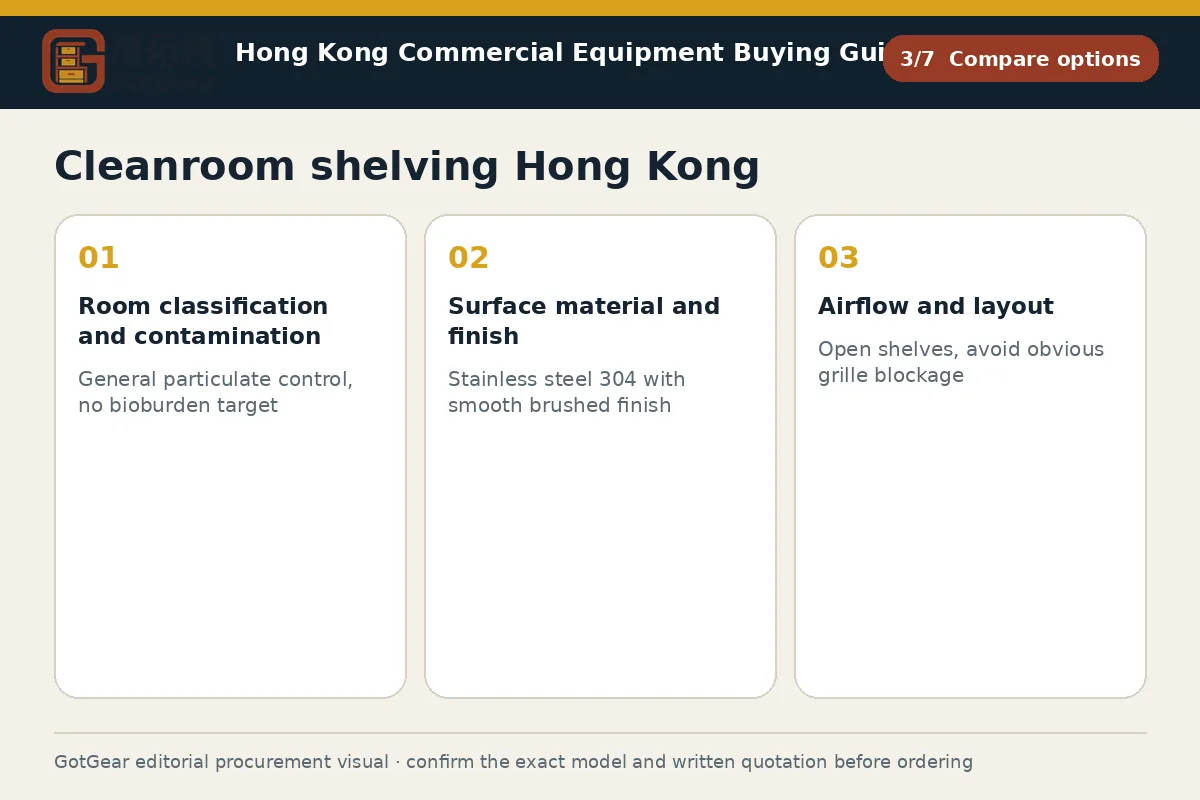
| Room classification and contamination | General particulate control, no bioburden target | Defined class with microbial control and ESD constraints | Site SOP excerpt and room owner confirmation |
| Surface material and finish | Stainless steel 304 with smooth brushed finish | 316L with passivation/electropolish and closed ends | Datasheet plus finish description and any certificates |
| Airflow and layout | Open shelves, avoid obvious grille blockage | Specified shelf type/orientation and defined setbacks | Marked plan showing diffusers/returns and bay positions |
| Cleaning compatibility | Compatible with alcohol wipes only | Routine VHP, quats or hypochlorite exposure | List of agents/concentrations and manufacturer statement |
| Load and stability | Light static loads with wide aisles | Higher loads, mobile units and anti-tip/anchoring | Load table from manufacturer and assembly method |
This framework helps buyers create comparable written enquiries. Final model specifications, availability, delivery and commercial terms must be confirmed in a formal quotation.
Match cleanroom shelving Hong Kong to cleaning agents and routines
List every cleaning and disinfection agent actually used, with maximum concentrations and typical contact times as example starting points only, to be confirmed in site procedures. Common agents include isopropyl alcohol, hydrogen peroxide vapour or mist systems, quaternary ammonium compounds and hypochlorite; some can attack certain stainless steels or polymers. State whether wipes are lint-free, whether hot water is used, and if thermal disinfection or autoclave exposure is required for removable components. In Hong Kong’s humid climate and salt-laden air near loading bays, corrosion resistance is a practical concern even for indoor spaces adjoining external docks.
Match materials and finishes to that regime. If chloride exposure or vapour-phase hydrogen peroxide is routine, request confirmation that the proposed alloy and finish are compatible, and ask for a chemical-resistance statement from the manufacturer against your named agents. Where polymer shelves are proposed, ask for detailed polymer grade, filler content and leachables information. Specify cleanability features such as radiused corners, sealed casters, flush fasteners and removable shelf inserts. Request the recommended cleaning method for the exact model, including any forbidden agents. Ensure the formal quotation reproduces the agreed alloy grade, finish, shelf type and casters, so that the document, not verbal notes, governs supply.
Verify product suitability for cleanroom shelving Hong Kong
Before selection, cross-check the proposed model against your site SOPs and records. Ask the manufacturer for a current datasheet stating alloy grade, finish process, shelf adjustment pitch, maximum load per shelf and per bay and the test method used; request a statement of compatibility with your listed cleaning agents, and, where applicable, an ESD control note for mixed electronics-pharma spaces. If a specific surface finish is critical, ask whether a finish certificate, passivation record or electropolish batch report can be supplied. Where mobile units are proposed, obtain the caster specification (sealed bearings, tread compound, brake type) and any recommended floor loading guidance.
Implementation checks matter. Book delivery within your building’s approved time windows and specify the maximum crate dimensions permitted by the goods lift. On receipt, inspect for transit damage, burrs, incomplete weld dressing, pinholes, embedded abrasives and unsealed tube ends. Verify that components match the written quotation and that fixings and accessories are supplied in full. Assemble in a clean staging area and wipe down per the manufacturer’s instructions before bringing into the controlled space. If wall fixings or floor anchors are planned, confirm permit-to-work, substrate type and any institutional or insurer approvals first. Keep bilingual documentation where your workforce requires it, and retain all manufacturer literature with your cleanroom file for audit readiness.
Cleanroom shelving Hong Kong decision checklist
Confirm the room’s cleanliness target and whether microbial or ESD control applies, then translate that into alloy and finish requirements. List stored items, shelf loads, adjustability and retention needs. Map supply and return air, defining acceptable shelf types and setbacks as example starting points for agreement. Compile cleaning agents with concentrations and contact times, and request manufacturer compatibility statements. Record goods-lift, doorway and turning constraints, and whether the unit must be knock-down. Ask for datasheets detailing alloy, finish, load method and casters. Ensure the formal quotation repeats those specifics. Plan delivery within building rules, obtain any required permits for anchors, and inspect for weld quality, sealed ends and surface integrity before introducing the shelving to the controlled space.
- Operating use, quantity and expected frequency
- Dimensions, capacity, material and accessory requirements
- Delivery address, floor, goods lift and loading window
- Required documents, acceptance checks and after-sales arrangements
Key points for cleanroom shelving Hong Kong
Hong Kong facilities often face tight goods-lift and corridor constraints, management-office delivery bookings, and humid conditions that can accelerate corrosion. Capture lift car and doorway sizes, turning spaces and loading-window rules early so suppliers size frames and crates accordingly. Where rooms adjoin external docks or sea air, prioritise corrosion-resistant alloys and finishes. Bilingual documents and labels may be needed for mixed Cantonese–English teams. This page outlines operational considerations only and is not legal advice; confirm requirements with your building manager, competent adviser and manufacturer.
Questions about cleanroom shelving Hong Kong
Should I choose 304 or 316L stainless steel for my cleanroom shelving?
Select based on your cleaning agents and corrosion exposure. 316L is often preferred where chlorides or vapour-phase hydrogen peroxide are present; 304 may suit dry electronics or laboratory storage. Ask the manufacturer to confirm compatibility with your named agents and finish, and ensure the model specification and written quotation state the exact alloy and surface process.
Are wire shelves better than solid shelves in a cleanroom?
Wire or perforated shelves usually support airflow uniformity and reduce dust accumulation. Solid shelves can be appropriate where spill containment or small-item retention is needed. Decide after mapping supply and return air and confirming with the room owner. Specify your choice in the enquiry and request the manufacturer’s cleaning method for that shelf type.
Can mobile shelving be used inside controlled environments?
Yes, provided casters are sealed, cleanable and braked, and the unit remains stable under your loads. Check floor compatibility and turning space from airlocks to the room. Ask for caster specifications in writing, including tread compound and brake type, and verify that your cleaning routine and agents will not degrade wheel materials or bearings.
What documentation should I request before ordering?
Ask for a current datasheet showing alloy grade, finish process, shelf and bay load ratings and the test method used. Request a cleaning-agent compatibility statement, installation and cleaning instructions, and, if relevant, ESD notes. Where finishes are critical, ask whether a passivation or electropolish record can be provided. Ensure all agreed details appear in the formal quotation.
Continue with closely related procurement topics
These pages share equipment, operating or decision-stage signals with this guide.
Laboratory shelving Hong Kong
GotGear provides a checklist for laboratory shelving Hong Kong to help buyers assess container fit, load capacity, spill and cleaning needs, layout, access and material suitability.
Read the guide
AS/RS racking Hong Kong
GotGear in Hong Kong assesses the feasibility of AS/RS racking Hong Kong and mini-load storage system Hong Kong for distribution centres, examining loads, dimensions, throughput and control interfaces.
Read the guide
ESD shelving Hong Kong
ESD shelving Hong Kong: The GotGear buyer checklist explains handling of sensitive items, assessing load capacity, ensuring grounding and planning layout. It includes checks against manufacturer guidance and your control plan.
Read the guide
Industrial shelving Hong Kong
GotGear outlines loads, dimensions, layout and moisture considerations for industrial shelving Hong Kong. It compares galvanised steel shelving Hong Kong with powder-coated steel shelving Hong Kong.
Read the guideRelated topic indexOpen more English procurement pages2 topics
Browse additional equipment families, applications and procurement questions relevant to a wider buying brief.