
For ESD shelving Hong Kong, provide the sensitive items, handling sequence, storage containers, loads, accessories, grounding approach and work-area layout. Verify the complete proposal against manufacturer instructions, the site’s control plan and any applicable Hong Kong requirements before use.
Map sensitive items and handling steps for ESD shelving Hong Kong
Before selecting ESD shelving Hong Kong, buyers should map which devices, subassemblies and reels are electrostatically sensitive, where they travel and how long they dwell at each step. Start at goods-in and follow items through kitting, rework, test and finished-goods quarantine. Note every hand-off, trolley transfer and container change, including any periods when items wait on shelves, carts or staging racks. Record personnel interactions and whether gloves, smocks or wrist straps are used at each point, so the storage solution supports the site’s electrostatic-control plan rather than working against it.
Build a written list of storage tasks: loose PCBs, taped components, tool sets, calibrated instruments and documents. For each entry, capture an example starting point for dimensions, estimated weight, container type (e.g., dissipative bin, shielding bag, tote) and preferred segregation or labelling method; confirm all values with the responsible engineer. Flag charge generators such as bubble wrap or foam so isolating bays, liners or purging plans can be specified. This mapping becomes the basis for shelf width, depth, bay count, divider pitch, bin-rail needs and signage. Where processes cross into adjoining spaces — for example, workshop shelving used for mechanical preparation or laboratory shelving used for inspection — note handover points and cleanliness expectations so the storage specification and procedures remain consistent end to end.
Plan the work-area layout around ESD shelving Hong Kong
Translate the handling map into a physical layout that prevents bottlenecks and uncontrolled staging. Establish aisle clearances for two-way cart traffic and safe person access; as an example starting point, some sites review 900–1,200 mm for primary aisles, then confirm with the building manager and the site safety policy. Check column lines, sprinklers, air returns and wall skirting that affect bay heights or fixing choices. Measure doorways and goods-lift cars, including diagonals and turning radii, to ensure packed bays or knock-down kits can reach the floor without unplanned rework.
Position shelves relative to benches, test points and grounding bars to minimise long leads and improvised daisy-chains. Consider humidity, HVAC and sunlight: high humidity in Hong Kong reduces airborne charge build-up but can affect coatings and labels, so specify finishes and label materials accordingly. Allow staging near ESD test stations for strap checks before staff handle items. If the zone adjoins clean areas, align with cleanroom shelving Hong Kong housekeeping and material controls. If heavier fabrication is nearby, keep impact and dust sources separated and align with industrial shelving specification Hong Kong methods for measured load data, floor loading notes and anchoring plans. Produce a simple scale drawing with bay codes for inclusion in the enquiry and quotation.
What should buyers compare for ESD shelving Hong Kong?
| Criterion | Straightforward requirement | More complex requirement | Evidence to provide |
|---|---|---|---|
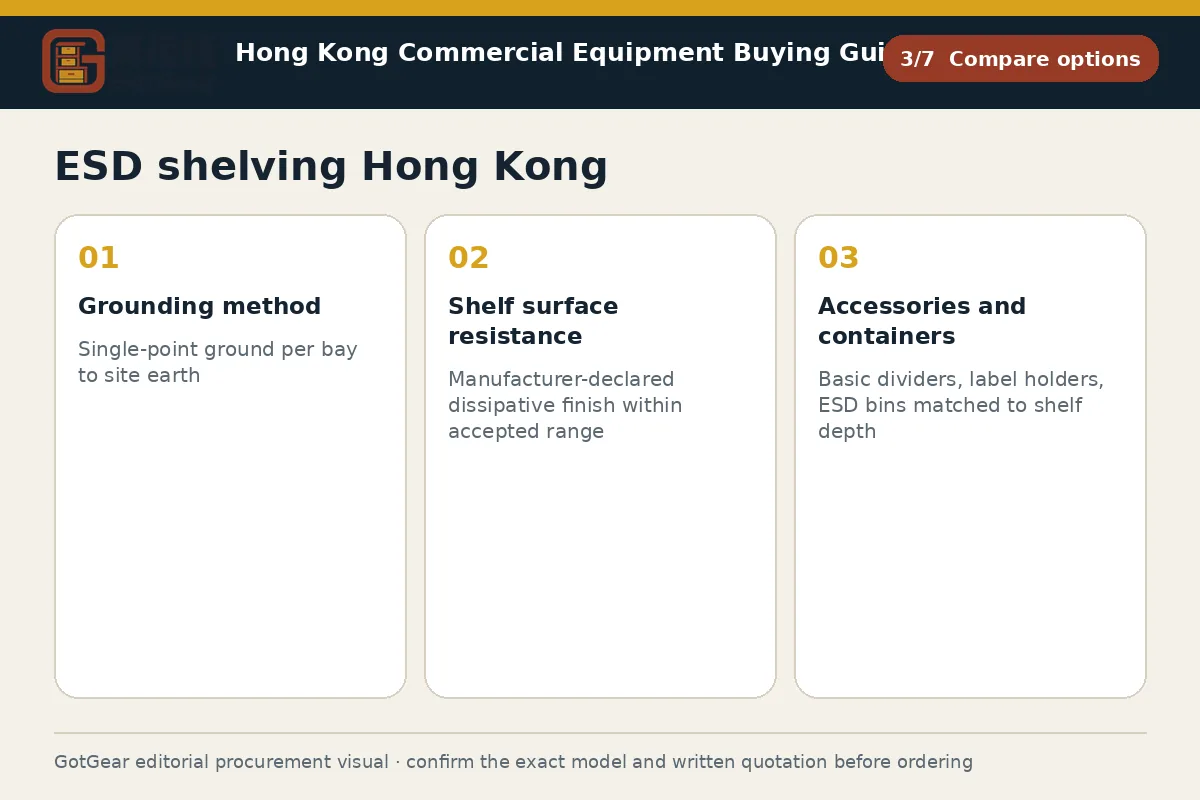
| Grounding method | Single-point ground per bay to site earth | Multiple-bay bonding to a local busbar with defined jumpers | State earth location, connector type, and whether jumpers between shelves/uprights are included |
| Shelf surface resistance | Manufacturer-declared dissipative finish within accepted range | Mix of materials (shelves, mats, bins) each with stated resistance characteristics | Provide data sheets and confirmation of acceptable ranges per site plan |
| Accessories and containers | Basic dividers, label holders, ESD bins matched to shelf depth | Bin rails, wrist-strap parking, document wallets, colour zoning and shielding totes | List part numbers, sizes, material declarations and required quantities |
| Load and stability | Per-shelf and per-bay loads with floor anchoring if needed | Mobile bays with conductive castors, brakes and tip-resistance measures | Give example loads, floor flatness notes, castor ratings and anchoring preferences |
| Delivery and site access | Knock-down delivery with standard doorway access | Sequenced delivery to booked lifts and constrained industrial-building routes | Share lift car and doorway dimensions, booking rules and any offloading restrictions |
This framework helps buyers create comparable written enquiries. Final model specifications, availability, delivery and commercial terms must be confirmed in a formal quotation.
Set grounding and accessory needs for ESD shelving Hong Kong
Define how each bay bonds to earth and which accessories make handling consistent. Select uprights and shelves with a manufacturer-declared surface-resistance range suitable for dissipative control; as an example starting point, some teams request data sheets showing typical resistance-to-ground in the 10^6–10^9 ohm band, then confirm acceptance with the site control plan. Request details of ground studs, busbars, jumpers between shelves and uprights, and the main earth connection method. Ask if anti-static feet or conductive castors are available and whether they affect bonding arrangements.
List accessory needs tied to your mapped tasks: ESD bin rails, steel dividers with insulative caps, dissipative shelf mats, label holders, document wallets, wrist-strap parking points, and colour-banded zone markers. Specify container compatibility by size and material declaration. For powered test-bay interfaces, state that any electrical work or final earth connection must be verified by a competent person according to the venue’s requirements. Request installation, maintenance and test instructions in bilingual format, plus material and surface-resistance statements from the manufacturer. Align any hygiene or cleanliness notes with adjacent laboratory or clean areas without assuming uniform rules; the model specification and the formal written quotation prevail.
Verify the complete configuration for ESD shelving Hong Kong
Before placing an order, compile a configuration checklist that cross-references items, layout and grounding. Compare written quotations side by side: bay count, shelf dimensions, per-shelf and per-bay load ratings, finish type, stated surface-resistance range, number and type of ground points, accessories listed by part number, and whether assembly, anchoring and test guidance are included. Ask for a dimensioned drawing and a packing list for delivery planning within tight loading windows common in Hong Kong industrial buildings.
On receipt, inspect coating uniformity, hardware completeness, and any transit damage. Verify continuity between each shelf and the upright, and from the bay to the designated earth point, using methods agreed in the site plan; record results against bay codes. Check that labels, accessories and bilingual instructions match the quotation. If required by the insurer, venue or institution, request a manufacturer’s written statement for materials and resistance characteristics. After installation, schedule a competent person to confirm the ground path and update the ESD control plan. Train operators on handling, signage and container use; define a site-specific verification interval as part of routine quality audits. Coordinate with management offices where shelving sits near public-event routes or shared corridors.
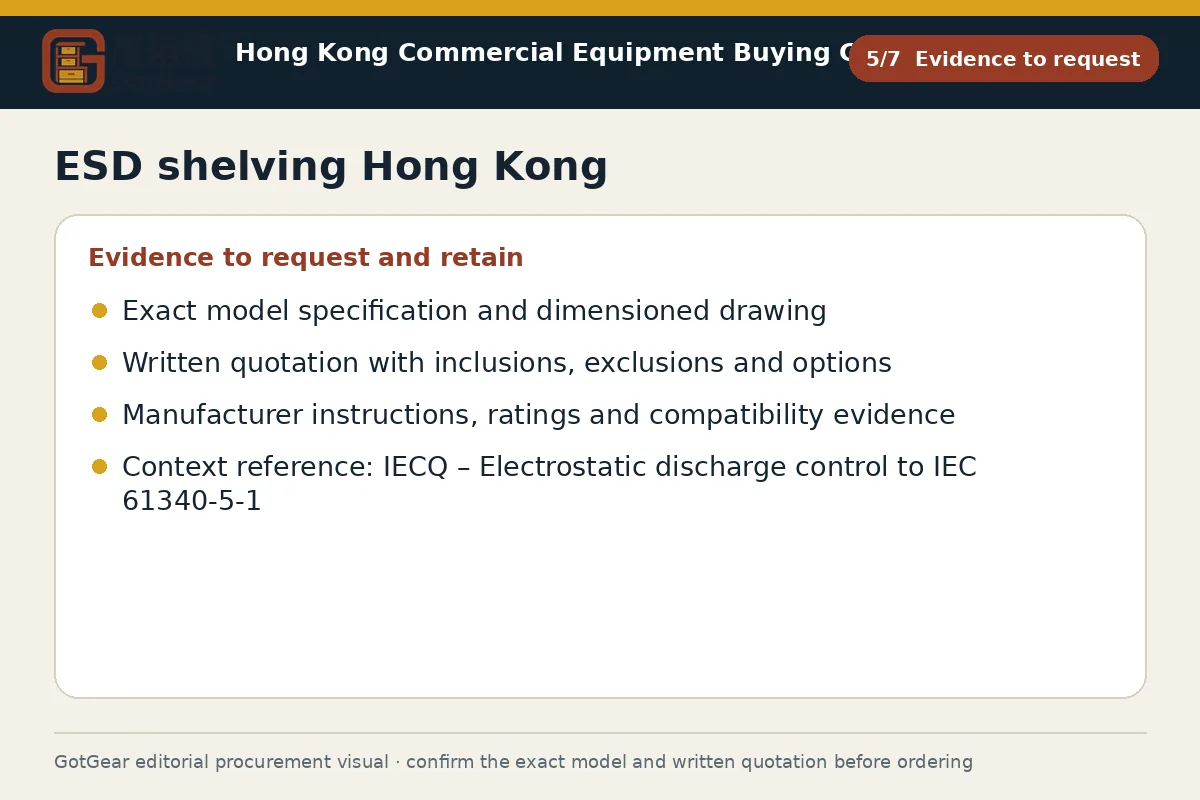
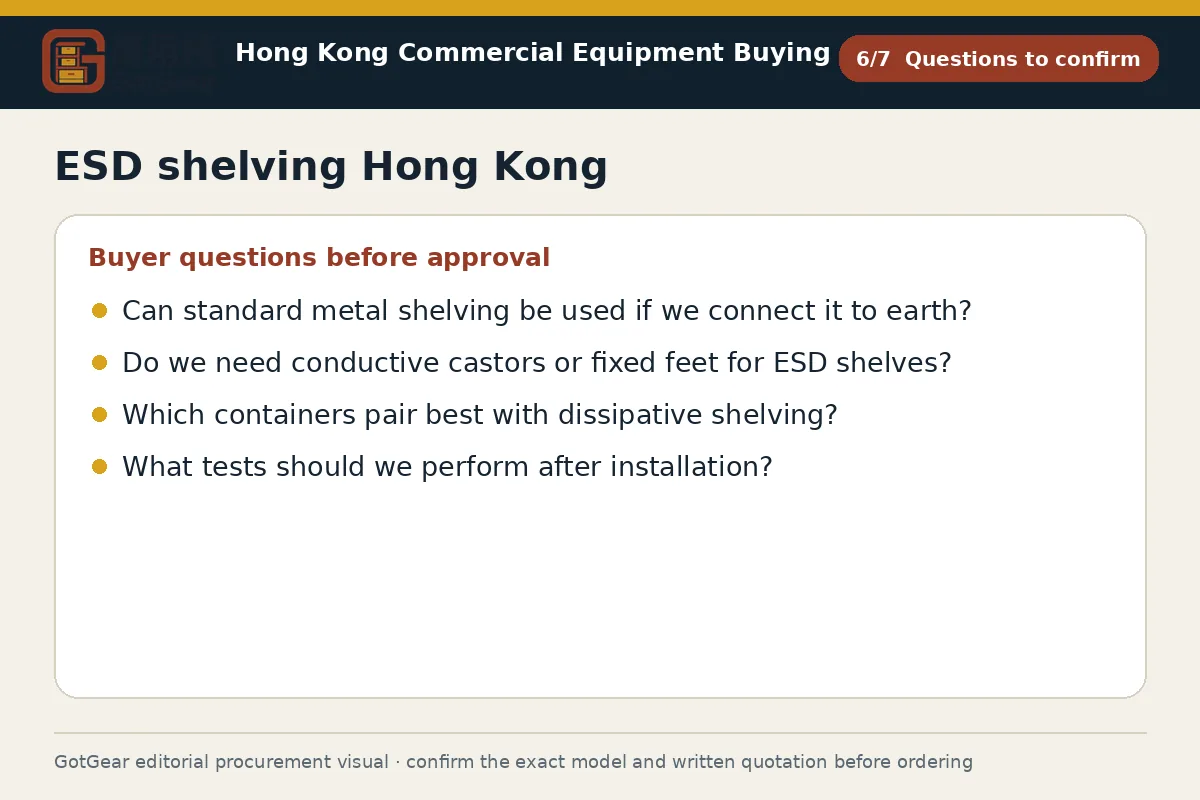
ESD shelving Hong Kong decision checklist
Start by listing every ESD-sensitive item, its container and handling step. Measure the intended area, including doorways, goods-lift car sizes and aisle targets, and sketch a scaled layout with bay codes. In your enquiry, request shelf and bay load ratings, finish and stated resistance range, ground-point details, accessories by part number, anchoring notes and bilingual instructions. Record site constraints such as booking hours, floor flatness and adjacency to clean or workshop zones. Compare quotations line by line against the same fields and ask for drawings. On receipt, inspect finish, completeness and continuity to ground before assembly. Where applicable, obtain manufacturer statements on materials and resistance, then arrange competent-person checks and update the ESD control plan.
- Operating use, quantity and expected frequency
- Dimensions, capacity, material and accessory requirements
- Delivery address, floor, goods lift and loading window
- Required documents, acceptance checks and after-sales arrangements
Key points for ESD shelving Hong Kong
Hong Kong sites often face narrow doorways, small goods-lift cars and fixed delivery windows managed by building offices. Plan knock-down deliveries, book lift slots early and confirm whether staging in common areas is permitted. Humidity and coastal air can affect finishes and labels; ask for care instructions and material statements from the manufacturer. Many institutions require bilingual documentation, and some venues ask for competent-person confirmation of earth bonding before use. Treat any permits, fire or electrical considerations as site-specific: confirm requirements with the building manager, insurer or responsible authority.
Questions about ESD shelving Hong Kong
Can standard metal shelving be used if we connect it to earth?
Not automatically. Earthing bare metal may create rapid discharge points that risk device damage. Only use shelving with a manufacturer-declared surface resistance and grounding method suited to your control plan. Ask for written data and installation instructions, then have a competent person verify bonding on site if your venue, insurer or internal policy expects it.
Do we need conductive castors or fixed feet for ESD shelves?
Choose based on mobility and bonding. Fixed bays with anti-static feet simplify permanent earthing. Mobile bays need conductive castors and a defined grounding method when parked. Confirm load per castor, braking, floor compatibility and the bonding approach with the manufacturer. Verify that movement routes, lifts and doorways can handle the packed or assembled dimensions.
Which containers pair best with dissipative shelving?
Use containers with declared ESD properties that match your control plan: dissipative bins or shielding totes rather than insulative plastics. Request material and resistance statements and consider lids, dividers and label materials. Where cleanliness matters, align with lab or cleanroom practices. Always confirm container sizes against divider pitch and shelf clear openings in the written quotation.
What tests should we perform after installation?
Check mechanical stability, then verify electrical continuity from shelf to upright and to the designated earth point using agreed methods. Record results by bay code. If your insurer, venue or internal procedures require it, have a competent person review the ground path. Define a site-specific recheck interval in the control plan; the model specification and formal quotation take precedence.
Continue with closely related procurement topics
These pages share equipment, operating or decision-stage signals with this guide.
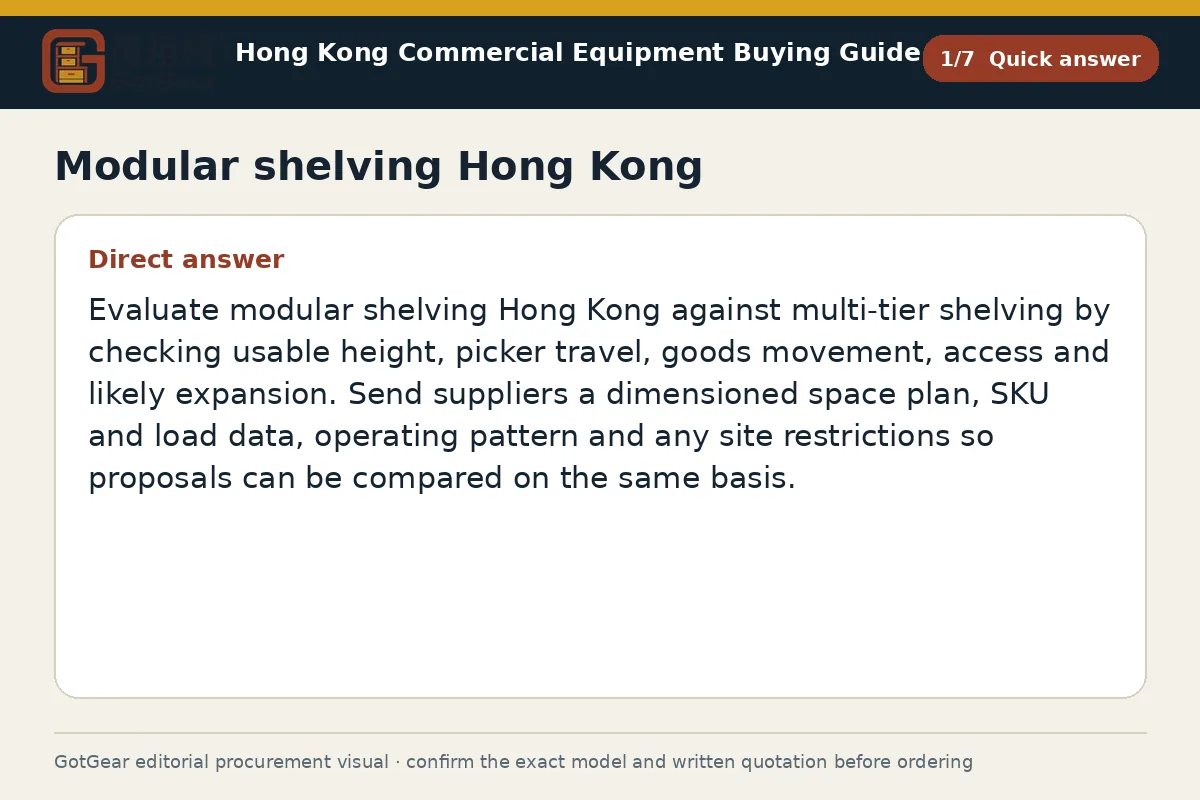
Modular shelving Hong Kong
Compare usable height, picker travel, access and expansion when choosing between modular shelving Hong Kong and multi-tier shelving Hong Kong. Read practical layout guidance from GotGear.
Read the guide
Laboratory shelving Hong Kong
GotGear provides a checklist for laboratory shelving Hong Kong to help buyers assess container fit, load capacity, spill and cleaning needs, layout, access and material suitability.
Read the guide
Cleanroom shelving Hong Kong
Choosing cleanroom shelving Hong Kong? GotGear provides a checklist for room classification, load limits, surface finishes and cleaning agents checked against manufacturer documents, site procedures and applicable requirements.
Read the guide
Industrial shelving Hong Kong
GotGear outlines loads, dimensions, layout and moisture considerations for industrial shelving Hong Kong. It compares galvanised steel shelving Hong Kong with powder-coated steel shelving Hong Kong.
Read the guide