
Use the commercial equipment delivery access checklist Hong Kong, together with the packed item dimensions and the specified handling method. Verify building rules, bookings, route conditions and applicable Hong Kong safety requirements before the movement is confirmed.
Commercial equipment delivery access checklist Hong Kong: Map loading-bay details
Start by plotting how a vehicle will arrive, stop, unload and exit without conflicting with other tenants or public areas. Identify whether the delivery is kerbside or via a managed bay, and record vehicle limits: maximum height, weight and turning radius, plus any ramp gradients, ceiling services or bollards that reduce access. Note whether tail-lifts can be fully deployed, whether wheel chocks are required and whether banksmen are compulsory during reversing. Record the security process (ID checks, contractor passes, site rules) and who authorises entry.
For a commercial equipment delivery loading bay Hong Kong, facilities often operate timed windows and strict noise controls, so document the booking method, earliest and latest slot, and whether overnight moves are permitted. Photograph the bay and the route start, showing kerb edges, drains and thresholds. Specify permitted handling: pallet truck only, stacker, or forklift with a certified operator, and note any prohibition zones near glass, public lobbies or escalators. Capture bilingual signage requirements and provide the management office contact.
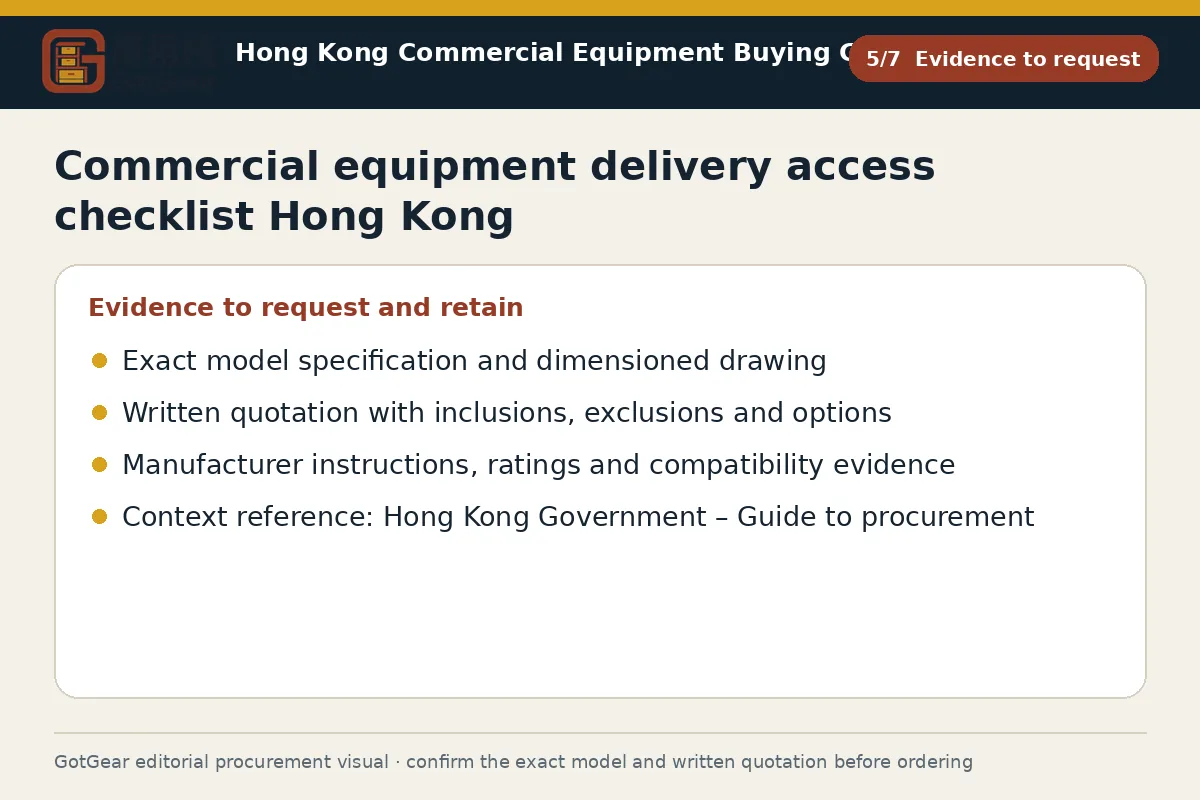
In your enquiry pack request: current bay drawings or a clearly marked sketch; clear dimensions at pinch points; the designated waiting area; and contingency staging space under cover for rain. Include who will provide floor, corner and lift protection so quotations can cover the same scope. Reference "commercial equipment delivery loading bay Hong Kong" in your internal notes so your teams align on process terminology across sites.
Commercial equipment delivery access checklist Hong Kong: Measure every constraint
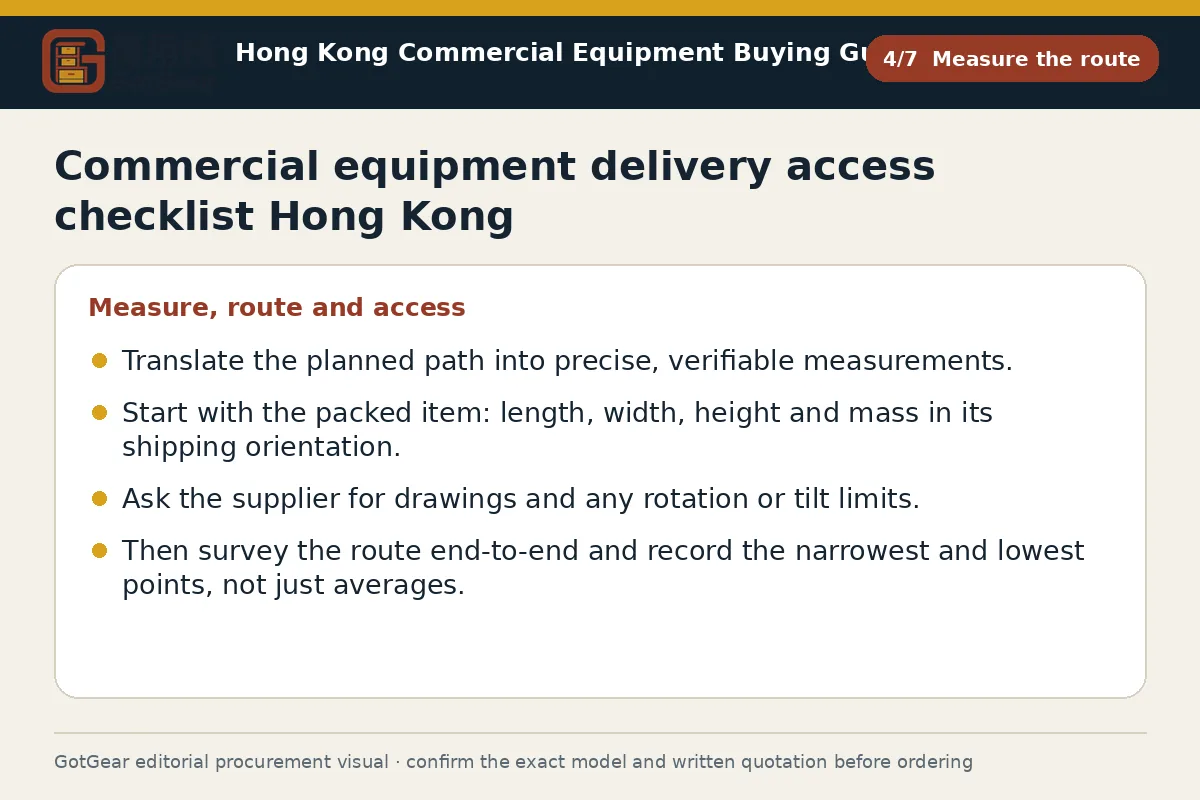
Translate the planned path into precise, verifiable measurements. Begin with the packed item: record length, width, height and mass in its shipping orientation, and request drawings plus any rotation or tilt limits from the supplier. Survey the route end-to-end and record the narrowest and lowest points rather than averages. Measure clear widths between handrails, columns or fire-hose reels; check door leaf swing and hold-open capability; note threshold heights; measure ramp gradients; record lobby depths; and identify any ceiling fixtures that could obstruct movement.
Provide a simple plan or annotated photos showing tape measurements at every constraint, with a scale or a reference object. Capture turning geometry at each corner: available diagonal, wall-to-wall distance and whether skirting or corner guards intrude. Confirm floor type and any stated load tolerance, and whether temporary protection is required by building rules. Identify alternative routes for contingency, and note any stairs, raised sills or ongoing construction works. Include power availability for powered stair climbers or pallet trucks where permitted. The commercial equipment delivery access checklist for Hong Kong is the document teams rely on; it should consolidate these facts into a single pack for suppliers so written quotations can confirm fit, method and any need for de-crating, reorientation or additional labour. Make clear that the model specification and the formal written quotation take precedence over survey notes.
What should buyers compare for commercial equipment delivery access checklist Hong Kong?
| Criterion | Straightforward requirement | More complex requirement | Evidence to provide |
|---|---|---|---|
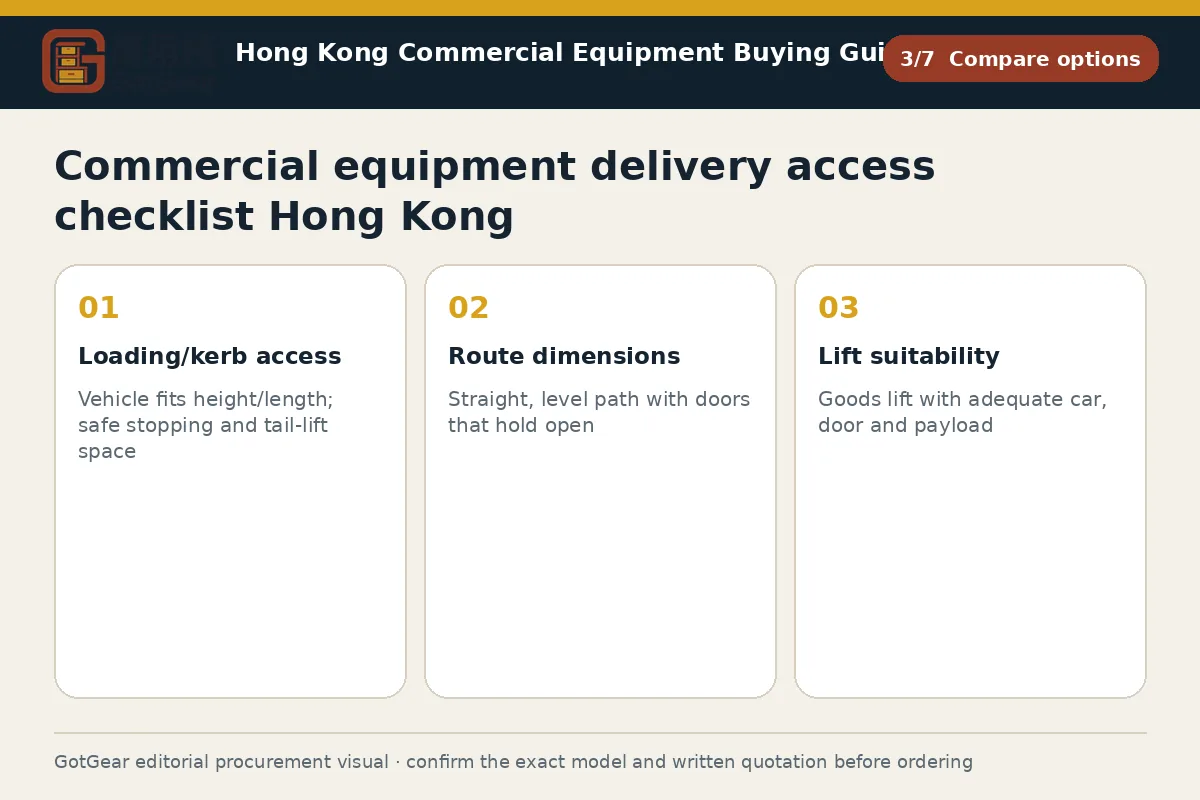
| Loading/kerb access | Vehicle fits height/length; safe stopping and tail-lift space | Complex route with ramps, tight turns, shared bays | Photos, bay sketch, max vehicle envelope, booking reference |
| Route dimensions | Straight, level path with doors that hold open | Corners with tight diagonals, thresholds, low services | Measured widths/heights, turning diagram, pinch-point photos |
| Lift suitability | Goods lift with adequate car, door and payload | Passenger-only access, peak lockouts, spread load needed | Lift plate photo, internal/door dims, priority rules in writing |
| Approvals and bookings | Basic security registration and standard slot | Permit-to-work, protection, out-of-hours, event moratoriums | Copies of building rules, insurance note, confirmed slot ID |
| Handling and safety | Pallet truck with floor protection allowed | Stair work, de-crating, special tools or attendants required | Method statement, risk assessment, equipment list, staffing plan |
This framework helps buyers create comparable written enquiries. Final model specifications, availability, delivery and commercial terms must be confirmed in a formal quotation.
Commercial equipment delivery access checklist Hong Kong: Record lift access limits
Lift constraints can determine feasibility and cost. Record the lift car’s internal length, width and height, the clear door opening, and the diagonal clearance from the ceiling to the opposite corner. Photograph the lift specification plate showing the rated load and maximum occupants, then confirm whether loads may be concentrated on a pallet or must be spread. Ask whether protective blankets, floor sheets or a lift attendant are mandatory, and whether the lift can be switched to priority service during booked slots.
Peak-hour lockouts are common in mixed-use towers; document permitted delivery times and any surcharge for out-of-hours moves. For industrial buildings, verify whether the goods lift serves the loading level directly or if there is an intermediate ramp or dock. Moist, humid air in lift lobbies can condense on cold-packaged equipment; request the supplier’s guidance on wrapping and acclimatisation before power-up. Where vibration, tilt or shock limits are tight, ask the manufacturer for handling tolerances and any requirement for spreader bars or shock indicators, and include these in the enquiry. If relevant, state that commercial equipment delivery lift access requirements in Hong Kong may differ across properties, and that building manager instructions will override provisional plans included in the quotation scope.
Commercial equipment delivery access checklist Hong Kong: Confirm building approval
Before confirming movement, align approvals, documentation and bookings. Check contractor registration status and obtain insurance evidence as required by the building, and determine whether a method statement and risk assessment are needed for the proposed handling method. Include named supervisors and Cantonese/English contacts. Secure a delivery slot reference that covers the loading area, route and lift, and note restrictions such as public event moratoriums, school examinations or retail black-out periods. If floor, wall or lift protection is required, specify who supplies and installs it.
Institutional buyers should route approvals through estates, safety and, where applicable, IT or clinical engineering. Where the unit interfaces with power, water, ventilation or drainage, request manufacturer installation notes and any authority or insurer conditions that could affect access or staging. If the route requires temporary de-crating or part-removal of panels, ask for written confirmation that warranty remains valid. Coordinate timing with your commercial equipment delivery appointment Hong Kong, and align that timing with your overall plan; agree handover points with the supplier. Ensure the method fits your commercial equipment safe handling Hong Kong, including staffing levels and PPE. Keep copies of bilingual building rules and the confirmed slot, so the gate team recognises the appointment on arrival.
Commercial equipment delivery access checklist Hong Kong decision checklist
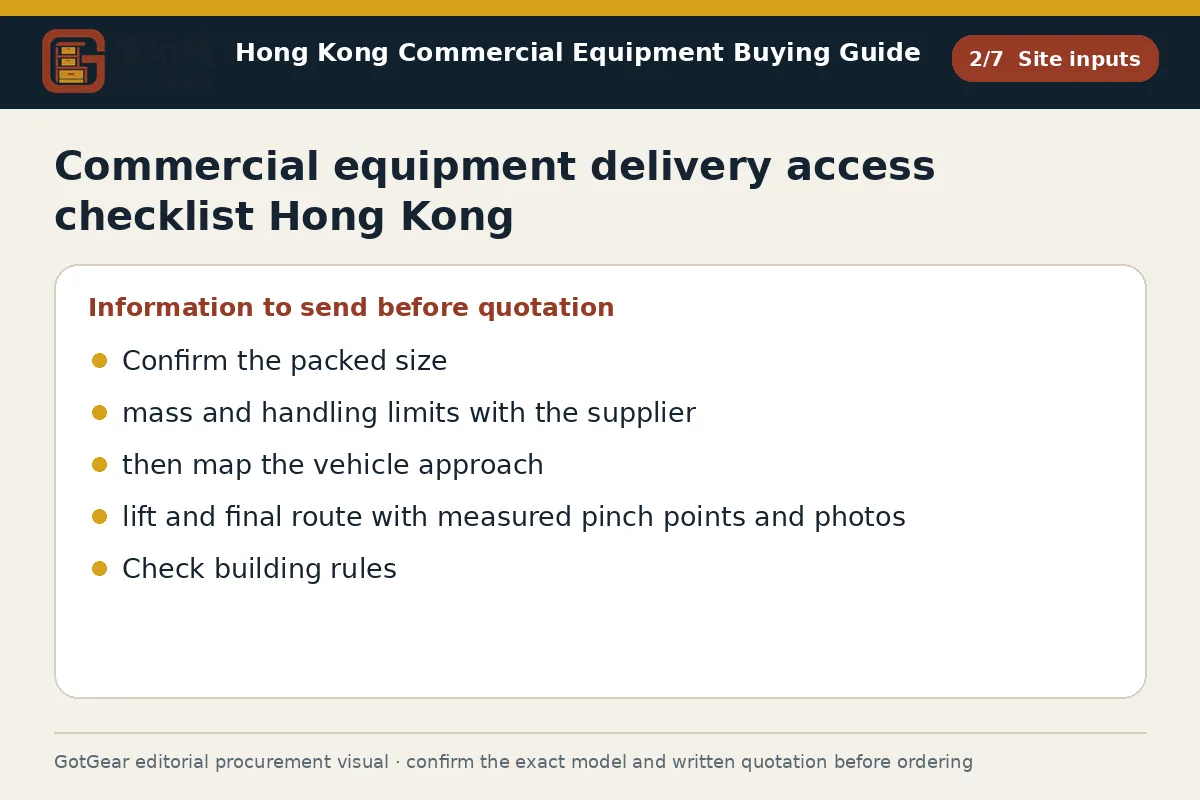
Confirm the packed size, mass and handling limits with the supplier, then map the vehicle approach, bay, lift and final route with measured pinch points and photos. Check building rules, booking windows, protection requirements and whether priority lift service is available. Request written quotations that state method, manpower, lift use, protection, out-of-hours terms and contingencies for reorientation or de-crating. Ensure institutional or landlord approvals and insurance evidence are in place, and that your team’s contacts are bilingual. Schedule the move, brief staff on risks, stage protection and tools, and prepare receipt checks so condition and serial numbers are verified before sign-off.
- Operating use, quantity and expected frequency
- Dimensions, capacity, material and accessory requirements
- Delivery address, floor, goods lift and loading window
- Required documents, acceptance checks and after-sales arrangements
Key points for commercial equipment delivery access checklist Hong Kong, commercial equipment delivery loading bay Hong Kong, commercial equipment delivery lift access Hong Kong
Hong Kong properties often combine tight goods-lift cars, narrow lobbies and strictly managed loading windows, especially in mixed-use or strata buildings. Management offices may require pre-registration, insurance details and bilingual documents, and public-facing routes can be restricted during trading hours or events. Vehicle heights, turning space and ramp gradients can vary sharply between industrial estates and CBD towers; confirm each site’s constraints and booking rules. Weather and humidity can affect packaging and floor protection, and severe conditions can pause movements. Treat building instructions as prevailing over provisional plans, and confirm all details in writing.
Questions about commercial equipment delivery access checklist Hong Kong
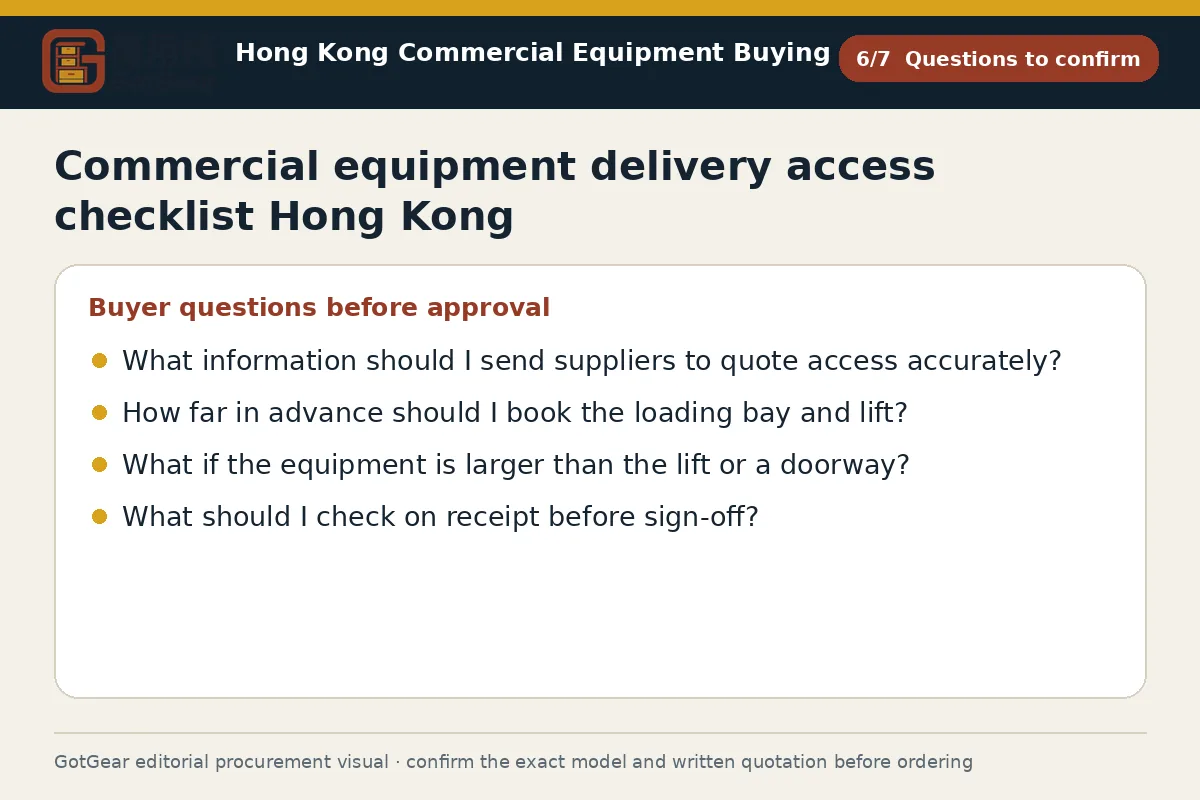
What information should I send suppliers to quote access accurately?
Provide packed item dimensions, weight and any tilt or rotation limits, plus annotated photos or a sketch of the full route with clear widths, heights and turning space. Add lift internal and door dimensions, payload from the specification plate, and the building’s booking and protection rules. Photos of the loading bay and pinch points reduce assumptions and let quotations state method and contingencies clearly.
How far in advance should I book the loading bay and lift?
Book as early as the building will allow. As an example starting point, some managers accept requests two to five working days ahead for standard moves, with longer notice for peak periods or out-of-hours slots. Always confirm the lead time, documentation and cut-off with the management office, and obtain a written reference covering both bay and lift priority if required.
What if the equipment is larger than the lift or a doorway?
Options include reorientation, partial de-crating, panel removal, or an alternative route with wider doors. As an example starting point, night moves or temporary lobby reconfiguration may be permitted under supervision. Hoisting or exterior access requires explicit building approval and competent contractors. Ask the manufacturer to confirm handling tolerances so warranty and safety are not compromised by the chosen method.
What should I check on receipt before sign-off?
Inspect packaging for signs of impact or moisture, verify serial numbers, accessories and quantity, and record any variances with photos. Check that floor and lift protection has been removed without damage, and allow acclimatisation if equipment arrived cold into humid spaces. Follow your commercial equipment receiving inspection Hong Kong; adhere to your established receiving process, and escalate issues immediately so the supplier can investigate while carriers and site teams are still present.
Continue with closely related procurement topics
These pages share equipment, operating or decision-stage signals with this guide.
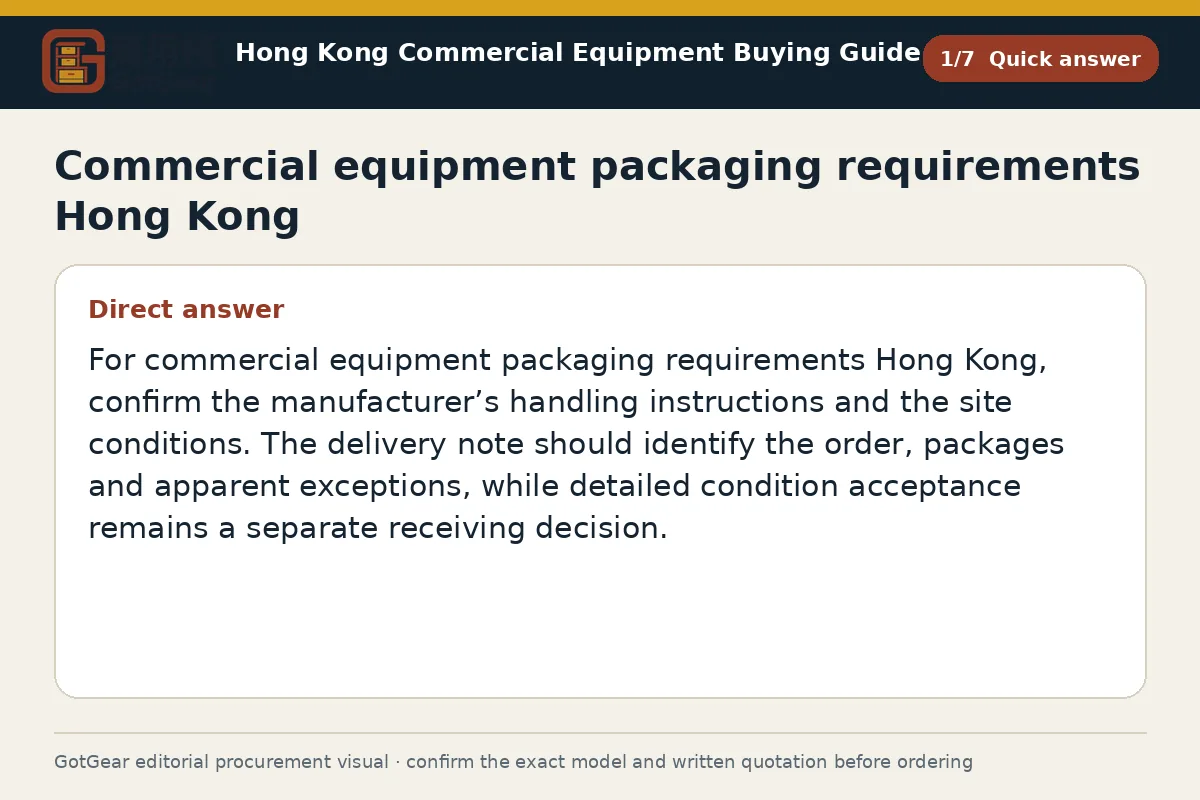
Commercial equipment packaging requirements Hong Kong
The GotGear guide to commercial equipment packaging requirements Hong Kong explains protection, marking and identification. Use the commercial equipment delivery note Hong Kong to record order details and any visible exceptions.
Read the guide
Commercial equipment bulk purchase checklist Hong Kong
Use the commercial equipment bulk purchase checklist Hong Kong to confirm demand, specifications, samples, quantities, site splits, storage, receiving, and approvals for informed purchasing decisions from GotGear.
Read the guide
Commercial equipment delivery Hong Kong
For commercial equipment delivery Hong Kong, confirm equipment dimensions, access routes and building regulations, and provide a receiving contact and inspection records. Contact GotGear.
Read the guide
Commercial equipment safe handling Hong Kong
GotGear provides guidance for commercial equipment safe handling Hong Kong. Begin with a commercial equipment manual handling risk assessment Hong Kong and a commercial equipment workplace safety checklist Hong Kong.
Read the guideRelated topic indexOpen more English procurement pages2 topics
Browse additional equipment families, applications and procurement questions relevant to a wider buying brief.