
For commercial equipment safe handling Hong Kong, follow the manufacturer’s instructions, verify actual site conditions and apply the relevant Hong Kong workplace requirements. Competent personnel should decide controls and stop the task if the load or route differs from the assessment.
Base commercial equipment safe handling Hong Kong on a commercial equipment manual handling risk assessment Hong Kong
Treat every move as a unique task. Build your commercial equipment manual handling risk assessment Hong Kong around verified data, not assumptions. Request current manufacturer information: gross and net weight, packed and unpacked dimensions, centre of gravity location, approved lifting or push points, tilt limits, and any wheels, skids, or fragile surfaces. Ask for a handling and packaging drawing, plus statements on moisture sensitivity and top-heavy risks. For powered units, confirm if transit locks, battery isolators, or shipping braces are fitted and must be removed only after positioning.
Survey the real route from vehicle to final location. Record doorway and corridor widths and heights, turning radii, floor finishes, thresholds, slopes, kerbs, and any ceiling or sprinkler obstructions. Check goods-lift car and door dimensions, lift load rating, and whether counterweights or pallet jacks are permitted. Note building management loading windows, supervisor contacts, and any bilingual signage requirements. Prepare a written method statement that specifies equipment (e.g., pallet truck, machine skates, stair climber), manpower, exclusion zones, communication signals, and stop conditions. Commercial equipment safe handling Hong Kong depends on aligning these elements and confirming they match the site on the day.
People, route and equipment in commercial equipment safe handling Hong Kong
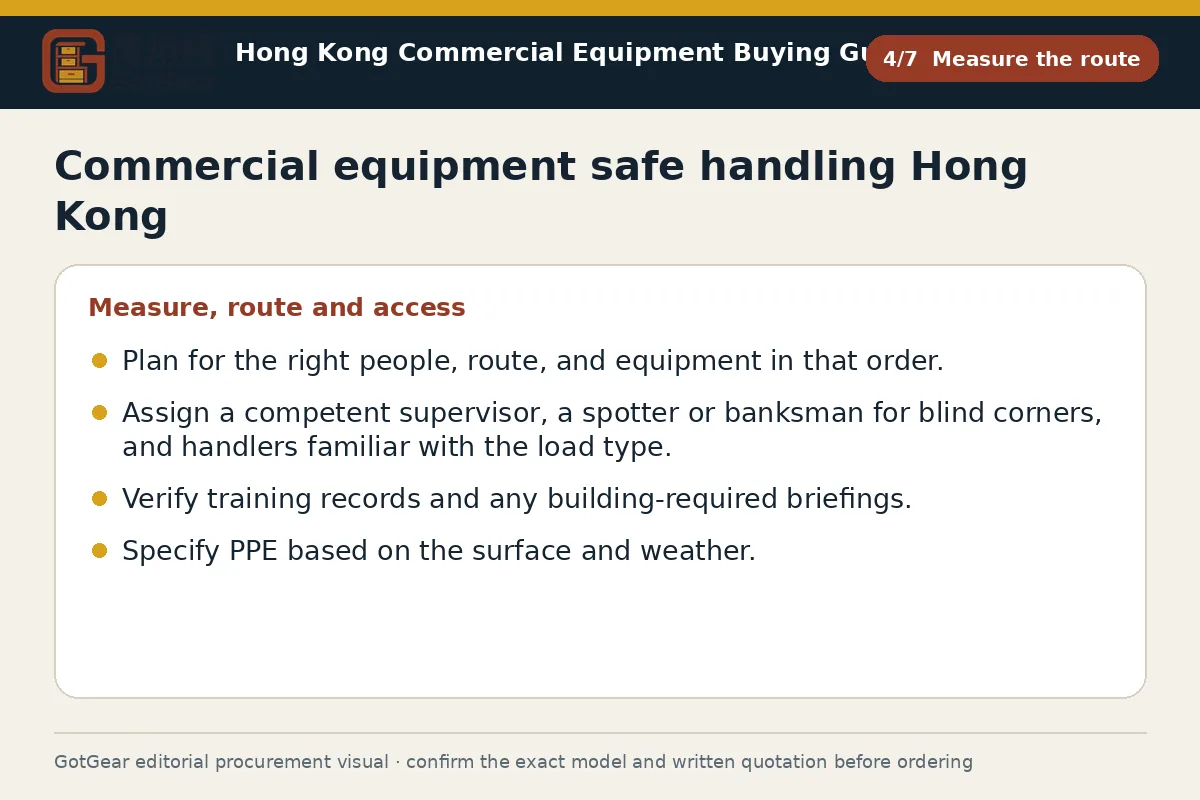
Plan for the right people, route, and equipment in that order. Assign a competent supervisor, a spotter or banksman for blind corners, and handlers familiar with the load type. Verify training records and any building-required briefings. Specify PPE based on the surface and weather. Agree simple hand or radio signals and ensure all staff can understand bilingual instructions where required. For campuses, malls, or venues with public footfall, pre-mark an exclusion path and arrange stewards to prevent pedestrian encroachment.
Select equipment that suits the measured route, not the other way round. Low-profile skates, pallet trucks with brakes, stair-capable units, or adjustable bars may be needed for thresholds and gradients. Check floor load capacity in sensitive areas with the venue or property manager. Confirm lift permissions for powered handling aids and forklifts; some industrial buildings restrict fuels, noise, or exhausts. Reconfirm the route immediately before movement, including wet floors, wind at docks, and live works nearby. Where a vehicle tail-lift is used, ensure the landing area is level and protected from passing traffic and that any anti-roll or chocking devices are in place before unfastening restraints.
What should buyers compare for commercial equipment safe handling Hong Kong?
| Criterion | Straightforward requirement | More complex requirement | Evidence to provide |
|---|---|---|---|
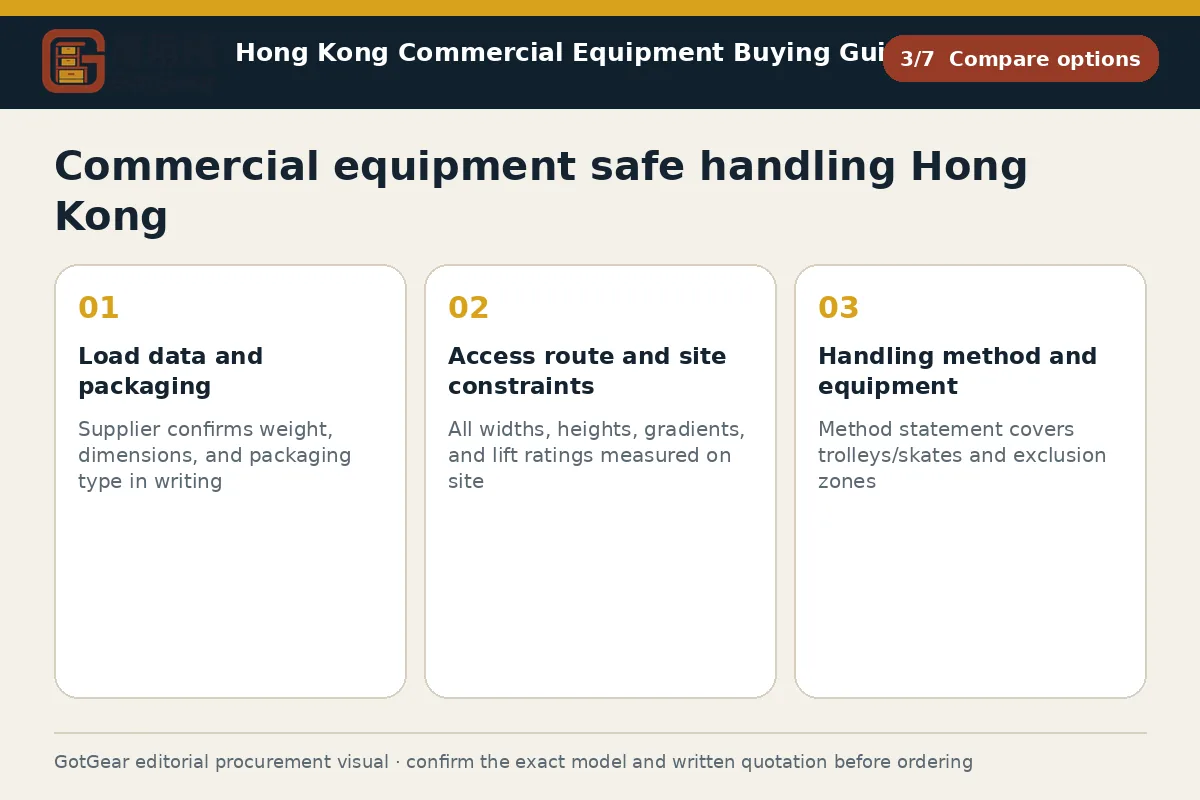
| Load data and packaging | Supplier confirms weight, dimensions, and packaging type in writing | Complex load with high centre of gravity or fragile surfaces documented | Manufacturer handling note, packaging drawing, and written confirmation from supplier |
| Access route and site constraints | All widths, heights, gradients, and lift ratings measured on site | Shared/public route requiring bilingual notices and security escorts | Measured sketch with photos, building-management booking and contact details |
| Handling method and equipment | Method statement covers trolleys/skates and exclusion zones | Stairs, tight turns, or floor-protection plan require specialised aids | Method statement with equipment specs, floor-protection plan, and contingency |
| Personnel and supervision | Named competent supervisor and briefed team | Banksman/spotters for blind corners and public interfaces | Training records/briefing sign-in, communication signals, and stop rules |
| Documentation and approvals | Insurance and delivery schedule filed with building management | Institutional sign-off and revised plan if route or load changes | Booking confirmations, permits (if required), bilingual notices, and version-controlled plan |
This framework helps buyers create comparable written enquiries. Final model specifications, availability, delivery and commercial terms must be confirmed in a formal quotation.
Use a commercial equipment workplace safety checklist Hong Kong for commercial equipment safe handling Hong Kong
Use a structured sequence to keep the team aligned. A workplace safety checklist for commercial equipment in Hong Kong should cover pre-delivery, arrival, movement, and receipt. Before delivery, verify the model and packaging drawing match the quotation, confirm total weight and footprint with the supplier in writing, and book the loading bay and goods lift with building management. Capture photos and measured notes of pinch points and prepare bilingual notices if the route crosses public-facing space. Attach the method statement and insurance to your internal approval request.
On arrival, repeat critical measurements, confirm lift availability, check weather and floor conditions, and inspect packaging integrity before unloading. During movement, keep an active exclusion zone, pace the move to match visibility and slope, and update the plan if the route changes. At position, de-crate safely, retain bracing until stability is confirmed, and complete a receiving record with serial number, accessories, and damage notes. Pair this with the delivery access checklist for commercial equipment in Hong Kong for route planning and the receiving inspection for commercial equipment in Hong Kong for post-delivery controls.
Stop conditions for commercial equipment safe handling Hong Kong
Define clear, shared stop conditions before anyone starts. Halt the move if the measured route does not match the assessment, if the load appears unstable or heavier than documented, or if packaging is wet, split, or missing bracing. Stop for inaccessible or out-of-service goods lifts, blocked corridors, unexpected gradients, poor lighting, or crowding beyond the agreed exclusion plan. Hold where communication fails, the supervisor is absent, or the handling device shows faults or leaks.
Pause during adverse weather affecting traction or visibility, and follow venue policy during high wind or rain warnings. If a public event overruns into your route, reschedule through the management office. On stopping, make the load safe, withdraw to a controlled area, and reassess: update dimensions, staffing, equipment choice, or timing. Issue a revised method statement and obtain written acceptance from the supplier and property manager before resuming. Cross-check any re-plan against institutional equipment delivery requirements Hong Kong. For coordination steps, refer to guidance for commercial equipment delivery Hong Kong.
Commercial equipment safe handling Hong Kong decision checklist
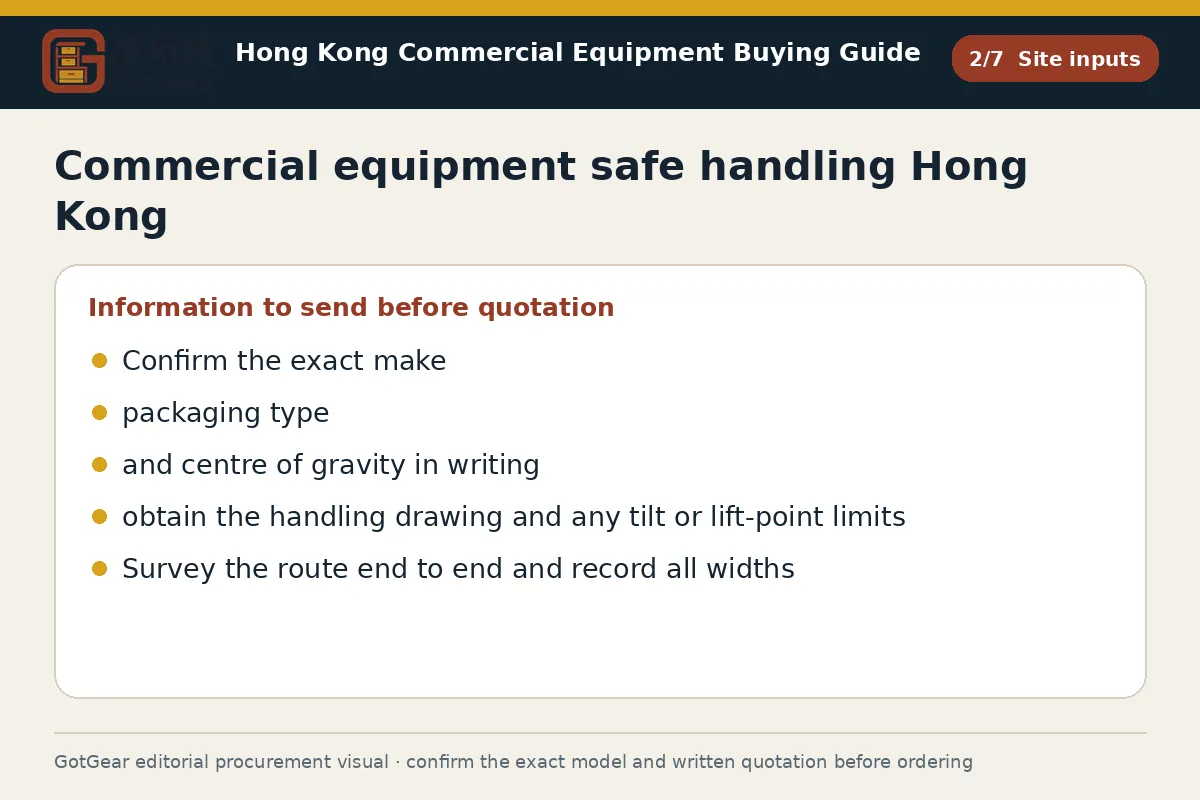
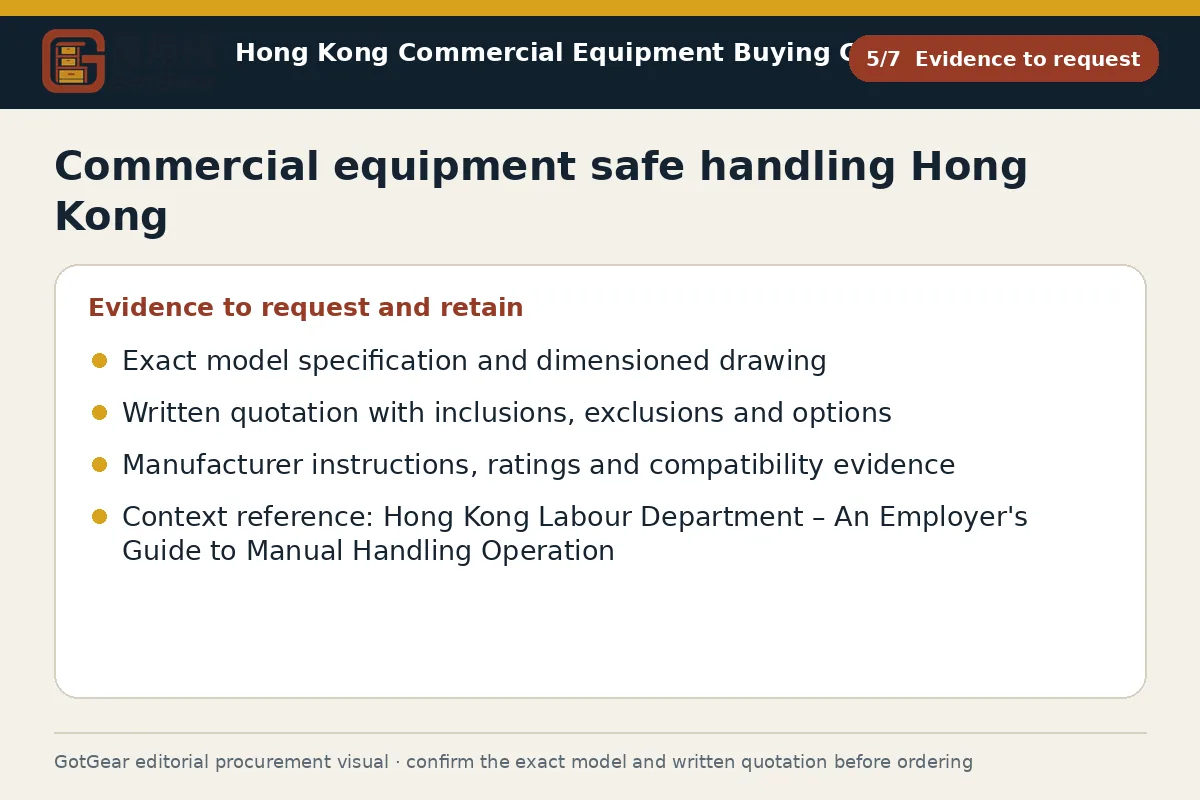
Confirm the exact make, model, packaging type, gross weight, and centre of gravity in writing; obtain the handling drawing and any tilt or lift-point limits. Survey the route end to end and record all widths, heights, gradients, thresholds, lift dimensions and ratings, and floor sensitivities; collect photos. Book loading and lift windows with the management office and prepare bilingual signage. Choose handling equipment to suit measured constraints; assign a competent supervisor and spotters. Brief stop conditions and communication signals. On the day, re-measure critical points, verify weather, inspect packaging before unfastening, maintain an exclusion zone, and complete a receiving record with serial and damage notes.
- Operating use, quantity and expected frequency
- Dimensions, capacity, material and accessory requirements
- Delivery address, floor, goods lift and loading window
- Required documents, acceptance checks and after-sales arrangements
Key points for commercial equipment safe handling Hong Kong, commercial equipment manual handling risk assessment Hong Kong, commercial equipment workplace safety checklist Hong Kong
Hong Kong moves often hinge on goods-lift constraints, narrow service corridors, and limited loading-bay windows set by property management offices. Expect to pre-book time slots, submit method statements, and align with concierge or security escorts, especially in mixed-use towers and industrial buildings. Humid conditions and sudden rain can make ramps and packaging slippery, so confirm floor protection and traction. Where routes pass through public areas, bilingual notices and temporary barriers are commonly required. This note outlines practical constraints only; your organisation’s rules, model specifications, and building approvals prevail.
Questions about commercial equipment safe handling Hong Kong
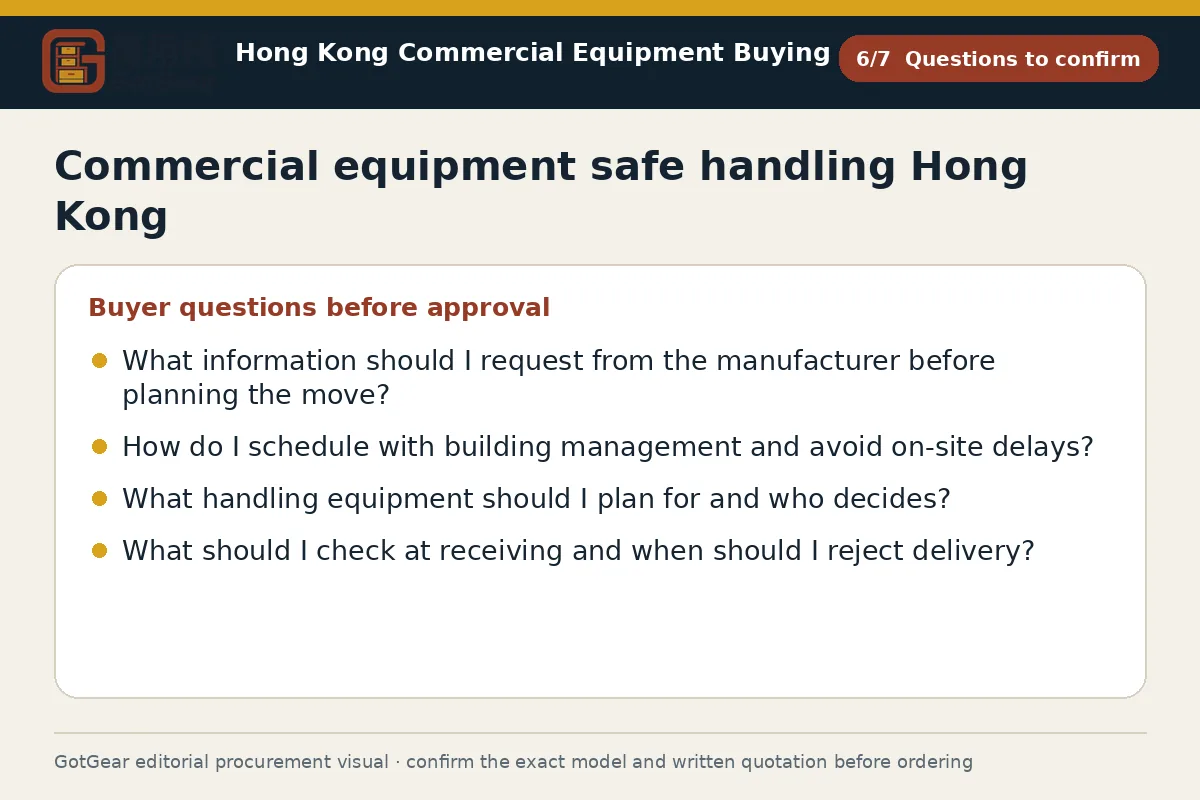
What information should I request from the manufacturer before planning the move?
Ask for the current datasheet or handling note showing gross weight, packed and unpacked dimensions, centre of gravity, approved lift or push points, tilt limits, and any transit locks. Request a packaging/handling drawing and stability notes. For powered items, confirm isolation procedures. Written confirmations from the supplier and any updates in the quotation should prevail over earlier brochures.
How do I schedule with building management and avoid on-site delays?
Book loading-bay and goods-lift slots, submit your method statement and insurance, and name a responsible supervisor. Provide measured route notes and photos with the booking. Many premises require bilingual notices and security coordination. If you need route-planning prompts, see the commercial equipment delivery access checklist Hong Kong for typical measurement points to capture before you confirm dates.
What handling equipment should I plan for and who decides?
Select equipment to fit the surveyed route: low-profile skates for tight thresholds, pallet trucks with brakes for slopes, or stair-capable units if lifts are unsuitable. A competent person should decide after reviewing dimensions, gradients, and floor limits. Confirm any building restrictions on powered aids in writing and ensure operators are trained for the chosen devices.
What should I check at receiving and when should I reject delivery?
Inspect packaging integrity, tilt or shock indicators if fitted, and confirm the serial number, accessories, and visible condition before signing. Photograph any issues and note them on the delivery record. If dimensions, weight, or packaging condition conflict with your assessment, stop and escalate. Use the commercial equipment receiving inspection Hong Kong to structure evidence for the supplier and venue.
Continue with closely related procurement topics
These pages share equipment, operating or decision-stage signals with this guide.
Commercial equipment bulk purchase checklist Hong Kong
Use the commercial equipment bulk purchase checklist Hong Kong to confirm demand, specifications, samples, quantities, site splits, storage, receiving, and approvals for informed purchasing decisions from GotGear.
Read the guide
Commercial equipment delivery access checklist Hong Kong
Use GotGear commercial equipment delivery access checklist Hong Kong to verify routes and dimensions. Check commercial equipment delivery loading bay Hong Kong and commercial equipment delivery lift access Hong Kong limits.
Read the guide
Institutional equipment delivery requirements Hong Kong
GotGear explains institutional equipment delivery requirements Hong Kong, covering operating hours, site access and rules, security and authorised receiver procedures, and inspection and handover steps.
Read the guide
Commercial equipment delivery Hong Kong
For commercial equipment delivery Hong Kong, confirm equipment dimensions, access routes and building regulations, and provide a receiving contact and inspection records. Contact GotGear.
Read the guideRelated topic indexOpen more English procurement pages3 topics
Browse additional equipment families, applications and procurement questions relevant to a wider buying brief.