
For commercial equipment packaging requirements Hong Kong, confirm the manufacturer’s handling instructions and the site conditions. The delivery note should identify the order, packages and apparent exceptions, while detailed condition acceptance remains a separate receiving decision.
Match commercial equipment packaging requirements Hong Kong to the handling route
Start by mapping the journey from supplier to point of use. State the route clearly in your enquiry: container unpack, cross-dock, local truck, loading bay, goods lift, corridor and room. Note any need to tail-lift, use stair-climbers, or to protect against rain and high humidity between kerbside and store. The commercial equipment packaging requirements Hong Kong, as agreed by local teams, should reflect these steps so packages remain secure, manoeuvrable and legible until final placement and inspection.
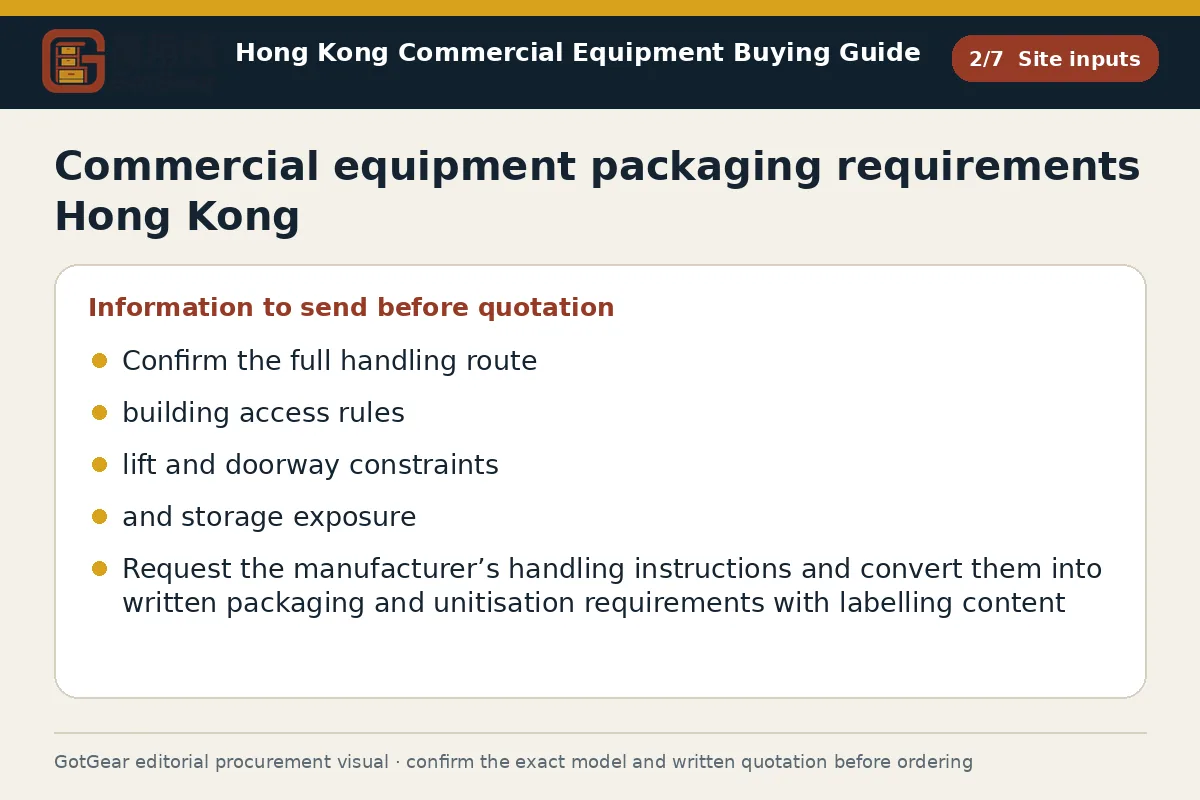
Request handling data from the manufacturer and convert it into packaging fields the supplier must confirm in writing. Ask for unitisation type (pallet, skid, crate, roll-cage), maximum package dimensions and weight limits tied to your lifts and doors, centre-of-gravity marking, forklift/clamp/no-clamp rules, stacking permission, handholds and tie-down points. Specify moisture barriers, desiccant and corrosion control where storage may be prolonged, plus edge boards and corner protection for strapping. Require weather-resistant wrap if any uncovered handling is expected. For sensitive assemblies, request cushioning performance, tip/shock indicators and a clear "do not tilt" marking if orientation matters. Where equipment will be staged in schools, hospitals or retail floors, add a clean-film or bag to prevent dust transfer. Make all conditions “subject to model specification and the supplier’s formal quotation,” and ensure building-management rules are reflected before you approve.
Marking and unitisation under commercial equipment packaging requirements Hong Kong
Translate handling choices into clear marking and unitisation so every party can route, store and inspect consistently. Require bilingual exterior labels with purchase order, item code, model, serial (if known), package ID “X of Y,” gross/net weight, dimensions, and handling warnings. Orientation arrows, “no stack” cones (if applicable), and clamp/no-clamp icons help third-party carriers. Ask for a packing list in a weatherproof pouch on the lead package and a duplicate inside the master pack. Where traceability matters, specify barcode or QR symbology compatible with your system, and show a sample in the quotation.
Define unitisation fit for Hong Kong buildings: four-way entry pallets or skids that clear lift thresholds, banding with edge protection, stable wrap that resists humidity, and baseboards that allow pump-truck access without tipping. For high-finish panels, call for interleaving sheets and scratch guards. If condensation is a risk, require sealed liners with desiccant and a humidity indicator card. For shock-sensitive items, request tilt/shock indicators and a visible acceptance threshold. Clarify waste expectations: whether crates are returnable, and whether the carrier removes packaging, noting any management-office restrictions on waste movement. Capture all of this in your enquiry so quotations can be compared like-for-like.
What should buyers compare for commercial equipment packaging requirements Hong Kong?
| Criterion | Straightforward requirement | More complex requirement | Evidence to provide |
|---|---|---|---|
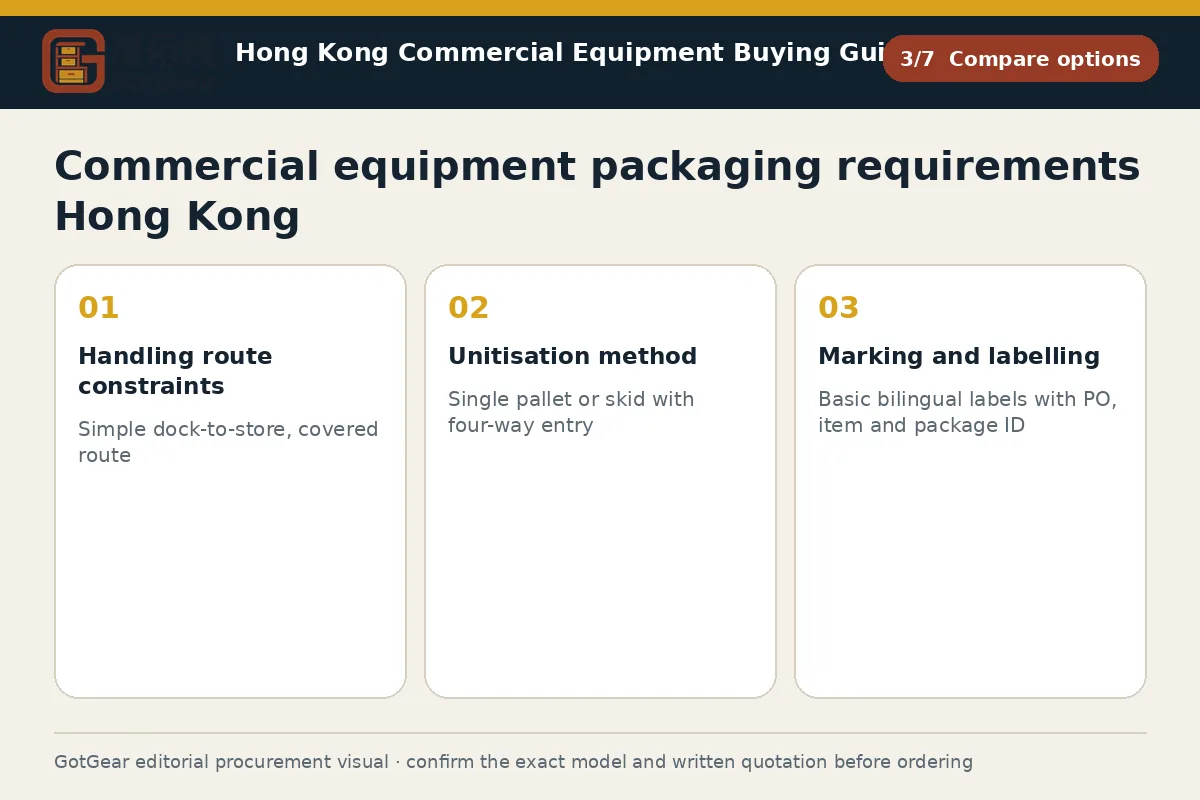
| Handling route constraints | Simple dock-to-store, covered route | Complex multi-stage route with outdoor exposure and lift limits | Describe each stage, lift/door sizes, turning spaces, weather exposure |
| Unitisation method | Single pallet or skid with four-way entry | Mixed unitisation: crate for core, separate pallet for accessories | State method per line, package count, pump-truck/lift needs |
| Marking and labelling | Basic bilingual labels with PO, item and package ID | Enhanced labels with serials, barcodes, weight, orientation icons | Provide sample label, language requirement, data fields |
| Moisture/shock protection | Stretch-wrap with edge boards and desiccant | Sealed liner with humidity card and tilt/shock indicators | Specify indicator types and acceptance thresholds |
| Delivery note and pre-advice | Order reference and package list on delivery note | ASN with package IDs and booked time slot | Share note template, pre-advice dataset, booking details |
This framework helps buyers create comparable written enquiries. Final model specifications, availability, delivery and commercial terms must be confirmed in a formal quotation.
Commercial equipment packaging requirements Hong Kong: Connecting to a commercial equipment delivery note Hong Kong
Connect packaging decisions with documents and booking steps so receiving can verify quickly. The commercial equipment delivery note Hong Kong carriers present should reference your order, list each package ID and description, and note any apparent discrepancies or missing indicators. Ask for a pro-forma delivery note sample with your quotation, plus confirmation that labels and notes will be bilingual where required by site. If the route needs a time slot, state that pre-advice and a commercial equipment delivery appointment Hong Kong are mandatory and list building forms or ID needed at the loading bay.
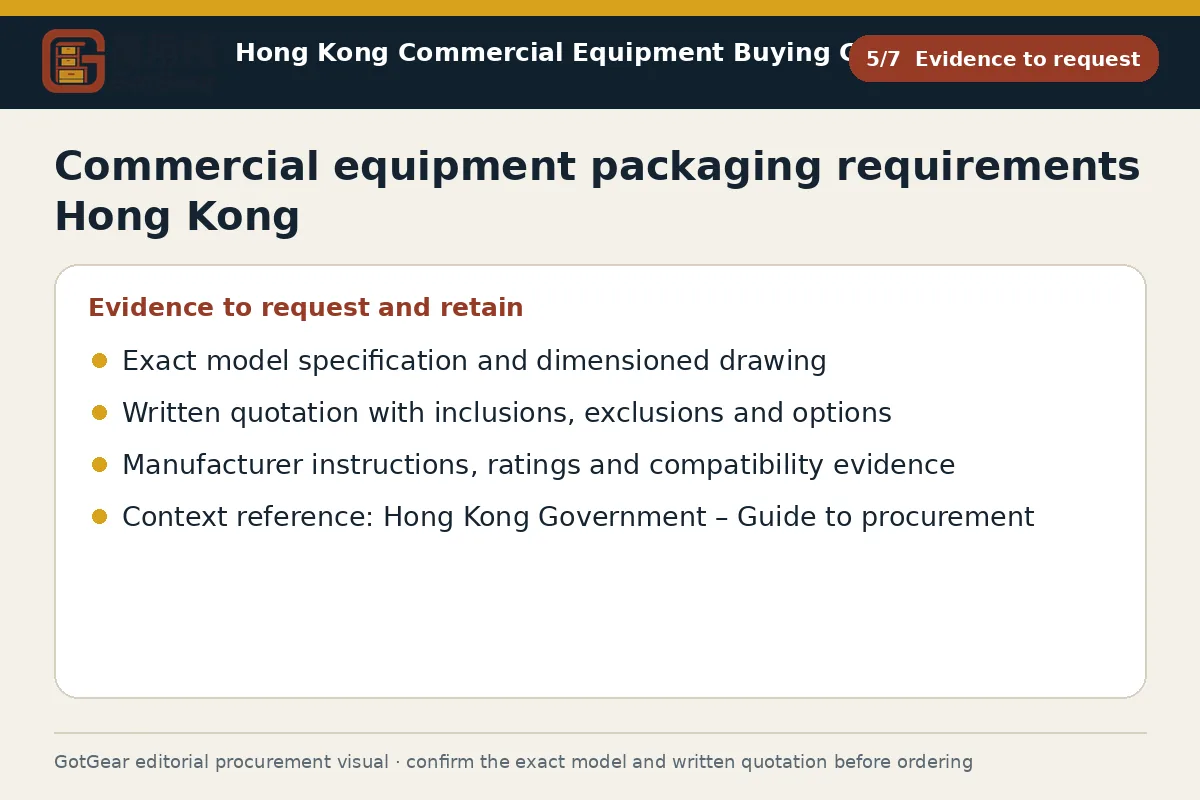
When comparing written quotations, check that unitisation, marking, moisture/shock controls, and delivery-note fields are explicitly committed, not left as “standard packing.” Confirm who pays for special crating, redelivery if a slot is missed, and whether packaging removal is included. Tie documentation to your commercial equipment purchase order Hong Kong and ensure the supplier’s commercial equipment order confirmation Hong Kong mirrors the agreed packaging and delivery-note content. Request manufacturer handling instructions or rigging notes where weight distribution or lifting points affect safety. If advanced shipment notices are available, require package counts and IDs in the pre-advice so the receiving team can pre-print checklists and plan equipment and labour accordingly.
Receiving evidence for commercial equipment packaging requirements Hong Kong
Receiving evidence starts before the first strap is cut. Count packages against the delivery note at the vehicle, photograph the overall condition, and take close-up shots of each label, the seal number and any tilt/shock or humidity indicators. Record exceptions directly on the delivery note and in your system, using bilingual remarks if needed. Do not confirm detailed condition until the item is unpacked and powered or assembled per your procedure; for the initial signature, sign only for what is visibly and objectively presented.
After items are placed safely, proceed to your commercial equipment receiving inspection Hong Kong, following your organisation’s established process. Retain packaging until the technical check passes or the supplier authorises disposal. If an indicator is triggered, or moisture is present, notify the supplier immediately with photographs and serial numbers, and request manufacturer guidance on acceptance limits. For sensitive equipment, request calibration sheets, handling instructions and any site-specific sign-offs if your venue, insurer or authority requires them. Weigh or measure packages when discrepancies are suspected, and maintain a chain of custody for seals and indicator devices. Where public areas are involved, segregate waste and ensure any crate breakdown follows building rules to avoid obstructing exits or lifts.
Commercial equipment packaging requirements Hong Kong decision checklist
Confirm the full handling route, building access rules, lift and doorway constraints, and storage exposure. Request the manufacturer’s handling instructions and convert them into written packaging and unitisation requirements with labelling content, moisture/shock controls and stacking rules. Ask suppliers to submit a sample label and delivery-note layout with bilingual fields. State booking needs, pre-advice data, and any packaging-removal scope. Compare quotations line-by-line against those fields and reject vague “standard packing.” On delivery, count, photograph and record indicator status before opening. Note exceptions on the delivery note, then proceed to detailed inspection. Retain packaging until acceptance or supplier advice. Ensure the purchase order and order confirmation reflect the agreed requirements.
- Operating use, quantity and expected frequency
- Dimensions, capacity, material and accessory requirements
- Delivery address, floor, goods lift and loading window
- Required documents, acceptance checks and after-sales arrangements
Key points for commercial equipment packaging requirements Hong Kong, commercial equipment delivery note Hong Kong
Hong Kong deliveries often require tight coordination with building management: limited loading windows, goods-lift size and weight constraints, and driver ID or access forms. Plan for rain and high humidity between kerbside and store, and specify bilingual labels and delivery notes where mixed-language teams work the dock. Many industrial buildings restrict waste movement and pallet types, so confirm packaging-removal responsibilities up front. For public venues and schools, extra routing controls or supervision may apply. Treat these as operating constraints to embed in your written enquiry and quotation comparison, rather than assumptions.
Questions about commercial equipment packaging requirements Hong Kong
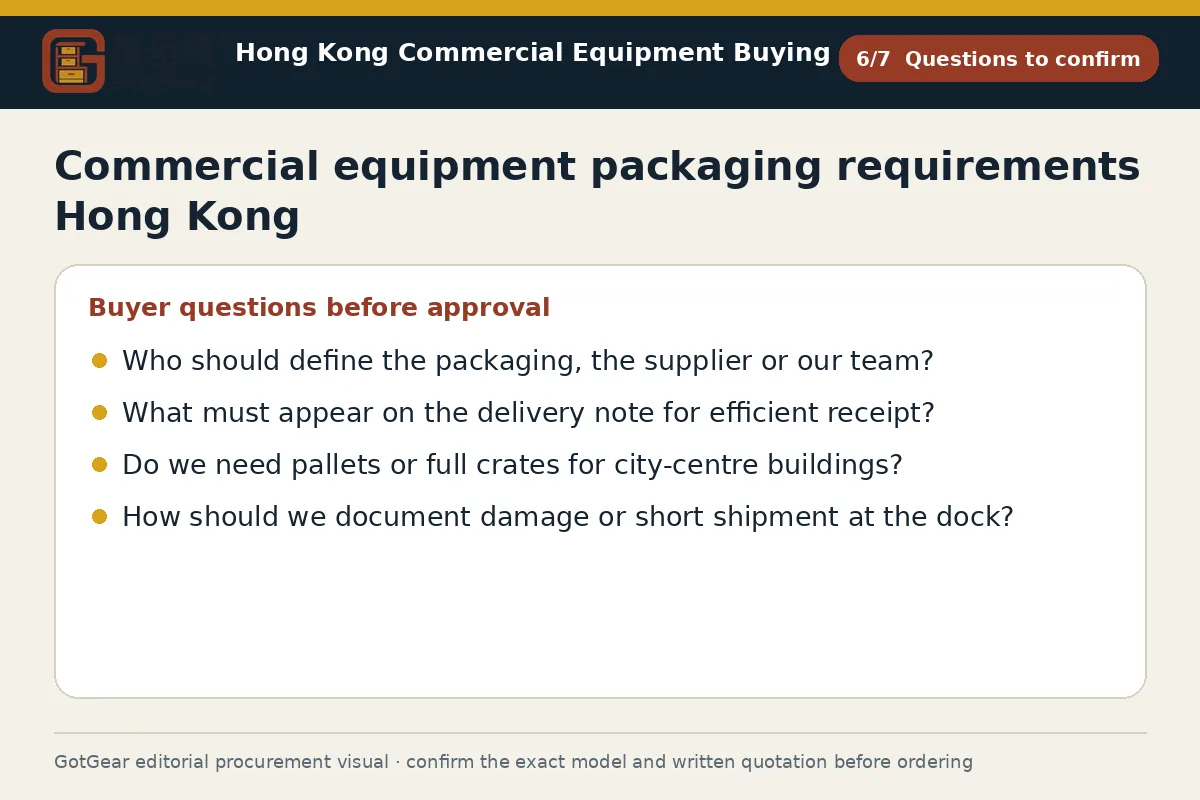
Who should define the packaging, the supplier or our team?
Your team should define needs based on route, site constraints and inspection, then the supplier confirms feasibility in writing. Manufacturers’ handling instructions inform the detail. Treat the model specification and formal quotation as prevailing. If access is atypical or the item is sensitive, request rigging notes or protective measures as part of the supplier’s response.
What must appear on the delivery note for efficient receipt?
At minimum, the delivery note should reference the order, list each package ID and description, and state any apparent exceptions. Bilingual fields reduce errors. Acceptance of technical condition remains a separate step after unpacking. Where available, ask for pre-advice with package counts so your team can plan manpower and equipment for the slot.
Do we need pallets or full crates for city-centre buildings?
Choose the lightest unitisation that still protects the item and fits lifts and corridors. Four-way entry pallets or skids often work, while crates help fragile or high-finish goods. Confirm thresholds, turning radii and waste rules with building management, then have the supplier commit to dimensions and handling icons in the quotation and order confirmation.
How should we document damage or short shipment at the dock?
Record photos of the vehicle, each package and all labels, note exceptions on the delivery note, and capture indicator readings and seal numbers. Keep packaging until the supplier advises. Technical acceptance follows your inspection procedure, not the driver’s schedule. Prompt notice, with serials and timestamps, supports swift resolution and avoids disputes.
Continue with closely related procurement topics
These pages share equipment, operating or decision-stage signals with this guide.
Commercial equipment delivery access checklist Hong Kong
Use GotGear commercial equipment delivery access checklist Hong Kong to verify routes and dimensions. Check commercial equipment delivery loading bay Hong Kong and commercial equipment delivery lift access Hong Kong limits.
Read the guide
Institutional equipment delivery requirements Hong Kong
GotGear explains institutional equipment delivery requirements Hong Kong, covering operating hours, site access and rules, security and authorised receiver procedures, and inspection and handover steps.
Read the guide
Commercial equipment delivery Hong Kong
For commercial equipment delivery Hong Kong, confirm equipment dimensions, access routes and building regulations, and provide a receiving contact and inspection records. Contact GotGear.
Read the guide
Commercial equipment bulk purchase checklist Hong Kong
Use the commercial equipment bulk purchase checklist Hong Kong to confirm demand, specifications, samples, quantities, site splits, storage, receiving, and approvals for informed purchasing decisions from GotGear.
Read the guideRelated topic indexOpen more English procurement pages1 topics
Browse additional equipment families, applications and procurement questions relevant to a wider buying brief.