
In preparation for commercial equipment delivery Hong Kong, align the supplier's stated basis with the site's access requirements, appointment schedule and inspection arrangements. Any proposed date remains conditional until it is confirmed by the relevant parties in the applicable document.
Site facts to confirm for commercial equipment delivery Hong Kong
Confirm the legal entity for billing and receiving, the full site address in English and Chinese, unit/floor, and a named receiving contact with mobile number and email. Note the building management office contact for bookings, any contractor induction, and whether vehicle registration is required in advance. Record standard operating hours and the loading window offered by the building. If a delivery must avoid school hours, patient handover, prayer times or event build schedules, state these explicitly in the enquiry.
Measure access constraints that the supplier needs to plan packing and handling: goods-lift door width and height, car depth, and rated capacity; corridor clear widths and turning spaces; doorway sizes including ironmongery; ramp gradients; and floor load ratings. Example starting points to document are a goods-lift door width of 1,100 mm, car depth of 2,000 mm and capacity of 1,000 kg, to be confirmed in writing by the building manager. Specify whether pallets, skids or crates are acceptable indoors, the staging area size available near the final location, humidity or condensation risk for uncrating, waste handling instructions, and whether out-of-hours delivery is permitted subject to management approval and resident or tenant quiet hours.
Route and access data for commercial equipment delivery Hong Kong
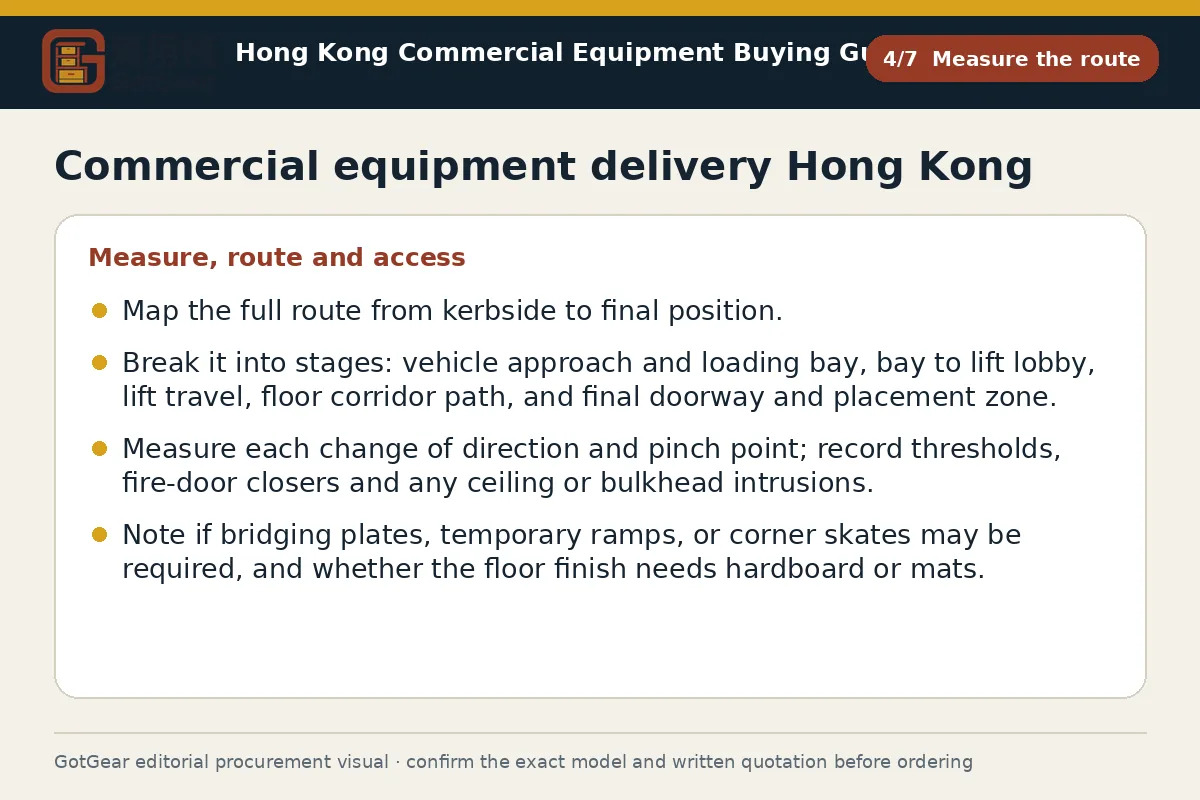
Map the full route from kerbside to final position. Break it into stages: vehicle approach and loading bay, bay to lift lobby, lift travel, floor corridor path, and final doorway and placement zone. Measure each change of direction and pinch point; record thresholds, fire-door closers and any ceiling or bulkhead intrusions. Note if bridging plates, temporary ramps, or corner skates may be required, and whether the floor finish needs hardboard or mats. Provide labelled photos with tape-measure references and a simple plan sketch; both save time in the supplier’s handling-method assessment.
Confirm the vehicle class allowed by the building and streets nearby, including height limits at podium car parks and any one-way or pedestrianised access at the last block. Book the cargo lift and loading bay through the management office with the unit number and bilingual company name shown on the pass. Share the driver’s WhatsApp contact, Chinese address and gate instructions. If there is a cross-harbour movement, allow contingency for tunnel queues. Agree a weather contingency for heavy rain or typhoon signals, and insert the confirmed appointment window into the order record once the building manager acknowledges it in writing.
What should buyers compare for commercial equipment delivery Hong Kong?
| Criterion | Straightforward requirement | More complex requirement | Evidence to provide |
|---|---|---|---|
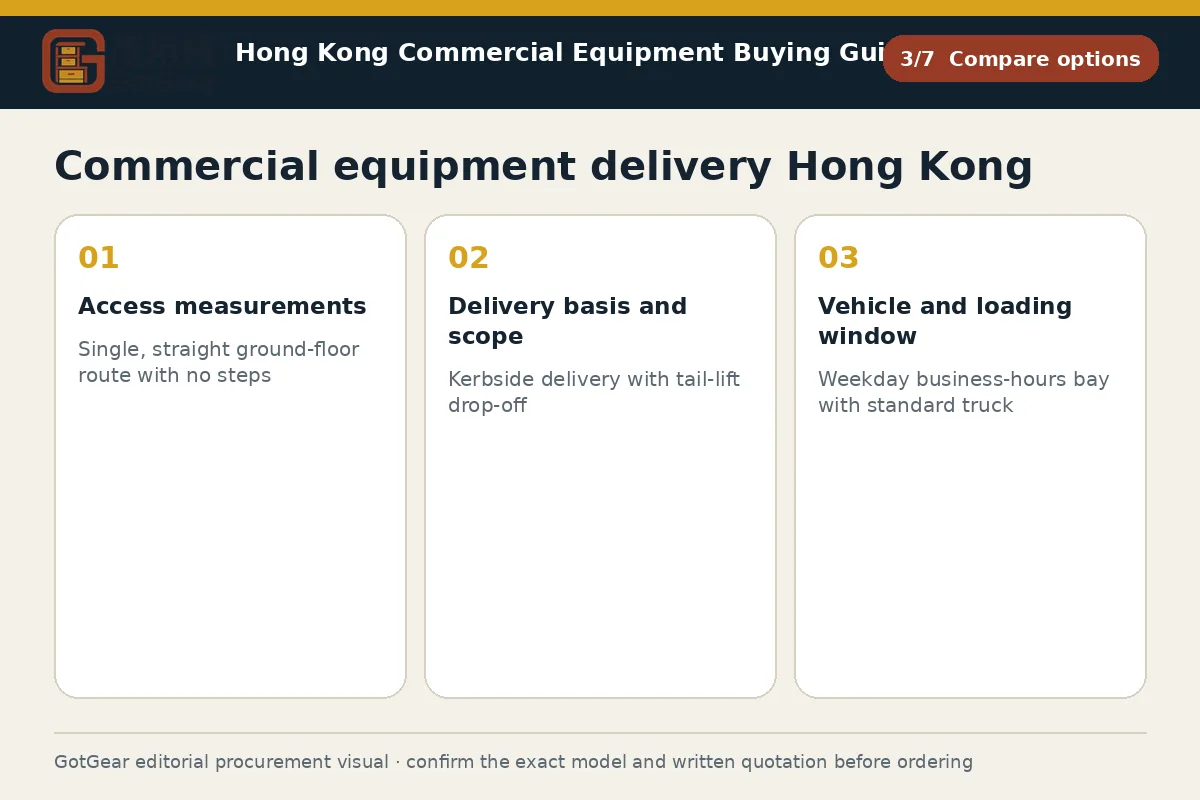
| Access measurements | Single, straight ground-floor route with no steps | Multiple turns, lift use, thresholds or short stair carry | Annotated photos, corridor and doorway sizes, lift car W×D×H and capacity |
| Delivery basis and scope | Kerbside delivery with tail-lift drop-off | Inside placement via goods lift with floor protection and repositioning | Stated basis, handling method, manpower count, floor-protection plan |
| Vehicle and loading window | Weekday business-hours bay with standard truck | Height-limited podium, security pass, or out-of-hours slot | Vehicle height/weight limits, bay booking email, pass requirements |
| Packaging and protection | Cartoned on pallet, basic wrap | Crated with moisture barrier, tilt/shock indicators, waste removal | Packing list, crate sizes/weights, protection spec, waste disposal plan |
| Receiving and records | Delivery note and POD signature | Bilingual paperwork, serial list, photo record, exceptions log | Templates or specimen docs, asset/serial list, sign-off authority names |
This framework helps buyers create comparable written enquiries. Final model specifications, availability, delivery and commercial terms must be confirmed in a formal quotation.
Roles and records for commercial equipment delivery Hong Kong
Assign clear roles. The buyer coordinates the enquiry and quotation comparison; the supplier confirms model, packed dimensions and handling method; the logistics provider plans the vehicle, manpower and route protection; the building management office controls loading-bay and lift bookings; and the site receiving supervisor signs delivery notes and exceptions. Build an enquiry pack that includes the equipment model and options, packed size and weight, route photos and measurements, delivery basis sought, appointment preference, and required paperwork. When comparing offers for commercial equipment delivery Hong Kong, ensure the quoted basis matches your site access and booking constraints.
Evaluate quotations line by line. Check whether the quotation includes tail-lift, inside placement, stair carry, protective floor coverings, lift booking fees, waiting time, and removal of packing waste. Ask for exclusions and contingency rates in writing. Request bilingual delivery notes showing model and serial numbers, and a post-placement photo record if you require it. For sensitive venues (schools, healthcare, events), state if staff vetting, induction or insurance endorsements are needed, subject to building or insurer requirements. Use your organisation’s approval route and keep the signed offer, commercial equipment delivery terms Hong Kong, and the confirmed commercial equipment delivery appointment Hong Kong together in the order file; model specifications and the supplier’s formal written quotation prevail.
Acceptance handoff after commercial equipment delivery Hong Kong
On the day, reconfirm the appointment with the building office, prepare access passes and escort the crew from gate to location. Set floor and edge protection where required and keep the path clear. Count packages against the delivery note before movement. Check crates, straps and tilt indicators for any signs of disturbance. Photograph any scuffs or compression to the packaging. If a crate or pallet is larger than the measured route, pause and escalate rather than forcing passage. Note exceptions or reservations in detail on the proof of delivery before signing.
After placement, verify model and serial numbers, accessories, manuals and power leads against the packing list. If acclimatisation is recommended for humid conditions, keep the equipment boxed for the period advised by the manufacturer. Confirm that mounting hardware, levelling feet or anchor kits supplied match the proposed installation method. Record and photograph any damage and notify the supplier promptly. If commissioning, hard-wiring, plumbing or a gas connection is required, book competent persons separately; do not energise beyond plug-and-play without approval. File the signed receiving report, photo set and any warranty or calibration statements. For the audit trail, mirror the records in your asset register and in the commercial equipment receiving inspection documentation for Hong Kong.
Commercial equipment delivery Hong Kong decision checklist
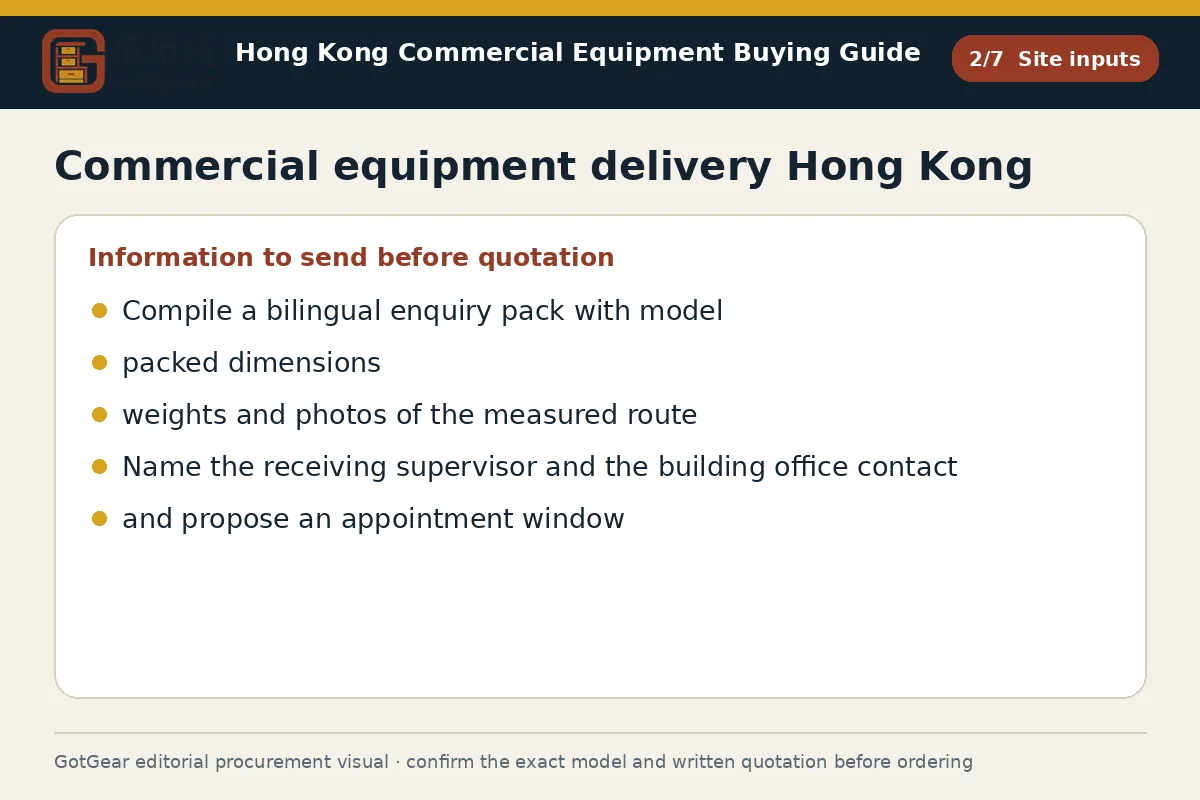
Compile a bilingual enquiry pack with model, options, packed dimensions, weights and photos of the measured route. Name the receiving supervisor and the building office contact, and propose an appointment window. State the delivery basis sought, required paperwork, and any induction or insurance needs. Compare quotations for scope: vehicle type, manpower, stair carry, lift booking, floor protection and waste removal. Confirm exclusions, waiting-time rules and weather contingencies in writing. Before approval, obtain the building manager’s acknowledgement of the booking and your institution’s internal sign-off. On the day, prepare protection, escort the crew, count packages, note exceptions on the proof of delivery, and file a receiving report with serials and photos for your asset register.
- Operating use, quantity and expected frequency
- Dimensions, capacity, material and accessory requirements
- Delivery address, floor, goods lift and loading window
- Required documents, acceptance checks and after-sales arrangements
Key points for commercial equipment delivery Hong Kong
Hong Kong deliveries are shaped by building management rules, small goods-lift cars, podium car-park height limits and fixed loading windows. Many industrial and mixed-use buildings require advance vehicle registration, contractor passes and cargo-lift bookings; some restrict noisy movements or out-of-hours work. Humid weather can affect uncrating and acclimatisation, and severe rain or typhoon signals commonly trigger rescheduling by management offices. Provide bilingual addresses and contacts to avoid gate delays. None of these factors are legal guidance; they are routine operating constraints to confirm in writing with the responsible parties for your site and equipment.
Questions about commercial equipment delivery Hong Kong
Do I need a pre-delivery site survey for heavy or bulky items?
Yes, where dimensions, weight or route complexity are uncertain, request a survey or provide comprehensive photos and measurements. A survey helps the supplier select the vehicle, manpower and handling gear. The need depends on the model, risk profile and building office requirements; agree scope, dates and any costs in writing before confirming delivery.
What should my enquiry specify to avoid re-quotes later?
Include model and options, packed dimensions and weight, route measurements with photos, delivery basis (kerbside or inside placement), appointment preferences, and paperwork needed (bilingual delivery note with serials). State constraints such as loading windows, induction, lift booking and floor protection. The formal written quotation and confirmed building-office arrangements will govern the final scope.
How do I compare two quotations that look similar?
Create a checklist of inclusions: tail-lift, stair carry, number of staff, protective coverings, lift booking, waiting time, waste removal, and photo proof. Check assumptions on access, dates and appointment windows. Ask each supplier to confirm exclusions and contingency rates in writing. The model specification and the supplier’s signed quotation prevail over informal notes.
What if a typhoon signal or black rain is raised on the delivery day?
Agree a weather contingency with the supplier and building office in advance, as many sites suspend loading under severe signals. If conditions trigger rescheduling, document the new appointment, any storage or redelivery arrangements, and responsibilities for standby charges. Follow the building manager’s instructions for safety and obtain written confirmation of the revised plan.
Continue with closely related procurement topics
These pages share equipment, operating or decision-stage signals with this guide.
Commercial equipment delivery access checklist Hong Kong
Use GotGear commercial equipment delivery access checklist Hong Kong to verify routes and dimensions. Check commercial equipment delivery loading bay Hong Kong and commercial equipment delivery lift access Hong Kong limits.
Read the guide
Commercial equipment packaging requirements Hong Kong
The GotGear guide to commercial equipment packaging requirements Hong Kong explains protection, marking and identification. Use the commercial equipment delivery note Hong Kong to record order details and any visible exceptions.
Read the guide
Institutional equipment delivery requirements Hong Kong
GotGear explains institutional equipment delivery requirements Hong Kong, covering operating hours, site access and rules, security and authorised receiver procedures, and inspection and handover steps.
Read the guide
Commercial equipment bulk purchase checklist Hong Kong
Use the commercial equipment bulk purchase checklist Hong Kong to confirm demand, specifications, samples, quantities, site splits, storage, receiving, and approvals for informed purchasing decisions from GotGear.
Read the guideRelated topic indexOpen more English procurement pages2 topics
Browse additional equipment families, applications and procurement questions relevant to a wider buying brief.