
What should the RFQ state? Define the use case, dimensions, capacity, quantity, delivery location, required documents and clarification deadline; ask bidders to identify alternatives, exclusions and recurring-cost assumptions separately before approval.
Commercial equipment quotation checklist Hong Kong — Define scope and response fields
A Hong Kong commercial equipment quotation checklist, which buyers rely on, should define the scope clearly and standardise how bidders respond. Start with the operational use case, performance targets and duty profile (for example, starting points only; to be confirmed in the written brief). Record measured doorway and goods‑lift clearances, turning spaces, floor load limits and the delivery route within the building. State available utilities (electrical supply, water, drainage, compressed air, data), ambient conditions (temperature, humidity, saline air) and any hygiene, noise or fire‑resistance expectations that may apply depending on model and venue.
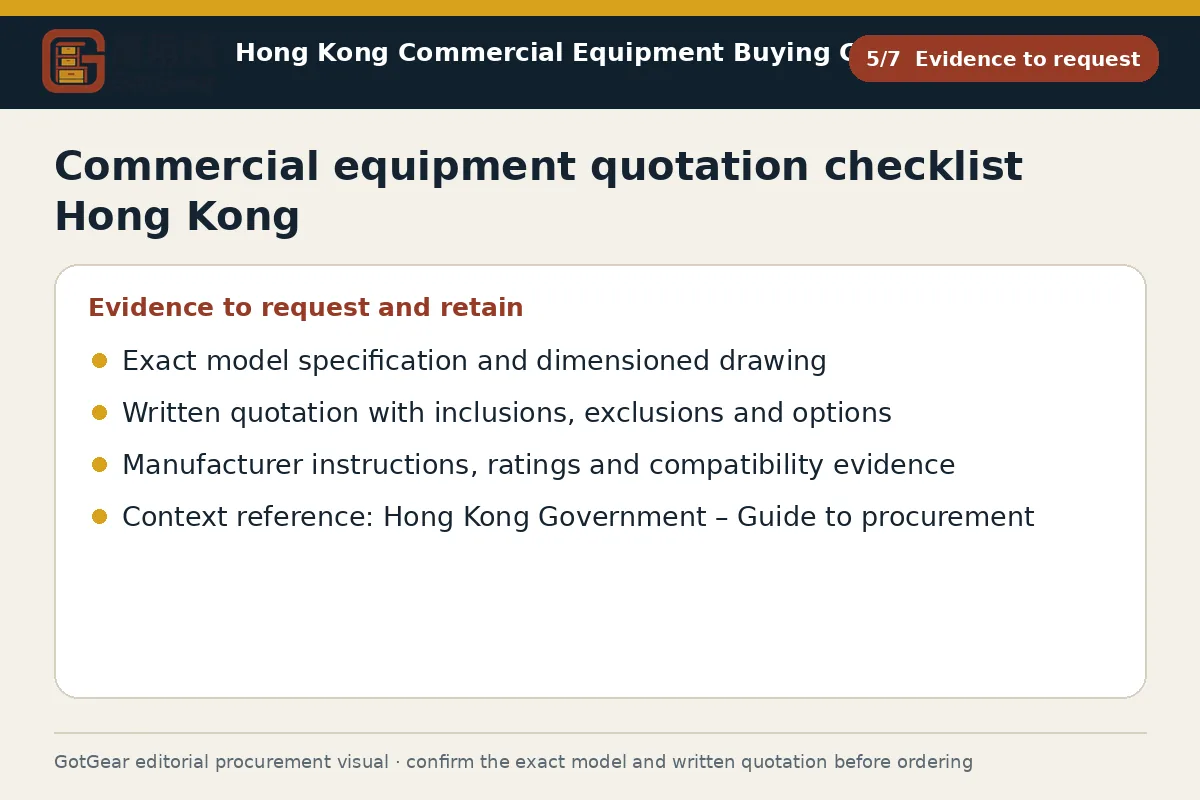
Ask suppliers to complete fixed-response fields: brand and model; country of manufacture; detailed specification; included accessories; unit and any installation charge as separate lines; proposed delivery and installation timeframe as an indicative starting point to be confirmed in the formal quotation; warranty scope; after‑sales service coverage; and training format. Require crate and equipment dimensions and weights, anchoring or clearance needs, and packaging‑removal responsibility. For installations, request a method statement and the interface points for MEP connections. Require bilingual operation and maintenance manuals where your workforce needs them, plus data sheets, energy‑consumption figures, sample maintenance schedules and a statement of any special tools or consumables. Make clear that the model specification and the formal written quotation prevail over brochures or emails.
Commercial equipment quotation checklist Hong Kong: Separate Exclusions, Alternatives and Lifecycle Costs
To keep comparisons fair, instruct bidders to list exclusions, inclusions and priced options in separate, clearly labelled sections. Common exclusions can include electrical isolation, builders’ works, hoisting beyond standard building access, after‑hours labour, IT integration, commissioning beyond basic tests, or site permits; require each to be itemised, not implied. Specify that consumables (filters, lubricants, media), first‑fill items, disposal of old equipment and removal of packaging must be either explicitly included or priced separately. Where training or user certification may be required depending on the model and venue, ask for the format, duration and language to be costed and stated.
Invite alternatives only when they are submitted with a variance table that pinpoints differences in capacity, materials, corrosion resistance, controls, warranty, service network and footprint. State that approval of an alternative depends on written acceptance after evaluation. When evaluating total cost of ownership for commercial equipment Hong Kong, buyers should request recurring costs and assumptions as separate lines: energy profile under your expected duty cycle, consumables usage, preventive‑maintenance tasks and intervals, availability and cost of critical spares, and any software or connectivity subscriptions. This separation prevents “headline cost” bias and supports institutional approval.
What should buyers compare for commercial equipment quotation checklist Hong Kong?
| Criterion | Straightforward requirement | More complex requirement | Evidence to provide |
|---|---|---|---|
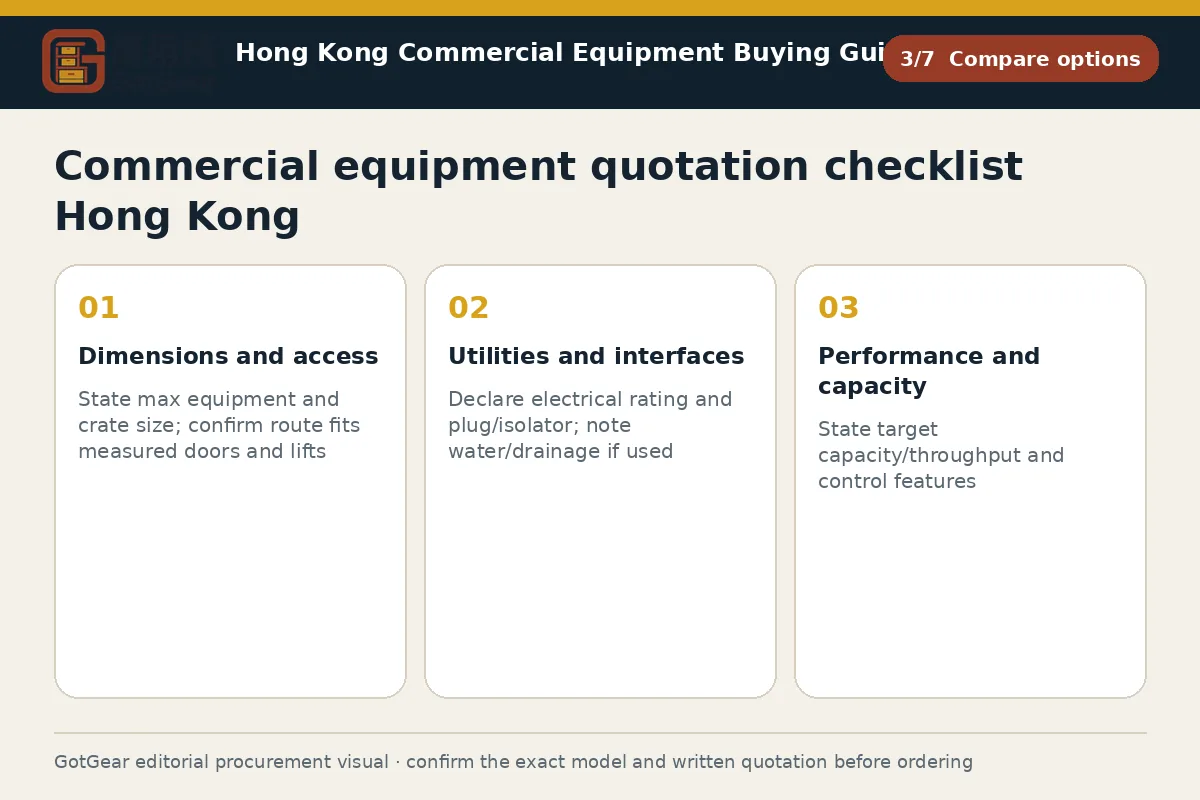
| Dimensions and access | State max equipment and crate size; confirm route fits measured doors and lifts | Provide route survey with turning radii, floor load checks and booking windows | Photos, measured sketch, building‑management confirmation of access |
| Utilities and interfaces | Declare electrical rating and plug/isolator; note water/drainage if used | Provide three‑phase details, ventilation needs, data/air lines and isolator positions | Utility schedule, interface drawing, MEP confirmation in writing |
| Performance and capacity | State target capacity/throughput and control features | Define duty cycle, environmental limits and corrosion‑resistant options | Data sheet with test conditions, use‑case description, options list |
| Delivery and installation | Specify delivery to room‑of‑use and packaging removal | Include placement, fixing/anchoring, T&C plan and building‑office coordination | Method statement, insurance, booking approval, responsibility matrix |
| Lifecycle and service | List warranty length and inclusions; basic service info | Provide PM plan, spares kit, consumables usage and energy at declared load | TCO worksheet, maintenance checklist, consumables and energy |
This framework helps buyers create comparable written enquiries. Final model specifications, availability, delivery and commercial terms must be confirmed in a formal quotation.
Commercial equipment quotation checklist Hong Kong: Set Out Lifecycle Assumptions in the RFQ
Lifecycle assumptions often drive the real cost. Ask each bidder to declare the assumed operating hours, load factors, ambient temperature and humidity ranges, cleaning chemicals tolerated, and expected service life for major components, then normalise these in your comparison. Require evidence for maintainability: time‑to‑service, access panels, lubrication points, calibration frequency where relevant, and tool requirements. Check whether finishes and fasteners are suitable for Hong Kong’s humid, coastal environment and whether corrosion‑resistant options are available as priced lines. Align on spare‑parts availability and target response times as example starting points only, to be confirmed in the quotation.
Procurement teams often ask what a Hong Kong commercial equipment RFQ should include; the answer is a clear scope, quantities, location, site constraints, utilities, documentation requirements and a firm clarification deadline. Add fields for lifecycle items: warranty period and coverage, preventive‑maintenance recommendations, energy and water consumption at declared duty cycle, consumables lists with expected change intervals, and training. For institutions, request bilingual manuals and labelling if required by your users. Indicate whether disposal of replaced units and environmental handling are in scope, and who coordinates with the building management office for delivery bookings and induction.
Commercial equipment quotation checklist Hong Kong — Close clarifications before approval
Close all questions before issuing an approval note. Maintain a clarification log, circulate it to all bidders, and set a final cut‑off date for queries. Before award, hold a short technical alignment call or meeting to confirm model numbers, drawings, installation clearances, MEP interfaces, testing and commissioning steps, and acceptance criteria. Where a site method statement or risk assessment is appropriate, ask for a draft to review; building‑management approvals, delivery bookings and access inductions should be coordinated and confirmed in writing. Agree the training plan, documentation set (including bilingual O&M where required) and who provides as‑built records.
At receipt, inspect packaging integrity before uncrating, then verify model and serial numbers, included accessories, finish quality and data‑plate ratings. Conduct power‑on or function checks that are safe for the site, capturing photos and a deficiency list if needed. Confirm waste removal and make‑good responsibilities. Any deviations or last‑minute substitutions should be documented as a variation and approved before use. Keep in view that the formal written quotation and the manufacturer’s published model specification take precedence over marketing materials, and ensure your asset register is updated on handover.
Commercial equipment quotation checklist Hong Kong decision checklist
Confirm the measured route from street to final position, including lift car dimensions, door swings, turning spaces and floor loading; share dated photos and a simple sketch. Verify utilities, heat and humidity at the point of use, and state any required isolators or drainage. Check each quotation’s specification against your scope, then reconcile exclusions, alternatives and lifecycle assumptions before comparing offers. Ask for energy, consumables and maintenance items as separate lines. Ensure documents are listed: bilingual manuals if needed, data sheets, method statement where relevant, warranty terms and spares list. Align on delivery booking, packaging removal, testing and acceptance criteria. Before approval, close clarifications in writing and note that the formal quotation and model specification prevail. At handover, record serial numbers, accessories and condition, and schedule training.
- Operating use, quantity and expected frequency
- Dimensions, capacity, material and accessory requirements
- Delivery address, floor, goods lift and loading window
- Required documents, acceptance checks and after-sales arrangements
Key points for commercial equipment quotation checklist Hong Kong, what should a Hong Kong commercial equipment RFQ include, total cost of ownership for commercial equipment Hong Kong
Hong Kong buyers operate in high‑rise, tightly managed buildings where goods‑lift capacity, corridor turns and loading‑bay bookings can decide feasibility. Building management offices often require advance delivery slots, induction and proof of contractor insurance; confirm these with the venue before locking in dates. Humid, saline conditions and dense usage patterns demand attention to materials, corrosion resistance and ventilation. Public‑facing venues may set additional controls on noise, signage and crowd safety depending on the event or campus policy. These are practical procurement constraints rather than legal advice; always follow your venue and insurer’s written requirements.
Questions about commercial equipment quotation checklist Hong Kong
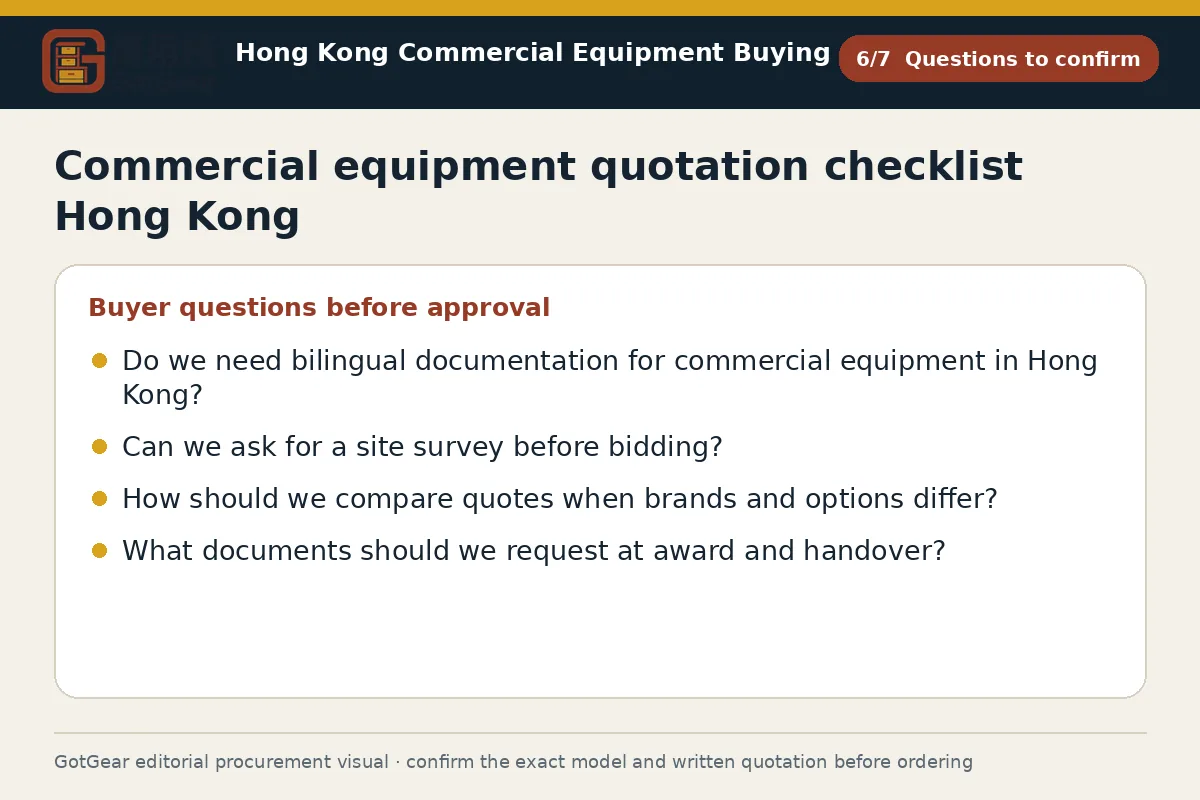
Do we need bilingual documentation for commercial equipment in Hong Kong?
Request bilingual manuals and labels when your users operate in both Cantonese and English, as it speeds training and reduces service calls. If your site team is English‑only, state that clearly. Some institutions prefer bilingual O&M sets for audit consistency; confirm language needs with stakeholders and consider labelling for safety‑critical controls depending on model and venue.
Can we ask for a site survey before bidding?
Yes, where access is tight or interfaces are complex, invite a non‑binding survey or provide measured photos and a route sketch. Some buildings require contractor induction before surveys; coordinate with the management office. If surveys are impractical, instruct bidders to base their bids on your documented constraints and confirm any residual assumptions in their quotations.
How should we compare quotes when brands and options differ?
Normalise scope first: align quantities, accessories and installation responsibilities, then evaluate declared deviations and lifecycle assumptions. Use separate schedules for exclusions, options and alternatives, and compare energy, consumables and maintenance as distinct lines. Where performance or materials differ, assess suitability for your environment and duty profile before considering commercial terms. Document decisions for institutional approval.
What documents should we request at award and handover?
Ask for final drawings, interface points, method statement where applicable, insurance evidence, warranty terms, data sheets, and bilingual O&M manuals if required. At handover, collect serial lists, training records, commissioning results and a spares/consumables list. Where the venue or insurer requires risk assessments or permits, obtain these through the building management office and keep them with the asset file.
Continue with closely related procurement topics
These pages share equipment, operating or decision-stage signals with this guide.
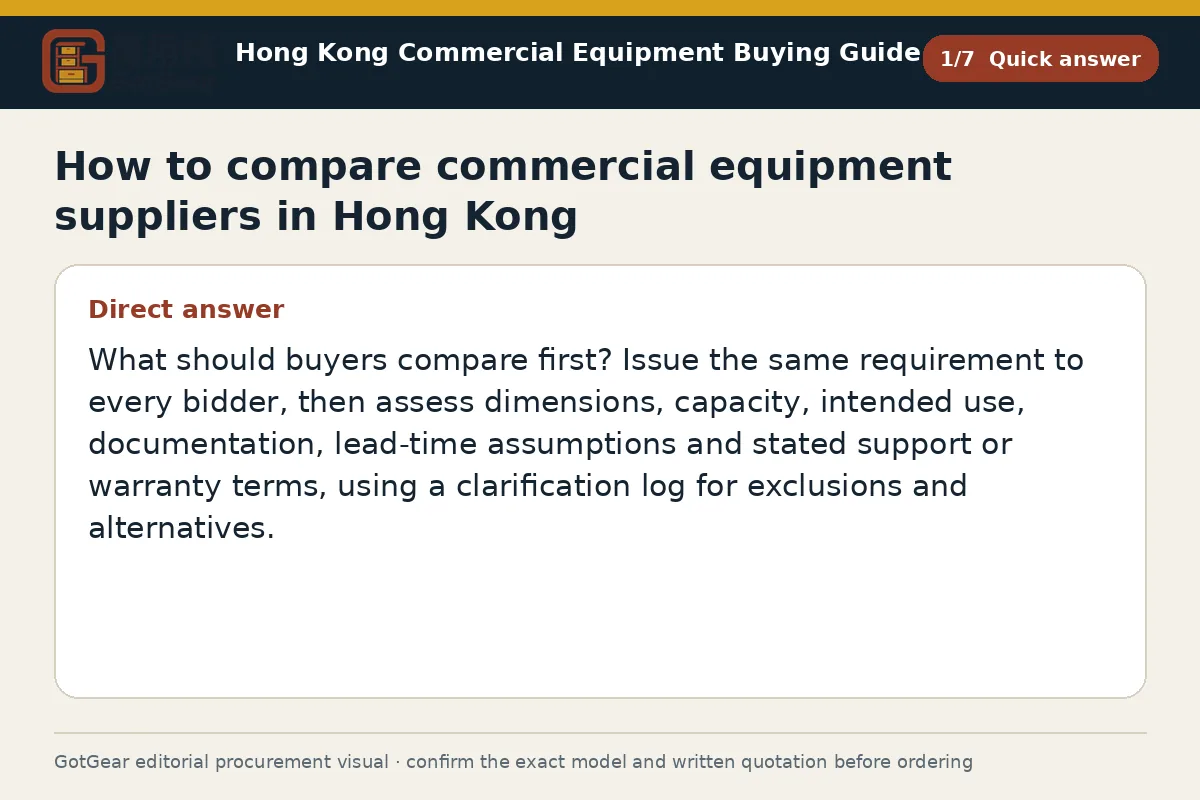
How to compare commercial equipment suppliers in Hong Kong
GotGear shows how to compare commercial equipment suppliers in Hong Kong by checking specifications, intended use and lead time. It explains how to compare commercial equipment quotations in Hong Kong.
Read the guide
Commercial waste separation bin checklist Hong Kong
GotGear's commercial waste separation bin checklist Hong Kong outlines recommended station layouts, sorting streams and bin openings for your site. Confirm recycling bin labels for Hong Kong offices with your collector.
Read the guide
Materials handling equipment checklist Hong Kong
Materials handling equipment checklist Hong Kong from GotGear helps buyers record loads, movement frequency, pick-up and set-down heights, aisle and lift dimensions, routes, storage and maintenance. Use it to compare options.
Read the guide
Retail display fixture procurement checklist Hong Kong
Use this retail display fixture procurement checklist Hong Kong to standardise requests for quotation and include dimensioned layouts, sample products, load requirements, accessories and full specifications from GotGear.
Read the guideRelated topic indexOpen more English procurement pages2 topics
Browse additional equipment families, applications and procurement questions relevant to a wider buying brief.