
Which details should the buyer verify? Record room measurements, storage limits and changeover frequency; request dimensions, rated-use information and samples where appropriate, then assess accessibility, stability and handling against instructions and site conditions.
Community workshop furniture checklist Hong Kong — Define activities and participant groups
Start by mapping the activity formats you actually run: craft and repair benches, STEM tinkering, parent-and-child sessions, quiet classes, or open drop-in builds. Procurement teams and buyers in Hong Kong typically rely on the community workshop furniture checklist, which begins with a headcount broken down by adults, children, wheelchair users and carers, plus the number of facilitators and any demonstration zones. Note whether participants stand for short bursts or sit for long periods, and whether they write, cut, solder or use laptops. Record the need for washable surfaces, tool trays, whiteboards or pinboards, and whether materials must be locked away between sessions.
Translate those needs into furniture attributes. Decide on table formats (rectangular, trapezoid or narrow bench), whether folding or height-adjustable frames are required, and whether chairs should be stacking, linking, with or without arms, or stools for bench work. Specify target seat heights, table working heights, and whether castors should be lockable. State the floor type so suppliers can propose non-marking glides. Ask for seat shell material, upholstery type (if any), frame finish, and the recommended cleaning method. If your space doubles as a classroom, review the training-room furniture used in Hong Kong to keep specification language consistent across programmes. Request manufacturer spec sheets, dimensioned drawings and photos of standard colours to support internal approvals.
Community workshop furniture checklist Hong Kong — Include accessibility and handling questions
Inclusive access and safe handling determine whether furniture helps or hinders your programme. Plan wheelchair positions and companion seats within each layout and request tables with suitable knee clearance; for aisles, set an example starting point (e.g., 900 mm) to be confirmed by your venue or competent adviser. If participants include older adults or those with limited mobility, ask for chairs with arms, stable frames and supportive seat angles; for heavier users, request the maker’s stated maximum recommended user mass. For children, consider rounded edges and durable laminates. If stools are proposed, ask how anti‑tip stability is achieved and what footrest height is provided.
Handling questions should appear in the enquiry pack. Request unit weight, folded thickness, recommended stack height, and compatible trolleys, noting any route thresholds or gradients. Confirm goods‑lift car size, door width and capacity, plus turning space at landings, especially in industrial buildings. In Hong Kong, coordinate delivery slots with the management office and state any loading‑bay windows. Ask for bilingual (Chinese/English) instructions, warnings and care labels. Where folding mechanisms are offered, request rated‑use information and a hands‑on sample to check pinch‑point protection and ease of setup. Cleaning guidance should cover disinfectants your organisation uses, with confirmation from the manufacturer that finishes are compatible.
What should buyers compare for community workshop furniture checklist Hong Kong?
| Criterion | Straightforward requirement | More complex requirement | Evidence to provide |
|---|---|---|---|
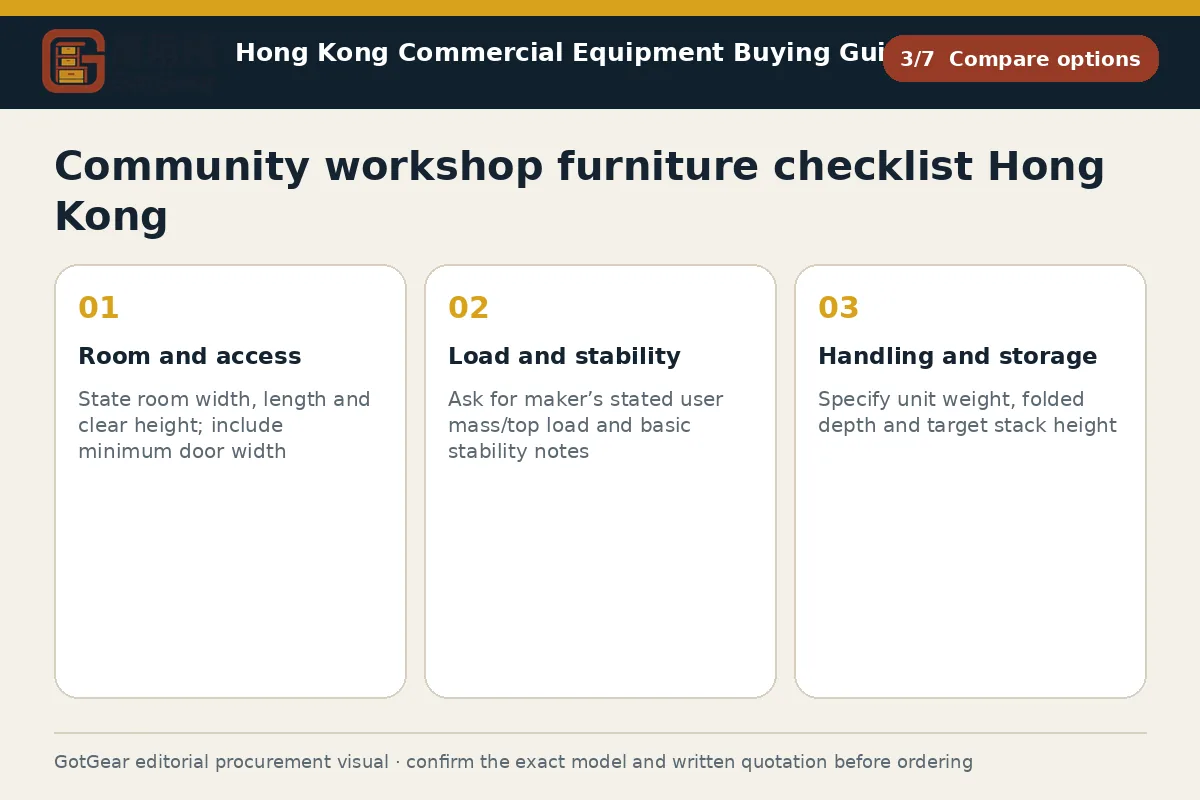
| Room and access | State room width, length and clear height; include minimum door width | Add route details, turning radii, goods‑lift car size and load rating | Scaled plan, labelled photos of pinch points, management‑office booking notes |
| Load and stability | Ask for maker’s stated user mass/top load and basic stability notes | Request static/dynamic stability summaries and stacking‑stability guidance | Manufacturer datasheet, test summary, sample inspection notes |
| Handling and storage | Specify unit weight, folded depth and target stack height | Request compatible trolleys, tie‑downs and any ramp/threshold solutions | Trolley specification, route sketch, example changeover plan |
| Surface and moisture resilience | Select wipe‑clean tops and non‑marking feet for your floor | If humid/coastal, ask for corrosion protection and substrate moisture resistance | Finish description, cleaning guide, maintenance recommendations |
| Documentation and after‑sales | Require bilingual instructions and care information | Provide evidence where venue/insurer requires FR/emissions for relevant items | Manuals, warranty statement, test reports if applicable |
This framework helps buyers create comparable written enquiries. Final model specifications, availability, delivery and commercial terms must be confirmed in a formal quotation.
Community workshop furniture checklist Hong Kong — Capture room, storage and changeovers
Room, storage and changeover factors belong in the first RFQ email. Measure length, width and clear height; plot columns, door swings and any fixed cabinets. Mark socket positions if you plan power at tables. State how often the room transforms between formats and your available labour window for each changeover (as an example starting point only, you might model one or two same‑day resets, to be confirmed with your team). If changeovers are frequent, indicate a preference for folding or nesting frames and specify whether tables must roll through doors when folded. Identify the nearest store, its clear dimensions and how far loaded trolleys must travel.
Storage details should be precise. Ask for folded depth per table, nested footprint, chair stack height and the trolley footprint, so you can prove everything fits. Record goods‑lift car dimensions, weight limits and booking procedures, plus corridor turning radii. In Hong Kong’s humid months, request information on corrosion protection for metal frames and moisture resistance for tops; confirm maintenance intervals recommended by the maker. If layouts include seminar formats, consult folding table layout for Hong Kong training rooms to pressure‑test your counts. For multi‑use venues, compare options against multi purpose room furniture Hong Kong to keep expectations aligned across departments.
Community workshop furniture checklist Hong Kong — Compare samples and bid clarifications
Comparisons are clear only when suppliers quote like‑for‑like. Ask every bidder to state product codes, table top construction (and edging), frame material and section size, chair shell material and thickness, finish type, standard colours, unit dimensions, unit weight, recommended stack height, and accessory part numbers (trolleys, linking clips, grommets). Require confirmation of delivery scope to room, assembly (if any), packaging removal and whether lift booking assistance is included. Evaluate warranty statements alongside rated‑use data for folding mechanisms and chair frames, noting any exclusions. Use the commercial equipment quotation checklist Hong Kong to structure your line‑by‑line review.
For bid clarifications, request photographs of the actual models proposed in a Hong Kong setting and a sample where feasible. Ask for cleaning and maintenance guides, bilingual instructions, and spare‑parts availability. Where your venue, insurer or organiser requires additional assurance (e.g., fire‑retardant upholstery for public events), request current test summaries from the manufacturer. If access is constrained, ask for a delivery method statement that addresses stair carries or narrow corridors. Before award, confirm lead time as an estimate only, subject to factory and building‑management approvals. On receipt, your acceptance criteria should include stability, levelness, finish quality, correct linkage accessories and the safe operation of folds or locks—matched against the model specification and formal written quotation.
Community workshop furniture checklist Hong Kong decision checklist
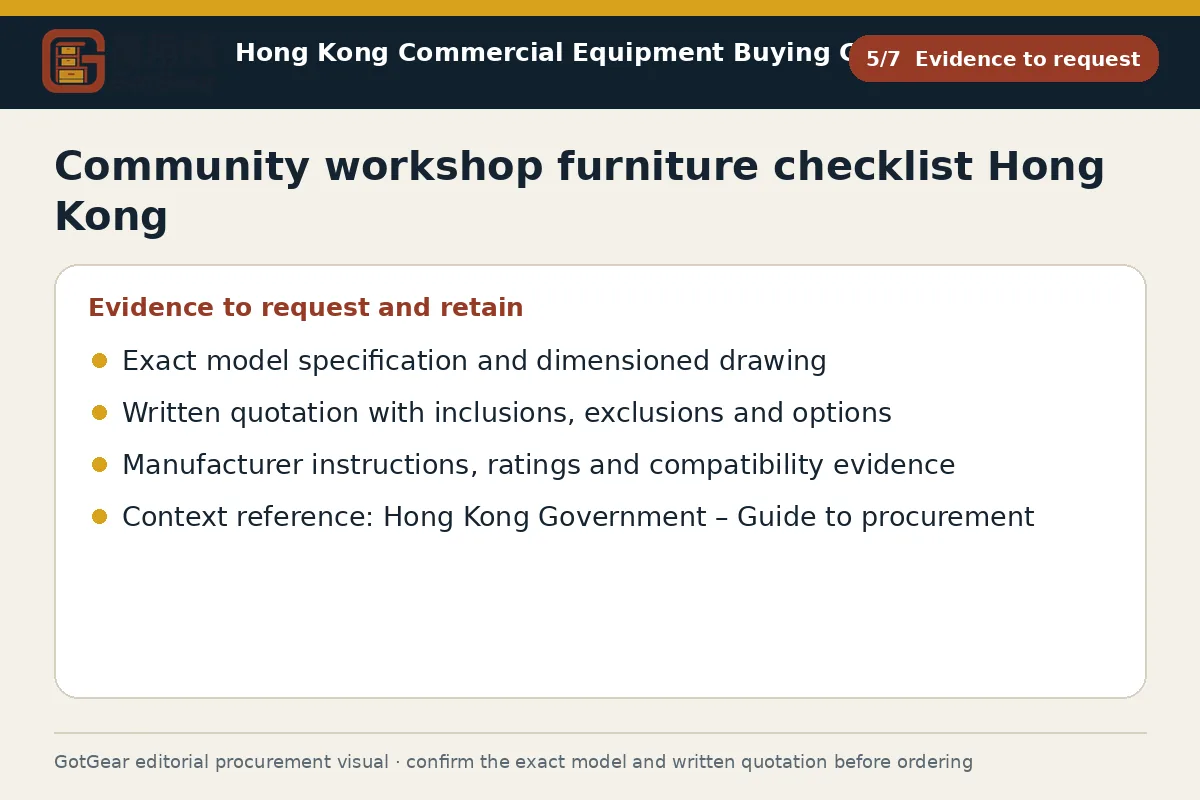
Confirm activities, headcount by participant type and the facilitator’s equipment footprint. Capture room measurements, fixed obstructions, door swings and the access route from loading bay to store. State changeover frequency, available labour time and storage dimensions, including trolley footprints. Define table formats, chair types, height targets and whether folding, nesting or linking is preferred. Request unit dimensions, weights, rated‑use and recommended stack heights, plus compatible trolleys. Ask for cleaning instructions, corrosion and moisture‑resistance notes for humid conditions, and bilingual manuals. Require clear delivery scope to room, assembly and packaging removal, with management‑office coordination. Compare quotations line by line against the model specification. Before approval, trial a sample. On receipt, check counts, finish, stability, levelness, linkage and operation of folds against the formal quotation.
- Operating use, quantity and expected frequency
- Dimensions, capacity, material and accessory requirements
- Delivery address, floor, goods lift and loading window
- Required documents, acceptance checks and after-sales arrangements
Key points for community workshop furniture checklist Hong Kong
Community spaces in Hong Kong often rely on narrow lifts, tight doorways and booked loading bays. Coordinate with the building’s management office for delivery windows, goods‑lift reservations and access cards, and record any no‑stopping restrictions at kerbside. Where public programmes are hosted, some venues impose additional furniture placement or egress rules; always check with the venue operator or insurer. Humidity and salt air can affect unprotected steel and certain wood substrates, so request information on finishes and care routines. Bilingual instructions and safety labels help volunteer teams set up correctly across Cantonese and English crews.
Questions about community workshop furniture checklist Hong Kong
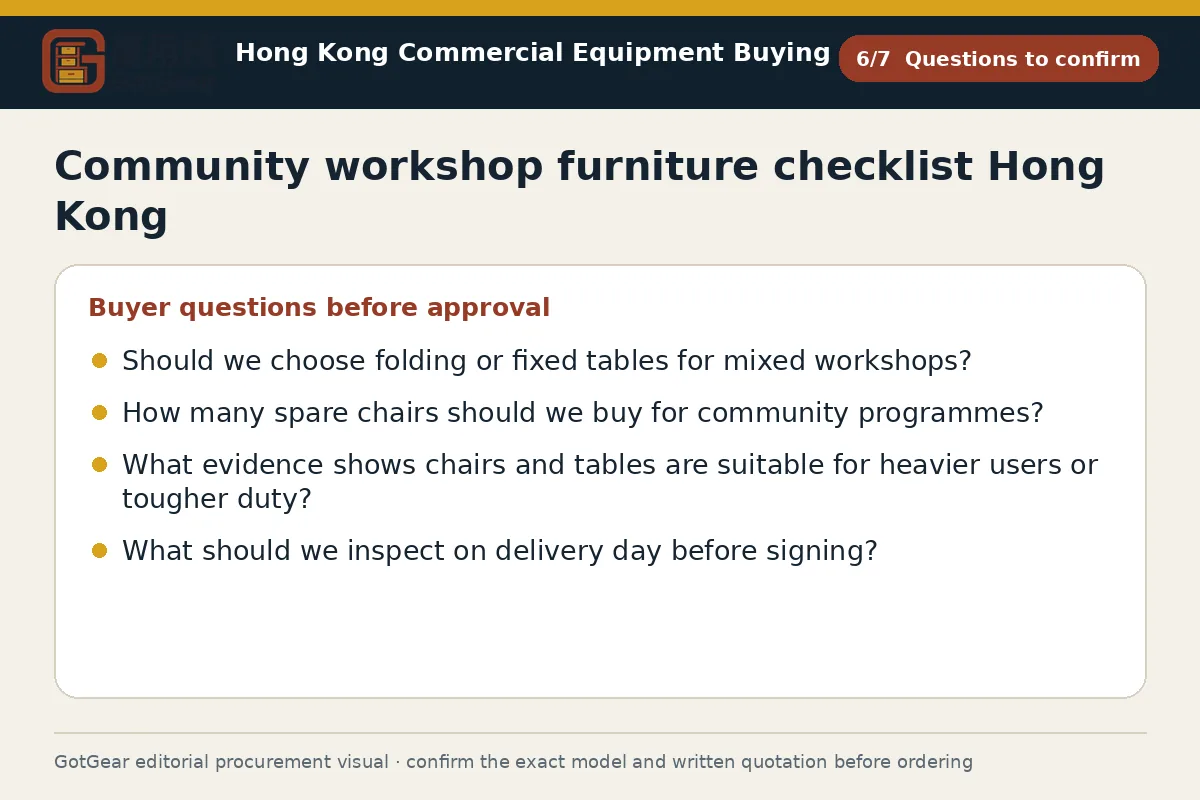
Should we choose folding or fixed tables for mixed workshops?
If you reset layouts frequently, folding or nesting tables usually cut changeover time and storage volume. For mainly single‑purpose rooms, fixed frames can feel sturdier and quieter in use. Request mechanism rated‑use information, folded thickness, compatible trolleys and a sample demo before deciding. Confirm the approach with your team’s changeover window and the building’s access constraints.
How many spare chairs should we buy for community programmes?
Hold a small buffer to cover breakages and late additions. As an example starting point only, some coordinators model a 5–10% surplus, then confirm the figure against storage capacity, trolley space and budget. Ask the supplier to state recommended stack height and unit weight so you can prove the spare sets will fit and can be handled safely.
What evidence shows chairs and tables are suitable for heavier users or tougher duty?
Ask for the manufacturer’s stated maximum recommended user mass for chairs and a top load/use description for tables, plus any stability or cycle‑test summaries. Then trial a sample with your facilitators. If your venue or insurer requires additional assurance, request current test information from the maker. Written specifications and the formal quotation should prevail over verbal claims.
What should we inspect on delivery day before signing?
Count items, match product codes, and check finish quality, glides, caps and edge banding. Confirm chairs sit flat without wobble, tables are level, and folding or linking parts operate safely. Photograph any damage and note packaging condition. Ensure bilingual instructions and care sheets are included. Where agreed, verify assembly, packaging removal and access bookings were completed as quoted.
Continue with closely related procurement topics
These pages share equipment, operating or decision-stage signals with this guide.
Catering equipment procurement checklist Hong Kong
GotGear outlines the catering equipment procurement checklist Hong Kong, showing how to define menu and peak output, plan space and utilities, organise cleaning, and align bidder assumptions with maker guidance and site needs.
Read the guide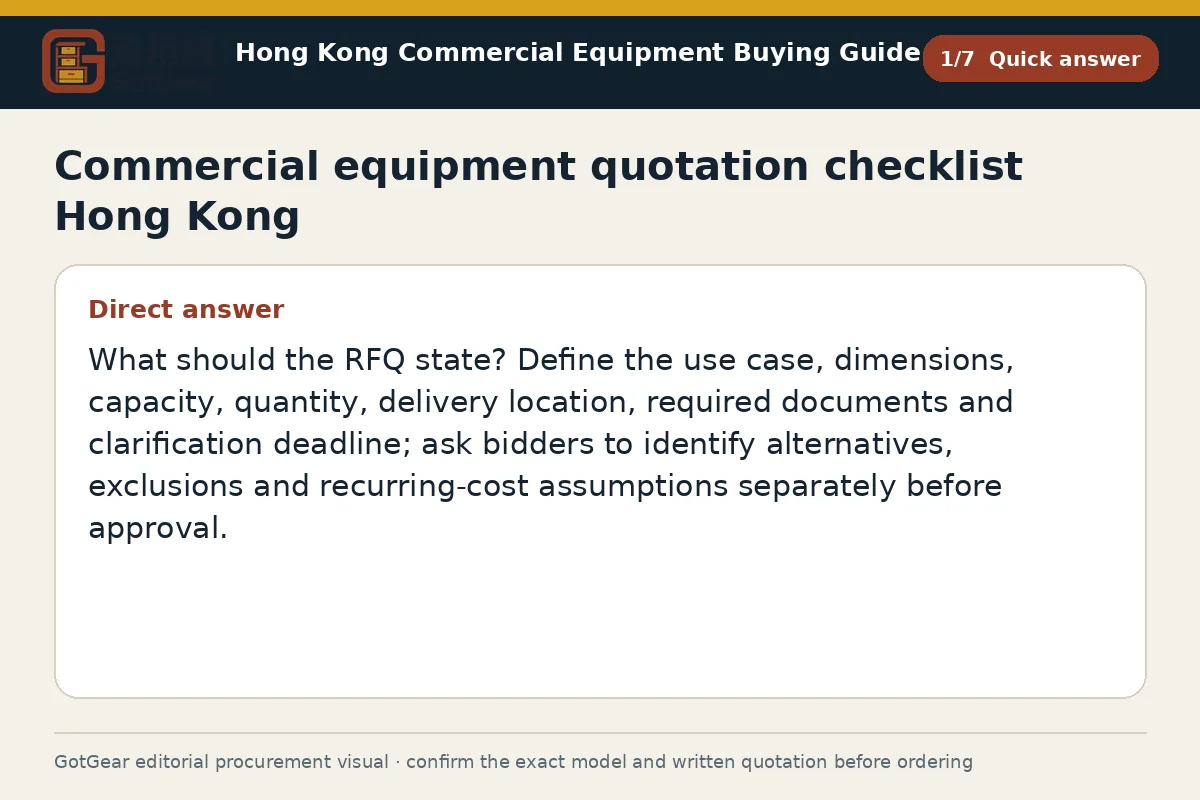
Commercial equipment quotation checklist Hong Kong
GotGear covers what should a Hong Kong commercial equipment RFQ include in a commercial equipment quotation checklist Hong Kong, and outlines scope, exclusions and the total cost of ownership for commercial equipment Hong Kong.
Read the guide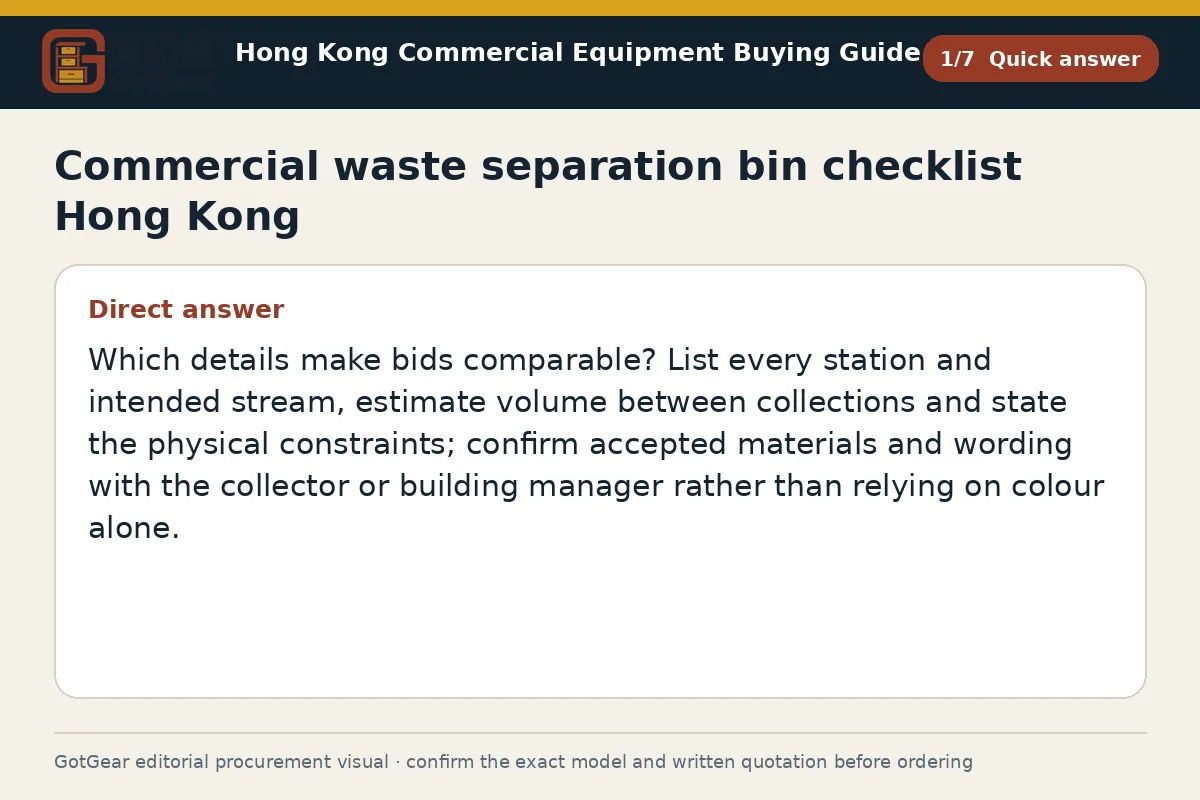
Commercial waste separation bin checklist Hong Kong
GotGear's commercial waste separation bin checklist Hong Kong outlines recommended station layouts, sorting streams and bin openings for your site. Confirm recycling bin labels for Hong Kong offices with your collector.
Read the guide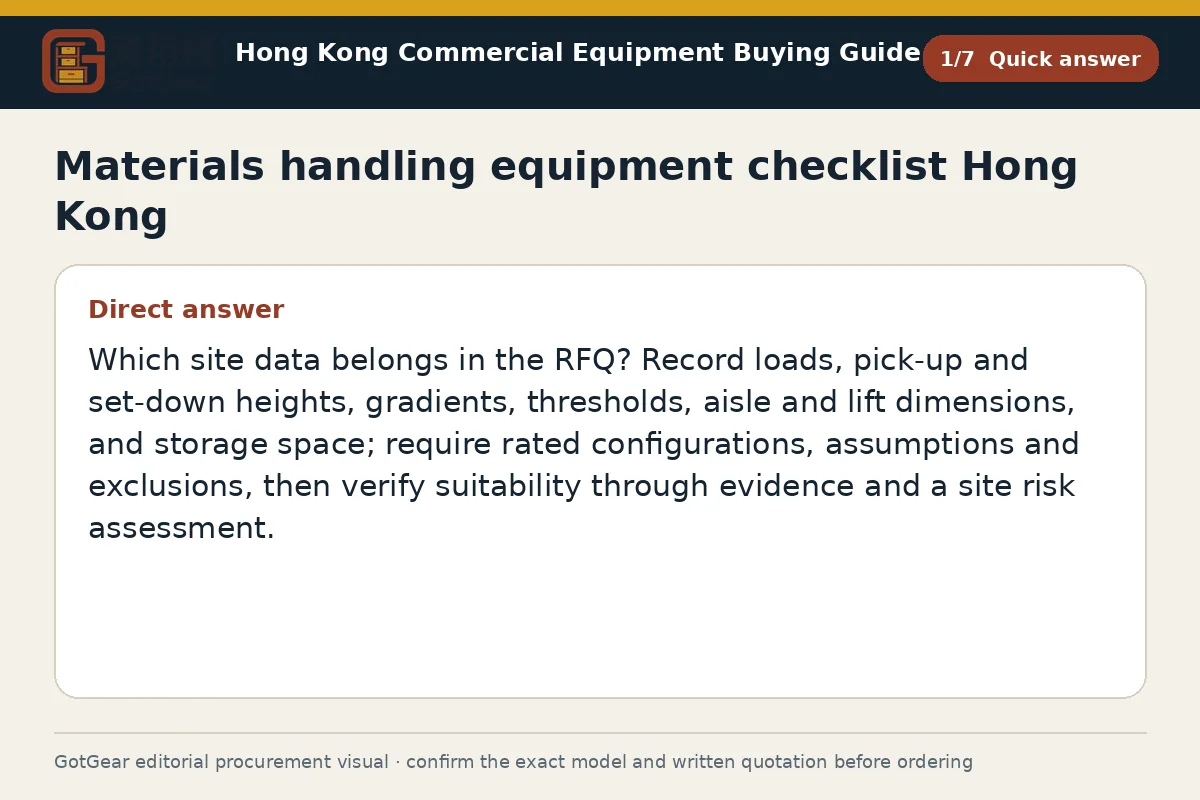
Materials handling equipment checklist Hong Kong
Materials handling equipment checklist Hong Kong from GotGear helps buyers record loads, movement frequency, pick-up and set-down heights, aisle and lift dimensions, routes, storage and maintenance. Use it to compare options.
Read the guideRelated topic indexOpen more English procurement pages2 topics
Browse additional equipment families, applications and procurement questions relevant to a wider buying brief.