
What should buyers compare first? Issue the same requirement to every bidder, then assess dimensions, capacity, intended use, documentation, lead-time assumptions and stated support or warranty terms, using a clarification log for exclusions and alternatives.
How to compare commercial equipment suppliers in Hong Kong — Set one comparable requirement
To make bids comparable, issue a single written specification to every supplier and finalise and lock it before quotations arrive. State the intended use, daily duty profile and any hygiene, noise, or safety expectations. Request the exact model code; dimensions (overall, service clearances and package size); weight; rated capacity; electrical requirements; consumables; and operating environment tolerances. In Hong Kong, note humidity, salt air near the harbour and temperature swings in loading bays that can affect metals, seals or electronics.
Map the delivery route: doorway widths, corridor turns, ramp gradients, and goods-lift car size and weight limit. Include a simple plan showing access from the street or loading bay, lift booking rules set by the management office and any working-hour restrictions. Record floor loading, ceiling height, power outlet types, and proximity of water or drainage, plus Wi‑Fi or data needs for connected equipment. Define what “supply” covers—delivery only, positioning, installation, commissioning, training and crate removal—and name the responsible party for each task. A practical way to decide how to compare commercial equipment suppliers in Hong Kong is to produce this single pack and require bidders to state inclusions, exclusions and any alternatives against it.
How to compare commercial equipment suppliers in Hong Kong — Build a clarification record
Create a clarification log the moment the enquiry is issued and use it as the single source of truth across all bidders. Give every query and response a unique reference, timestamp and version. Capture the supplier’s named contact, proposed model code, datasheet revision, lead-time basis, warranty headline, and any installation or commissioning assumptions. Separate “confirmed inclusions” from “proposed alternatives”, and insist that exclusions are written, specific and cost-neutral for comparison purposes.
Add columns for site references (drawing index, room numbers, access photos), building-management approvals and permits required. Record delivery windows, crate sizes, method statements, and whether disposal of packaging is in scope. Keep bilingual fields for product names and safety notices if your users need Chinese and English. When the requirement changes, issue an addendum and log bidder acknowledgements so everyone bases their submissions on the same baseline. The log should also note any performance tests the supplier proposes at handover. Use this guide to compare specifications and prepare a written enquiry, so the clarification record pairs naturally with a disciplined, evidence-based comparison.
What should buyers compare for how to compare commercial equipment suppliers in Hong Kong?
| Criterion | Straightforward requirement | More complex requirement | Evidence to provide |
|---|---|---|---|
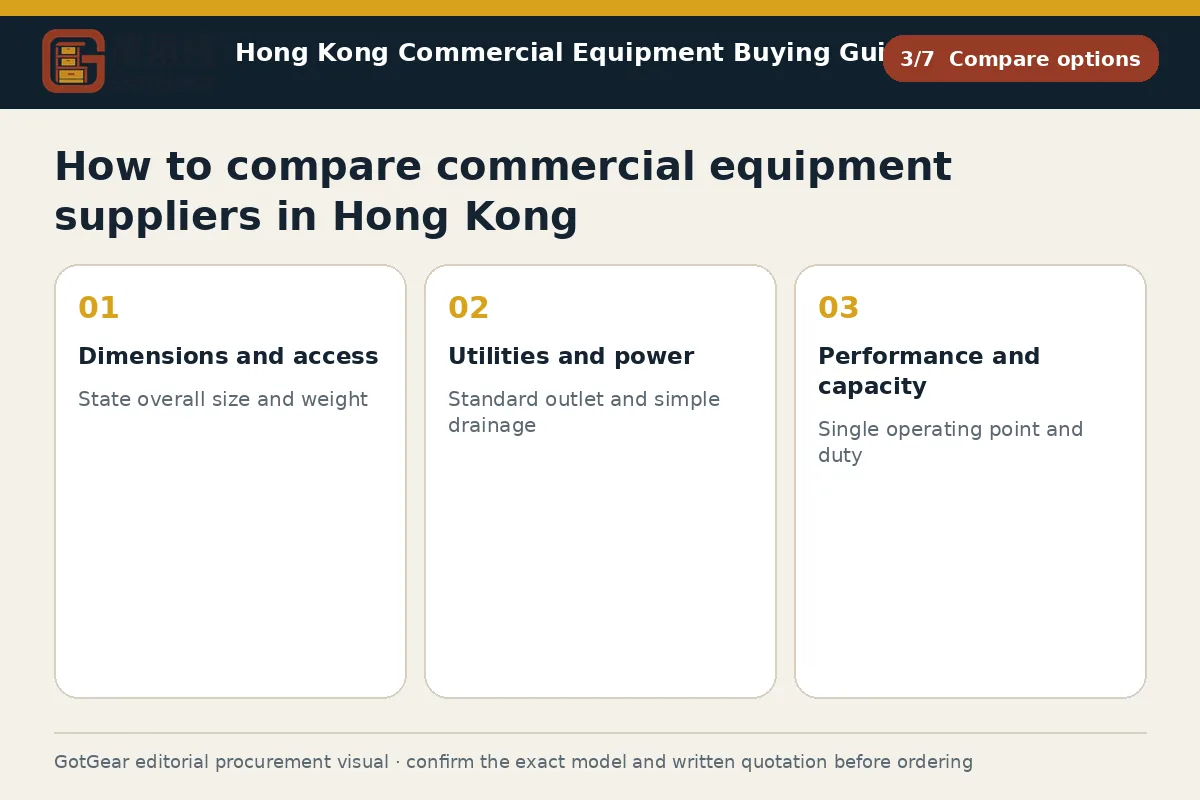
| Dimensions and access | State overall size and weight | Add route plan with turns, gradients and lift constraints | Scaled drawings, annotated photos, building rules and lift booking notes |
| Utilities and power | Standard outlet and simple drainage | Three-phase, water/drain runs, data and ventilation needs | Electrical schedule, utility map, landlord approvals and REW involvement (if any) |
| Performance and capacity | Single operating point and duty | Variable loads, humidity and temperature ranges | Manufacturer datasheet with ratings and any derating guidance |
| Delivery and installation | Kerbside drop-off only | Positioning, fixing, commissioning, training and waste removal | Scope list, time window, permits, insurance and method statement |
| Warranty and support | Written parts-and-labour baseline | On-site response, spares stock, training and PM options | Warranty terms, service plan, parts list and named contacts |
This framework helps buyers create comparable written enquiries. Final model specifications, availability, delivery and commercial terms must be confirmed in a formal quotation.
How to compare commercial equipment suppliers in Hong Kong: Test Supplier Scope, Exclusions and Quotation Assumptions
Clarify the scope, exclusions and assumptions before you create your shortlist. Confirm whether a pre-delivery site visit is permitted, who will provide the lifting gear, and what the contingency is if the goods-lift booking falls through. Ask whether training will be conducted on-site, how many attendees are included, and whether bilingual user guides are provided. When comparing quotations for commercial equipment in Hong Kong, look closely at what each bidder excludes; cable trays, minor electrical terminations, water connectors, drain traps, anchor bolts and IT network setup are common boundary items.
Request documentation proportionate to the model and venue: the manufacturer datasheet, user and maintenance manuals, and, where the installation interfaces with fixed wiring, written confirmation that a Registered Electrical Worker will handle that part. For public venues, your insurer or the venue may expect proof of flame spread or hygiene characteristics for relevant materials. For catering or food-preparation areas, ask for cleaning chemical compatibility and food-contact statements. For structured guidance, refer to the commercial equipment quotation checklist for Hong Kong, the catering equipment procurement checklist for Hong Kong, the materials handling equipment checklist for Hong Kong, and the retail display fixture procurement checklist for Hong Kong. Test claims with simple acceptance criteria — for example, agreed noise levels measured at a defined distance — subject to confirmation in the formal written quotation.
How to compare commercial equipment suppliers in Hong Kong — Document the selection rationale
Record the selection rationale so an approver can retrace the decision. Start with a matrix: compliance with the written requirement, verified inclusions/exclusions, capacity and fit to purpose, delivery and installation approach, and service and warranty terms. Note lifecycle considerations such as consumables, routine maintenance access and training coverage. Flag risks and mitigations, including reliance on building access, typhoon or rainstorm rescheduling, and any single-source spare parts exposure the supplier has disclosed.
Define receipt and acceptance checks. On delivery, verify model code, serial number, quantity, finish, accessories and damage-free packaging; photograph the access route if there is a perceived risk. For installed items, confirm alignment, fixings, power-up, calibration and safety guards before signing any delivery note. Collect bilingual manuals, warranty statements, parts lists, and training attendance records. Where pressure vessels, lifting points or load-bearing components are present, request the manufacturer’s technical data and any test certificates consistent with the proposed equipment. Conclude with a dated summary stating why the chosen offer best meets the requirement on evidence, not assumptions.
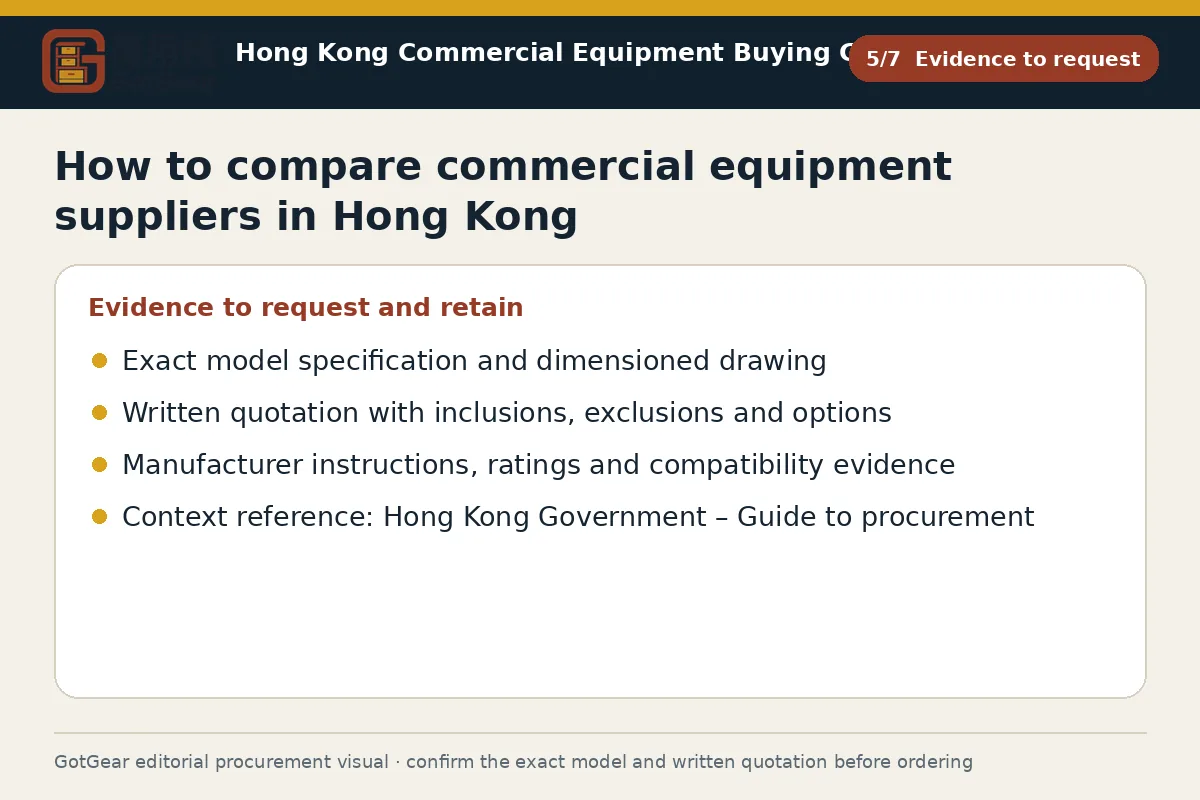
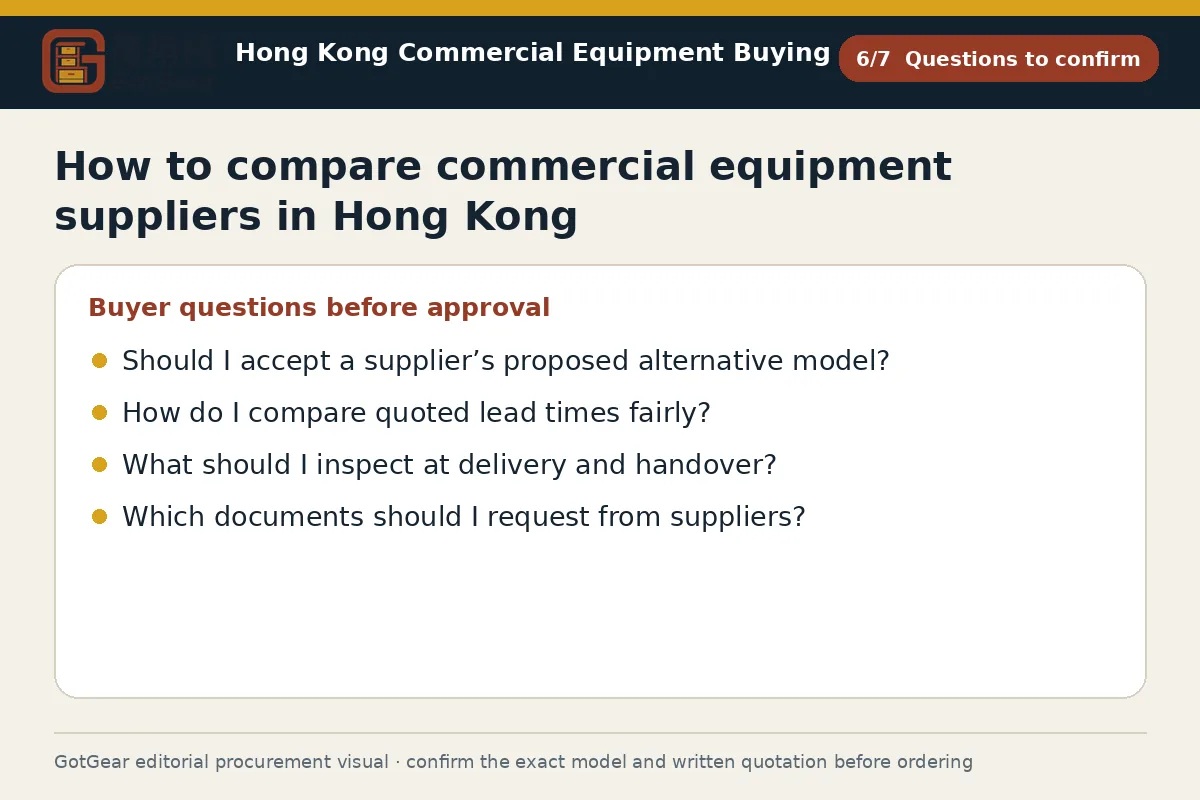
How to compare commercial equipment suppliers in Hong Kong decision checklist
Begin by confirming every bidder has priced the same written requirement and drawing set. Check that dimensions, capacity, power, installation tasks and training are marked as inclusions, with exclusions explained. Validate delivery assumptions against actual building access and loading windows. Compare lead times on the same basis, noting holiday shutdowns or booking limits. Review warranty wording, on-site response scope and spare parts availability. Ensure bilingual manuals and safety information are provided where needed. Set acceptance tests that reflect the stated performance. At award, record the documented rationale and issue an order that restates the final scope, dates, and any permits or management-office approvals required. Plan receipt checks and serial-number capture in advance.
- Operating use, quantity and expected frequency
- Dimensions, capacity, material and accessory requirements
- Delivery address, floor, goods lift and loading window
- Required documents, acceptance checks and after-sales arrangements
Key points for how to compare commercial equipment suppliers in Hong Kong, how to compare commercial equipment quotations in Hong Kong
Hong Kong buyers face real-world constraints that can make or break delivery success. Industrial buildings and mixed-use towers typically require advance goods-lift bookings, capped loading windows and proof of contractor insurance. Access routes can be tight, with narrow doorways, low lobbies and shared lifts limiting package size and weight. Humid conditions and salt air can influence material and coating choices, especially near the waterfront. Many institutions require bilingual operating information and prior management-office coordination. None of these are legal rules here, but they are frequent operating constraints that should be confirmed in writing with your venue and the supplier before issuing a purchase order.
Questions about how to compare commercial equipment suppliers in Hong Kong
Should I accept a supplier’s proposed alternative model?
Yes—if it demonstrably meets your core requirement and the differences are logged. Request the exact model code, datasheet and any change to performance, footprint, utilities or warranty. Test the impact on access, training and spares. Only compare alternatives against the same acceptance criteria, and ensure the change is acknowledged in a formal quotation addendum before award.
How do I compare quoted lead times fairly?
Ask each bidder to state lead time with its basis: stock status, manufacturing queue, shipping method, booking windows and any holiday shutdowns. Note dependencies such as management-office approvals or lift bookings. Capture the “ready to ship” point and the “ready for use” date separately. Compare on the same milestones, then confirm the agreed schedule in the order.
What should I inspect at delivery and handover?
Check model and serial numbers, quantities, finishes, and any transit damage before signing. Verify accessories, fixings, tools and consumables against the quotation. For installations, witness power-up, calibration and safety guards. Collect bilingual manuals, warranty terms, and training records. Photograph the access route if damaged. Record acceptance test results and note any punch-list items with agreed rectification dates.
Which documents should I request from suppliers?
Request the manufacturer’s datasheet, user and maintenance manuals, and warranty statement. Where relevant to the model and venue, ask for installation drawings, method statement, material or hygiene declarations, and any test or commissioning records. If fixed wiring is involved, confirm a Registered Electrical Worker will handle it. Keep documents bilingual where your users or institution require both languages.
Continue with closely related procurement topics
These pages share equipment, operating or decision-stage signals with this guide.
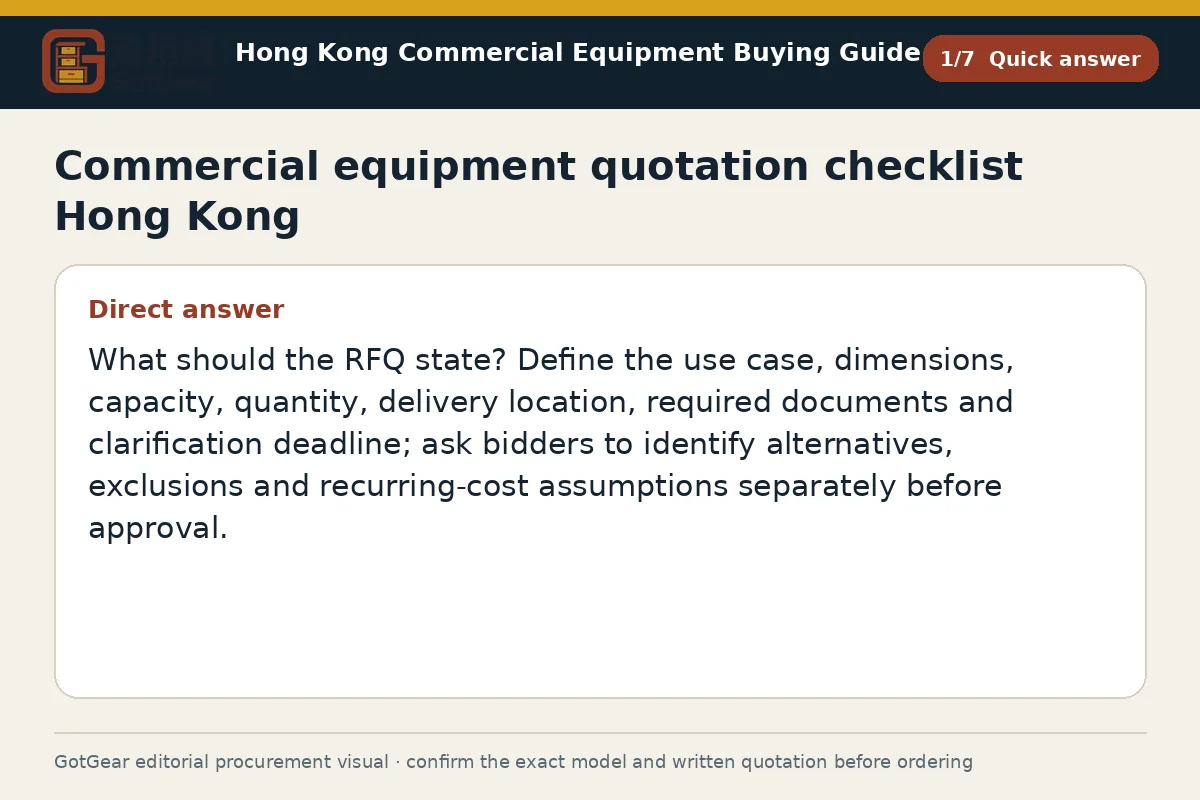
Commercial equipment quotation checklist Hong Kong
GotGear covers what should a Hong Kong commercial equipment RFQ include in a commercial equipment quotation checklist Hong Kong, and outlines scope, exclusions and the total cost of ownership for commercial equipment Hong Kong.
Read the guide
Commercial waste separation bin checklist Hong Kong
GotGear's commercial waste separation bin checklist Hong Kong outlines recommended station layouts, sorting streams and bin openings for your site. Confirm recycling bin labels for Hong Kong offices with your collector.
Read the guide
Catering equipment procurement checklist Hong Kong
GotGear outlines the catering equipment procurement checklist Hong Kong, showing how to define menu and peak output, plan space and utilities, organise cleaning, and align bidder assumptions with maker guidance and site needs.
Read the guide
Materials handling equipment checklist Hong Kong
Materials handling equipment checklist Hong Kong from GotGear helps buyers record loads, movement frequency, pick-up and set-down heights, aisle and lift dimensions, routes, storage and maintenance. Use it to compare options.
Read the guideRelated topic indexOpen more English procurement pages3 topics
Browse additional equipment families, applications and procurement questions relevant to a wider buying brief.