
Which site data belongs in the RFQ? Record loads, pick-up and set-down heights, gradients, thresholds, aisle and lift dimensions, and storage space; require rated configurations, assumptions and exclusions, then verify suitability through evidence and a site risk assessment.
Materials handling equipment checklist Hong Kong — Define the task, load and frequency
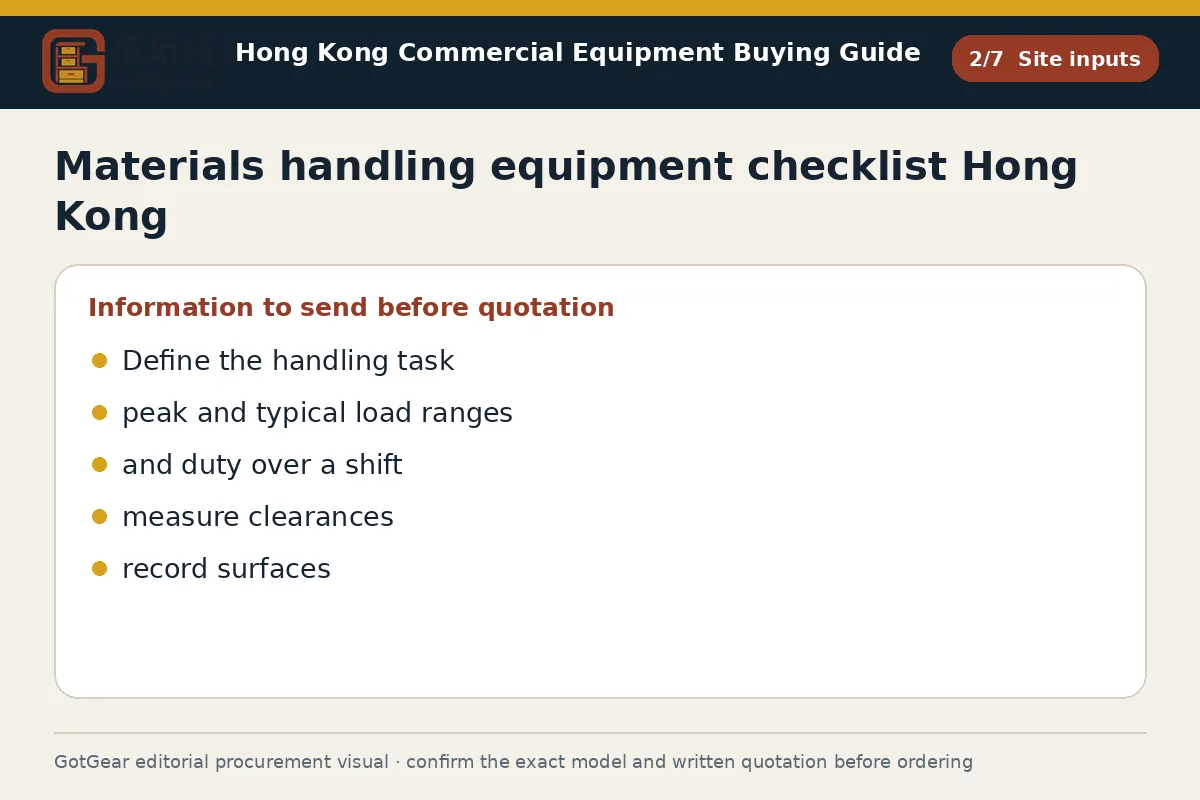
Begin with a precise description of the handling task. State the product form, container or pallet type; the typical and peak load ranges; and who performs the task, how often and for how long. Note any fragile, wet, dusty, sharp-edged, or temperature-sensitive items. If the item’s centre of gravity is offset, record how it is currently stabilised. Photograph the pick-up and set-down positions and annotate the details. For traceability, keep this scope with your enquiry and ensure that model specifications and the formal written quotation prevail.
Match the duty profile to operator capability and the operating environment. Confirm whether handling is manual push–pull, semi-powered, or fully powered, and whether the route is shared with the public or limited to back-of-house. In humid Hong Kong conditions, request corrosion-resistant finishes and sealed bearings where appropriate. If equipment must interface with shelving, conveyors, or vehicles, capture mounting heights and clearances. For a materials handling equipment checklist for Hong Kong, buyers can put this into practice by making the duty and context measurable, then translating that into fields a supplier can rate, such as platform size, wheel type, braking method, and stability at the heights and on the surfaces present on site.
Materials handling equipment checklist Hong Kong — Request rated configurations and evidence
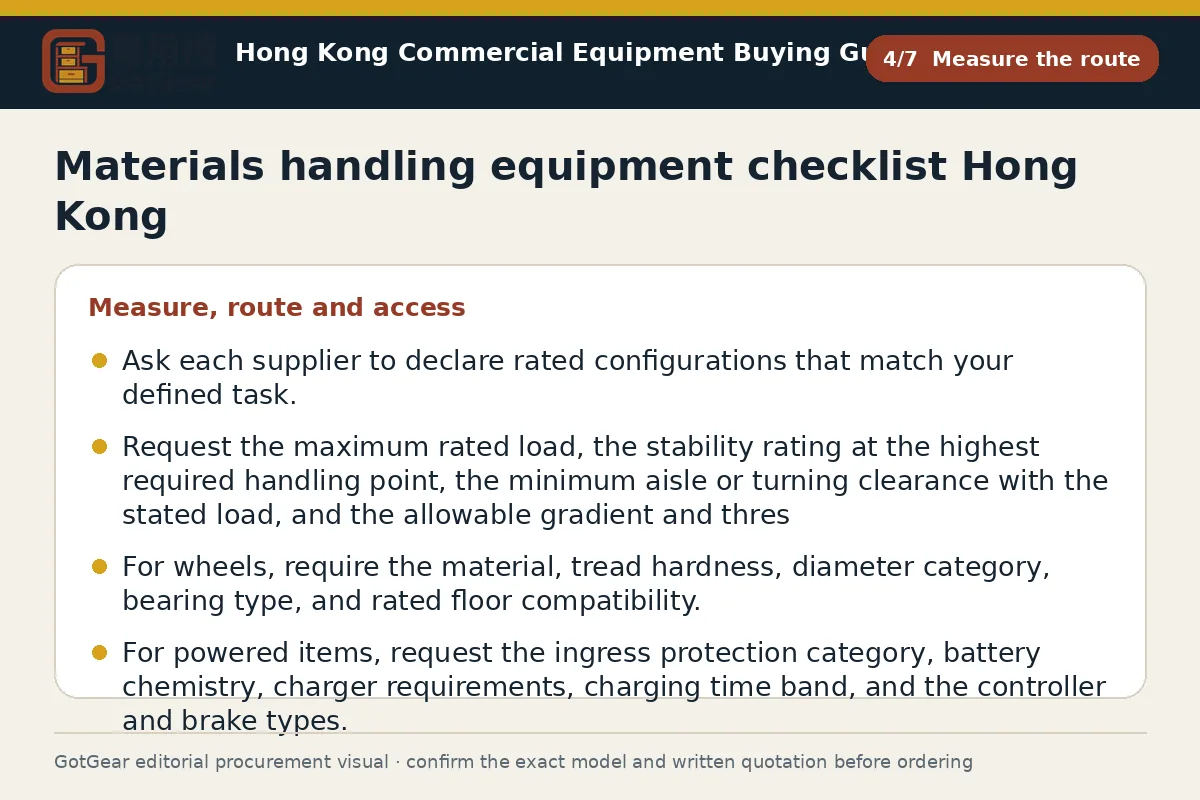
Ask each supplier to declare rated configurations that match your defined task. Request the maximum rated load, the stability rating at the highest required handling point, the minimum aisle or turning clearance with the stated load, and the allowable gradient and threshold type. For wheels, require the material, tread hardness, diameter category, bearing type, and rated floor compatibility. For powered items, request the ingress protection category, battery chemistry, charger requirements, charging time band, and the controller and brake types. Questions such as how to choose trolley wheels for Hong Kong warehouse floors belong in this section.
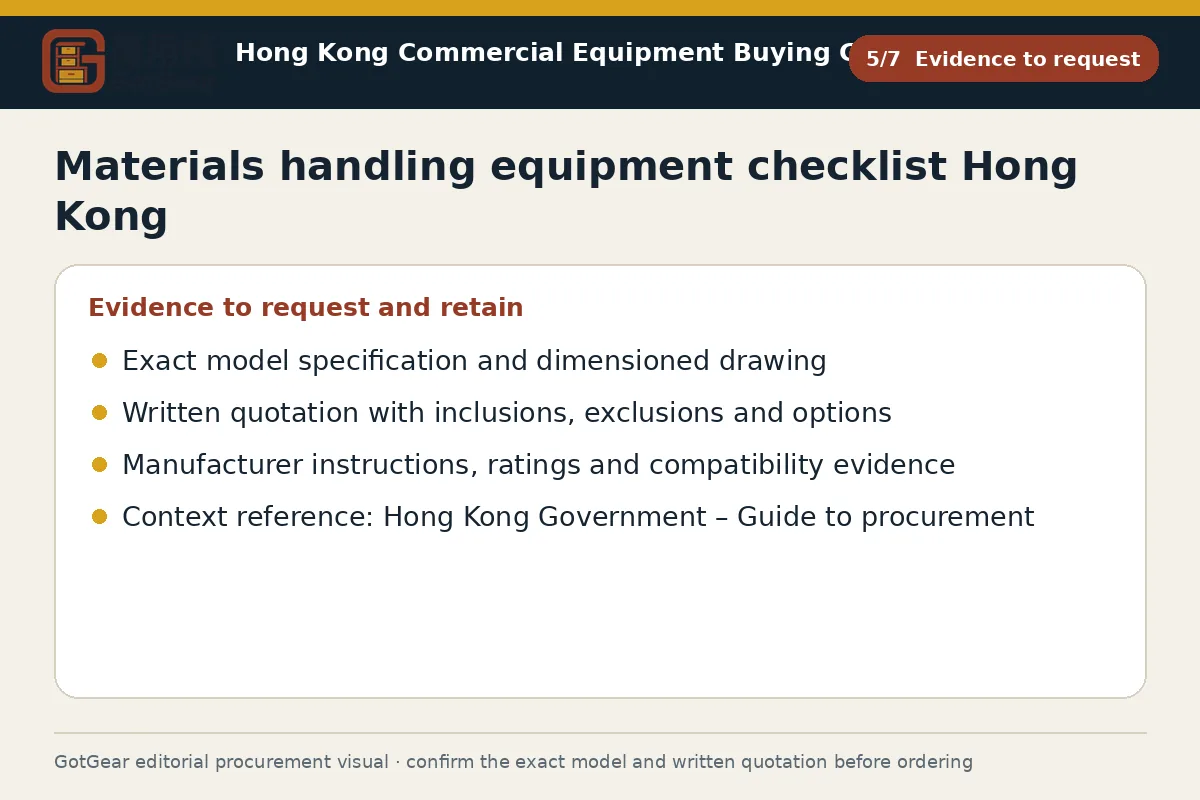
Insist on evidence. Ask for a current datasheet, a dimensioned drawing, the rating basis with assumptions and exclusions, and a signed declaration of conformity from the manufacturer when applicable to the model. Where the quote claims push–pull force advantages, ask for the test method and conditions. If noise, emissions, or washdown are relevant, request the test standard used. For finish and corrosion claims, request coating type and thickness description. Keep all claims tied to the offered part number and require the supplier to confirm any deviations in writing.
What should buyers compare for materials handling equipment checklist Hong Kong?
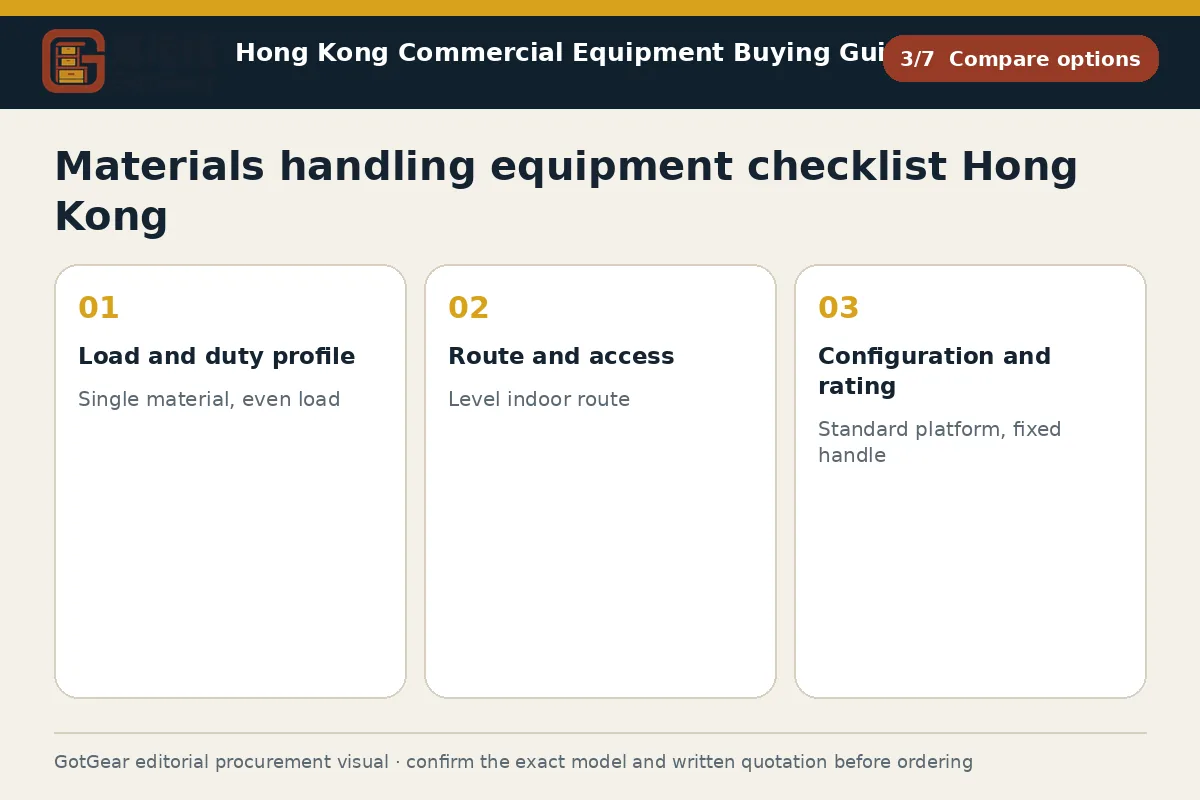
| Criterion | Straightforward requirement | More complex requirement | Evidence to provide |
|---|---|---|---|
| Load and duty profile | Single material, even load | Mixed items, offset centre | Weight range, container, duty cycle |
| Route and access | Level indoor route | Gradients, thresholds, lifts | Measured drawings, photos |
| Configuration and rating | Standard platform, fixed handle | Modular sides, special forks | Rated drawings, test report |
| Environment and hygiene | Dry store, light cleaning | Humid areas, washdown | Materials, coatings, wheel spec |
| Support and paperwork | User guide, warranty | Training, spares plan | Manual, parts list, declarations |
This framework helps buyers create comparable written enquiries. Final model specifications, availability, delivery and commercial terms must be confirmed in a formal quotation.
Materials handling equipment checklist Hong Kong — Capture route and storage constraints
Record the actual route from goods-in to the storage or service point. Measure clear widths and heights of doors and gates, lift car dimensions and door clear openings, threshold profiles, turning areas, and any ramps or kerbs. Capture floor types, joints, gratings, and drainage covers. Photograph pinch points and include a scale reference. Confirm building loading windows, lift booking rules, and whether a management office escort is needed. Where equipment must move through public areas, include security screening steps and crowd-control barriers in the plan.
Define storage and charging constraints. State the footprint available, racking beam positions, ventilation, spill control, and proximity to power outlets for chargers if relevant. Consider humidity, cleaning regimes, and pest-control chemicals that may contact wheels or coatings. Align reach, turning, and approach clearances with the warehouse shelving access aisle planning that Hong Kong teams are already using. If shared lifts or loading bays are small, specify the maximum acceptable packed size for delivery and any requirement for split components and on-site assembly. Attach sketches or marked floor plans to prevent misinterpretation and ensure the written quotation addresses the actual route.
Materials handling equipment checklist Hong Kong — Run trials and close clarifications
Before placing an order, plan a structured demonstration or a sample evaluation with acceptance criteria tied to safety and duty. Run the unit along the intended route with representative loads, check braking performance on slopes, confirm stability at pick-up and set-down, and observe operator technique. Where personnel are pushing or pulling, include a manual handling risk assessment for warehouse trolleys in Hong Kong. Supervisors can file this with site records. Close every clarification in writing, including exclusions and any alternative configuration the supplier proposes.
Compare quotations line by line. Normalise for rated load with the stated gradient and aisle, wheel material and bearings, brake type, platform or fork dimensions, corrosion protection, documentation pack, warranty statement, lead-in for training, and spares availability. Note conditions that trigger extra charges, site access restrictions, and packaging or assembly requirements. Internally, coordinate approvals across operations, safety, facilities, and finance. On receipt, check the identification plate against the offer, verify wheel and brake specifications, inspect welds and fasteners, confirm bilingual manuals and parts lists, record the serial number, and retain the evidence pack. This is how to compare commercial equipment suppliers in Hong Kong with confidence.
Materials handling equipment checklist Hong Kong decision checklist
Define the handling task, material form, container, peak and typical load ranges, and duty over a shift. Map the route, measure clearances, record surfaces, thresholds, and gradients, and confirm loading bay and lift rules. Translate these into specification fields suppliers can rate, including platform or fork size, wheel material and bearings, brakes, stability at height, and any powered features. Request drawings, rated configurations with assumptions, and evidence for claims. Normalise quotations by duty and route constraints, then document exclusions. Arrange a site trial where risk justifies it. Secure internal approvals, book delivery within building rules, and on receipt verify ratings, build quality, wheel and brake details, and bilingual documentation before signing off.
- Operating use, quantity and expected frequency
- Dimensions, capacity, material and accessory requirements
- Delivery address, floor, goods lift and loading window
- Required documents, acceptance checks and after-sales arrangements
Key points for materials handling equipment checklist Hong Kong
Hong Kong sites often combine narrow lift cars, strict loading bay bookings, and shared public routes, so access planning drives selection. Many buildings require management office coordination, delivery notices, and quick turnarounds, which favour equipment that arrives in manageable sections with clear assembly guides. Humidity and sea air can shorten coating life, so buyers commonly request stainless fasteners, sealed bearings, or enhanced finishes where justified. Public-facing moves may need marshals and signage. Always confirm any permits, insurance notifications, or house rules with the venue or building manager for the stated model and route.
Questions about materials handling equipment checklist Hong Kong
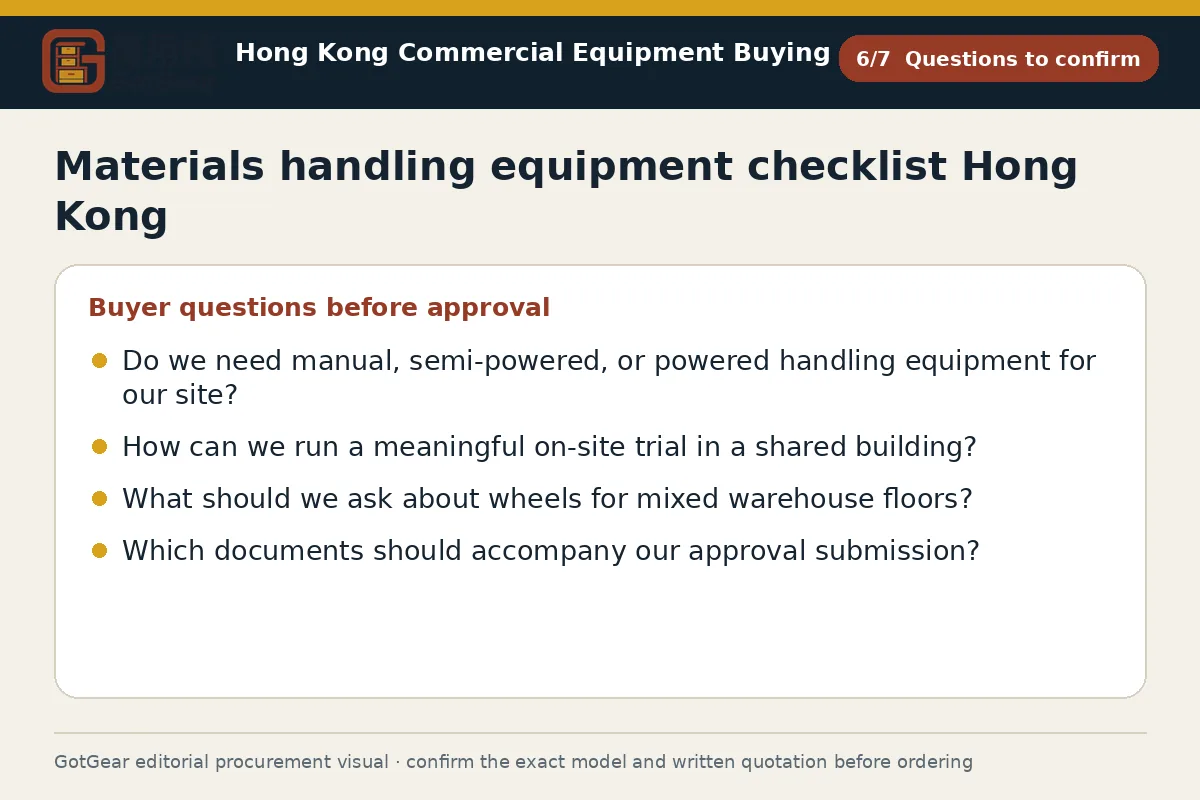
Do we need manual, semi-powered, or powered handling equipment for our site?
Choose the lightest technology that safely meets the duty and route. If loads, gradients, or frequency exceed what trained staff can handle, step up to semi-powered or powered models. Confirm the decision through a site-specific risk assessment, route measurements, and an evaluation of charging, ventilation, and maintenance arrangements for the proposed model.
How can we run a meaningful on-site trial in a shared building?
Schedule within the building’s loading and lift booking rules, notify the management office, and plan a controlled route with marshals if crossing public areas. Use representative loads and include the tightest doorway and steepest section. Record observations, photographs, and any deviations proposed by the supplier, then file them with the quotation and approval notes for traceability.
What should we ask about wheels for mixed warehouse floors?
Request the wheel material, tread hardness category, diameter class, bearing type, and the floor types the supplier rates as suitable. Ask for guidance on debris, grating, thresholds, and wet patches. Where floors vary, consider dual- or soft-tread options with corrosion-resistant bearings, confirmed by the manufacturer for the offered configuration and the measured route.
Which documents should accompany our approval submission?
Include the supplier’s quotation, dimensioned drawing, rated configurations with assumptions, user manual, parts list, and any model-specific declarations the manufacturer provides. Add your route survey, photographs, and risk assessment notes. Some venues or insurers may also ask for maintenance instructions or training outlines, so confirm the exact pack with the approving party.
Continue with closely related procurement topics
These pages share equipment, operating or decision-stage signals with this guide.
Commercial equipment quotation checklist Hong Kong
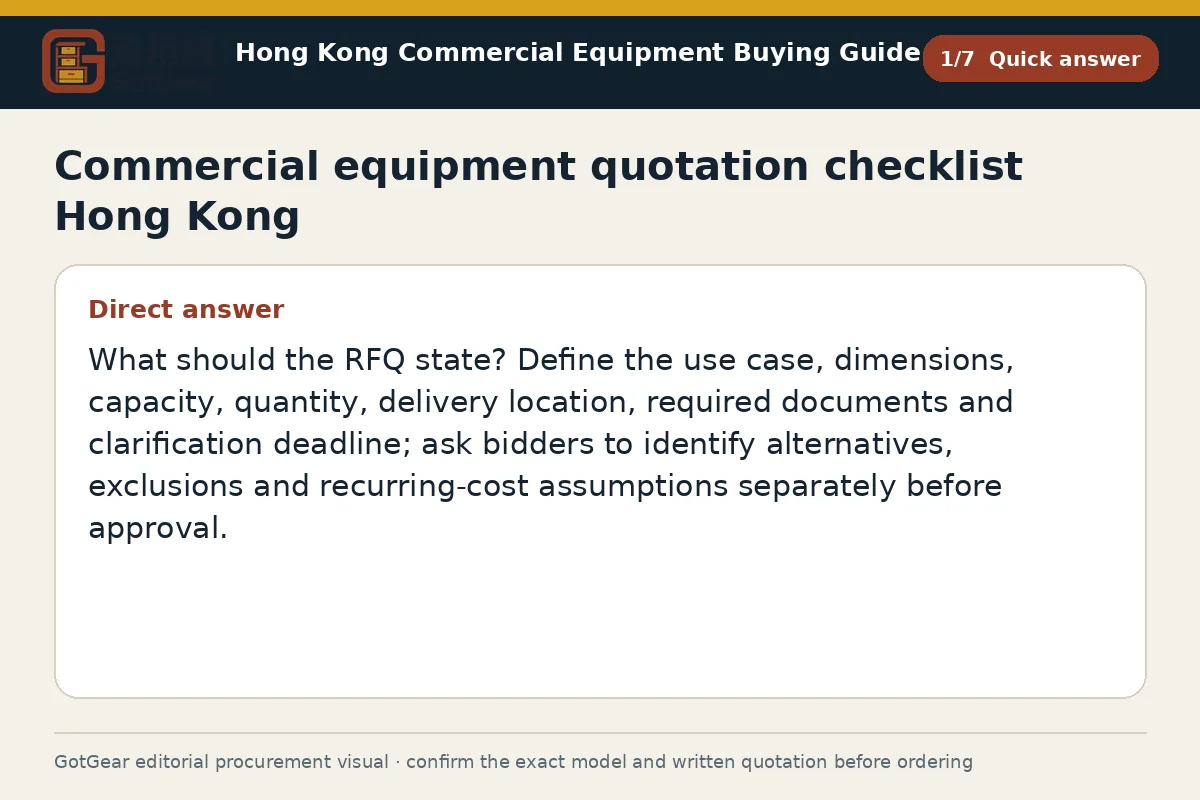
GotGear covers what should a Hong Kong commercial equipment RFQ include in a commercial equipment quotation checklist Hong Kong, and outlines scope, exclusions and the total cost of ownership for commercial equipment Hong Kong.
Read the guide
Retail display fixture procurement checklist Hong Kong
Use this retail display fixture procurement checklist Hong Kong to standardise requests for quotation and include dimensioned layouts, sample products, load requirements, accessories and full specifications from GotGear.
Read the guide
Commercial waste separation bin checklist Hong Kong
GotGear's commercial waste separation bin checklist Hong Kong outlines recommended station layouts, sorting streams and bin openings for your site. Confirm recycling bin labels for Hong Kong offices with your collector.
Read the guide
Catering equipment procurement checklist Hong Kong
GotGear outlines the catering equipment procurement checklist Hong Kong, showing how to define menu and peak output, plan space and utilities, organise cleaning, and align bidder assumptions with maker guidance and site needs.
Read the guideRelated topic indexOpen more English procurement pages2 topics
Browse additional equipment families, applications and procurement questions relevant to a wider buying brief.