
Which details make bids comparable? List every station and intended stream, estimate volume between collections and state the physical constraints; confirm accepted materials and wording with the collector or building manager rather than relying on colour alone.
Commercial waste separation bin checklist Hong Kong — Translate the waste audit into quantities
Turn your waste audit into a bin-by-bin schedule before you approach suppliers. For each location (open office, pantry, print area, lift lobby, reception), list the intended streams and the estimated volume between collections. As an example starting point only, if your audit suggests around 120 litres of mixed paper between collections in a print zone, note two 60L paper modules or one 120L unit; confirm this in the written brief with the building manager or collector. Include peak days if housekeeping or loading windows change. This makes the commercial waste separation bin checklist Hong Kong actionable rather than theoretical.
Record constraints that drive sizing: doorway and goods-lift clear widths and heights, turning space, the maximum depth that does not pinch corridors, and under-counter heights where relevant. Note whether stations must be freestanding, wall-linked or caster-mounted. Specify liner sizes and gauges in millimetres and microns, plus bag-retention type (ring, clamp or internal caddy). For each station, draft a line item with stream, nominal capacity, footprint (W×D×H), body material/finish, label language set, and any accessories (restrictor lids, drip trays, locks). If your organisation spans multiple floors or an industrial building, separate the schedule by floor and access route so bidders understand lifts, permits and timing requirements that affect serviceability and replenishment.
Commercial waste separation bin checklist Hong Kong — Match labels to accepted streams
Labels must reflect what the downstream collector will actually accept, not what the bin body colour implies. Confirm streams and wording with the property manager or collector in writing, including any limits (for example: clean office paper only; PET and aluminium at pantry, no glass; coffee cups lids only). Provide bilingual copy in English and Traditional Chinese, and request a proof for approval before production. For front-of-house, specify iconography style and minimum character height so staff can read at a standing distance.
For durability, ask for the label substrate (vinyl, polyester or rigid plate), adhesive class, and resistance to humidity, UV and common cleaning chemicals; a manufacturer statement is acceptable unless your venue or insurer asks for specific documentation. State whether you prefer panel-mounted placards or applied decals and if you need spares. If you require colour cues, specify the Pantone or RAL references as guidance, but reiterate that acceptance depends on written stream definitions. If you are refreshing recycling bin labels for Hong Kong offices, request a matched set across models so messaging is consistent in print rooms, pantries and lift lobbies, with placement heights that do not clash with wall finishes or furniture.
What should buyers compare for commercial waste separation bin checklist Hong Kong?
| Criterion | Straightforward requirement | More complex requirement | Evidence to provide |
|---|---|---|---|
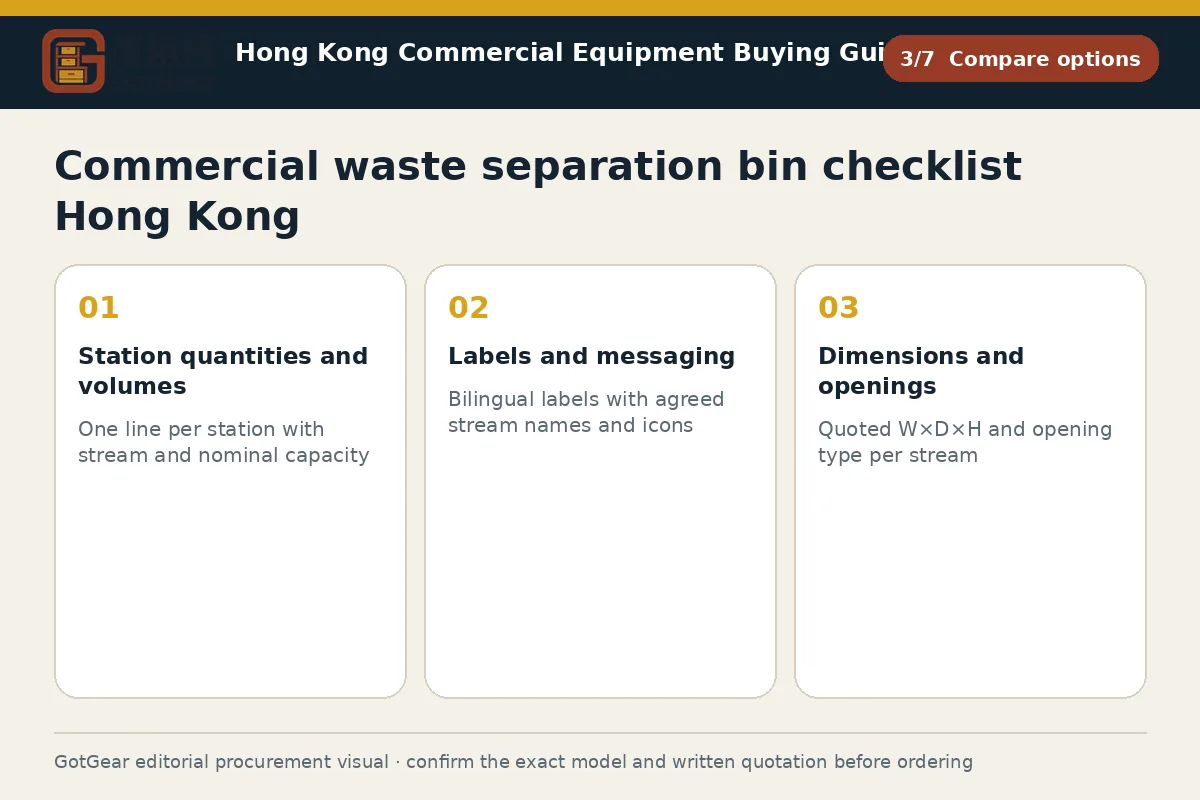
| Station quantities and volumes | One line per station with stream and nominal capacity | Add estimated litres between collections and peak-day notes | Waste-audit extract and a station schedule with volumes |
| Labels and messaging | Bilingual labels with agreed stream names and icons | Specified substrate, adhesive class, spares and colour references | Collector/building email confirming acceptance + label proof |
| Dimensions and openings | Quoted W×D×H and opening type per stream | Clearance to open lids, linkable banks, caster needs | Scaled drawings or spec sheets with measurements |
| Liners and servicing | Stated liner size and bag-retention method | Cleaning access, drip trays, locks, noise control | Liner specs, service assumptions and housekeeping confirmation |
| Delivery and approvals | Floor delivery via booked goods lift and packaging removal | Permits, loading windows, warranty and lead-time stated | Management-office booking notes and written logistics plan |
This framework helps buyers create comparable written enquiries. Final model specifications, availability, delivery and commercial terms must be confirmed in a formal quotation.
Commercial waste separation bin checklist Hong Kong: Specify Openings, Footprints, Servicing and Labels
Openings should guide behaviour and ease housekeeping. In your enquiry, state the opening shape per stream (slot for paper, small circle for cans, flap or hood for mixed recyclables, wide aperture for residuals) and whether restrictors are removable for cleaning. Note if lids need damping to reduce noise in quiet offices. Where odours could build in pantries, ask for internal caddies, drip trays and ventilated housings. If your site or insurer requires fire performance, make that conditional and ask bidders to declare the tested material and provide documentation. For sensitive files, include lockable paper lids and key control details.
Footprint affects safety and compliance. Provide maximum W×D×H for each station, clearance required to open lids without striking walls, and the turning radius available from goods lift to location. State whether stations must be linkable to form a stable bank, and if casters are acceptable. Define bin-liner fit, change-out method, and cleaning access (front door, top lift-off or inner caddy). Include service assumptions—example starting point: daily pantry servicing, alternate-day office floors—then confirm in building management practice. For label mounting, specify the fixed height for header signs and whether anti-tamper fasteners are required in public-facing areas.
Commercial waste separation bin checklist Hong Kong — Verify the bid before award
Before award, line up each bidder’s schedule against your station list. Verify that every location has a stated stream, capacity, footprint, body material/finish, opening type and bilingual label proof reference. Check that liners, bag-retention method and any restrictors, locks or trays are included, not assumed. Where an “equivalent” model is offered, ask for dimensions, photos and a material data sheet so you can assess durability and cleanability against the brief.
Confirm logistics in Hong Kong terms: delivery to floor via booked goods lift, protective packaging removal, disposal method, and any management-office permits or loading window constraints. Request lead-time and warranty statements in writing, noting that the model specification and formal quotation prevail. If your venue or insurer requires fire performance or hygiene documentation, require manufacturer certificates or test reports with the bid. For approval, circulate the final label artwork to your brand or sustainability lead. On receipt, inspect finish, dimensions, stability, lid action, label adhesion and presence of specified accessories. Keep packaging until stations pass acceptance. If anything differs from the quotation, record it and resolve before first use.
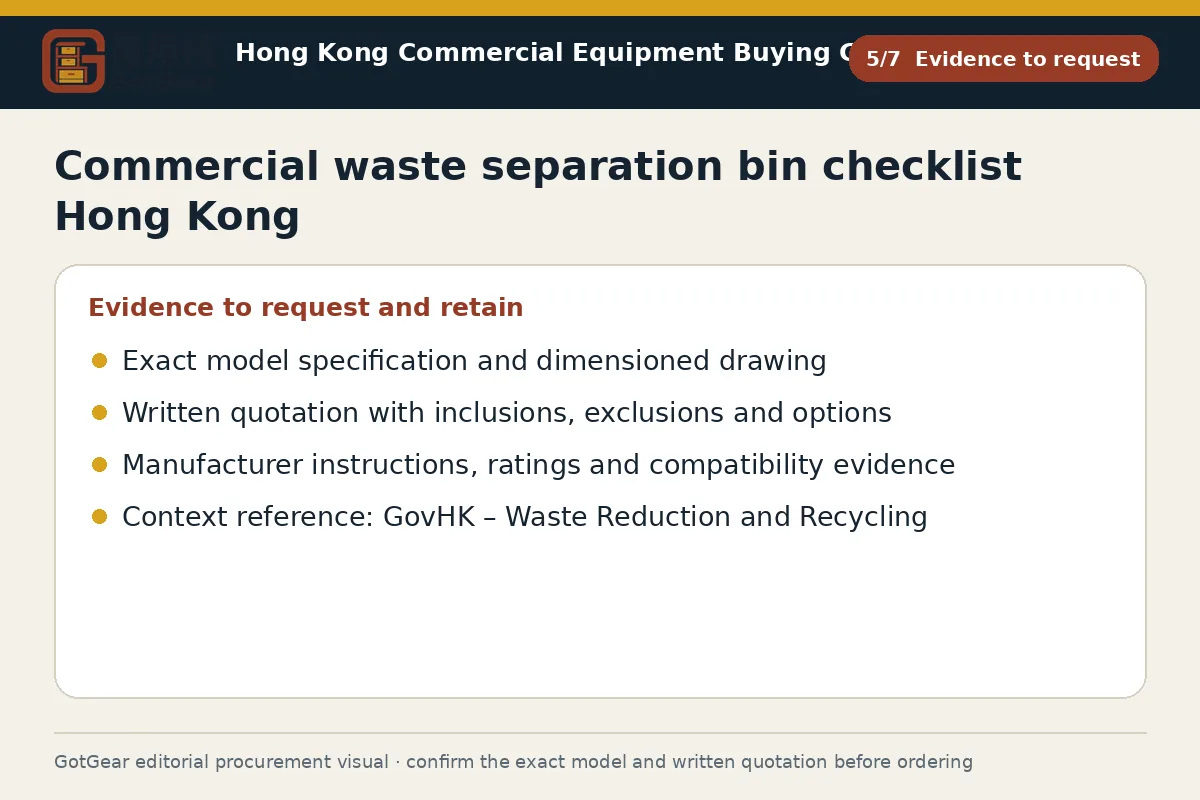
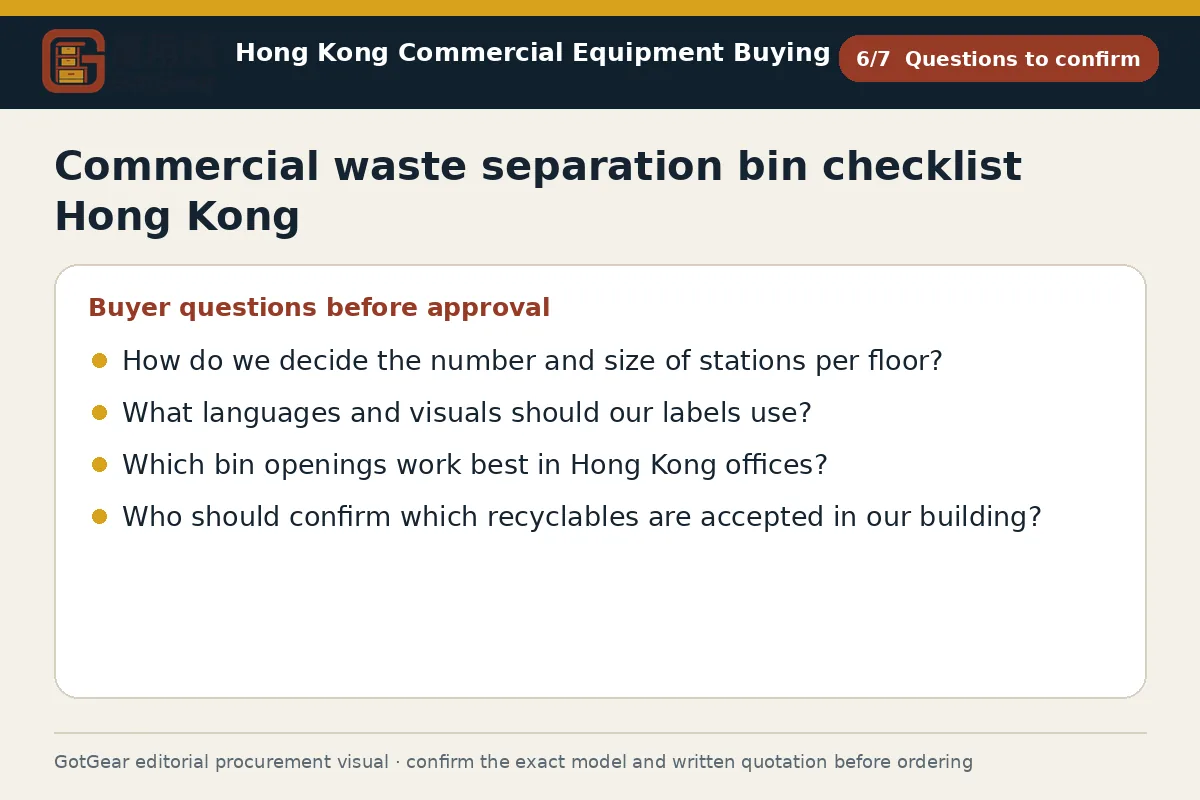
Commercial waste separation bin checklist Hong Kong decision checklist
Draft a station-by-station schedule that lists location, stream, estimated volume between collections, capacity, footprint and opening type. Record site limits: goods-lift size, door widths, turning space, and any wall or floor constraints. Specify liner dimensions and bag-retention. Provide bilingual label copy, colour guidance and placement heights, and request artwork proofs. State service assumptions and any conditional fire or hygiene requirements. Ask for data sheets, finishes, warranty and lead-time in the quotation. Compare bids line-by-line, confirm stream acceptance with the collector, and verify delivery, booking and packaging removal arrangements. Approve label proofs internally before award, then inspect dimensions, finish, stability, opening action and label adhesion on receipt.
- Operating use, quantity and expected frequency
- Dimensions, capacity, material and accessory requirements
- Delivery address, floor, goods lift and loading window
- Required documents, acceptance checks and after-sales arrangements
Key points for commercial waste separation bin checklist Hong Kong, recycling bin labels for Hong Kong offices
Hong Kong building operations often hinge on two constraints: goods-lift access and property-management acceptance of streams and messaging. Tight lifts, narrow corridors and booked loading windows can dictate maximum bin depth and delivery sequencing, so these should be measured and included in the enquiry. Stream definitions vary by collector and property, and bilingual labels are usually expected; confirm both in writing. Humid conditions and frequent cleaning also argue for durable finishes and chemical-resistant labels. Treat these as procurement inputs, not legal advice, and defer to the building manager, supplier and insurer for site-specific requirements.
Questions about commercial waste separation bin checklist Hong Kong
How do we decide the number and size of stations per floor?
Start with your waste audit and estimate litres per stream between collections, then size stations so containers are not routinely overfilled. As an example starting point, you might pair two medium modules instead of one large unit to suit narrow corridors. Confirm with the building manager’s housekeeping schedule and actual lift-booking constraints before fixing quantities.
What languages and visuals should our labels use?
Use clear English and Traditional Chinese with simple icons, and keep wording aligned to your collector’s acceptance rules. In front-of-house, specify character height and contrast for readability at a standing distance. If your brand has colour standards, provide references, but do not rely on colour alone to convey stream acceptance without written definitions.
Which bin openings work best in Hong Kong offices?
Use restrictive shapes that match the stream—paper slots, can/bottle circles, and wide apertures for residuals—to discourage contamination. Include removable restrictors for cleaning and damping where noise matters. Measure clearances so lids do not strike walls or glass. If odour is a concern in pantries, specify inner caddies and drip trays, then confirm servicing frequency with housekeeping.
Who should confirm which recyclables are accepted in our building?
Ask the property manager or appointed collector to confirm accepted materials and wording in writing, then mirror that in your labels and signage. Do not assume colour coding equals acceptance; plastics, for example, may be limited to certain types or only collected at specific areas. Keep the confirmation with your quotation pack for audit and training.
Continue with closely related procurement topics
These pages share equipment, operating or decision-stage signals with this guide.
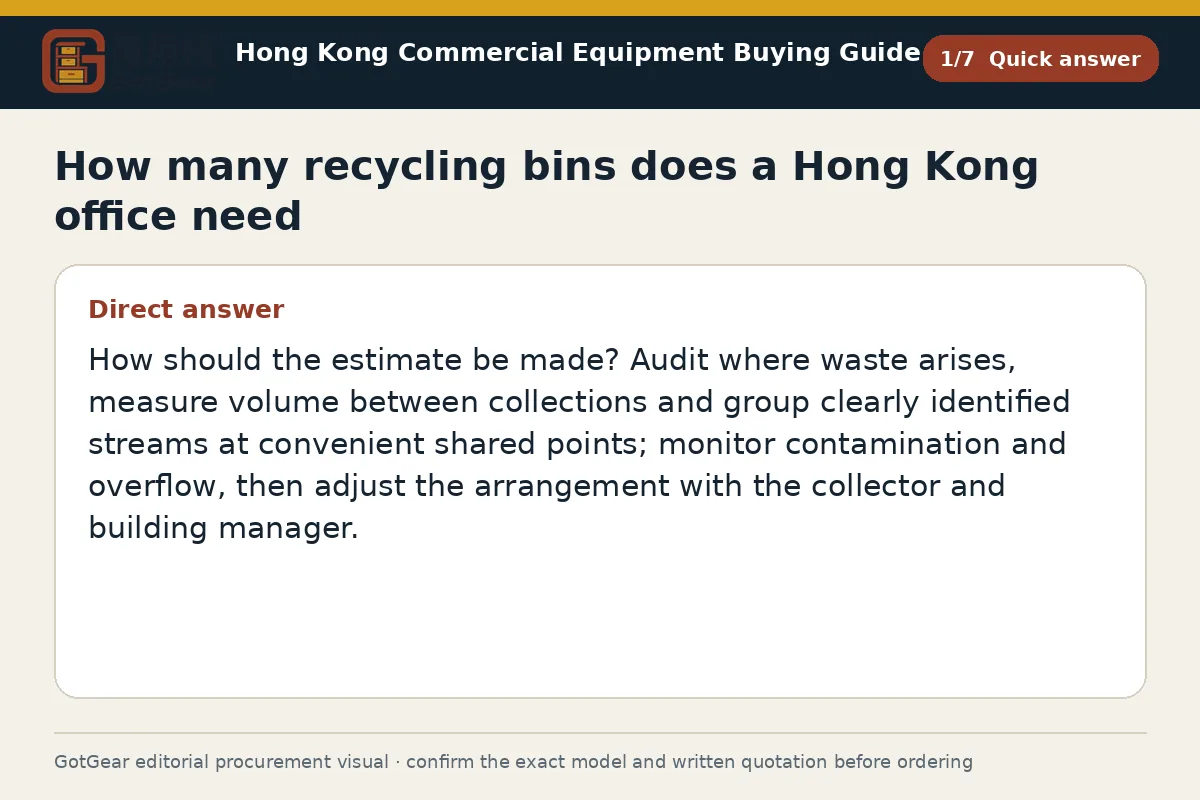
How many recycling bins does a Hong Kong office need
GotGear explains how many recycling bins does a Hong Kong office need, covering collection frequency and zone sizing, plus office recycling station setup Hong Kong and clean recycling bin placement in Hong Kong offices.
Read the guide
Commercial equipment quotation checklist Hong Kong
GotGear covers what should a Hong Kong commercial equipment RFQ include in a commercial equipment quotation checklist Hong Kong, and outlines scope, exclusions and the total cost of ownership for commercial equipment Hong Kong.
Read the guide
Catering equipment procurement checklist Hong Kong
GotGear outlines the catering equipment procurement checklist Hong Kong, showing how to define menu and peak output, plan space and utilities, organise cleaning, and align bidder assumptions with maker guidance and site needs.
Read the guide
Materials handling equipment checklist Hong Kong
Materials handling equipment checklist Hong Kong from GotGear helps buyers record loads, movement frequency, pick-up and set-down heights, aisle and lift dimensions, routes, storage and maintenance. Use it to compare options.
Read the guideRelated topic indexOpen more English procurement pages3 topics
Browse additional equipment families, applications and procurement questions relevant to a wider buying brief.