
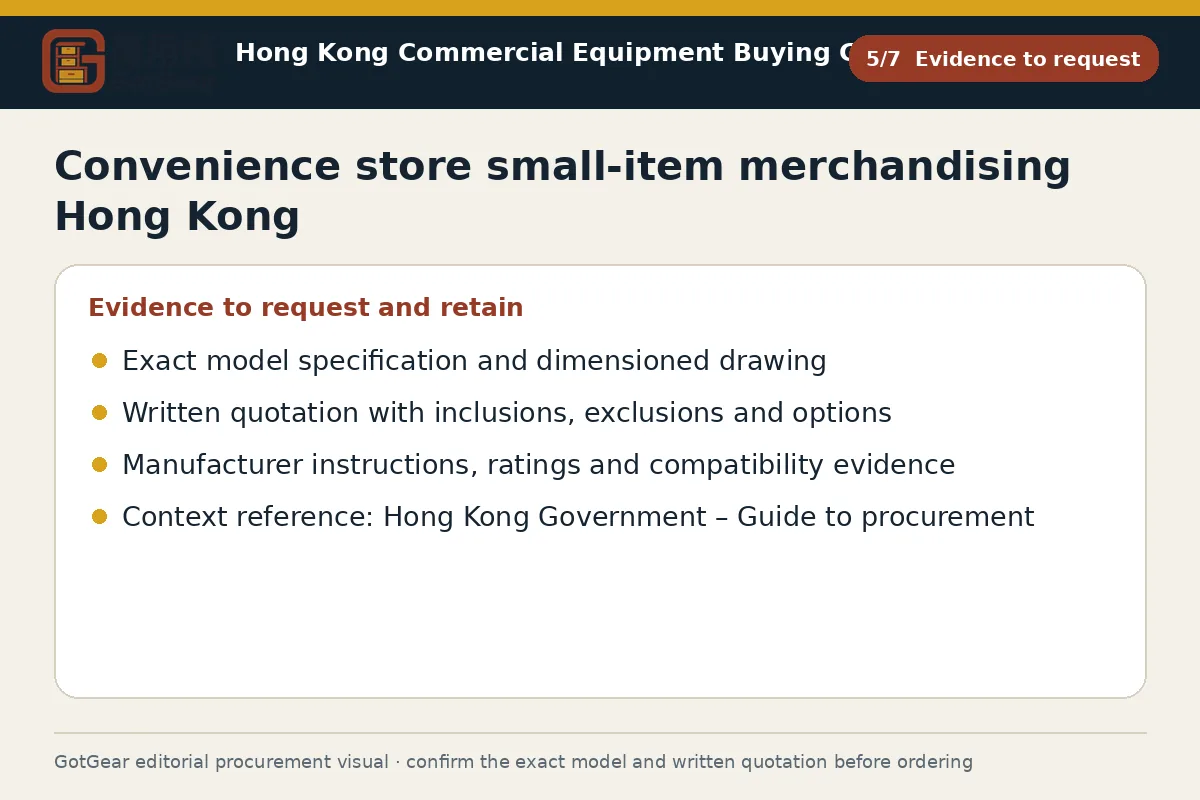
What should the trial measure? Group products by shopping mission and pack size, give priority lines clear facings, preserve replenishment access and observe customer and staff movement before wider use.
Convenience store small-item merchandising Hong Kong — Group the range by mission and pack size
Start by mapping your top shopping missions: quick breakfast and coffee add-ons (mints, cereal bars), hydration accompaniments (electrolyte sachets), on-the-go fixes (batteries, cables), and late-night snacks (gum, candy). Within each mission, tier by pack size: singles at eye level for speed, small multipacks nearby for value, and travel minis grouped tightly to avoid scatter. Keep adjacency practical: phone accessories near the till, breath-fresheners along the coffee queue, and small toiletries beside chilled drinks where hand traffic is high but controlled.
Translate that thinking into measurable modules. Record each SKU’s footprint (width, depth, height) and, for hang-sell, the full hanging length including header and any sag. Note whether the product needs a pusher tray, divider, gravity bin or peg hook. Measure the host fixture’s usable width between uprights, shelf depth, pegboard pitch, hook diameter, lip height and ticket-rail profile. In written quotations, compare material and finish (e.g., powder coat or zinc), shelf and hook load ratings, count of pushers/dividers supplied, ticket-rail compatibility, and any anti-corrosion treatment. On receipt, inspect welds and edges for burrs, finish consistency, ticket-rail clarity, and the labelling/bill of materials. Any example figures used during scoping (such as a target pusher width or hook length) are a starting point only and must be confirmed in the supplier’s specification and formal quotation, which prevail.
Convenience store small-item merchandising Hong Kong — Plan replenishment and loss controls
Replenishment speed and predictability decide whether a dense fixture pays off. Choose modules your staff can refill without dismantling: push-feed trays for flat pouches, gravity bins for pods and sachets, short pegs for fast-turn hang-sell, and shallow trays for loose minis. Observe restocking routes from stockroom to till, noting pinch-points and whether front-fill or rear-fill is practical. As a starting point, test finger clearance above product for a clean pinch-grip and record any minimum aisle width you need for a restock trolley; confirm both with your team before committing.
Blend loss controls into the plan rather than adding them later. Sightlines from the cashier should remain clear; place higher-shrink SKUs closer to staff or in lockable acrylic bins with tamper-evident lids. Where applicable, specify EAS-compatible hooks or stop-locks, and tethers for premium accessories. In enquiries, ask for fixing methods (bolt-through, clamp, adhesive), compatibility with your existing uprights, recommended maximum loads, and any EAS integration notes. Request bilingual assembly instructions and an exploded diagram to speed training. If your site, insurer or landlord requires it, ask for material data sheets for plastics and statements on fire performance from the manufacturer. All controls should reflect your store policy and building rules, not a generic template.
What should buyers compare for convenience store small-item merchandising Hong Kong?
| Criterion | Straightforward requirement | More complex requirement | Evidence to provide |
|---|---|---|---|
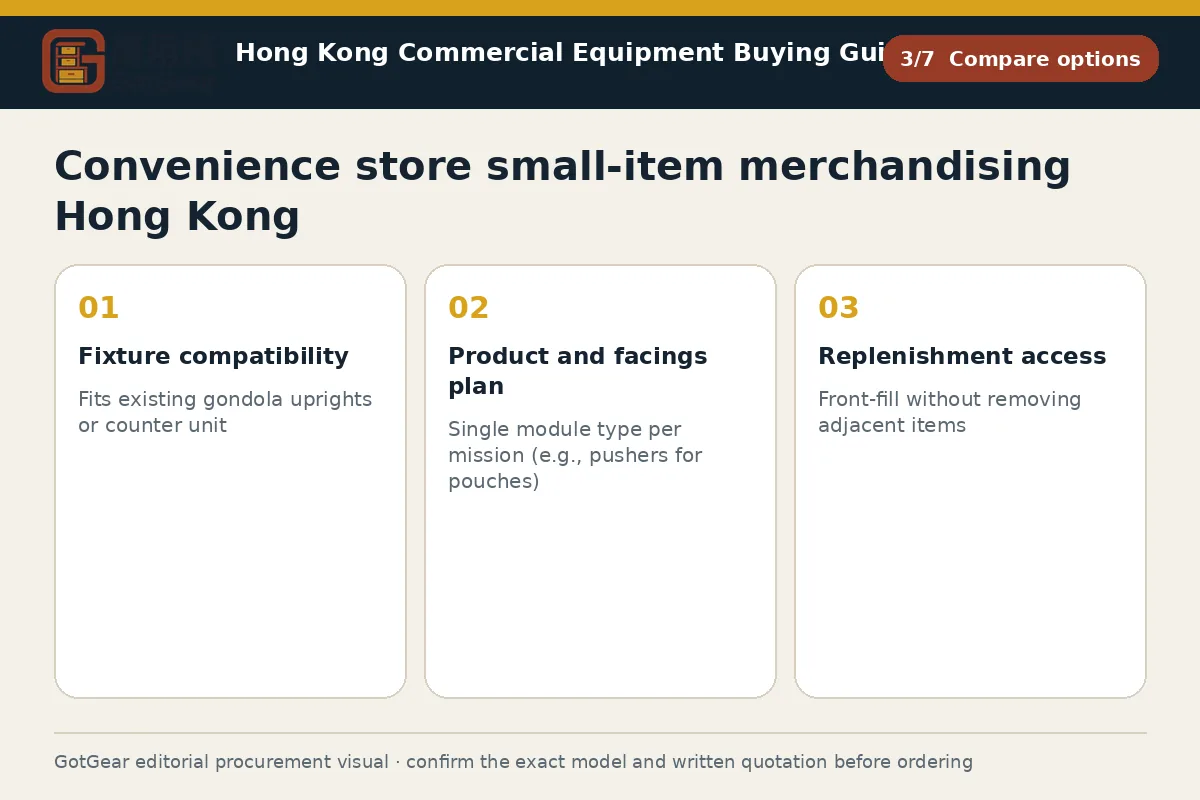
| Fixture compatibility | Fits existing gondola uprights or counter unit | Mixed formats (pegboard plus shelves) with adapters | Photos and dimensions of host fixture; upright pitch; mounting method requested |
| Product and facings plan | Single module type per mission (e.g., pushers for pouches) | Hybrid modules by pack (pegs, bins, dividers) with spacers | SKU list with W×D×H or hanging length; desired facings per line; sample packs available |
| Replenishment access | Front-fill without removing adjacent items | Defined trolley route and finger/hand clearances at each shelf | Annotated bay sketch; aisle/queue widths; example clearances to confirm in spec |
| Loss-control integration | Basic stop-locks or cashier sightline placement | Lockable bins, EAS-ready hooks and tethers near POS | Store loss-policy notes; request for EAS compatibility; CCTV sightline considerations |
| Delivery and documentation | Standard daylight delivery and simple assembly guide | Booked loading window, lift-size limits, bilingual instructions | Building rules, lift/door sizes, delivery window, required manuals and any approvals |
This framework helps buyers create comparable written enquiries. Final model specifications, availability, delivery and commercial terms must be confirmed in a formal quotation.
Convenience store small-item merchandising Hong Kong — Balance visibility with customer reach
Visibility drives impulse purchases, but only if customers can reach items without disturbing adjacent aisles. Maintain open sightlines from the entrance and from the POS; avoid tall headers that block cashier views. As a practical starting point, test a top-shelf pick height your typical shoppers can reach comfortably and a mid-shelf band for bestsellers; validate these settings on site before rollout. Consider wheelchair-access zones where relevant to your store's policy, and keep tickets clear, bilingual and non-glare to avoid reflections on polybags.
Specify fixtures that support legibility and touch: angled shelves for small pouches, data strips with anti-glare lenses, and wire fronts that hold pushers without hiding packs. Compare quotations on angle adjustability, ticket-rail profile, divider spacing increments and corrosion resistance for humid conditions. If adding shelf lighting, ask whether low-voltage tracks and cabling routes are provided, and confirm any electrical work with a competent contractor according to venue rules. Stainless or zinc-plated hooks reduce tarnish near drink stations. For convenience store small-item merchandising Hong Kong, teams should balance eye-level facings with fingertip reach and clean ticketing to prevent crowding while keeping service brisk.
Convenience store small-item merchandising Hong Kong — Test a representative bay
Before wider deployment, run a controlled trial on one representative bay positioned where the traffic and missions you mapped actually converge. Define success measures you can observe easily: how quickly facings sell down, whether staff can restock without moving adjacent items, how often customers fumble or drop packs, any queue interference, and signs of shrink. Use a few example observation windows across peak and off-peak periods as a starting point only, then refine the planogram with your team.
For procurement, request a bay-level drawing with module codes, mounting heights and facings per SKU, plus options for added dividers, extra pushers and lockable bins. Ask for overall and packaged dimensions to check lift cars, stair cores and doorways, and confirm delivery booking requirements with the building office. On receipt, count all components, check interchangeability across shelves, test pusher tension on your actual products, and verify that fixings suit the wall or gondola substrate. If anchoring or power routing is proposed, coordinate permissions with the landlord or management office and, where required by the venue, engage a competent contractor. Ensure documentation is bilingual for daily use by floor staff.
Convenience store small-item merchandising Hong Kong decision checklist
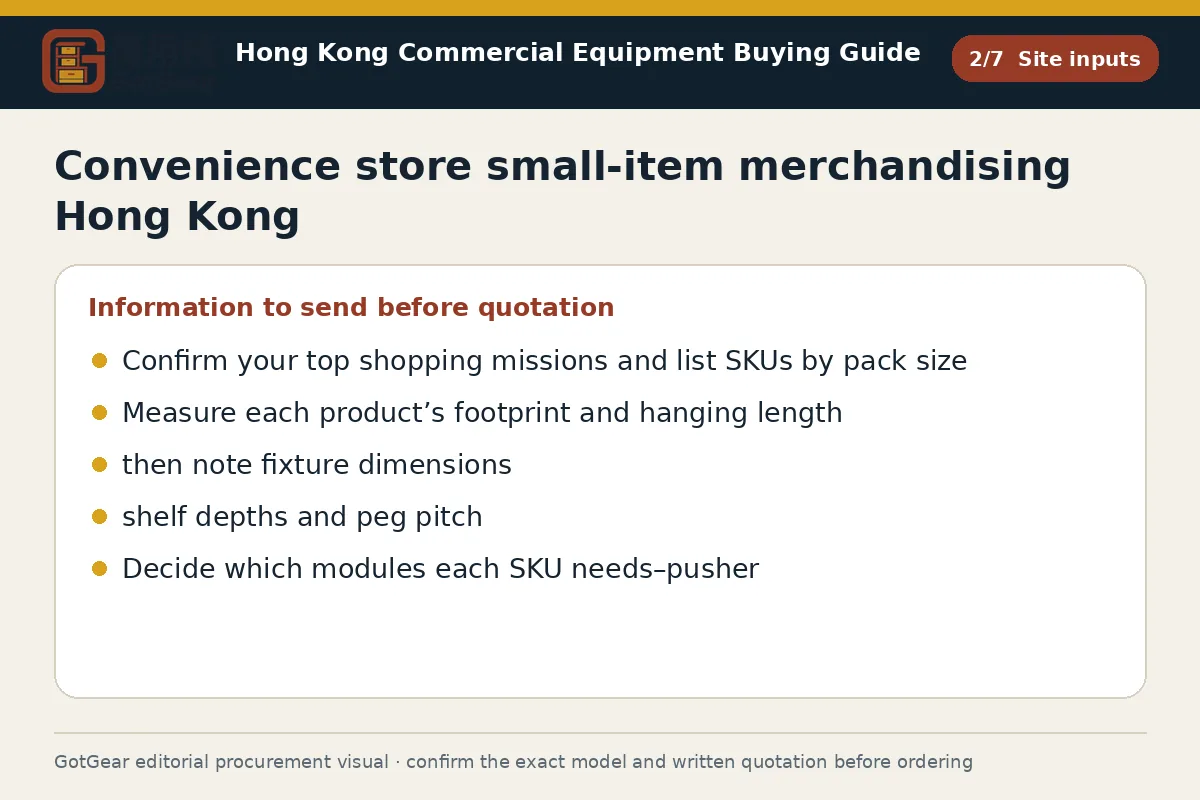
Confirm your top shopping missions and list SKUs by pack size. Measure each product’s footprint and hanging length, then note fixture dimensions, usable widths, shelf depths and peg pitch. Decide which modules each SKU needs—pusher, divider, peg or bin—and sketch facings per line. Walk the restocking route from stockroom to till, noting pinch-points, finger clearance and any queue conflicts. Select loss controls suitable for your policy: lockable bins, EAS hooks or tethers. In your written enquiry, request load ratings, finish, ticket-rail profile, compatibility with existing uprights and bilingual assembly guides. Provide delivery constraints: lift car, door widths and booking windows. On receipt, verify component counts, finish quality and module interchangeability, and test with your actual products. Let the supplier’s formal specification and quotation prevail over any scoping examples.
- Operating use, quantity and expected frequency
- Dimensions, capacity, material and accessory requirements
- Delivery address, floor, goods lift and loading window
- Required documents, acceptance checks and after-sales arrangements
Key points for convenience store small-item merchandising Hong Kong
Hong Kong convenience stores often operate off a small shopfront with tight doorways, narrow aisles and shared industrial-building access. Confirm goods-lift size, loading windows and delivery booking procedures with the management office before ordering, as many sites require advance notification and specific time slots. Humid conditions near chilled cases favour corrosion-resistant finishes and anti-fog ticket lenses. Some malls insist on accredited contractors for drilling or electrical works; confirm any such conditions with the landlord. Bilingual labels and instructions support mixed staff teams and customer bases. This overview highlights operating constraints, not legal advice; align final choices with your venue’s rules and written supplier specifications.
Questions about convenience store small-item merchandising Hong Kong
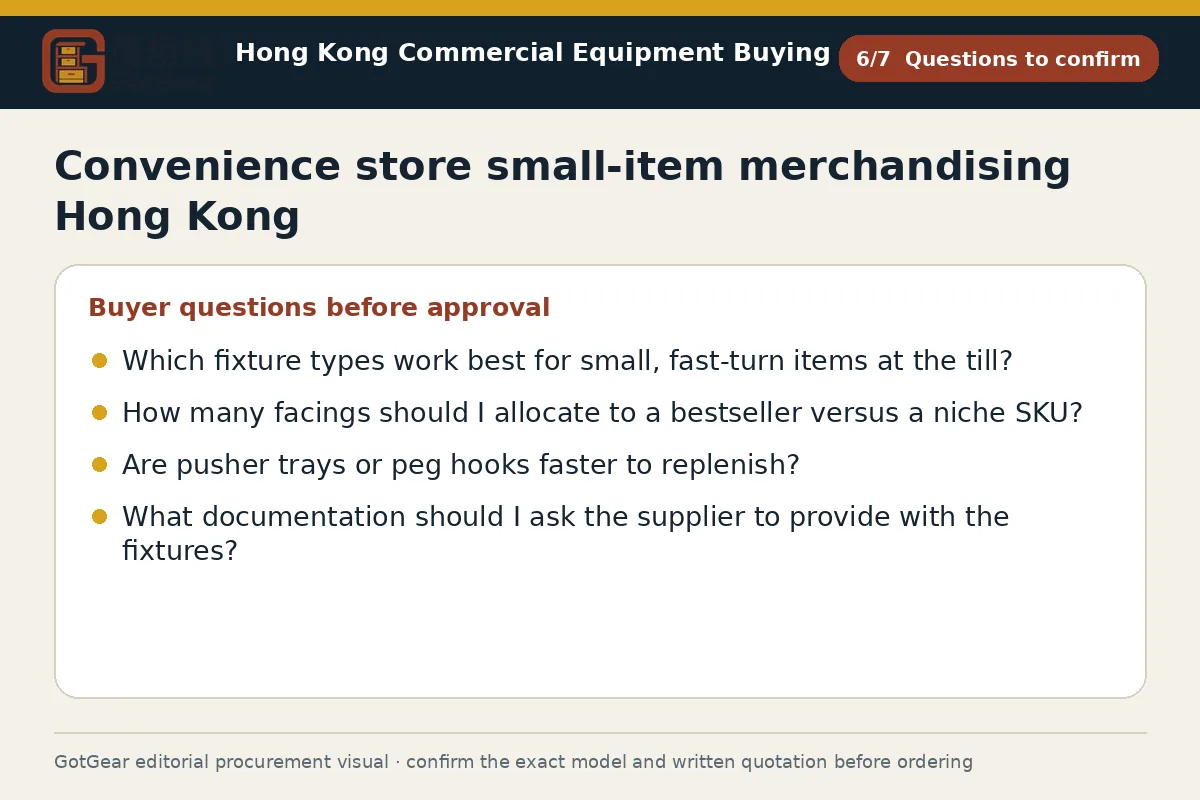
Which fixture types work best for small, fast-turn items at the till?
Use a mix: short peg hooks for hang-sell tabs, pusher trays for flat pouches, shallow divided shelves for small boxes, and lockable acrylic bins for high-shrink lines. Choose modules staff can refill quickly without dismantling the bay. Confirm compatibility with your existing uprights and request load ratings, divider increments and ticket-rail details in the quotation.
How many facings should I allocate to a bestseller versus a niche SKU?
Start by giving priority lines multiple clear facings and holding niche SKUs to fewer facings, then adjust after a short observation period. Any figures should be trial-based; use your POS data, staff feedback and supplier advice to refine. Ensure the planogram matches your replenishment capacity and the bay’s physical limits in the confirmed specification.
Are pusher trays or peg hooks faster to replenish?
For flat pouches and small bars, pushers usually enable quick front-fill; for carded items with hang tabs, pegs are efficient and easy to count by gaps. The right choice depends on pack geometry, turnover and shrink risk. Request sample modules or a demo, check compatibility with your fixtures, and confirm recommended loads and fixing methods in writing.
What documentation should I ask the supplier to provide with the fixtures?
Request bilingual assembly instructions, an exploded diagram, materials and finish statements, and manufacturer guidance on cleaning and maintenance. If your landlord or insurer requires it, ask for plastic material data and any available fire performance information. For EAS accessories or locks, seek compatibility notes. The supplier’s formal specification and quotation govern the final scope.
Continue with closely related procurement topics
These pages share equipment, operating or decision-stage signals with this guide.
How to store food off the floor in a Hong Kong commercial kitchen
GotGear explains how to store food off the floor in a Hong Kong commercial kitchen with raised shelving. Use the commercial kitchen food storage checklist Hong Kong to plan your restaurant back-of-house storage layout Hong Kong.
Read the guide
How many recycling bins does a Hong Kong office need
GotGear explains how many recycling bins does a Hong Kong office need, covering collection frequency and zone sizing, plus office recycling station setup Hong Kong and clean recycling bin placement in Hong Kong offices.
Read the guide
Where should waste containers be placed in a Hong Kong commercial kitchen
Where should waste containers be placed in a Hong Kong commercial kitchen? This GotGear guide explains how to map prep, service, wash-up and refuse flows and how to check access, cleaning and collection.
Read the guide
Event recycling station setup Hong Kong
GotGear has a checklist for event recycling station setup Hong Kong covering disposal points, servicing and signage. It includes recycling station signage for Hong Kong events and visitor direction signage for Hong Kong events.
Read the guideRelated topic indexOpen more English procurement pages3 topics
Browse additional equipment families, applications and procurement questions relevant to a wider buying brief.