
What should the placement review cover? Map preparation, service, wash-up and refuse movements, then check safe access, containment and cleaning against manufacturer instructions, the premises’ food-safety procedures, site conditions and applicable Hong Kong requirements.
Where should waste containers be placed in a Hong Kong commercial kitchen — Map preparation and wash-up movements
Start with a scaled plan of the whole kitchen and back-of-house, marking prep benches, cookline, pass, wash-up, pastry, bar, waste room and loading route. For teams asking where waste containers should be placed in a Hong Kong commercial kitchen, map where waste is generated (peelings, offcuts, packaging, plate scrapings, recyclables) and sketch the shortest safe movement from each point to a container, then from containers to the refuse room. Keep paths single-direction where possible to avoid crossings between clean and dirty flows.
Measure door clear openings, corridor and aisle widths, turning circles at corners, and the footprint available under or beside counters. Note door swings, steps, thresholds, floor drains, hose bibs, and goods-lift car and lobby sizes. As a procurement action, record the maximum container footprint, height with lid closed and with lid fully open, and the clearance needed to pull liners. Specify required volumes as examples only (for instance, an 80 L unit at veg prep), to be confirmed with the team. Request manufacturer drawings with dimensions, liner-ring or clamp style, caster type, and whether a dolly is included. Ask for photos of the proposed unit in plan and side elevation placed against your marked spaces to validate fit before you issue a written enquiry.
Where should waste containers be placed in a Hong Kong commercial kitchen — Allow containment and cleaning access
Place units so lids and liner changes can be done without contacting food or cleanware, and so that staff can access a hose point and floor drain for cleaning the container and surrounding floor. Maintain space to wheel a unit to a nearby wash area without crossing the plating pass. Where splashing could occur, position splash guards or choose tight-fitting, foot-operated lids. If odour and pests are concerns, consider gasketed lids and smooth interior walls to reduce soil retention and ease washing as captured in any commercial kitchen equipment cleaning checklist Hong Kong.
In your enquiry, request the material grade (e.g., HDPE wall thickness or stainless steel gauge), lid type (pedal, swing, stay-open function), hinge design, and whether gaskets are replaceable. Ask for the recommended cleaning procedure, chemicals and water temperature limits, and bilingual (Chinese/English) cleaning instructions. For mobility and wash-down, state caster diameter as an example starting point (for instance, 100 mm), wheel material (non-marking, oil-resistant), and brake locations. On receipt, inspect that lids close flush, pedals operate smoothly, casters swivel and lock, interior corners are smooth, drain plugs (if any) seat correctly, and that liner retention hardware matches the quoted specification. Keep manufacturer instructions with your routine cleaning records.
What should buyers compare for where should waste containers be placed in a Hong Kong commercial kitchen?
| Criterion | Straightforward requirement | More complex requirement | Evidence to provide |
|---|---|---|---|
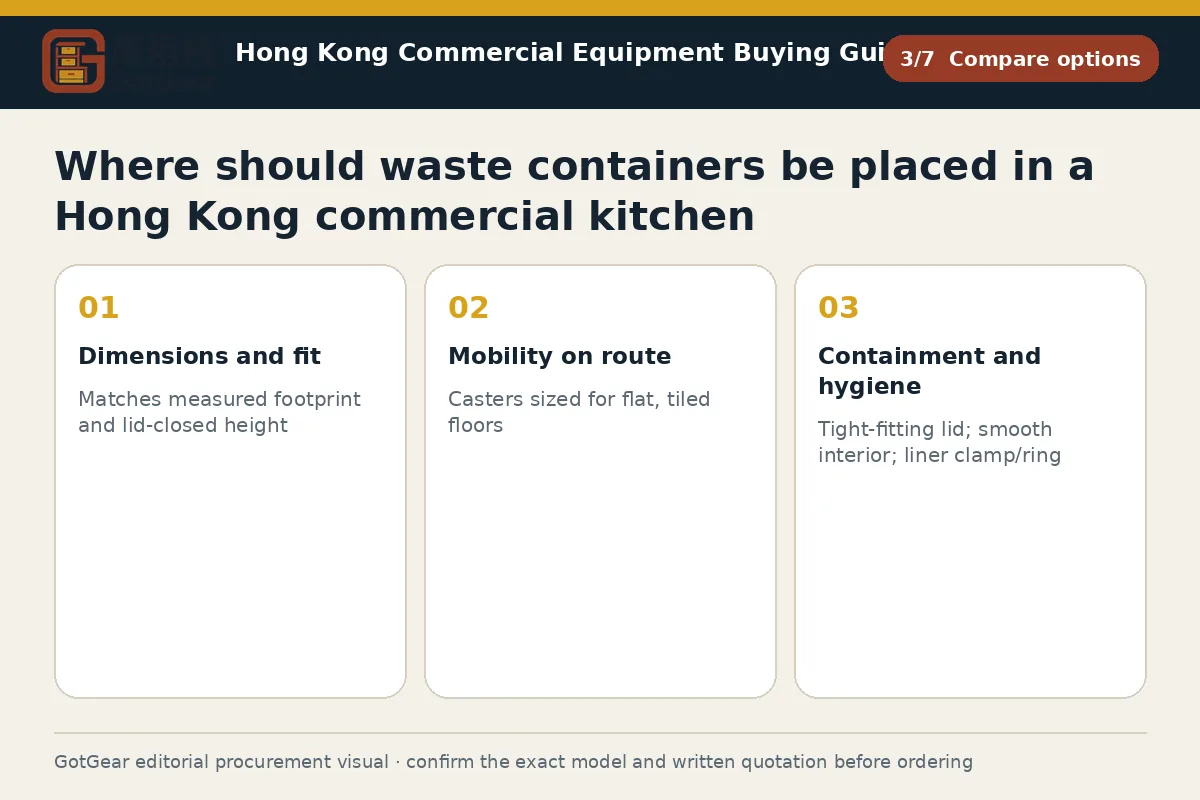
| Dimensions and fit | Matches measured footprint and lid-closed height | Confirms lid-open height and liner-pull clearance at each station | Scaled drawings; photos marked on your plan; on-site measurements |
| Mobility on route | Casters sized for flat, tiled floors | Wheel and bearing spec suited to thresholds, ramps and wet floors | Caster diameter/material; threshold heights; short route video if possible |
| Containment and hygiene | Tight-fitting lid; smooth interior; liner clamp/ring | Gasketed lid, drain plug, and pedal for hands-free operation | Cleaning instructions (bilingual); gasket/hinge details; detergent limits |
| Safety and access | Does not block doors or escapes; outside door swing arcs | Noise-dampened lids and brakes; reflective strips in dim service areas | Risk assessment notes; management-office sign-off on final plan |
| Documentation and service | Model number, volume, materials and warranty stated | Spare-parts list, pedal cycle-life and statement on heat/chemical resistance | Full quotation with fields; material data sheets if required by venue/insurer |
This framework helps buyers create comparable written enquiries. Final model specifications, availability, delivery and commercial terms must be confirmed in a formal quotation.
Where should waste containers be placed in a Hong Kong commercial kitchen — Protect staff and emergency routes
Protect staff movement and emergency routes by keeping containers out of door swing arcs and away from marked escape pathways. Use “shadow spaces” beside equipment ends or under benches where the open lid will not project into walking lines. Check turning areas at corridor junctions; if a bin and trolley must share space, prioritise trolley turning and place the bin where it can be pulled forward in one movement. As an example starting point, maintain 800 mm aisle clearance where bins are present, then confirm with your risk assessment and building manager.
In your specification, request overall dimensions with lid both closed and fully opened, handle heights, and any protrusions. Ask for wheel and bearing details suitable for textured or wet tiles, and for brake pedals that do not catch footwear. If noise-sensitive neighbours are above or adjacent, request data or examples on lid-dampening and quiet-rolling wheels. Confirm the route to the refuse room, management-office collection windows, and whether night access is allowed. If your insurer or venue requires it, ask the manufacturer for material data sheets and a statement on heat resistance when locating units near cooking ranges, then finalise placement so bins do not encroach on first-aid stations, fire equipment or electrical panels.
Where should waste containers be placed in a Hong Kong commercial kitchen — Complete site-specific checks
Before ordering, run a site-specific check: walk the whole route with a tape, camera and the building manager, noting lift sizes, lobby turning radii, and any steps or tight corners. Confirm refuse contractor requirements for segregating recyclables and food waste, and whether containers must dock to a compactor or tipper. In humid areas, consider corrosion and odour; specify sealed lids and smooth, cleanable finishes. For schools, hospitals or public-event venues, confirm any institutional approval and whether lockable lids or screened positions are required.
Compare written quotations line by line. Ask suppliers to state model numbers, internal volume (L), external footprint, height with lid closed/open, material, liner compatibility, caster diameter and material, brake count, pedal mechanism and quoted cycle life as an example starting point (for instance, 50,000 cycles), spare-parts availability, warranty statement, delivery method and access notes. Request scaled drawings and photos showing the unit against your floor plan, plus bilingual user and cleaning instructions. Test a representative unit on your marked route if a demo is offered. Keep bins clear of dry-goods areas; for broader layout discipline, see guidance such as how to store food off the floor in a Hong Kong commercial kitchen and food delivery container checklist Hong Kong.
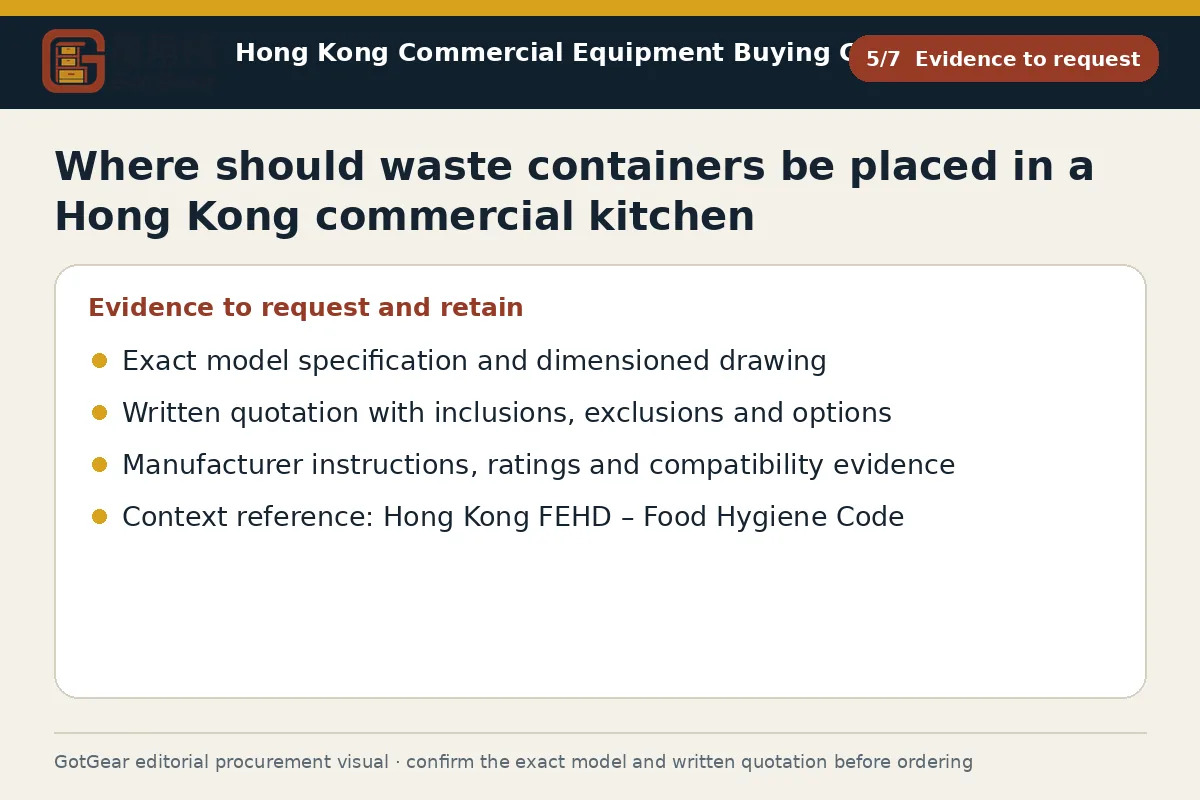
Where should waste containers be placed in a Hong Kong commercial kitchen decision checklist
Confirm waste-generation points and draw movement lines from each to the nearest container and on to the refuse room. Measure door clear openings, aisle widths, turning spaces, and lid-open heights against benches and walls. Specify volume, footprint, lid and pedal type, caster diameter and wheel material, liner-retention method, and whether gaskets or drain plugs are required. Request bilingual cleaning instructions, material data, drawings and photos showing fit. Compare quotations on identical fields, noting spare parts and warranty statements. Walk the delivery path with the building manager, book lifts if needed, and test a sample route if offered. After delivery, check casters, brakes, lid closure and liner fit, then update cleaning and pest-control routines to match the final placement plan.
- Operating use, quantity and expected frequency
- Dimensions, capacity, material and accessory requirements
- Delivery address, floor, goods lift and loading window
- Required documents, acceptance checks and after-sales arrangements
Key points for where should waste containers be placed in a Hong Kong commercial kitchen
Hong Kong kitchens often work within narrow corridors, sharp turns and goods-lift constraints, with refuse rooms located in basements or service podiums. Plan placements and transport routes that pass through lift lobbies and management-controlled doors without blocking traffic, and confirm refuse-room opening hours before finalising movements. Humidity and pests heighten the need for sealed lids and prompt cleaning. Where licensing, building management rules or venue policies apply, verify any placement and segregation requirements with the responsible party; this page provides operational guidance, not legal advice.
Questions about where should waste containers be placed in a Hong Kong commercial kitchen
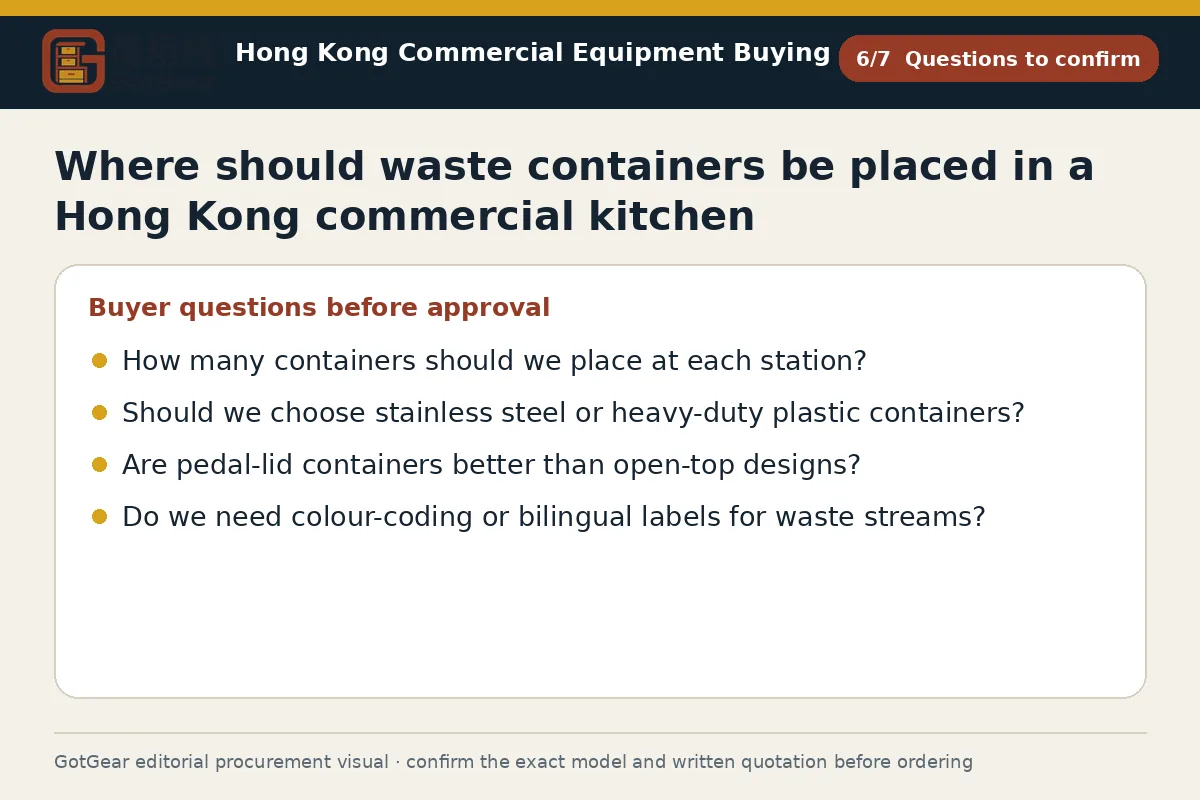
How many containers should we place at each station?
Size and count should follow observed waste volumes and change-out frequency. An example starting point is one 120 L unit at each main prep or wash-up area, then adjust after a timed service. Confirm with supervisors, refuse contractors and your risk assessment, and ensure the route to the refuse room can handle the container when full without blocking service or escape routes.
Should we choose stainless steel or heavy-duty plastic containers?
Plastic is lighter and quieter to move; stainless steel resists heat and is highly cleanable. Choose based on humidity, cleaning method, and the need for sealed gaskets or impact resistance. Where insurers or venues require material documentation, ask for manufacturer data sheets before ordering, and confirm caster and pedal compatibility with your floor finish and route.
Are pedal-lid containers better than open-top designs?
Pedal lids reduce hand contact and odours at prep and plate-scraping points, while open-top suits very high-throughput sorting zones. Select by station and workflow, ensuring space for safe lid opening. Ask the supplier for lid-dampening details and pedal cycle-life as an example starting point, and verify that the open-lid height clears shelves, pass lamps and door frames on your route.
Do we need colour-coding or bilingual labels for waste streams?
Colour-coding and clear bilingual (Chinese/English) labels help staff separate food waste, recyclables and general refuse. Match any scheme used by your waste contractor or venue policy so collection is accepted. Request containers or lids in suitable colours, or order durable label sets; confirm the final labelling with management before training, and keep spare labels for replacements.
Continue with closely related procurement topics
These pages share equipment, operating or decision-stage signals with this guide.
How many recycling bins does a Hong Kong office need
GotGear explains how many recycling bins does a Hong Kong office need, covering collection frequency and zone sizing, plus office recycling station setup Hong Kong and clean recycling bin placement in Hong Kong offices.
Read the guide
Commercial building recycling station Hong Kong
GotGear provides a checklist for a commercial building recycling station Hong Kong that covers a waste audit, tenant and cleaner routes, confirmation of material streams and signage, and verification of collection access.
Read the guide
How to store food off the floor in a Hong Kong commercial kitchen
GotGear explains how to store food off the floor in a Hong Kong commercial kitchen with raised shelving. Use the commercial kitchen food storage checklist Hong Kong to plan your restaurant back-of-house storage layout Hong Kong.
Read the guide
Commercial kitchen equipment cleaning checklist Hong Kong
This commercial kitchen equipment cleaning checklist Hong Kong organises cleaning tasks by food-contact risk, records manufacturer guidance, defines dismantling limits and includes a final sign-off with GotGear.
Read the guideRelated topic indexOpen more English procurement pages2 topics
Browse additional equipment families, applications and procurement questions relevant to a wider buying brief.