
What should managers verify? Use storage intended for the load and environment, maintain the clearances required by site procedures, and confirm shelf loading, stability, installation instructions and the layout against applicable Hong Kong requirements.
How to store food off the floor in a Hong Kong commercial kitchen — Select suitable raised storage
If you are deciding how to store food off the floor in a Hong Kong commercial kitchen, begin by matching raised storage types to the loads, humidity and cleaning regime on site. Dunnage racks keep bulk ingredients and crates off the floor and allow mopping beneath. Wire shelving improves airflow for dry goods, while solid or lipped shelves control drips in chillers. In humid back-of-house spaces and coastal districts, ask suppliers to state metal grade, coatings and corrosion-resistance claims in writing, and to confirm suitability for your cleaning chemicals. For mobile use, specify braked castors designed for wet floors and frequent washdowns, and request details of wheel materials and axle sealing.
Record constraints before you contact vendors: usable floor area, slope to drains, gulley positions, and any step or threshold that affects trolley movement. Measure door and goods-lift clear openings and note time-limited loading windows typical in industrial buildings. In your written enquiry, request load per shelf and per bay, shelf-height adjustment range, maximum stack height, foot type (levelling feet or pads), anti-tip options, and whether wall ties or floor anchors are available if your risk assessment requires them. Ask for installation instructions, stability guidance and cleaning instructions in bilingual format for management-office and staff review. State that your site procedures set the required under-shelf clearance so the supplier sizes feet or dunnage height accordingly.
How to store food off the floor in a Hong Kong commercial kitchen: Set Shelf Dimensions, Access and Back-of-House Layout
Base shelf dimensions on actual site measurements, not assumptions. When refining the back-of-house storage layout for a restaurant in Hong Kong, translate corridor, doorway and goods-lift sizes into shelf modules, aisle widths and turning spaces that work for your trolleys and delivery cages. As a practical starting point to validate during a site walk, aim for an uninterrupted primary aisle that comfortably clears your widest trolley, then check turning at pinch points near chillers and the receiving door. Confirm the height of any ceiling soffits, the location of fire-services obstructions and places where wall bracing might clash with conduits.
Convert your product mix into usable pitch by noting the outer dimensions of the containers you actually use (for example, trays, flour sacks, 600×400 crates and GN pans) and asking suppliers to confirm shelf depth and the vertical adjustment increments that make those containers efficient to pick. Request drawings showing bay lengths, corner solutions and how anti-sway bracing affects access on lower levels. In quotations, compare like-for-like data: number of shelves per bay, load rating per level, corrosion-resistance statement, finish, and whether labelling strips, dividers and bin stops are included. Require written confirmation that the proposed dimensions fit the measured routes and lifts on your drawing, not a generic catalogue footprint.
What should buyers compare for how to store food off the floor in a Hong Kong commercial kitchen?
| Criterion | Straightforward requirement | More complex requirement | Evidence to provide |
|---|---|---|---|
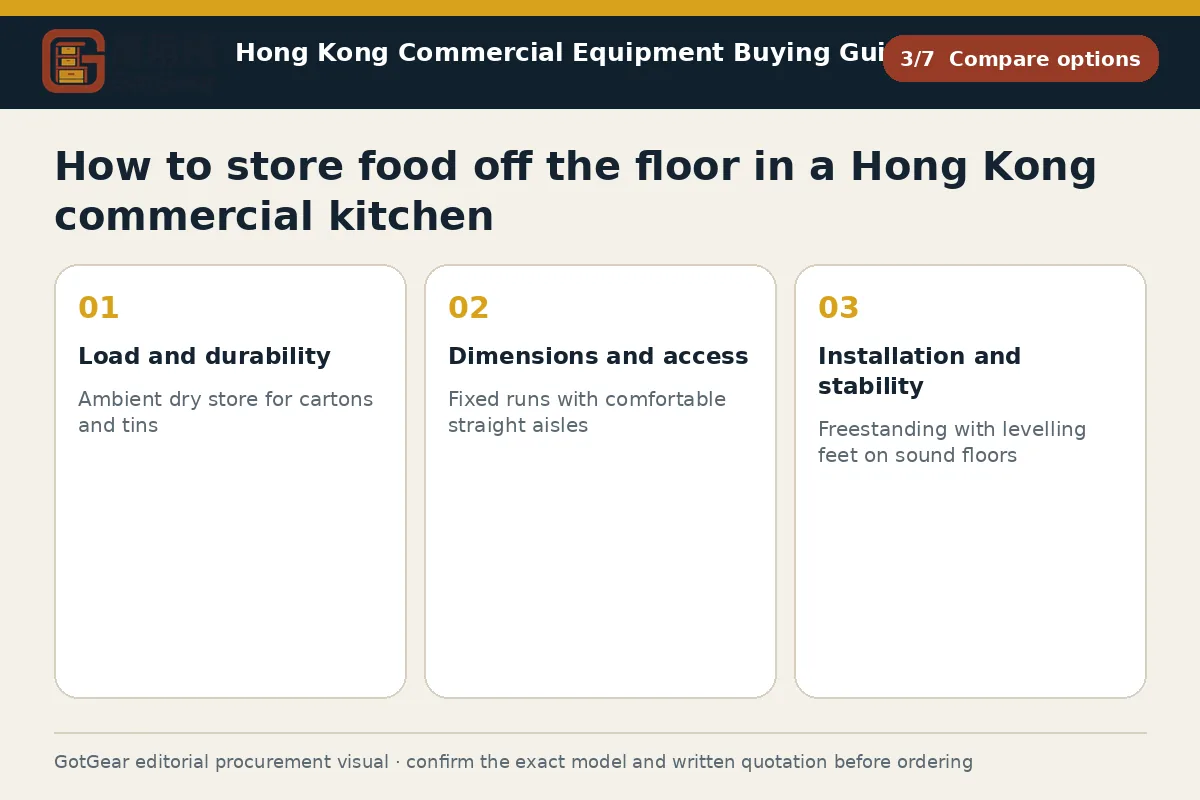
| Load and durability | Ambient dry store for cartons and tins | Mixed wet area use and heavy sacks on lower levels | State expected load per shelf and per bay, container types and required material grade/finish |
| Dimensions and access | Fixed runs with comfortable straight aisles | Routes that include lifts, tight turns and thresholds for trolleys | Provide scaled plan, door/lift clear openings, target aisle width and turning space |
| Installation and stability | Freestanding with levelling feet on sound floors | Wall/floor anchoring or anti-tip where risk assessment requires | Describe floor condition, anchoring permissions, and any vibration or traffic concerns |
| Cleaning and rotation | Removable shelves and smooth finishes for routine wipes | Pull-out on braked castors, colour coding and FIFO lanes | List cleaning chemicals, washdown method, and rotation/quarantine procedure |
| Documentation and approvals | Bilingual manual and basic installation guide | Method statement, drawings and acceptance checklist for venue sign-off | Name the approving party, insurer conditions, and required delivery/installation windows |
This framework helps buyers create comparable written enquiries. Final model specifications, availability, delivery and commercial terms must be confirmed in a formal quotation.
How to store food off the floor in a Hong Kong commercial kitchen: Connect Raised Storage with Cleaning and Stock Rotation
Off-floor storage only works if cleaning and rotation are built in. Choose finishes and shelf designs that tolerate your detergents, sanitisers and rinse temperatures, and ask manufacturers for written compatibility and care instructions. Open-wire shelves speed drying; solid inserts can be lifted for deep cleans if your procedure specifies periodic removal. Where frequent pull-outs are planned to allow cleaning behind units, specify lockable castors and corner bumpers, and obtain details of brake design and replacement parts. For stock rotation, plan FIFO lanes, date-labelling points and a clearly signed quarantine shelf for damaged or recalled items that sits off the floor and away from food-prep routes.
Treat cleaning as a procurement input, not an afterthought. Request documentation that ties materials and construction to your routine (for example, whether removable shelves are dishwasher-safe as a starting point, subject to confirmation). If you maintain a commercial kitchen equipment cleaning checklist Hong Kong, and your teams follow it, provide it with your enquiry so suppliers can confirm suitability. If you need a commercial kitchen food storage checklist Hong Kong, for supervisors to sign, ask vendors to supply a sample maintenance and inspection log for management-office approval. Ensure the layout accommodates waste transfer without cross-contamination and leaves planned clearances under racks to match your site procedures.
How to store food off the floor in a Hong Kong commercial kitchen — Fit stock into measured routes
Fitting stock into measured routes means modelling how goods arrive, are staged, shift into storage and flow to prep. Map the receiving point to dry store, chiller and freezer, then size landing shelves so delivery crates can be offloaded from the floor while counts are checked. If suppliers deliver in tall cages, confirm the cage footprint and height, and verify that your lift, thresholds and aisles can accommodate them. Place replenishment shelves where team members naturally pass on the way to production, with heavy items at mid-height to reduce strain and seldom-used stock positioned higher or further from the main route.
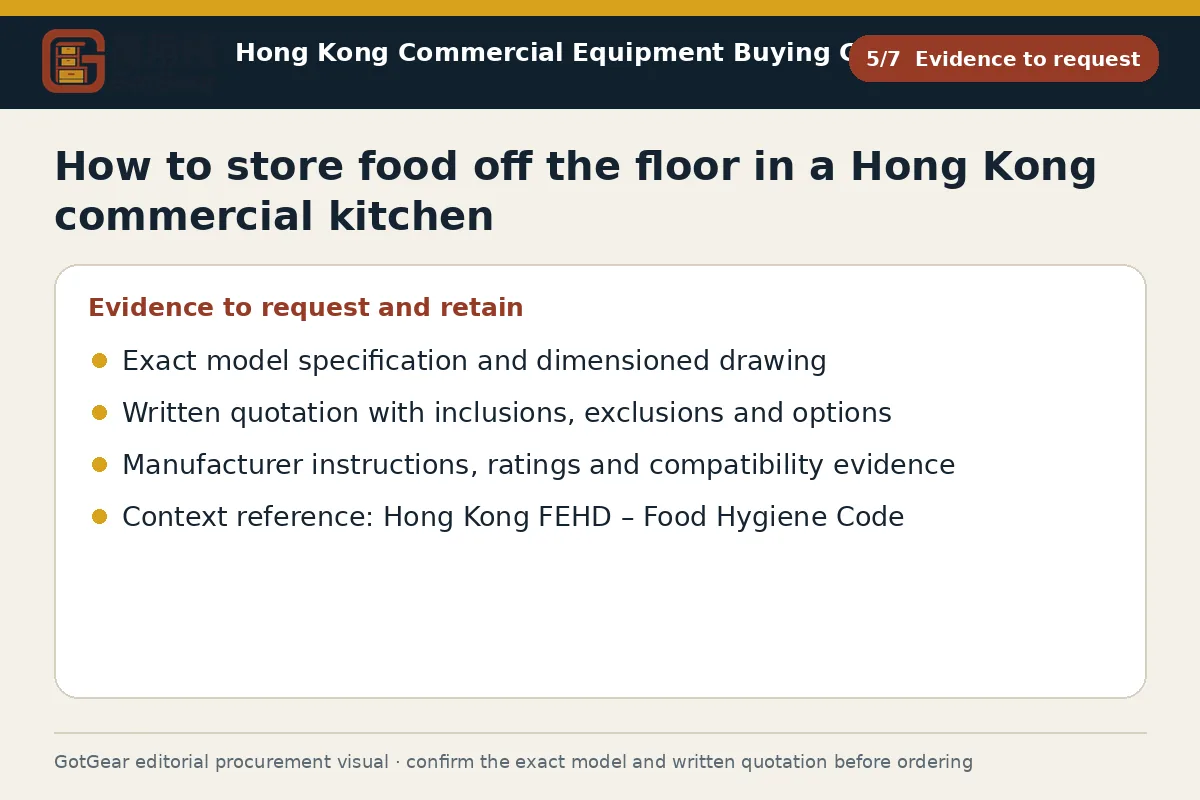
At the purchase order stage, specify what evidence will be checked on receipt. Ask for a packing list that matches the quotation, load-rating labels for each level, documented material grade or finish, fasteners and spares, and bilingual operating and installation instructions. For anchored systems, request an installation method statement if your venue, building manager or insurer requires it, and seek approval before drilling. During commissioning, verify that bays are level, castors lock and release cleanly, and that a sample load test reflects your expected use as an example starting point under supplier guidance. If your intake uses sealed delivery boxes, align shelf depths with your food delivery container checklist Hong Kong; procurement teams maintain it so replenishment is smooth and traceable.
How to store food off the floor in a Hong Kong commercial kitchen decision checklist
Walk your route from delivery bay to storage and prep, measuring doors, lifts, aisles and soffits, and noting drains, slopes and obstructions. Define product families, container sizes and the heaviest expected loads. In your enquiry, request material grade or finish, load per shelf and per bay, shelf depth and pitch increments, foot or caster details, and stability options. Ask for scale drawings that show total bay runs, bracing and turning clearances. Compare written quotations item by item, including accessories, corrosion statements and inclusion of bilingual manuals. Before ordering, secure any building-manager approval for anchors. At receipt, check all components, labels and instructions against the quotation, then verify levelling, brake function and fit within the measured routes. Record cleaning compatibility and rotation method for management-office sign-off.
- Operating use, quantity and expected frequency
- Dimensions, capacity, material and accessory requirements
- Delivery address, floor, goods lift and loading window
- Required documents, acceptance checks and after-sales arrangements
Key points for how to store food off the floor in a Hong Kong commercial kitchen, commercial kitchen food storage checklist Hong Kong, restaurant back-of-house storage layout Hong Kong
In Hong Kong, storage selection is shaped by tight goods-lift cars, narrow corridors in industrial buildings, and time-restricted loading windows. Plan raised storage so deliveries can move from the loading bay to the kitchen without removing doors or rails, and ensure bilingual documentation is available for management and frontline teams. Humid conditions and frequent washdowns favour corrosion-resistant materials and designs that dry quickly. Where wall or floor anchoring is proposed, check building-manager requirements and any venue-specific conditions tied to your licence or insurer. Treat this as planning guidance only; confirm clearances, hygiene expectations and installation methods against your site procedures and applicable Hong Kong requirements.
Questions about how to store food off the floor in a Hong Kong commercial kitchen
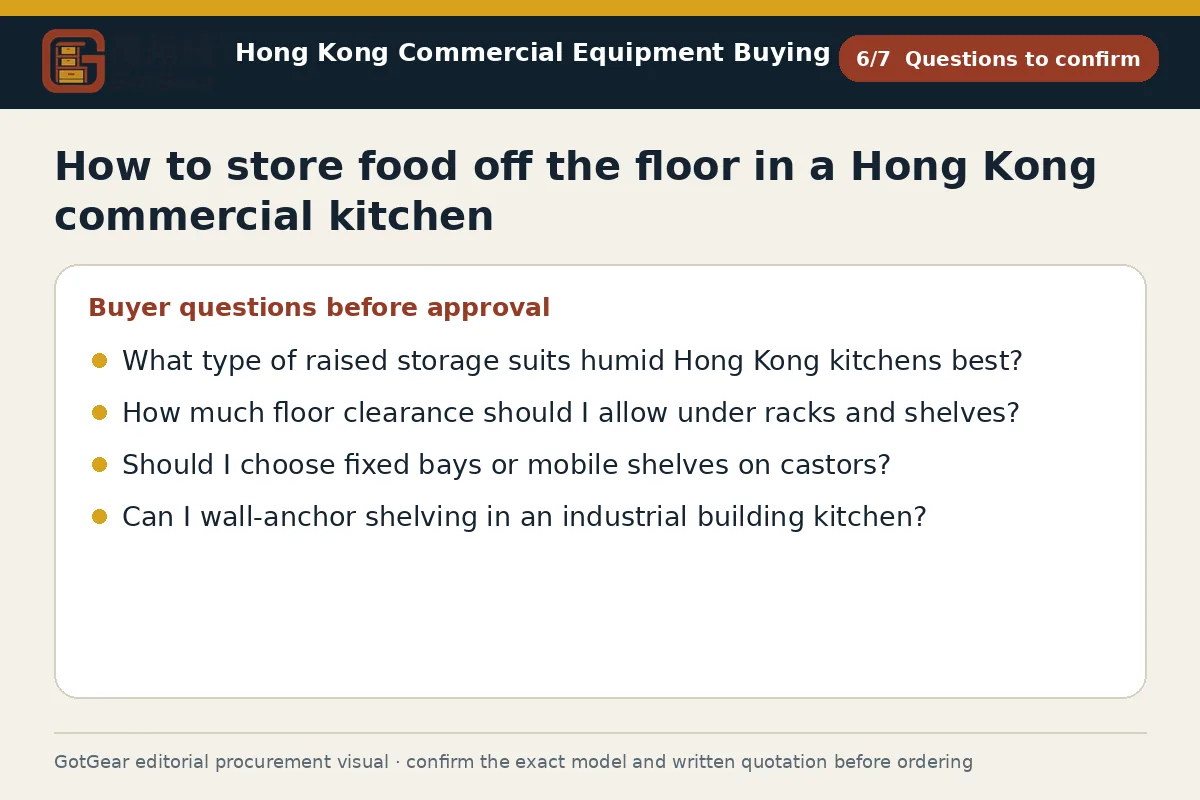
What type of raised storage suits humid Hong Kong kitchens best?
Favour corrosion-resistant finishes and open designs that dry quickly, such as stainless or coated wire with removable inserts. Ask the manufacturer to confirm material grade and cleaning-chemical compatibility in writing, and provide maintenance guidance. The best choice still depends on your exact environment, cleaning routine, and whether the shelves sit in ambient, chilled or intermittently wet areas.
How much floor clearance should I allow under racks and shelves?
Follow your site’s hygiene procedures and any applicable Hong Kong requirements first. As an example starting point to test with your team, many sites trial a clearance that allows mop heads and nozzles to reach fully beneath. Confirm the final dimension with your competent adviser, supplier instructions and the venue’s acceptance criteria before ordering.
Should I choose fixed bays or mobile shelves on castors?
Fixed bays maximise stability and capacity where aisles are predictable, while mobile shelves help pull units out for cleaning or reconfiguration. If you choose mobile, request details of wheel material, brake design and load ratings, and verify turning space within your measured routes. Your decision should reflect traffic levels, cleaning frequency and any anchoring restrictions on site.
Can I wall-anchor shelving in an industrial building kitchen?
Often yes, but only with prior approval from the building manager or venue and suitable fixings for the wall substrate. Ask suppliers for bracket options and a method statement if required, then submit drawings for approval. Some tenancies restrict drilling or require reinstatement, so obtain written consent and ensure the quotation reflects any extra works or coordination needed.
Continue with closely related procurement topics
These pages share equipment, operating or decision-stage signals with this guide.
Warehouse shelving access aisle planning Hong Kong
Consult our practical guide to warehouse shelving access aisle planning Hong Kong to review inventory handling, aisle clearances and emergency access. View the warehouse shelving layout checklist Hong Kong at GotGear.
Read the guide
Food delivery container checklist Hong Kong
GotGear outlines the food delivery container checklist Hong Kong, covering capacity, closure, cleaning and loading, and explains hot and cold food delivery separation Hong Kong with monitoring and handover steps.
Read the guide
Event recycling and queue management Hong Kong
GotGear covers event recycling and queue management Hong Kong and links peak forecasts and disposal points with queue barrier layout for Hong Kong registration events and exhibition registration flow planning Hong Kong.
Read the guide
How many recycling bins does a Hong Kong office need
GotGear explains how many recycling bins does a Hong Kong office need, covering collection frequency and zone sizing, plus office recycling station setup Hong Kong and clean recycling bin placement in Hong Kong offices.
Read the guideRelated topic indexOpen more English procurement pages2 topics
Browse additional equipment families, applications and procurement questions relevant to a wider buying brief.