
For a comparable library shelving Hong Kong RFQ, give collection quantities and formats, required bay and shelf dimensions, a measured layout and access considerations. Ask respondents to identify proposed materials and finishes, dimensional assumptions, exclusions and requested product documentation without presuming a particular outcome.
Define collections and user access for library shelving Hong Kong
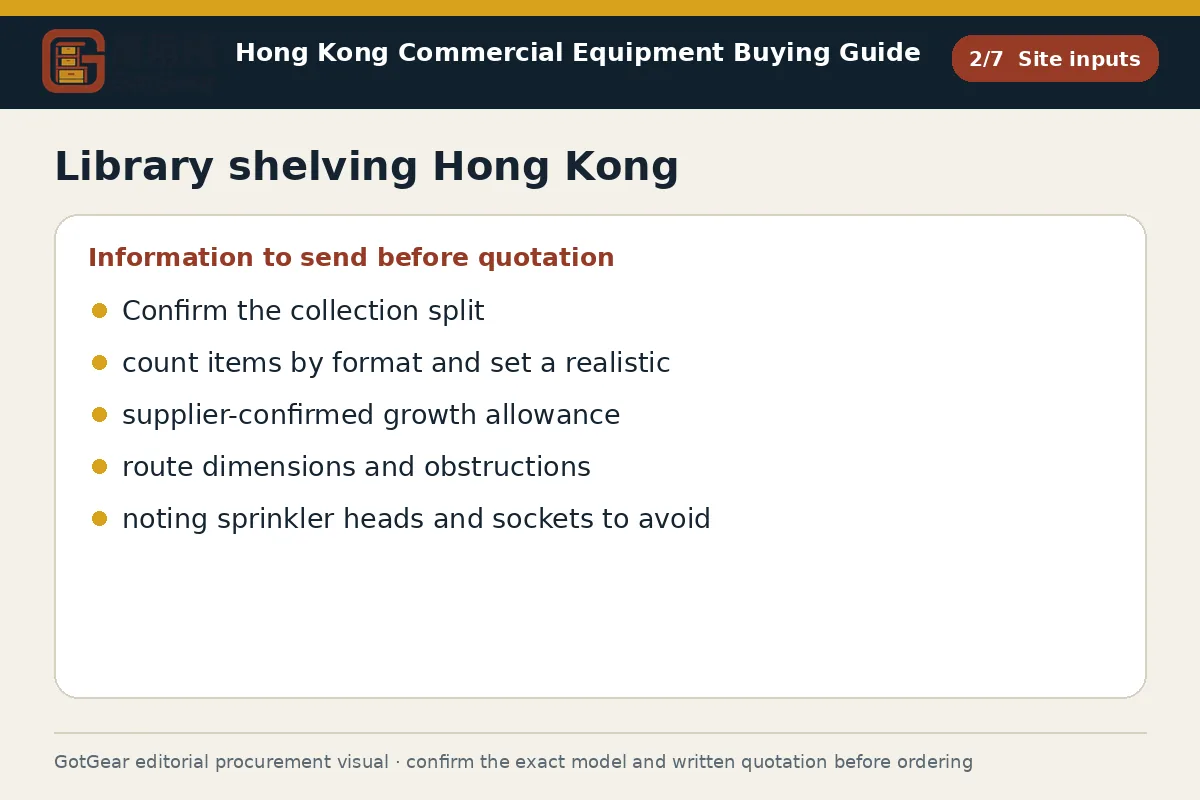
Start by classifying everything the library holds and how people will reach it. Split collections into lending books, reference, journals, media carriers, large-format items, children’s materials, displays and any special collections. Count items by format and language, then note growth allowances as an example starting point only (e.g., 10–15%) to be confirmed in the written brief. State whether shelves must be adjustable, whether titles will be front-faced, and where lockable bays are needed for higher‑value media. Institutions requesting library shelving in Hong Kong should state which spaces are open stacks and which are supervised or back‑of‑house.
Define access patterns and inclusivity goals. Record minimum aisle widths, turning zones at aisle ends, and the intended reach range for pupils, adults and wheelchair users, with any example dimensions clearly marked for supplier confirmation. Note trolley routes, book‑drop/returns proximity, signage positions and whether bilingual shelf‑edge labels are required. Identify quiet zones versus high‑traffic areas and any sightline or safeguarding constraints. If parts of the collection will move to closed stacks, describe how they interface with archive shelving in Hong Kong and whether retrieval is staff‑only. These access notes drive bay height, depth, bay‑to‑bay spacing and the need for anti‑tip measures or end‑panel protection in crowded corridors.
Document dimensions, finishes and site limits for library shelving Hong Kong
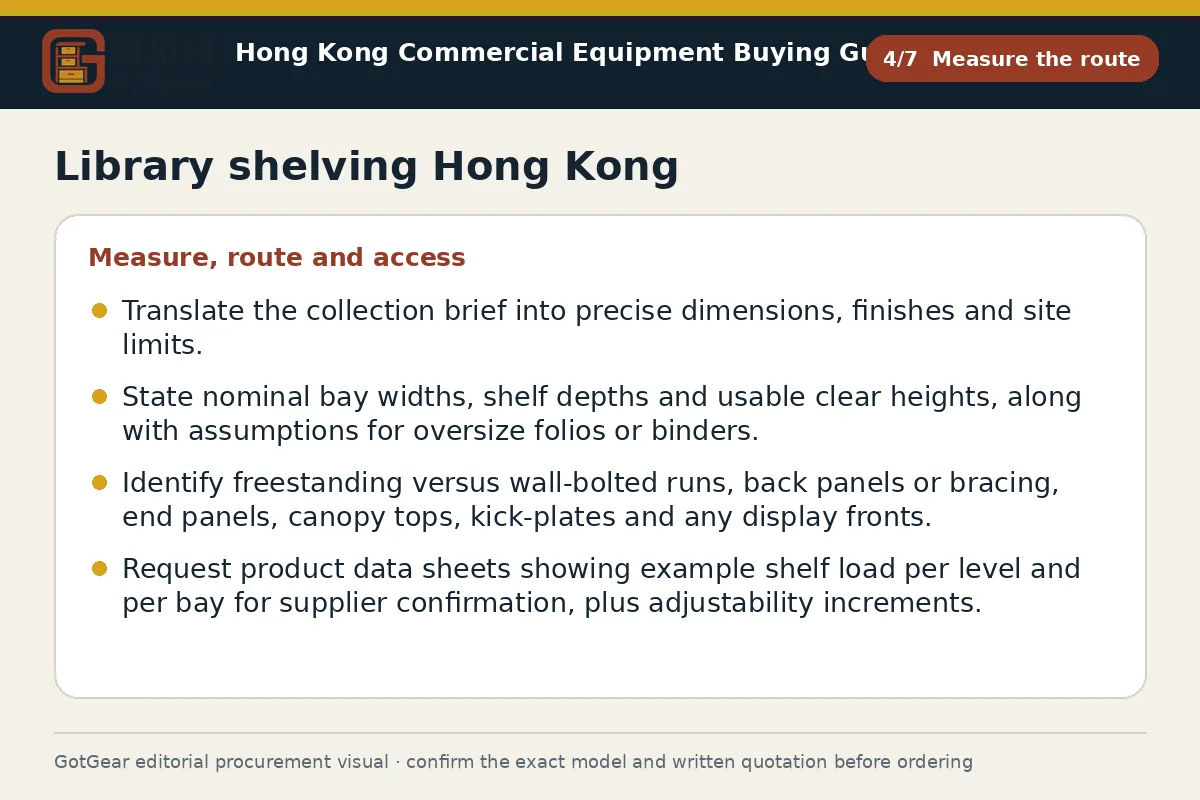
Translate the collection brief into precise dimensions, finishes and site limits. State nominal bay widths, shelf depths and usable clear heights, along with assumptions for oversize folios or binders. Identify freestanding versus wall-bolted runs, back panels or bracing, end panels, canopy tops, kick-plates and any display fronts. Request product data sheets showing example shelf load per level and per bay for supplier confirmation, plus adjustability increments. Specify preferred finishes (powder-coated steel, high-pressure laminate, timber veneer) and whether impact-resistant edges or concealed fixings are desired. In humid interiors, ask suppliers to advise on coating systems, stainless fasteners or ventilation gaps appropriate to the proposed model and site.
Document the realities of the building. Measure the route from unloading point to the room: goods-lift car, door and corridor clearances, turn radii and stair flight sizes. Include example measurements as starting points only (e.g., lift car 1,100 mm W x 1,400 mm D x 2,200 mm H) and require written confirmation against the chosen solution. Note booked delivery windows, noise limits in teaching hours, dust control, temporary floor protection and waste-removal rules common in Hong Kong industrial buildings. State any sprinkler head clearances, wall services or sockets to avoid, and request bilingual drawings and sample finish swatches for approval.
What should buyers compare for library shelving Hong Kong?
| Criterion | Straightforward requirement | More complex requirement | Evidence to provide |
|---|---|---|---|
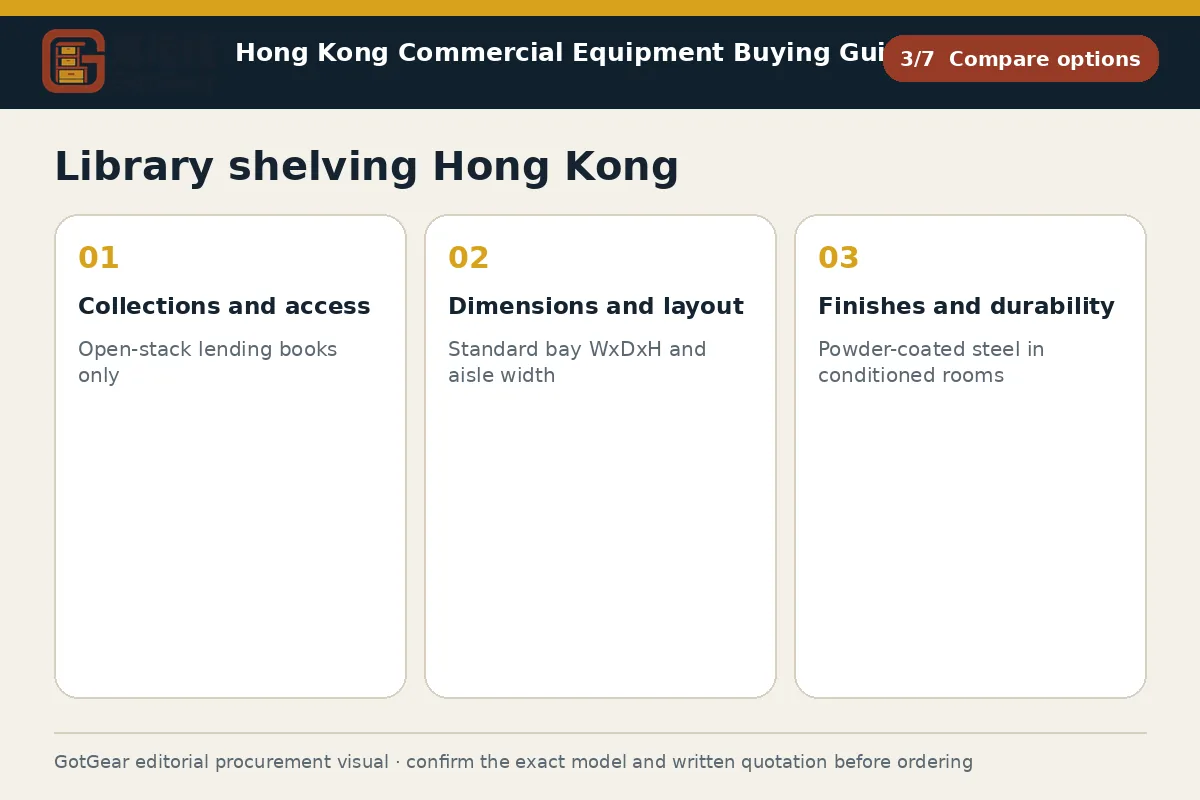
| Collections and access | Open-stack lending books only | Mix of lending, journals, media and staff-only stacks | Counts by format, access notes, growth allowance (to be confirmed) |
| Dimensions and layout | Standard bay WxDxH and aisle width | Oversize items, end-panels, obstructions and turning zones | Measured plan, route map, example bay drawing for confirmation |
| Finishes and durability | Powder-coated steel in conditioned rooms | Mixed laminate/veneer, impact edges, anti-corrosion options for humidity | Colour references, environment notes, cleaning regime request |
| Site access and programme | Daytime delivery via lift | Limited windows, stairs-only access, campus event constraints | Lift/door sizes, booking rules, proposed slots for manager approval |
| Documentation and evidence | Basic product data sheets | Shop drawings, anchor method, venue-required risk assessments | Deviations/exclusions list, insurance proof, bilingual O&M materials |
This framework helps buyers create comparable written enquiries. Final model specifications, availability, delivery and commercial terms must be confirmed in a formal quotation.
Write comparable RFQ requirements for library shelving Hong Kong
To obtain comparable quotations, structure the RFQ around quantifiable fields. Provide collection quantities by format, a measured layout showing walls, columns and obstructions, and required bay and shelf dimensions. Call up accessories such as dividers, book supports, label holders, periodical displays and media drawers. State whether anti-tip devices, wall fixings or floor anchors are anticipated, and ask suppliers to confirm suitability for the specific floor/partition type. Require shop drawings, a parts list, installation method notes and a schedule of deviations, exclusions and assumptions.
Standardise evaluation by asking all bidders to complete the same response table: dimensions offered, finishes, shelf load claims, installation hours, programme and any building-management fees for lift booking or out-of-hours work. Invite optional improvements as alternates rather than unpriced substitutions. Parity checks used in industrial shelving specification Hong Kong and warehouse racking tender specification Hong Kong also apply: normalise measurements, separate delivery and installation lines and highlight exceptions. Use this guide to compare specifications and prepare a written enquiry so each offer can be read on like-for-like terms before institutional approval.
Set a supplier response schedule for library shelving Hong Kong
Set clear milestones so suppliers can plan site surveys, samples and installation. Publish an example timetable for confirmation in the written brief: site visit window (e.g., one week), last date for queries (e.g., three working days before close), addendum issue date, finish sample submission deadline, tender closing time and optional presentations for shortlisted bidders. If mock-ups or a pilot bay are desired, request them as a priced alternate with a proposed evaluation date.
Define the submission pack format. Ask for a compliance summary, dimensioned layout with bay codes, confirmation of proposed fixings, method statement, programme with any campus event blackouts, manpower and supervision levels, access bookings plan, and risk assessments if required by the venue or insurer. Request proof of public liability and employees’ compensation insurance where the institution requires it, plus bilingual O&M information. After award, schedule a pre-start meeting to confirm measurements on site, review protection measures for floors and walls, and agree delivery slots with the building manager to suit term dates and exam periods. Where back rooms co-locate stores with industrial shelving Hong Kong, coordinate access and anchoring methods.
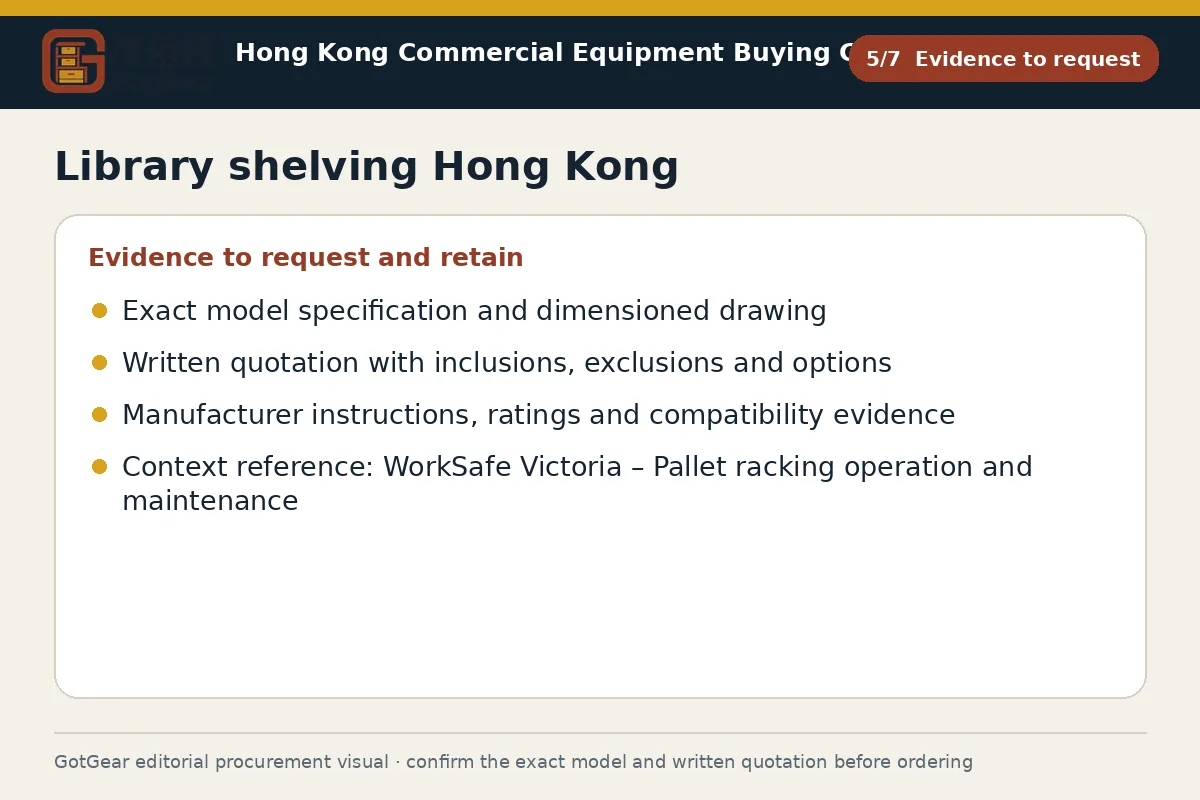
Library shelving Hong Kong decision checklist
Confirm the collection split, count items by format and set a realistic, supplier-confirmed growth allowance. Measure rooms, route dimensions and obstructions, noting sprinkler heads and sockets to avoid. Define aisle widths, turning zones and reach ranges for users. Specify bay sizes, shelf depths, adjustability and required accessories, then select finishes suitable for humidity. Request shop drawings, product data sheets, sample swatches and a deviations list. Standardise response tables so quotations can be compared line by line. Coordinate lift bookings, loading windows, waste removal and quiet-hour rules with the building office. At receipt, inspect packaging, colour match, component count and surface condition; during installation, check plumb, level, anchors and stability. Retain bilingual O&M materials and confirm maintenance points with the manufacturer.
- Operating use, quantity and expected frequency
- Dimensions, capacity, material and accessory requirements
- Delivery address, floor, goods lift and loading window
- Required documents, acceptance checks and after-sales arrangements
Key points for library shelving Hong Kong
Hong Kong sites often combine tight goods-lifts, narrow doorways and booked delivery windows managed by building offices. Allow time to secure lift reservations, obtain site inductions and align with school timetables or public quiet periods. Humid conditions can affect unprotected steel; discuss coatings and stainless fixings if the room lacks environmental control. Some institutions require bilingual drawings and shelf-edge labels. Sprinkler and lighting clearances, and event-blackout restrictions, may limit tall runs or overnight works. Confirm these constraints with the building manager before finalising layouts and installation sequencing.
Questions about library shelving Hong Kong
Do we choose fixed or fully adjustable shelves for institutional stacks?
Adjustable shelves suit mixed and changing collections; fixed shelves can work for stable reference runs. Ask suppliers to confirm adjustability increments, load limits and any tool requirements for reconfiguration. If children’s or large-format areas are included, request a layout showing how fixed and adjustable sections transition, and ask for a deviations list if proposed modules limit shelf spacing.
Is mobile shelving appropriate for public reading areas?
Mobile systems are generally best for supervised or staff-only zones; public areas prioritise safe, open access. Where mobility is considered, ask for floor rail details, trip-edge treatments and user controls, and confirm the need for venue approvals or engineering review. Request a risk assessment and method statement if the building manager or insurer requires them for rolling carriages.
How should we address humidity and corrosion risk in Hong Kong libraries?
Specify finishes and hardware suitable for humid interiors and request the supplier’s written proposal for coatings and fasteners. Where rooms are not conditioned, ask about galvanised elements, powder-coat systems and ventilation gaps. Seek cleaning and care guidance from the manufacturer and confirm any additional protection, such as desiccants, with facilities staff and the product’s model documentation.
What checks should we make on delivery and installation?
On delivery, verify quantities, colour codes, panel condition and that fasteners and accessories match the parts list. During installation, check plumb, level, bay alignment, fixings and anti-tip devices, and confirm no services are compromised. Record any damage, request rectification plans in writing and retain bilingual O&M materials. Let the written quotation and approved drawings prevail over earlier sketches.
Continue with closely related procurement topics
These pages share equipment, operating or decision-stage signals with this guide.
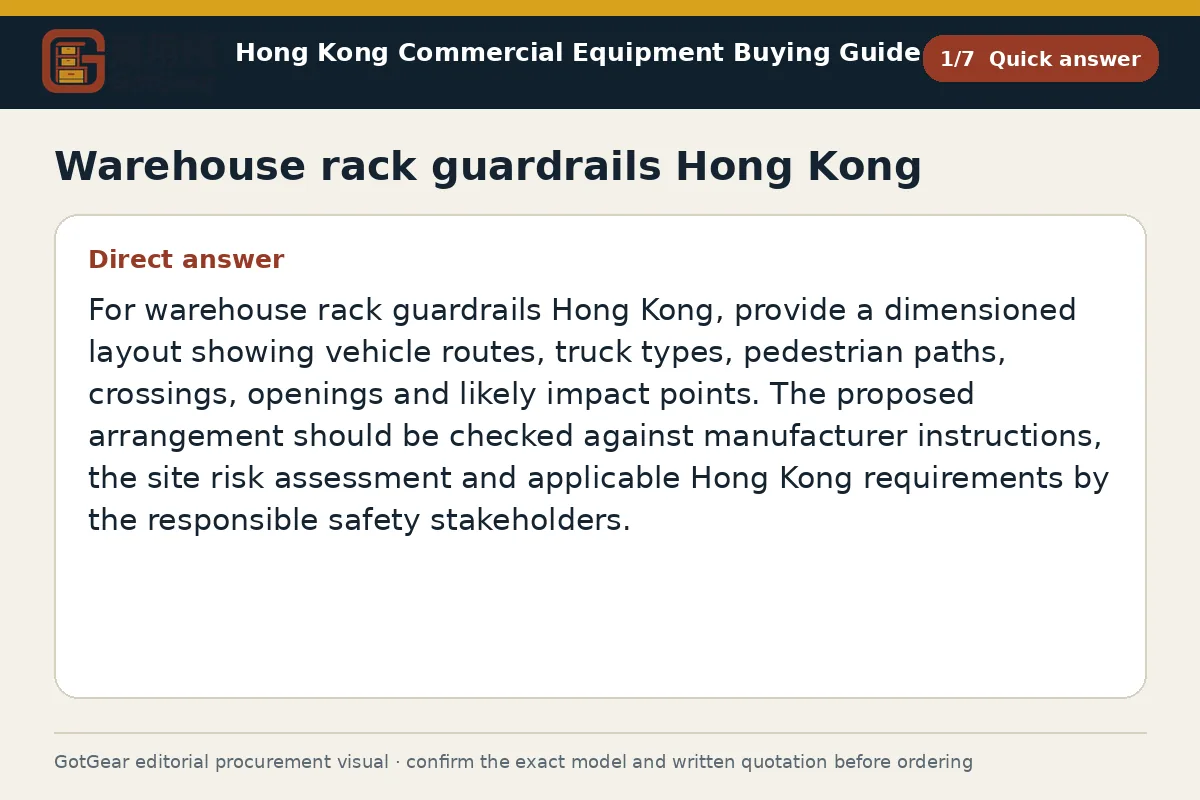
Warehouse rack guardrails Hong Kong
GotGear provides a checklist for warehouse rack guardrails Hong Kong and maps vehicle routes. It reviews racking aisle barriers Hong Kong and racking pedestrian barriers Hong Kong to assess risks in racking areas.
Read the guide
Rack end protection Hong Kong
Use the GotGear checklist to map forklift routes, measure rack end dimensions and assess impact exposure for rack end protection Hong Kong. Compare the results with racking collision protection Hong Kong to identify any gaps.
Read the guide
Racking fire flue space Hong Kong
GotGear provides a checklist for racking fire flue space Hong Kong, describing layouts, storage heights and fire protection considerations. It also gives guidance for warehouse racking sprinkler clearance Hong Kong.
Read the guide
Industrial shelving specification Hong Kong
GotGear explains industrial shelving specification Hong Kong. It covers shelving material specification Hong Kong, plus criteria for industrial shelving corrosion resistance Hong Kong.
Read the guideRelated topic indexOpen more English procurement pages1 topics
Browse additional equipment families, applications and procurement questions relevant to a wider buying brief.