
For rack end protection Hong Kong, record forklift routes, turning areas, rack-end dimensions, nearby doors or crossings and observed impact exposure. Verify any proposed protection against the rack configuration, manufacturer instructions, site conditions, risk assessment and applicable Hong Kong requirements.
Map truck movements around rack end protection Hong Kong
Begin by walking each operating shift to observe actual truck behaviour, not just intended routes. Note vehicle types, mast heights, attachments, typical load sizes, and whether aisles run one‑way or two‑way. Mark turning arcs at aisle mouths, blind corners, pinch points near dock doors, and any pedestrian crossings, time‑stamping where congestion peaks. Photograph existing scuffing or impact marks and sketch the approach angles. Include doors that open into traffic, mezzanine legs and protrusions that narrow turning space.
Transfer findings onto a current, scaled plan. Use distinct layers for forklift directions, reversing zones, parking or staging areas, and “no encroachment” envelopes you want protection to maintain. In Hong Kong, add constraints such as goods‑lift car size, corridor bends between lift and store, and building‑management loading windows that affect installation sequencing. If teams are bilingual, label plans in English and Chinese to aid internal approval. For procurement, package the plan with short video clips, photographs keyed to grid references, and a summary table listing route names, typical speeds and observed conflicts. This becomes the baseline against which suppliers describe rail lengths, post spacing and bollard placement, and it reduces redesign when quotations must reflect precise site geography and agreed operating patterns.
Measure aisle ends and impact points for rack end protection Hong Kong
At each aisle end, measure the clear width, the distance from the end upright face to the nearest obstruction, and the expected opening required for turning with the largest truck and load combination. Record upright size and baseplate footprint, pallet overhang, beam heights within the potential strike zone and any end‑frame bracing. Identify floor joints, drains, patch repairs and slopes that could affect anchoring. As an example starting point only, capture approach angles by taping two chalk lines from tyre tracks to the upright corner to show typical swing paths, then validate with the responsible operator.
Map likely impact heights: fork tips at low level, counterweight corners at mid‑level and load edges higher up. Request quotations that state barrier height, rail configuration, post centres, tested energy absorption, anchor type, finish (galvanised, powder‑coated or duplex), and minimum opening width to be maintained. Ask suppliers to mark any assumed removals, floor repairs and reinstatement. Compare like‑for‑like: number of posts and rails, anchor grade and embedment, end‑cap visibility features and protective caps, and whether installation drawings and a maintenance outline are included. On receipt, inspect coating uniformity, hardware counts, anchor markings and any supplied fixing templates. Where applicable to the proposed model, request the manufacturer’s installation instructions and a statement of compatibility with the racking brand and baseplate geometry before work starts.
What should buyers compare for rack end protection Hong Kong?
| Criterion | Straightforward requirement | More complex requirement | Evidence to provide |
|---|---|---|---|
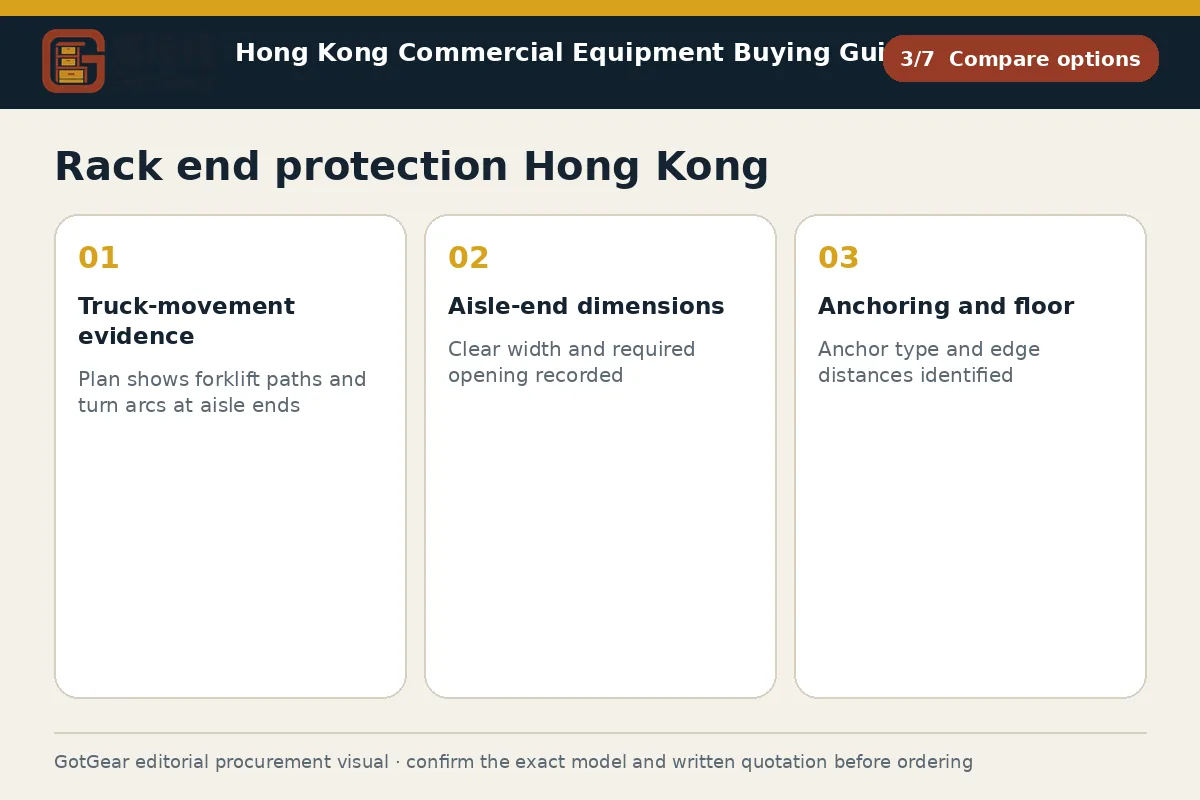
| Truck‑movement evidence | Plan shows forklift paths and turn arcs at aisle ends | Time‑stamped observations for all shifts with photos of impact marks | Scaled plan, videos, annotated photos linked to grid references |
| Aisle‑end dimensions | Clear width and required opening recorded | Upright/baseplate sizes, overhangs, approach angles and obstructions mapped | Measured sketches with dimensions and notes on door swings and crossings |
| Anchoring and floor | Anchor type and edge distances identified | Joint layout, slab strength and services checked; tests if proposed | As‑built drawings/confirmation, joint plan, proposed anchor datasheet and method |
| Barrier configuration | Single height and post spacing stated | Energy rating, multi‑rail layouts and tie‑ins with adjacent barriers defined | Manufacturer data on tested performance, layout drawing with post centres |
| Finish and environment | Powder‑coat colour stated | Corrosion‑resistant system specified for humid/coastal areas with maintenance notes | Finish specification, fastener material, cleaning/maintenance guidance from manufacturer |
This framework helps buyers create comparable written enquiries. Final model specifications, availability, delivery and commercial terms must be confirmed in a formal quotation.
Rack end protection Hong Kong: Coordinating with racking collision protection
Protection works best when planned as a system. Coordinate rack-end protection and racking collision protection in Hong Kong along aisles, at corners and near doorways so that elements do not compete for the same floor space. Align end-guards, bollards and any racking aisle barriers in Hong Kong to maintain agreed openings for turning and pedestrian routes, and keep access to fire equipment and controls clear. Confirm that line-marking, mirrors and signage complement the physical barriers rather than creating visual clutter.
Check with your rack supplier that end-guards do not obstruct baseplate inspection, shim access or upright plumb adjustments, and that anchors and edge distances will not compromise slab joints. Preserve pallet racking clearances in Hong Kong at end bays, including any building-manager egress requirements. Where longer runs are required beside busy walkways, consider integrating with warehouse rack guardrails in Hong Kong for continuity of impact resistance and a consistent top-rail height. In Hong Kong's humid conditions and salt-laden air near the harbour, evaluate finishes and fasteners for corrosion resistance appropriate to your environment. For procurement, request combined drawings showing barrier positions overlaid on the racking layout and the warehouse racking specification for Hong Kong, with phasing notes that respect loading-bay bookings and management-office access rules. Ask that quotations state assumptions for night or weekend work if daytime windows are limited.
Verify rack and floor details before choosing rack end protection Hong Kong
Before choosing any model, verify the exact rack configuration and the floor’s capacity to take anchors. Record the racking brand and series, upright profile and baseplate dimensions, shim details, the presence of end‑frame bracing and any accessories at end bays such as end‑panels or mesh. Obtain the rack manufacturer’s instructions regarding compatible guard positions and any restrictions around baseplates. For the slab, seek as‑built drawings or competent confirmation of thickness, reinforcement and compressive strength; note joint locations, embedded services and coatings that may affect drilling and adhesion.
Where the proposal relies on tested impact performance, ask for the manufacturer’s published test method and limits applicable to the offered configuration. If anchors are critical to performance, a pull‑out test may be considered subject to building‑manager consent and the installer’s method statement. In Hong Kong, also plan delivery paths through goods‑lifts and doors, measuring door frames, lift cars and turning space between lift and store; as an example starting point only, sketch a component envelope to check fit before ordering. Specify bilingual safety decals and wall signs where teams require them, and confirm whether institutional or insurer approval is needed for drilling or out‑of‑hours work. After installation, request torque records, photographs of edge distances, and as‑builts showing anchor positions relative to joints for your maintenance file.
Rack end protection Hong Kong decision checklist
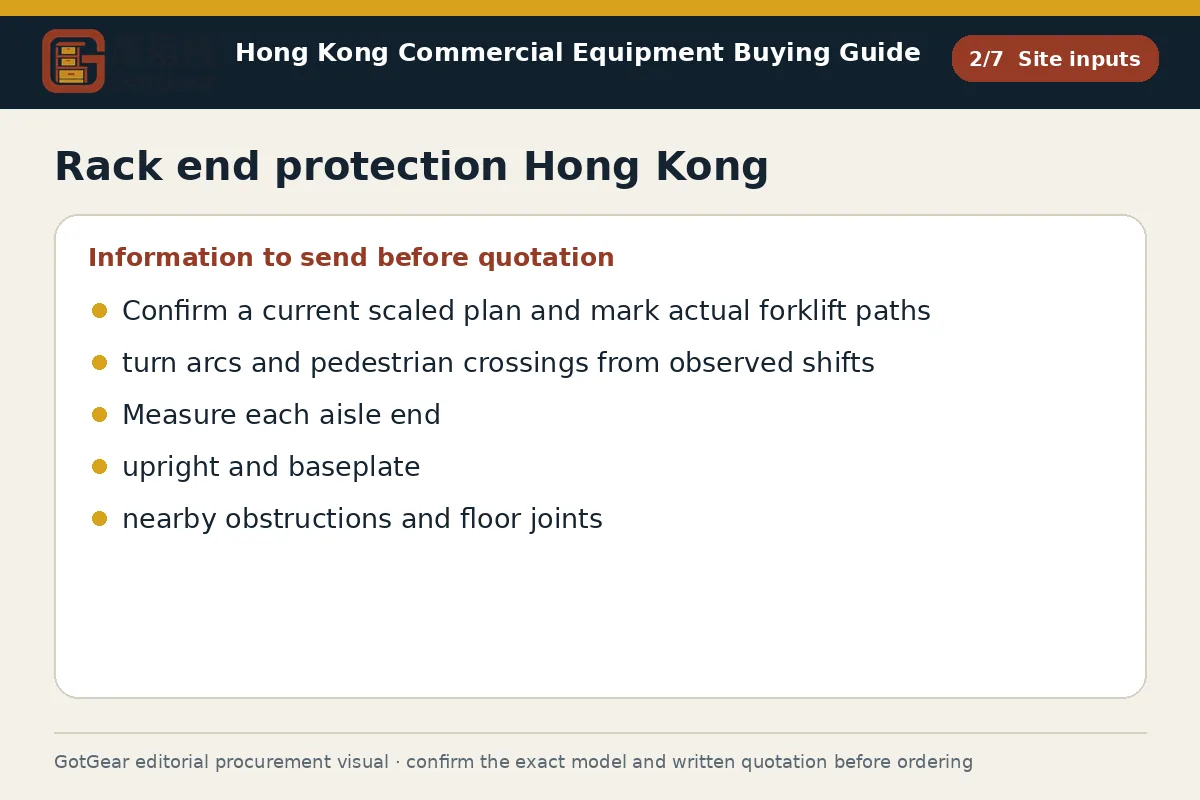
Confirm a current scaled plan and mark actual forklift paths, turn arcs and pedestrian crossings from observed shifts. Measure each aisle end, upright and baseplate, nearby obstructions and floor joints, and note required openings for the largest truck and load. Collate rack brand, series and instructions on compatible guard positions. Obtain floor information or competent confirmation of slab capacity and joint layout. Prepare a combined overlay showing proposed guards, line marking and maintained openings. Request written quotations that state rail heights, post spacing, energy rating, anchor type, finish and any assumed removals or floor repairs. Compare like‑for‑like counts of posts, rails and anchors, installation drawings and warranties offered by the manufacturer. Plan delivery via lifts and doors, booking loading windows with building management. Before work starts, secure any required internal, institutional or insurer approval and request installation and maintenance instructions in bilingual form if needed.
- Operating use, quantity and expected frequency
- Dimensions, capacity, material and accessory requirements
- Delivery address, floor, goods lift and loading window
- Required documents, acceptance checks and after-sales arrangements
Key points for rack end protection Hong Kong, racking collision protection Hong Kong
Many Hong Kong warehouses sit in multi‑storey industrial buildings with tight goods‑lift cars, narrow corridors and managed loading bays. Building‑management offices often allocate short loading windows and may require advance booking, noise control and traffic marshals during peak hours. These constraints affect delivery method, installation phasing and the practicability of heavy drilling. Humid, saline air in coastal districts can accelerate corrosion, so finishes and fasteners should be selected for the environment. Bilingual drawings and decals often speed internal approvals and toolbox talks. Always confirm site rules, building‑manager requirements and any insurer conditions before committing to a solution or programme; this page offers planning guidance, not legal advice.
Questions about rack end protection Hong Kong
What information should I include in a rack‑end protection enquiry?
Provide a scaled plan with forklift routes, turning arcs, aisle‑end dimensions, baseplate sizes, floor joints, required openings, and photos of impact marks. Add the racking brand and series, and any building‑management constraints such as loading windows or lift limits. Ask suppliers to state rail configuration, anchor type, finish and tested performance. The model specification and written quotation should always prevail.
How do I choose finishes for Hong Kong’s humid environment?
Select coatings and fasteners for the actual environment: consider galvanised or duplex systems for areas exposed to moisture or saline air, and durable powder coats for dry interiors. Ask manufacturers for maintenance guidance and touch‑up procedures. Where cleaning chemicals are used, confirm compatibility. Final finish choice should be confirmed with your site conditions, insurer advice and the supplier’s documentation.
Can guards be installed if floor joints or embedded services are near the rack ends?
Yes, but anchor type, edge distances and positions must be checked against joints, reinforcements and services. Provide slab drawings or competent confirmation, and request installation drawings showing hole locations. If critical to the proposal, a pull‑out test or alternative fixing method may be considered with building‑manager consent. The installer’s method statement and the manufacturer’s instructions govern the final approach.
What should I inspect on delivery before installation starts?
Count posts, rails and anchors against the quotation, check coating quality, verify anchor markings and lengths, and review any templates or drawings provided. Confirm that instructions and safety decals match the ordered model and language needs. If components must travel by goods‑lift, re‑check package sizes and weights. Any discrepancies should be resolved in writing with the supplier before drilling begins.
Continue with closely related procurement topics
These pages share equipment, operating or decision-stage signals with this guide.
Warehouse rack guardrails Hong Kong
GotGear provides a checklist for warehouse rack guardrails Hong Kong and maps vehicle routes. It reviews racking aisle barriers Hong Kong and racking pedestrian barriers Hong Kong to assess risks in racking areas.
Read the guide
Pallet racking clearances Hong Kong
Record pallet and load dimensions, overhang, rack geometry, beam levels, lift truck data and elevations for pallet racking clearances Hong Kong. Guidance on pallet load overhang racking Hong Kong is provided by GotGear.
Read the guide
Industrial shelving specification Hong Kong
GotGear explains industrial shelving specification Hong Kong. It covers shelving material specification Hong Kong, plus criteria for industrial shelving corrosion resistance Hong Kong.
Read the guide
Warehouse racking specification Hong Kong
Use the GotGear checklist to compare bids and confirm that your warehouse racking specification Hong Kong, pallet rack specification Hong Kong and racking procurement specification Hong Kong include complete load and layout data.
Read the guideRelated topic indexOpen more English procurement pages1 topics
Browse additional equipment families, applications and procurement questions relevant to a wider buying brief.