
Structure a warehouse racking tender specification Hong Kong around scope, site information, unit loads, handling equipment, layout and elevations, interfaces and responsibilities. Require each respondent to complete the same schedule for assumptions, exclusions, programme dependencies and supporting documents, while leaving verification to the appropriate project stakeholders.
Define project scope in a warehouse racking tender specification Hong Kong
Start by drawing a clear boundary that describes what the supplier must supply: provide a quotation, carry out installation and provide a warranty. Define the number of bays; the aisle type (wide, narrow or very narrow); bay heights; beam levels; pick faces; protection (end guards, column guards); load signage; labelling; and any mezzanine or tunnel-bay interfaces. State whether dismantle-and-dispose of existing racks is in scope, and whether relocation or reuse are prohibited. Provide a measured plan showing structural columns, fire equipment, doors, drains and any overhead conflicts to the best information available.
Describe logistics realities in Hong Kong buildings, including goods-lift and doorway sizes on the route from the loading area to the site, allowed loading hours, queuing limits and whether night work or quiet hours may be required by the building management office. If you already hold a warehouse racking specification for Hong Kong from a previous project, state whether it governs or whether this tender supersedes it. Identify stakeholders who will verify assumptions: the landlord or facilities team for slab data, the safety officer for access controls, and the insurer for any documentation expectations. Make clear which drawings and method statements the installer must submit for approval before fabrication or site mobilisation, and who will sign off each stage.
Issue load and site assumptions in a warehouse racking tender specification Hong Kong
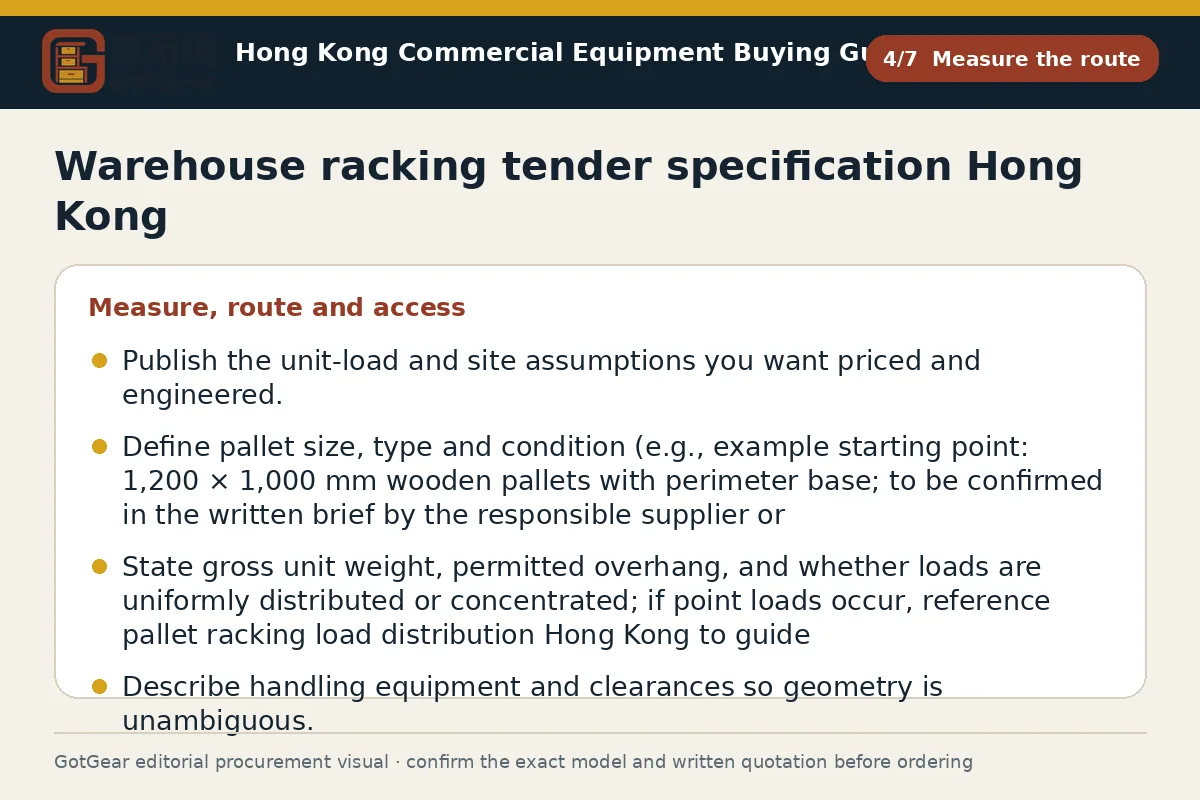
Publish the unit-load and site assumptions you want priced and engineered. Define pallet size, type and condition (e.g., example starting point: 1,200 × 1,000 mm wooden pallets with perimeter base; to be confirmed in the written brief by the responsible supplier or building manager). State gross unit weight, permitted overhang, and whether loads are uniformly distributed or concentrated; if point loads occur, reference pallet racking load distribution Hong Kong to guide how respondents evidence beam sizing.
Describe handling equipment and clearances so geometry is unambiguous. Specify truck types, mast heights, aisle widths and approach directions. If you expect order-picking or reach-truck operations, reference pallet racking clearances Hong Kong so bidders show pallet, beam and sprinkler separations accordingly. Record building assumptions to be verified: example starting point slab bearing capacity, allowable floor anchors, ceiling height to lowest obstruction, humidity exposure, and any corrosion risk near loading docks. Document the delivery route: lift car and door dimensions, turning spaces, ramp gradients and any public-area controls that could restrict material handling on event days.
What should buyers compare for warehouse racking tender specification Hong Kong?
| Criterion | Straightforward requirement | More complex requirement | Evidence to provide |
|---|---|---|---|
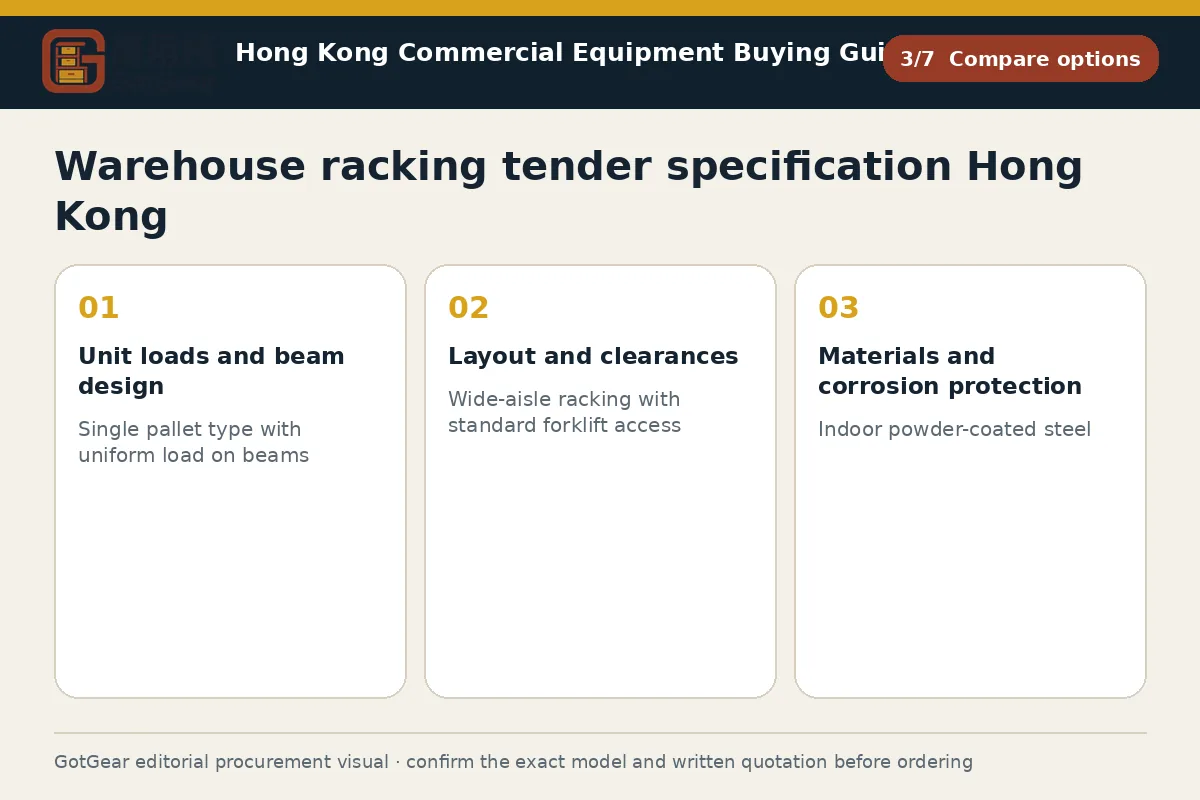
| Unit loads and beam design | Single pallet type with uniform load on beams | Mixed pallet sizes and point loads with dedicated zones | Pallet drawings, weights, overhang; load distribution notes |
| Layout and clearances | Wide-aisle racking with standard forklift access | Very narrow aisle with guidance and pick levels under sprinklers | Handling-equipment spec, aisle width, elevation drawing |
| Materials and corrosion protection | Indoor powder-coated steel | Hot-dip galvanised frames with stainless fixings in humid zones | Coating type, thickness, environment rationale |
| Interfaces and services | No services affected by racking | Sprinkler head drops, lighting changes, pick-face accessories | Coordination drawings; responsibilities matrix |
| Installation and handover | Weekday, daytime single-phase install | Night work, phased areas, lift bookings and noise limits | Programme, RAMS, permits and sample load sign |
This framework helps buyers create comparable written enquiries. Final model specifications, availability, delivery and commercial terms must be confirmed in a formal quotation.
Make responses comparable with a warehouse racking tender specification Hong Kong
To make responses truly comparable, issue a structured schedule of compliance. Require bidders to confirm the proposed racking series, upright section, beam profile, connector type, lock detail and safety locking method, and the steel grade and finish. Ask them to complete standardised tables for bay configurations, beam centres, load-per-beam level and frame load limits, with deflection criteria declared. Where variants are offered, require a separate, clearly labelled schedule for each alternative.
Set out a common list of drawings and data: plan layouts with elevations, load signage samples in English and Traditional Chinese, and a responsibilities matrix for interfaces such as sprinklers, lighting, floor repairs and IT equipment. To make quotations comparable, the warehouse racking tender specification for Hong Kong should also prescribe how programme, delivery method and installation phasing are to be presented, and how risks and exclusions are to be declared. If connector design matters to your maintenance regime, state acceptable pallet rack beam connectors for Hong Kong and lock types by generic description rather than by brand. Use this guide to compare specifications and prepare a written enquiry so evaluation focuses on fit-for-purpose outcomes rather than guesswork.
Request documents and exclusions in a warehouse racking tender specification Hong Kong
Ask every respondent to submit product data sheets, assembly instructions, and layout/elevation drawings aligned to your grid. Where your venue, insurer or landlord expects it, request structural calculations or a capacity statement by a competent party for the declared load case; clarify whether this must precede fabrication. Require a method statement and risk assessment covering delivery routes, lift booking, material staging, noise controls and waste disposal, along with a draft installation programme. Insist on sample load signs and any proposed training materials in bilingual format.
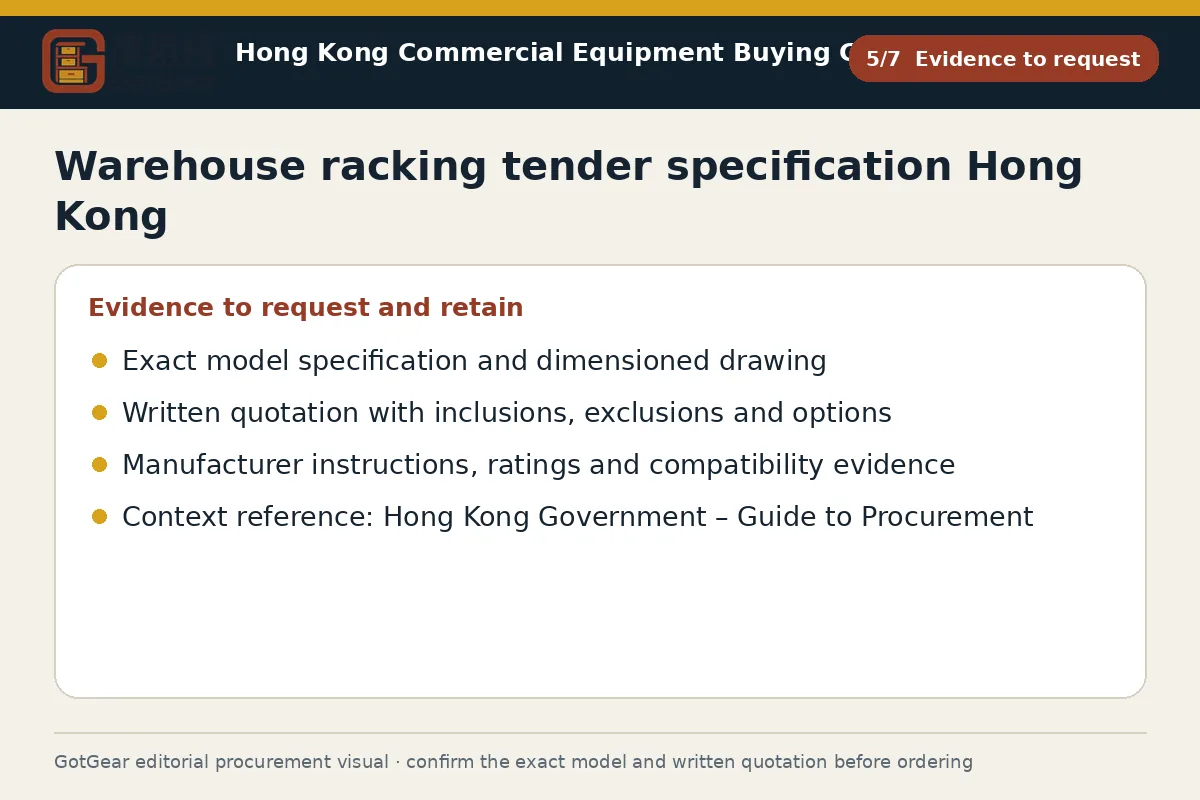
Make exclusions explicit to avoid false equivalence. Ask bidders to list what is not included: floor levelling or repairs, relocation of sprinklers or electrical/IT services, fire-alarm impairments, labels, netting, mesh backs, anti-collapse panels, and post-install cleaning—unless you have added them as discrete line items. For receipt and handover, request packing lists with marked components, coating specifications, and example starting point inspection checks for dents, coating damage and beam connector locks; final acceptance must follow your model specification and the contractor’s formal written quotation.
Warehouse racking tender specification Hong Kong decision checklist
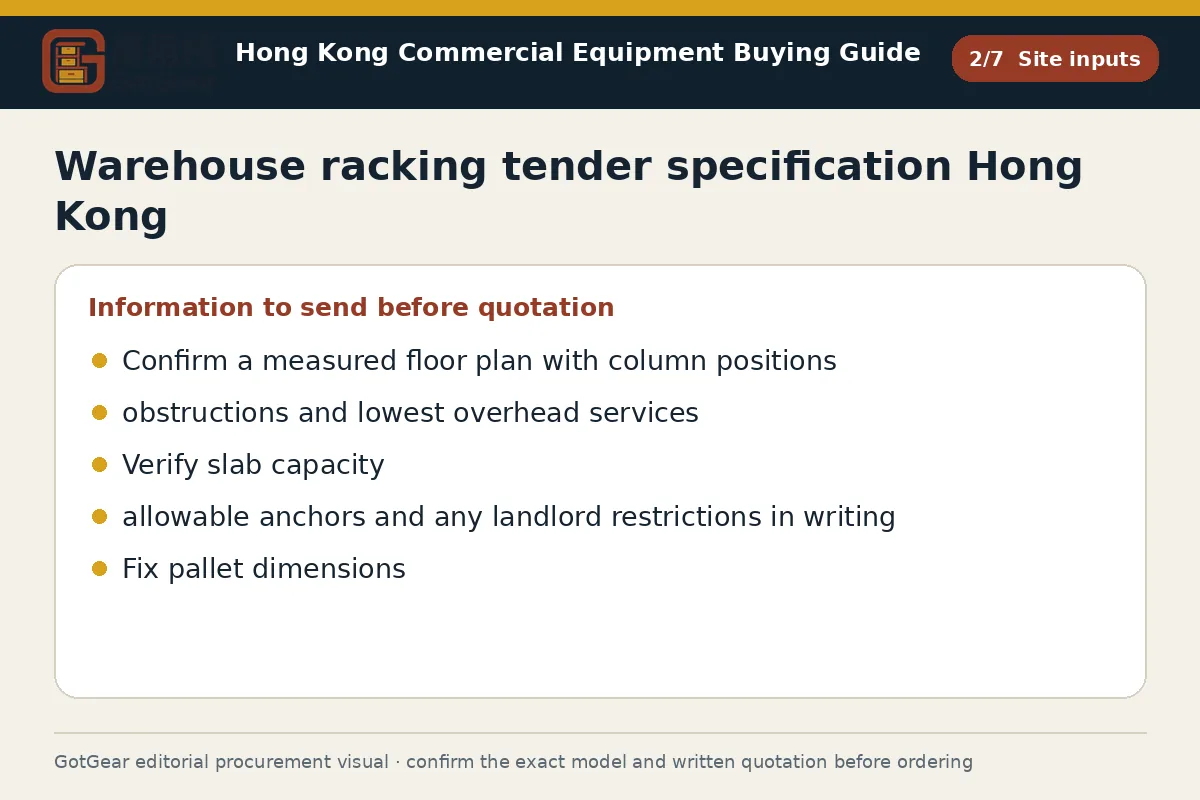
Confirm a measured floor plan with column positions, obstructions and lowest overhead services. Verify slab capacity, allowable anchors and any landlord restrictions in writing. Fix pallet dimensions, gross weights, overhang and load distribution, and declare handling equipment and required clearances. Record the delivery route, lift sizes and permitted loading windows. Issue a compliance schedule covering racking series, beam levels, load tables, finish, programme, risks and exclusions. Request drawings, bilingual load signs and method statements. Compare quotations line-by-line using the same schedule, separating variants. On receipt, check packing lists, component marks, coatings and connector locks before installation, and accept only against your model specification and the contractor’s formal written quotation.
- Operating use, quantity and expected frequency
- Dimensions, capacity, material and accessory requirements
- Delivery address, floor, goods lift and loading window
- Required documents, acceptance checks and after-sales arrangements
Key points for warehouse racking tender specification Hong Kong
Hong Kong sites often constrain racking projects with tight goods-lift cars, small doorways and limited loading windows controlled by the building management office. Confirm lift dimensions, booking rules and queuing tolerance in advance. Humid, coastal conditions may justify enhanced coatings indoors near loading docks; discuss with your venue and supplier. Some institutions require bilingual submissions and documented method statements before night work or noisy activities. This page highlights operating constraints, not legal advice; formal approvals and any authority interactions should be confirmed with your landlord, insurer and a competent adviser for the specific premises.
Questions about warehouse racking tender specification Hong Kong
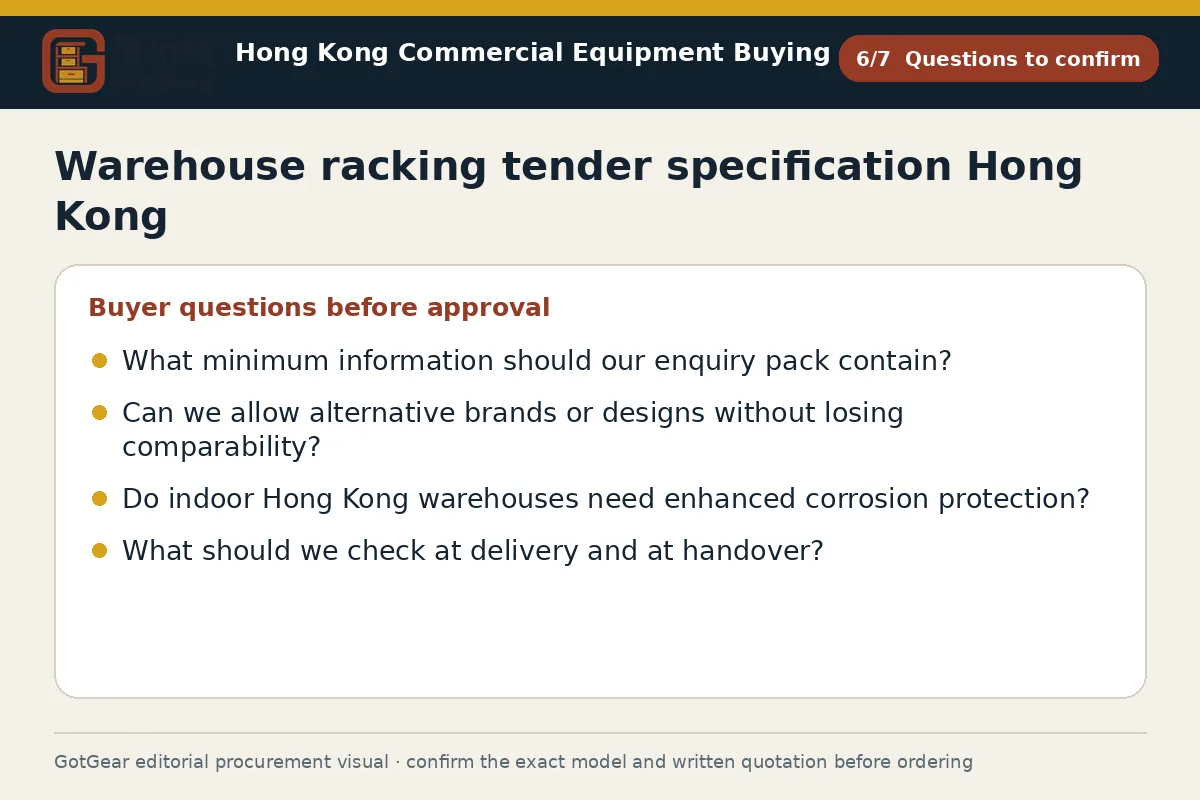
What minimum information should our enquiry pack contain?
Provide a measured plan, unit-load data (size, weight, overhang, distribution), handling equipment and clearances, environmental assumptions, delivery route details, and a responsibilities matrix. Include a compliance schedule for racking series, frames, beams, connectors, coatings, programme and exclusions. Add required drawings and bilingual load-signage samples. Final content should be confirmed with your building manager, facilities team and the shortlisted suppliers.
Can we allow alternative brands or designs without losing comparability?
Yes—require a separate, clearly labelled schedule of compliance for each variant, with identical fields: capacities, beam centres, materials, connectors, finish, programme and exclusions. Insist on distinct drawings and load tables per option. Make clear which option is the base offer used for evaluation. Any substitution remains subject to landlord, insurer and competent adviser acceptance for your site.
Do indoor Hong Kong warehouses need enhanced corrosion protection?
Often, standard powder coating is adequate indoors, but humidity and salt air near loading docks can justify galvanised components or upgraded finishes. Ask bidders to state coating type and thickness, with a rationale for your environment. Confirm expectations with your landlord or insurer, and align with housekeeping practices that affect moisture exposure and cleaning chemicals.
What should we check at delivery and at handover?
Match packing lists to marked components, then inspect uprights and beams for dents, twists, coating damage and straightness before installation. Verify connector locks and fasteners, and quarantine any suspect parts. At handover, require as-built layouts, bilingual load signs, and a maintenance and inspection briefing. Sampling levels and acceptance criteria should follow your model specification and the supplier’s written proposal.
Continue with closely related procurement topics
These pages share equipment, operating or decision-stage signals with this guide.
Warehouse racking specification Hong Kong
Use the GotGear checklist to compare bids and confirm that your warehouse racking specification Hong Kong, pallet rack specification Hong Kong and racking procurement specification Hong Kong include complete load and layout data.
Read the guide
Warehouse rack guardrails Hong Kong
GotGear provides a checklist for warehouse rack guardrails Hong Kong and maps vehicle routes. It reviews racking aisle barriers Hong Kong and racking pedestrian barriers Hong Kong to assess risks in racking areas.
Read the guide
Racking fire flue space Hong Kong
GotGear provides a checklist for racking fire flue space Hong Kong, describing layouts, storage heights and fire protection considerations. It also gives guidance for warehouse racking sprinkler clearance Hong Kong.
Read the guide
Industrial shelving specification Hong Kong
GotGear explains industrial shelving specification Hong Kong. It covers shelving material specification Hong Kong, plus criteria for industrial shelving corrosion resistance Hong Kong.
Read the guideRelated topic indexOpen more English procurement pages5 topics
Browse additional equipment families, applications and procurement questions relevant to a wider buying brief.