
For warehouse rack guardrails Hong Kong, provide a dimensioned layout showing vehicle routes, truck types, pedestrian paths, crossings, openings and likely impact points. The proposed arrangement should be checked against manufacturer instructions, the site risk assessment and applicable Hong Kong requirements by the responsible safety stakeholders.
Map vehicle routes before placing warehouse rack guardrails Hong Kong
Begin with a live map of powered-vehicle movement across shifts. List truck types (counterbalance, reach, VNA, pallet stackers), attachments, typical loads and seasonal peaks. Record origin/destination pairs: receiving dock, goods lifts, staging, export lanes and charging rooms. Note reverse moves, picking hot-spots and blind corners. Before you select warehouse rack guardrails Hong Kong, sketch these routes over a scaled plan so protection follows demonstrated risk rather than rack geometry.
Measure aisle clear widths between uprights and obstacles; end-of-aisle turning length; door and curtain widths; mast heights versus lintels; and any ramp gradients. Log obstructions (columns, hydrants, panels, drains) and current impact marks. As an example starting point only, test end-of-aisle turning boxes of 3–5 m length and corner radii of 1.8–2.4 m, then confirm with the supplier, manufacturer or competent adviser for your fleet. In multi-storey buildings, confirm goods-lift car size and the path width for getting posts and rails to the floor. Photograph scuffed corners, pallet-tear points and exposed structures; these locations often merit protection. Keep the route map bilingual if your teams span languages.
Record crossings and openings for warehouse rack guardrails Hong Kong
Catalogue every place where people, trolleys and vehicles intersect. Doors, roller shutters, fire exits, staircase landings, time‑clock queues and canteens often generate crossings. Identify dock edges, weighing points and scan stations that need side openings in longer runs. For each opening, state the intended traffic and direction, then set a target clear width and gate swing where relevant. As an example starting point only, you might trial 1.2 m for a single‑file pedestrian gate and 1.8 m for a two‑way crossing, subject to your risk assessment and approvals.
Define how users will see and use each opening. Specify floor markings, contrasting colours and rack aisle signs for Hong Kong sites that name the aisle and indicate any one‑way rules. Request self‑closing personnel gates with damped hinges unless your plan calls for controlled access. Number each crossing on the drawing, indicate which runs are continuous, and show keeper posts that prevent vehicles from clipping gate edges. Capture the descent paths of fire shutters and the minimum egress widths agreed with the building manager so barrier lines do not obstruct evacuation routes. Document any institutional approval steps, especially if public or student access is nearby.
What should buyers compare for warehouse rack guardrails Hong Kong?
| Criterion | Straightforward requirement | More complex requirement | Evidence to provide |
|---|---|---|---|
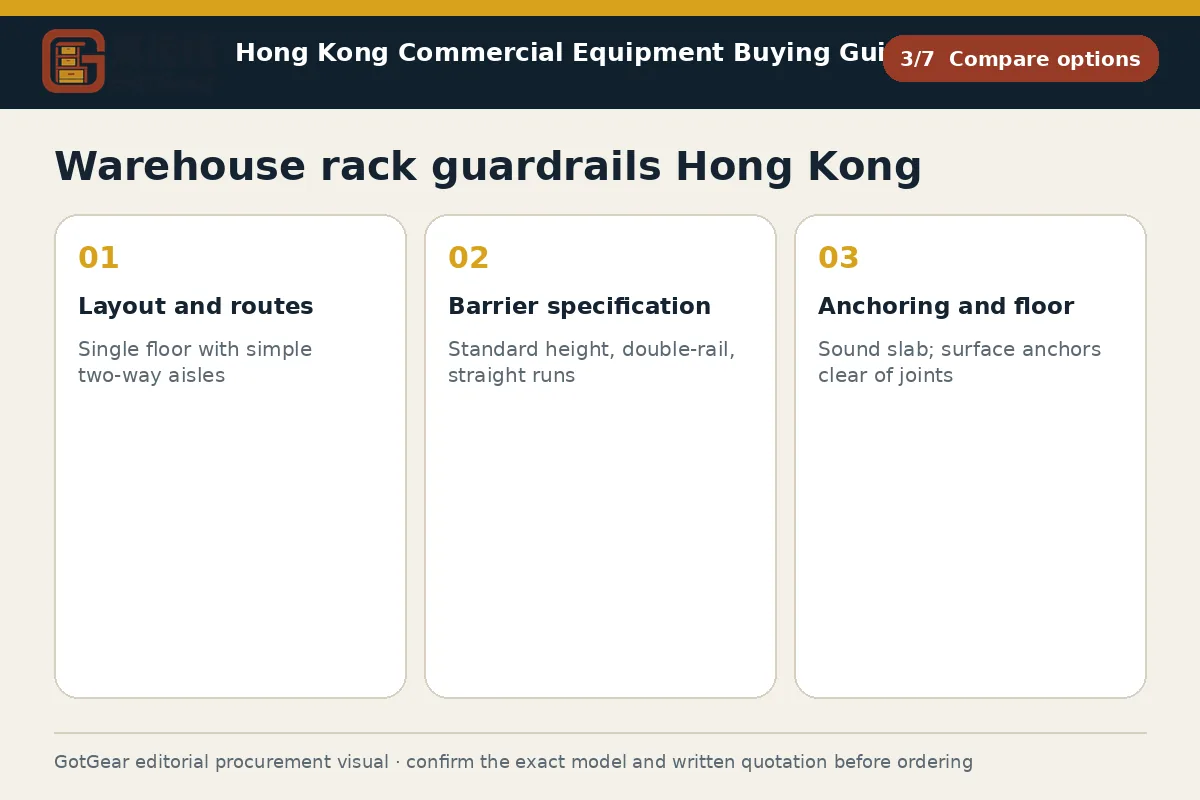
| Layout and routes | Single floor with simple two‑way aisles | Multi‑vehicle routes, mezzanines and blind corners | Scaled plan showing routes, turn radii, truck types and hot‑spots |
| Barrier specification | Standard height, double‑rail, straight runs | Mixed heights, corners, flares and gated openings | List height, rails, post centres, return lengths, corner radii and gate count |
| Anchoring and floor | Sound slab; surface anchors clear of joints | Rebar‑dense slab, waterproofing or expansion joints | Photos, joint map, core composition notes, scan results if available |
| Integration with racking | Parallel runs along aisles | Tight end‑of‑aisle with rack end protection and offsets | Distances from rack faces, bottom‑beam height, racking drawings |
| Finish and signage | Indoor powder coat; standard decals | Humid/coastal exposure; bilingual safety labels | Finish code, environment notes, language requirements and sample photo |
This framework helps buyers create comparable written enquiries. Final model specifications, availability, delivery and commercial terms must be confirmed in a formal quotation.
Warehouse rack guardrails Hong Kong: Coordinate with racking aisle barriers
Set barrier lines that work together with rack‑end defences. Where you plan rack end protection Hong Kong, align guardrail ends and returns so they neither snag pallets nor narrow the aisle entry. If you are adding racking aisle barriers Hong Kong along pick‑faces, show offsets from the rack face and end‑frame to preserve manoeuvring room and bin reach. Reference pallet racking clearances Hong Kong and your in‑house spacing rules to keep beam, upright and barrier relationships consistent across bays. Coordinate all barrier heights and offsets with the warehouse racking specification Hong Kong you hold on file.
On your specification, request post centres, rail count, barrier height, end returns or flares, corner modules and minimum inside radii. Ask the supplier to state fixing type, hole pattern, baseplate size and any expansion‑joint allowances. As example starting points only, test layouts with 200–300 mm offsets from upright faces at aisle ends and a gentle flare, then confirm with the rack and barrier manufacturers. Provide a marked‑up plan showing expansion joints, saw cuts and drains so anchor positions avoid them. For quotations, ask vendors to overlay proposals on your plan and itemise each run, corner, return and gate for like‑for‑like comparison.
Racking and pedestrian barriers in Hong Kong: Warehouse rack guardrails Hong Kong
Plan safe foot movement with racking pedestrian barriers Hong Kong complementing vehicle guardrails. Define where fixed handrail, mid‑rail and toe‑board are required, and where visibility gaps are preferable for supervision. Identify points that need self‑closing personnel gates, sections that may require removable rails under permit, and any tactile demarcation your institution specifies. In humid interiors or near sea air, request finishes suitable for corrosion exposure, such as hot‑dip galvanizing or duplex coatings, only if advised for your environment and maintenance regime.
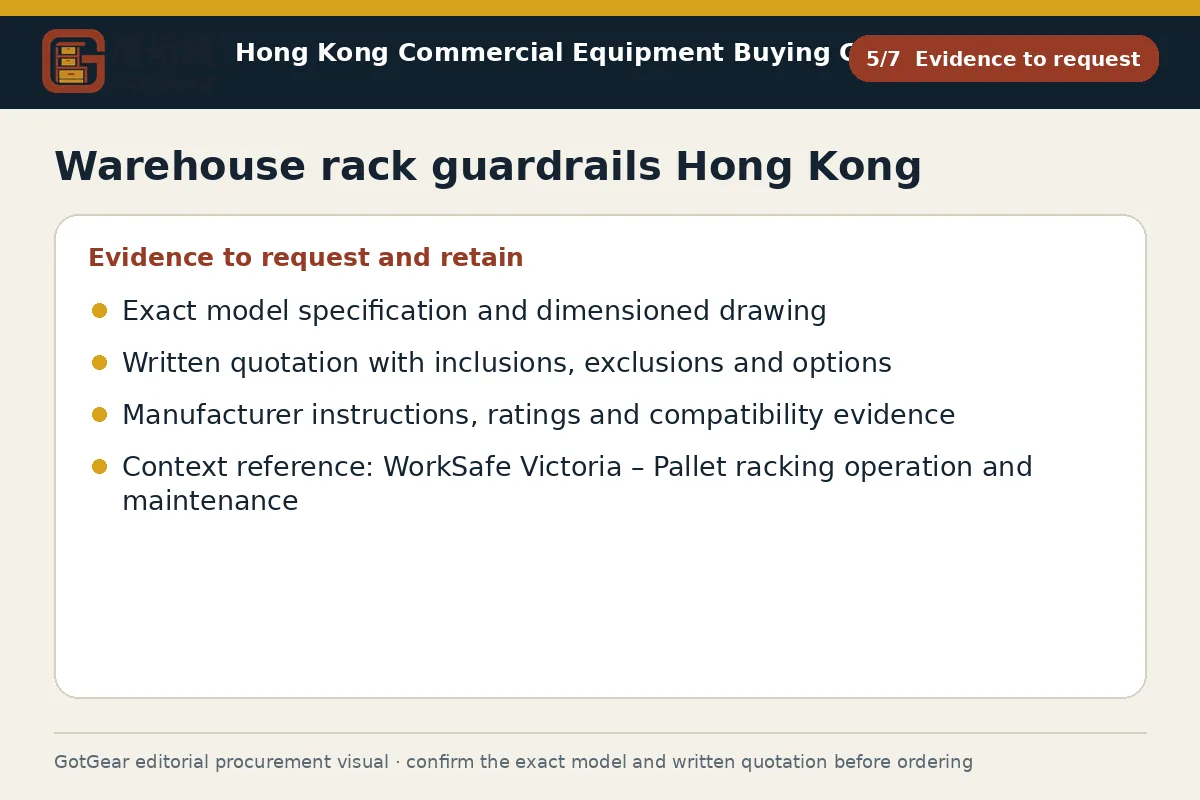
For procurement, ask for manufacturer installation instructions, torque values for anchors, material thicknesses, steel grades and maintenance guidance. Seek sample photos or a mock‑up component to check colour, surface finish and bilingual decals. On receipt, inspect posts and rails for coating damage, flat baseplates, correct fastener counts and clear part numbering against the packing list. After installation, verify bolt torque and gate self‑closing performance as instructed by the supplier, and record barrier IDs on your site plan. Where warehouse edges meet public‑event areas or retail back‑of‑house, plan temporary stewarding or tapers that never remove core protection.
Warehouse rack guardrails Hong Kong decision checklist
Confirm a scaled, dimensioned plan showing powered‑vehicle routes, turning at aisle ends, door lines and dock staging. List truck types, loads and attachments, then mark all crossings and any gate openings with clear widths, swing direction and keeper posts. Record floors’ joints, drains and sensitive areas, plus goods‑lift sizes and stair widths for moving components. On the specification, request barrier height, rail count, post centres, end returns or flares, corner radii, fixing type and finish, noting any corrosion exposure. Provide photos of impact points. Send the same pack to shortlisted suppliers and compare written quotations line‑by‑line against your plan. Ask for installation instructions, anchor data and maintenance notes. Installation windows, waste removal and bilingual labels should be confirmed in writing. Model specifications and the formal written quotation prevail.
- Operating use, quantity and expected frequency
- Dimensions, capacity, material and accessory requirements
- Delivery address, floor, goods lift and loading window
- Required documents, acceptance checks and after-sales arrangements
Key points for warehouse rack guardrails Hong Kong, racking aisle barriers Hong Kong, racking pedestrian barriers Hong Kong
Hong Kong warehouses often sit in multi‑storey industrial buildings with tight goods‑lift cars, narrow corridors and short loading windows. Coordinate with building management early for drilling permissions, noisy‑work time bands and any requirement to scan slabs for rebar or post‑tensioned cables before anchoring. Humid, saline air in some districts increases the case for robust coatings and regular inspections. Agree bilingual signage, method statements and evacuation path protection with stakeholders. This is operational guidance only; confirm project specifics with your manufacturers, competent advisers and the venue or landlord before works.
Questions about warehouse rack guardrails Hong Kong
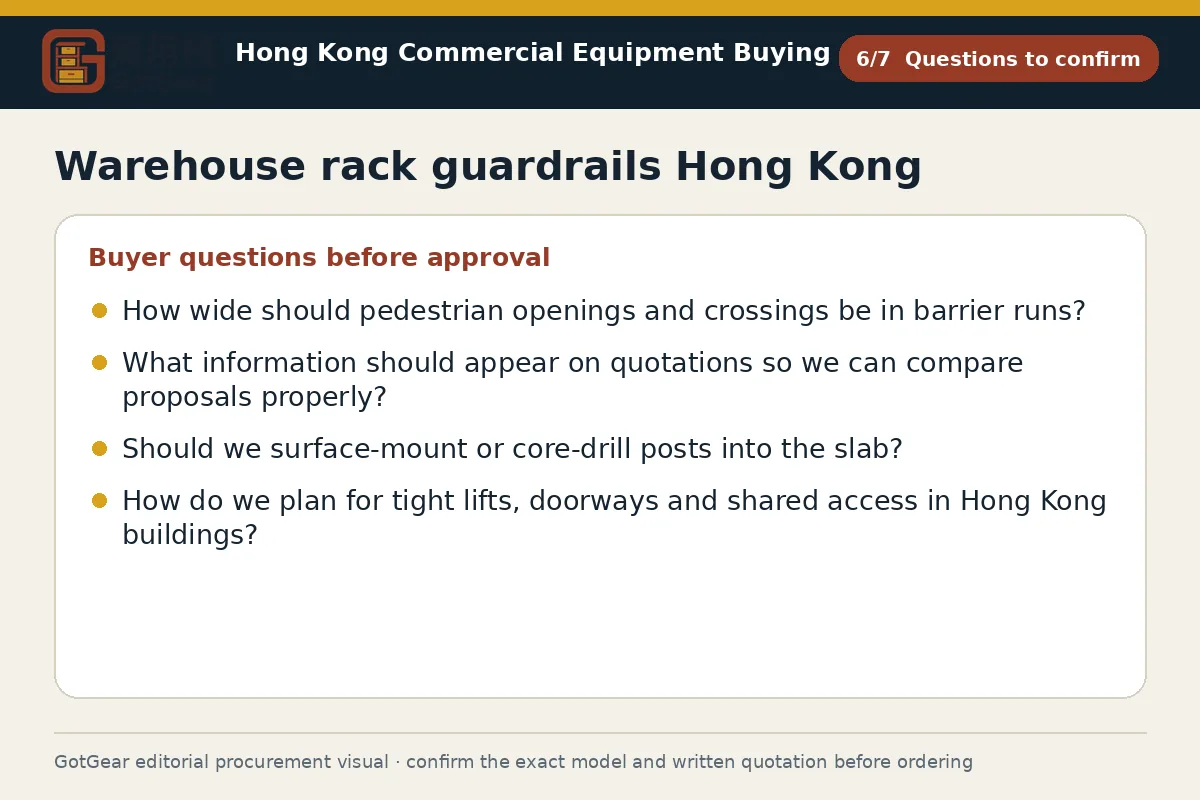
How wide should pedestrian openings and crossings be in barrier runs?
Size them to the traffic and evacuation needs you have defined on the plan. As an example starting point only, trial 1.2 m for a single‑file gate and 1.8 m for a two‑way crossing, then confirm with the supplier, building manager and your safety stakeholders. Mark swing direction, keeper posts and visibility aids so proposals can be checked against the site risk assessment.
What information should appear on quotations so we can compare proposals properly?
Look for a drawing overlay referencing every straight run, corner, return and gate to your plan, plus barrier height, rail count, post centres, fixing type, baseplate size and finish. Inclusion of end flares, corner radii, keeper posts and signage interfaces should be explicit. Require installation notes, anchor data sheets and warranty terms where offered. The written quotation and model specification prevail.
Should we surface‑mount or core‑drill posts into the slab?
Choose the fixing method that matches your slab construction, joint layout and maintenance plan. Surface‑mounted baseplates suit many retrofits; core‑drilled sockets may control impact loads differently. Either way, confirm edge distances, embedment and rebar location with the supplier or a competent adviser. Where building management requires it, obtain and file anchor data and any permitted‑work method statements.
How do we plan for tight lifts, doorways and shared access in Hong Kong buildings?
Measure lift car size, door widths, turning on landings and any height pinch‑points along the route to the floor. Share these constraints in your enquiry so suppliers can split rails, select shorter modules or propose assembly sequences. Coordinate loading times, lift booking and protection of common areas with management. State any out‑of‑hours limits and waste‑removal rules in writing.
Continue with closely related procurement topics
These pages share equipment, operating or decision-stage signals with this guide.
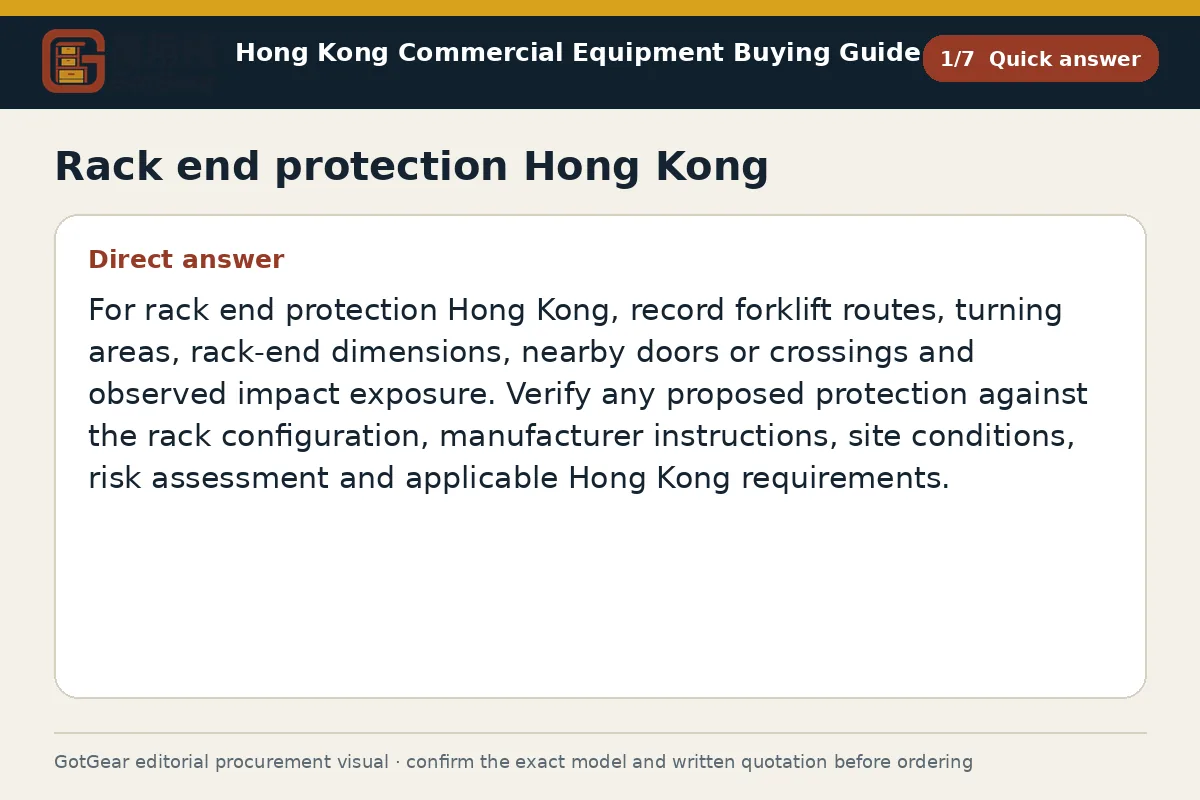
Rack end protection Hong Kong
Use the GotGear checklist to map forklift routes, measure rack end dimensions and assess impact exposure for rack end protection Hong Kong. Compare the results with racking collision protection Hong Kong to identify any gaps.
Read the guide
Warehouse racking specification Hong Kong
Use the GotGear checklist to compare bids and confirm that your warehouse racking specification Hong Kong, pallet rack specification Hong Kong and racking procurement specification Hong Kong include complete load and layout data.
Read the guide
Pallet racking clearances Hong Kong
Record pallet and load dimensions, overhang, rack geometry, beam levels, lift truck data and elevations for pallet racking clearances Hong Kong. Guidance on pallet load overhang racking Hong Kong is provided by GotGear.
Read the guide
Racking fire flue space Hong Kong
GotGear provides a checklist for racking fire flue space Hong Kong, describing layouts, storage heights and fire protection considerations. It also gives guidance for warehouse racking sprinkler clearance Hong Kong.
Read the guideRelated topic indexOpen more English procurement pages2 topics
Browse additional equipment families, applications and procurement questions relevant to a wider buying brief.