
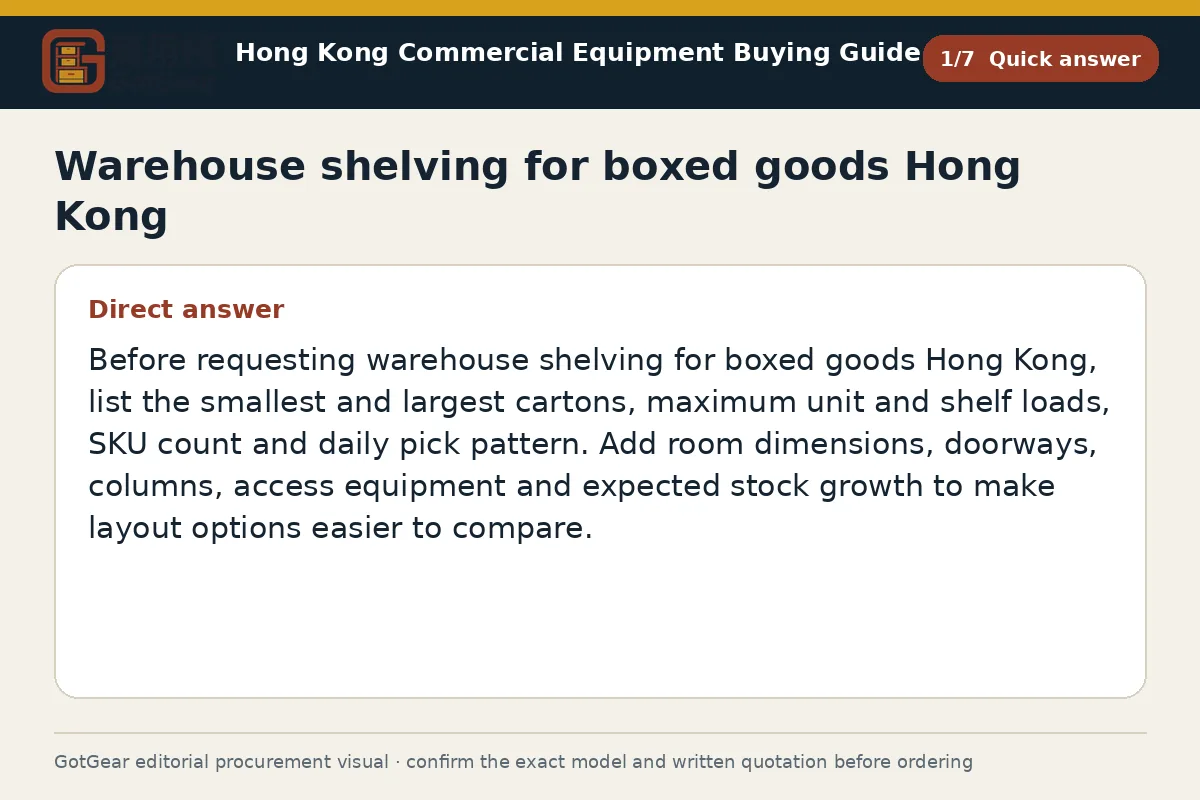
Before requesting warehouse shelving for boxed goods Hong Kong, list the smallest and largest cartons, maximum unit and shelf loads, SKU count and daily pick pattern. Add room dimensions, doorways, columns, access equipment and expected stock growth to make layout options easier to compare.
Size warehouse shelving for boxed goods Hong Kong around the carton range
Begin with the full carton span you actually handle, not an assumed average. Note the minimum and maximum length, width and height, plus the preferred orientation on shelf. Check whether lids or straps increase the overall envelope. When specifying warehouse shelving for boxed goods Hong Kong, teams should size usable shelf openings to the tallest cartons in each family, then decide shelf pitch with enough finger clearance for safe grabs. If cartons are overhanging or prone to crush, plan dividers or bin fronts so faces stay square and labels remain visible.
Measure the real room that bays must pass through: lift car, corridor and doorway clear widths and heights, the turning room to manoeuvre the longest beams, and any stair restrictions if relevant. Ask suppliers to state, in writing, external bay W×D×H, usable shelf depth, clear opening per level, adjustment pitch (for example, 25 mm steps – to be confirmed for the chosen model), shelf material and finish, back/side bracing options, and the accessories included. In humid stores or near loading bays, request corrosion-protection options and touch-up guidance. If bilingual load labels and assembly instructions are needed, flag this at enquiry. The model specification and the formal written quotation always govern final sizing and inclusions.
Record loads and access equipment for warehouse shelving for boxed goods Hong Kong
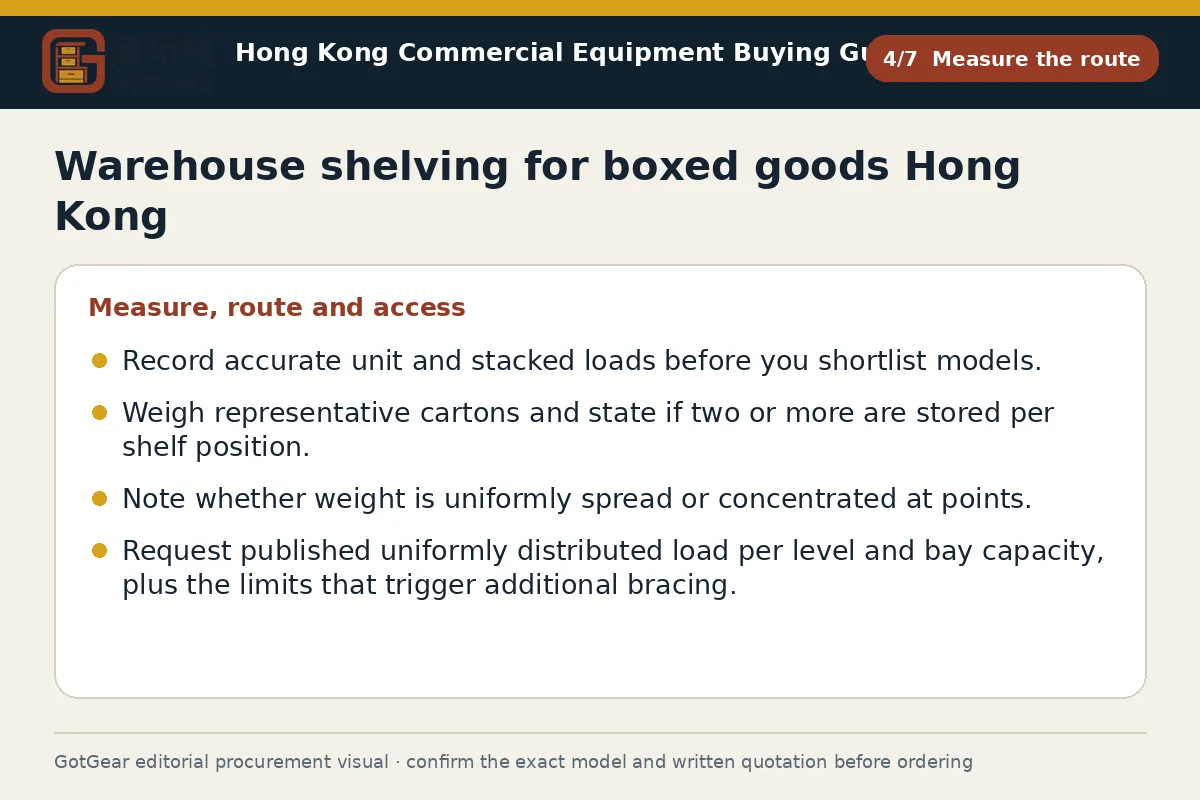
Record accurate unit and stacked loads before you shortlist models. Weigh representative cartons and state if two or more are stored per shelf position. Note whether weight is uniformly spread or concentrated at points. Request published uniformly distributed load per level and bay capacity, plus the limits that trigger additional bracing. If suppliers quote deflection or serviceability criteria, ask for the basis. Any example figures you collect (for example, a 120 kg level load) are starting points only and must be confirmed against the chosen model’s documents.
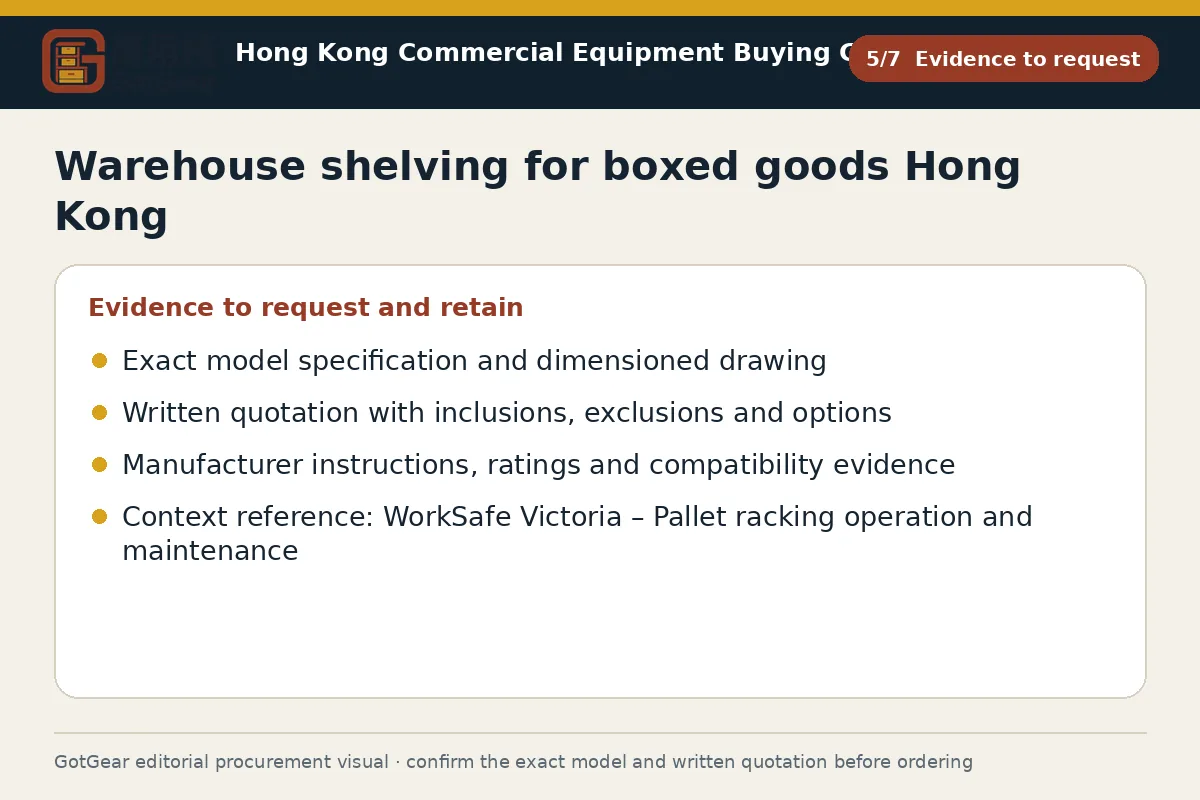
Document the access equipment you will use: order-picking trolleys, mobile steps, pallet jacks, or reach trucks if replenishing from above. Record aisle widths and turning radii, lighting levels at pick faces, and any overhead obstructions. If narrow aisles or high bays are planned, ask whether floor fixing, anti-topple ties, or back panels are recommended for stability. Seek evidence such as a manufacturer’s data sheet, installation manual and load rating labels for the exact configuration quoted. Where humidity is high, confirm coating type, recommended maintenance, and whether perforated or wire shelves are advisable for airflow. The written quotation should tie capacities to your stated shelf count and dimensions.
What should buyers compare for warehouse shelving for boxed goods Hong Kong?
| Criterion | Straightforward requirement | More complex requirement | Evidence to provide |
|---|---|---|---|
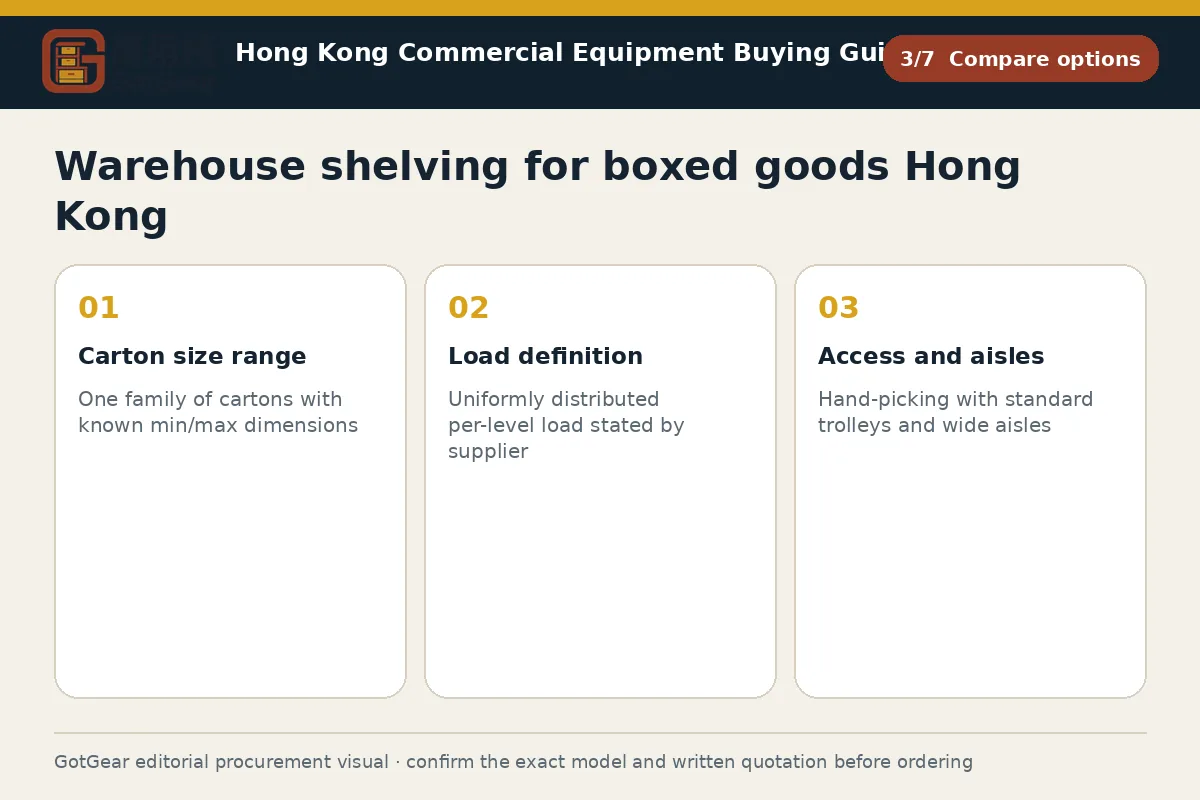
| Carton size range | One family of cartons with known min/max dimensions | Multiple families with mixed orientations and crush limits | Spreadsheet with L×W×H, orientation notes, and any do-not-stack rules |
| Load definition | Uniformly distributed per-level load stated by supplier | Mixed point loads or long cartons needing reinforcement | Measured weights, stacking plan, and any concentrated load positions |
| Access and aisles | Hand-picking with standard trolleys and wide aisles | Mobile steps/order pickers with narrow or one-way aisles | Equipment dimensions, turning radii, and target aisle width plan |
| Site access constraints | Ground-floor store with easy loading-bay access | Upper-floor store via small goods-lift and tight corridors | Lift car size, route sketches, doorway sizes, delivery windows |
| Environment and approvals | Dry indoor store with standard finish acceptable | Humid/coastal site or institutional approvals required | Humidity concerns, finish preference, building rules, document language |
This framework helps buyers create comparable written enquiries. Final model specifications, availability, delivery and commercial terms must be confirmed in a formal quotation.
Lay out warehouse shelving for boxed goods Hong Kong for picking and replenishment
Lay out bays so fast-moving SKUs sit in the ‘golden zone’ between waist and chest height, with slow movers placed lower or higher. Where space permits, separate picking aisles from replenishment aisles, or establish one-way flows to reduce interference. Keep cross-aisles to cut walking distance, but do not obstruct fire egress routes; confirm any aisle or clearance rules with the building manager or a competent adviser. Where cartons are heavy, use shorter-span shelving and more shelf levels to provide additional pick faces at ergonomic heights.
Integrate slotting with your WMS or paper system early. Agree location codes, label sizes and mounting points compatible with warehouse rack location labels used in Hong Kong; operations frequently use these. Check sightlines for scanners, lighting at beam levels and the need for colour bands to distinguish zones. In Hong Kong industrial buildings, plot columns, sprinkler heads, low beams and windows on a scaled plan, and verify how replenishment trolleys will move from the lift lobby to each aisle. Coordinate with the management office on delivery windows and noise controls that affect build sequencing. Allocate a quarantine and returns area, and plan waste removal so carton offcuts and packaging do not clog exits during installation or at go-live.
Check growth space before choosing warehouse shelving for boxed goods Hong Kong
Project SKU growth, carton changes and seasonal peaks before committing to a frame profile. Choose adjustable shelves with small pitch increments and avoid uncommon bay widths so adding standard levels later is straightforward. Leave space at aisle ends for at least one extra bay per block as a buffer, and confirm that future components will be compatible by model name and series. Where upper tiers or a small mezzanine might be required in future, record headroom and consult the building manager or competent engineer before assuming any structural change.
When comparing quotations, line up bay W×D×H, number of levels, usable shelf depth, per-level and per-bay load ratings, steel thickness, finish, bracing type, levelling plates, anchors, end panels, dividers, label holders, and any back/side panels. Ask for the manufacturer’s data sheet, installation manual, care instructions and load label samples; bilingual versions if required. On receipt, check counts against the packing list; inspect finishes for transit damage or early rust, verify that fixings match the quoted specification, and confirm documentation matches the delivered model. Example inspection checklists are starting points; the model specification and formal written quotation prevail.
Warehouse shelving for boxed goods Hong Kong decision checklist
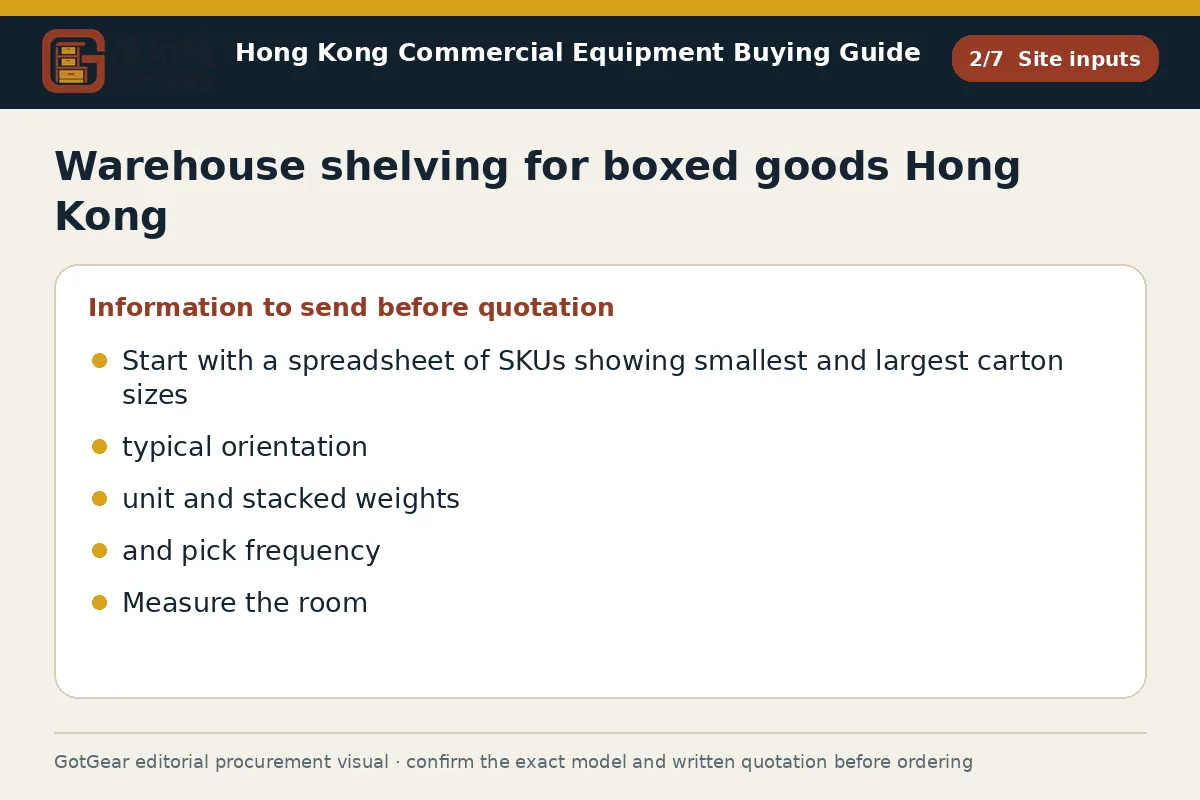
Start with a spreadsheet of SKUs showing smallest and largest carton sizes, typical orientation, unit and stacked weights, and pick frequency. Measure the room, lift, corridors and doorways on the delivery route, noting turning spaces and any steps. Mark columns, sprinklers and exits on a scaled plan. Document access equipment, aisle targets and lighting at pick faces. Specify per-level and per-bay loads, bay W×D×H, usable shelf depth, adjustment pitch and all accessories. Ask for data sheets, installation manuals, finish details, sample load labels and assembly languages. Align quotes line-by-line and confirm delivery sequencing, anchoring method, levelling, and waste handling. Validate any example dimensions with your building manager and ensure the formal written quotation states the exact configuration to be supplied.
- Operating use, quantity and expected frequency
- Dimensions, capacity, material and accessory requirements
- Delivery address, floor, goods lift and loading window
- Required documents, acceptance checks and after-sales arrangements
Key points for warehouse shelving for boxed goods Hong Kong
In Hong Kong, sizing and delivery are often constrained by goods-lift cars, tight lobbies and narrow doorways, so confirm the largest beam and panel lengths that can travel the route from loading bay to store. Many industrial buildings operate set loading windows and require advance booking with the management office; plan deliveries, waste removal and any noisy works accordingly. Humid summers can encourage corrosion, so discuss coatings and storage conditions for uninstalled components. Depending on venue and insurer, method statements, permits-to-work or RAMS may be requested. This summary highlights operating realities and is not legal advice; always follow your building manager’s and supplier’s written instructions.
Questions about warehouse shelving for boxed goods Hong Kong
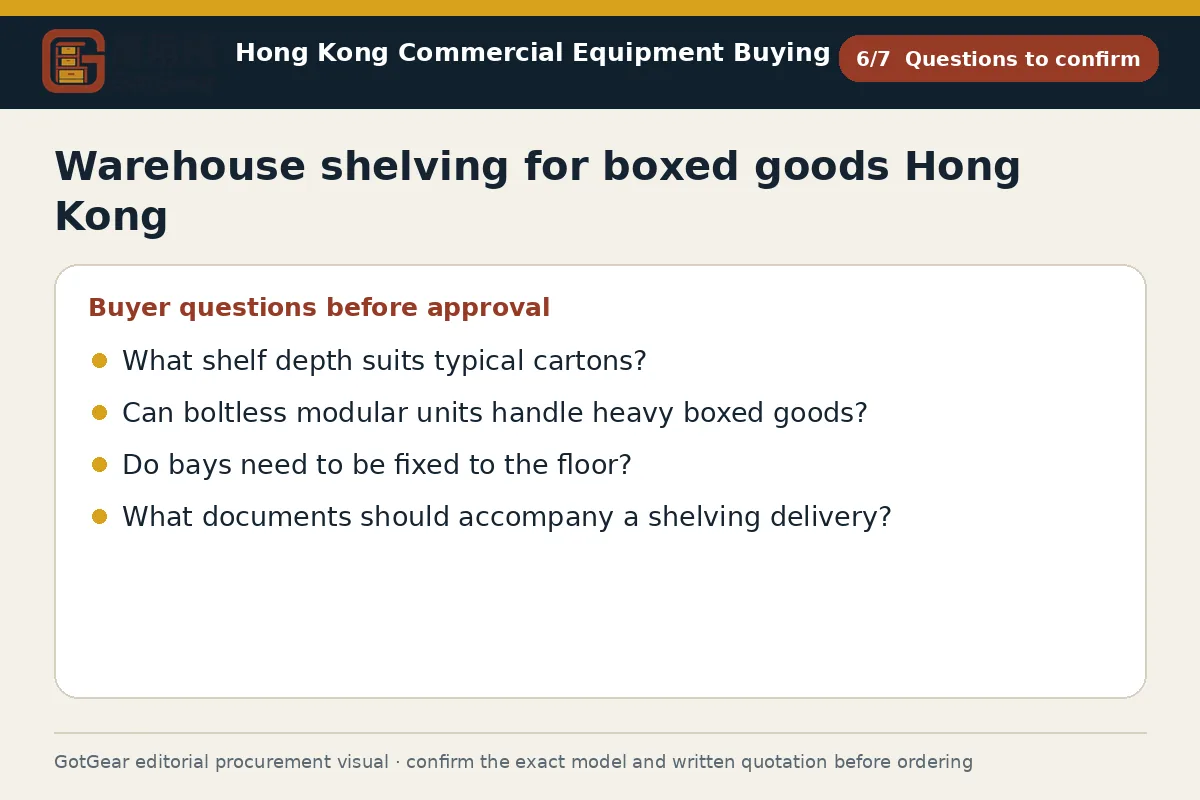
What shelf depth suits typical cartons?
Choose the shallowest shelf that fully supports the carton in its preferred orientation, leaving finger clearance and room for labels. As an example starting point, many light cartons sit well on 300–450 mm shelves, but verify against your largest box and the model’s usable depth. Confirm the bay depth, clear opening and any overhang rules in the supplier’s written specification.
Can boltless modular units handle heavy boxed goods?
Yes, some boltless systems carry substantial loads when fitted with steel shelves and correctly braced. Always verify the per-level and per-bay ratings for your exact span and number of levels, and check the serviceability criteria. If loads are concentrated or spans are long, consider heavier-duty industrial options and get capacities stated in the written quotation.
Do bays need to be fixed to the floor?
Floor fixing is commonly recommended for tall runs, narrow aisles or high activity areas to reduce topple risk. Your building manager, venue or insurer may set specific requirements. If anchors are used, confirm type, quantity and layout in the installation method statement and ensure the substrate and any membranes are acceptable for drilling or chemical fixings.
What documents should accompany a shelving delivery?
Expect a packing list, assembly instructions and load labels for the model supplied. It is reasonable to request a manufacturer’s data sheet, finish and care information, and an installation manual that matches your configuration. If approvals demand it, ask for bilingual documents. The final specification and inclusions must match the supplier’s formal written quotation.
Continue with closely related procurement topics
These pages share equipment, operating or decision-stage signals with this guide.
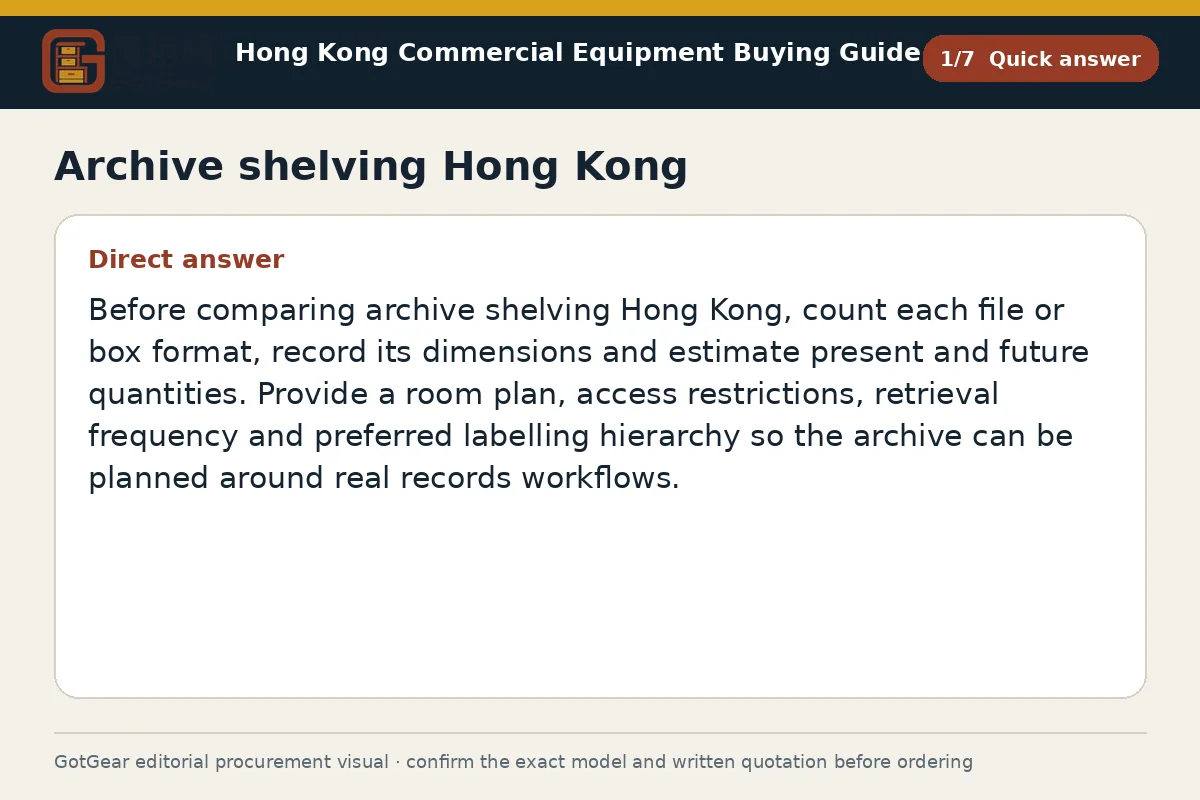
Archive shelving Hong Kong
Plan archive shelving Hong Kong by box size, document format, retention period, retrieval frequency and labelling to organise office records effectively. GotGear helps office and records buyers.
Read the guide
Industrial shelving Hong Kong
GotGear outlines loads, dimensions, layout and moisture considerations for industrial shelving Hong Kong. It compares galvanised steel shelving Hong Kong with powder-coated steel shelving Hong Kong.
Read the guide
Workshop shelving Hong Kong
If you are planning workshop shelving Hong Kong, GotGear provides a checklist covering item and bin sizes, shelf loads, access, cleaning and labelling and includes considerations for factory shelving Hong Kong.
Read the guide
Spare parts shelving Hong Kong
Use this maintenance, repair and operations checklist to compare sizes, weights, counts, pick rates and store layout for spare parts shelving Hong Kong and shelving for machinery parts Hong Kong. This checklist is from GotGear.
Read the guide