
What should records managers provide? Inventory formats and weights, allow documented growth and place frequent-use material within practical reach, then verify floor capacity, shelf ratings, stability, assembly and environmental conditions.
Adjustable shelving for Hong Kong office archives — Measure file formats and growth
When selecting adjustable shelving for Hong Kong office archives, start with a field survey of everything you actually store. List each format (archive cartons, lever-arch files, hanging file tubs, bound volumes) and measure real outer dimensions, not catalogue figures. Note the longest box edge to determine shelf depth, and the shortest edge to stack orientation options. Weigh a fully packed sample from each category so your load assumptions are grounded. Record linear filing metres now and projected additions by disposition category so growth is planned, not improvised. For deeper planning, see our warehouse shelf depth guide Hong Kong.
Turn the survey into specifications. For each bay, state clear opening width, usable depth, and the shelf pitch increment you require, with the minimum headroom above your tallest item for finger clearance. As an example starting point, many file boxes benefit from 20–40 mm clearance above the lid, but confirm your own value in the written brief that governs quotations. Document the number of levels per bay and the minimum count of bays now plus an allowance for documented growth. Capture site limits: goods-lift car dimensions, the tightest doorway and corridor turns, and any management-office delivery windows. Request drawings that show how uprights, bracing and shelves affect clear opening versus nominal footprint.
Adjustable shelving for Hong Kong office archives — Check floor loading and stability
Before committing to a layout, verify floor capacity and stability methods with the building manager and the manufacturer. Ask the supplier to state safe working load per shelf and per bay, the self-weight of a fully populated bay, and the base-plate size that spreads load to the slab. As an example starting point, some office floors are quoted in kPa ranges; treat any figure only as indicative until written building data confirms it. If you use raised floors, request the point-load distribution assumptions and any levelling-foot guidance.
Stability should be addressed in writing. Ask for the recommended anchoring method (mechanical floor anchors, back-to-back bays with shared bracing, or wall ties only if the landlord approves). Request a statement of the tested height-to-depth limits for free-standing use and when back/side bracing is mandatory. Specify any anti-movement features such as locking shelf clips. For humid sites and storerooms exposed to monsoon air or coastal air, consider coated or galvanised components and drainage-friendly shelves; see shelving for humid storerooms Hong Kong. On multi-tenant floors, coordinate noisy works and hoisting with the management office. Provide delivery constraints (loading-bay time slots, service-lift bookings) so the installation sequence, manpower and packaging take-back are planned and approved in advance.
What should buyers compare for adjustable shelving for Hong Kong office archives?
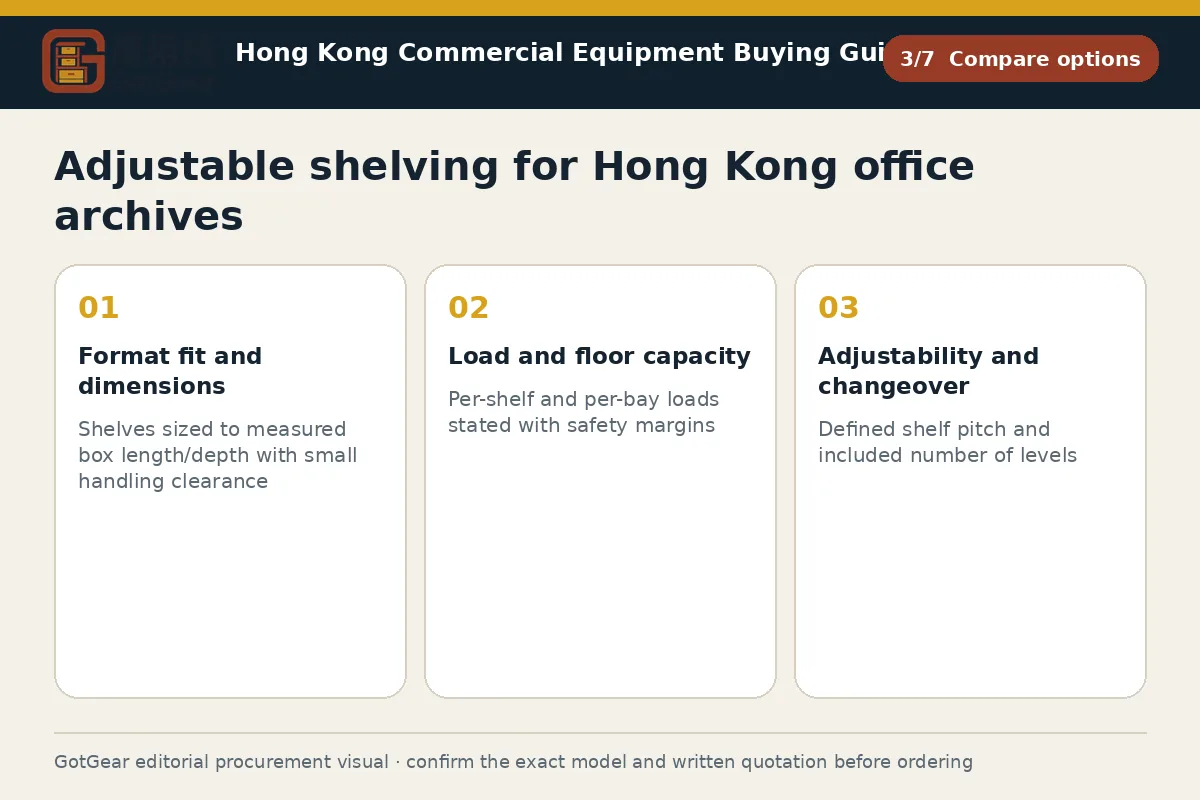
| Criterion | Straightforward requirement | More complex requirement | Evidence to provide |
|---|---|---|---|
| Format fit and dimensions | Shelves sized to measured box length/depth with small handling clearance | Mixed formats accommodated with orientation plan and dividers | Provide box outer L×W×H, linear metres by series, required clear openings |
| Load and floor capacity | Per-shelf and per-bay loads stated with safety margins | Load distribution to slab/raised floor verified and anchoring detailed | Request manufacturer load tables, base-plate sizes, building manager floor data |
| Adjustability and changeover | Defined shelf pitch and included number of levels | Tool-free re-slotting, spare clips and reconfiguration guidance | Specify pitch increment, effect on SWL, language of instructions (EN/ZH) |
| Stability and bracing | Free-standing bays within tested height-to-depth limits | Back-to-back, side/back bracing or anchoring scheme approved | Ask for written stability statement and installation drawings for your layout |
| Environment and delivery | Standard indoor finish and simple site access | Humidity-resistant finish and constrained service-lift logistics | State humidity exposure, cleaning regime, lift/door sizes, loading windows |
This framework helps buyers create comparable written enquiries. Final model specifications, availability, delivery and commercial terms must be confirmed in a formal quotation.
Adjustable shelving for Hong Kong office archives — Match adjustment to retrieval frequency
Match adjustment flexibility to how often records are retrieved and re-shelved. Keep the heaviest cartons at knee height and the most frequently accessed levels between knee and shoulder height. Group infrequently accessed material higher or lower, and position retention-critical series where two-person handling spaces are practical. In the enquiry, state the exact shelf pitch increment you need and whether shelves can be re-slotted tool-free. As an example starting point, some systems use 25–40 mm pitch; confirm the manufacturer’s figure and load effects in the formal quotation.
Clarify how reconfiguration affects load ratings and what training or instructions are provided in English and Chinese. Note any accessories that maintain order during fast access: dividers, bin fronts, label strips, and anti-slip mats. If you expect frequent level changes, ask for spare clips and an allowance for a safe-change kit (e.g., mallet, protector blocks) if recommended by the maker. Compare quotations on: number of included levels, adjustability increment, clip type, post profile and whether additional shelves can be purchased later. Where you are weighing different structures, see boltless shelving vs longspan shelving Hong Kong to ensure the chosen format balances rigidity, adjustability and future compatibility with your growing archive.
Adjustable shelving for Hong Kong office archives — Set labelling and review routines
Set up clear, bilingual labelling and periodic reviews so growth stays under control. Define a bay numbering scheme (room–row–bay–level), print durable English/Chinese labels, and add end-panel signs for series names and retention dates. Map the layout and store the file electronically. As an example starting point, schedule capacity and condition reviews every 6–12 months; confirm the right interval for your site with your records policy owner and insurer. Review shelf heights and move levels to recover space before ordering more bays.
Specify labelling hardware at purchase: integrated label holders on beams or shelf edges, magnetic strips for steel shelves, end-of-aisle frames, and blank inserts. Ask for bilingual assembly instructions, a reconfiguration guide, and a parts list so replacements can be ordered later; the model specification and formal written quotation prevail. On receipt, inspect finish quality, counts, and that protective caps, bracing and fixings match the quotation. Coordinate aisle numbering and safety signage with your space plan; if you are optimising circulation, see warehouse shelving access aisle planning Hong Kong to align walkway widths and turning spaces with your trolleys and archive workflows.
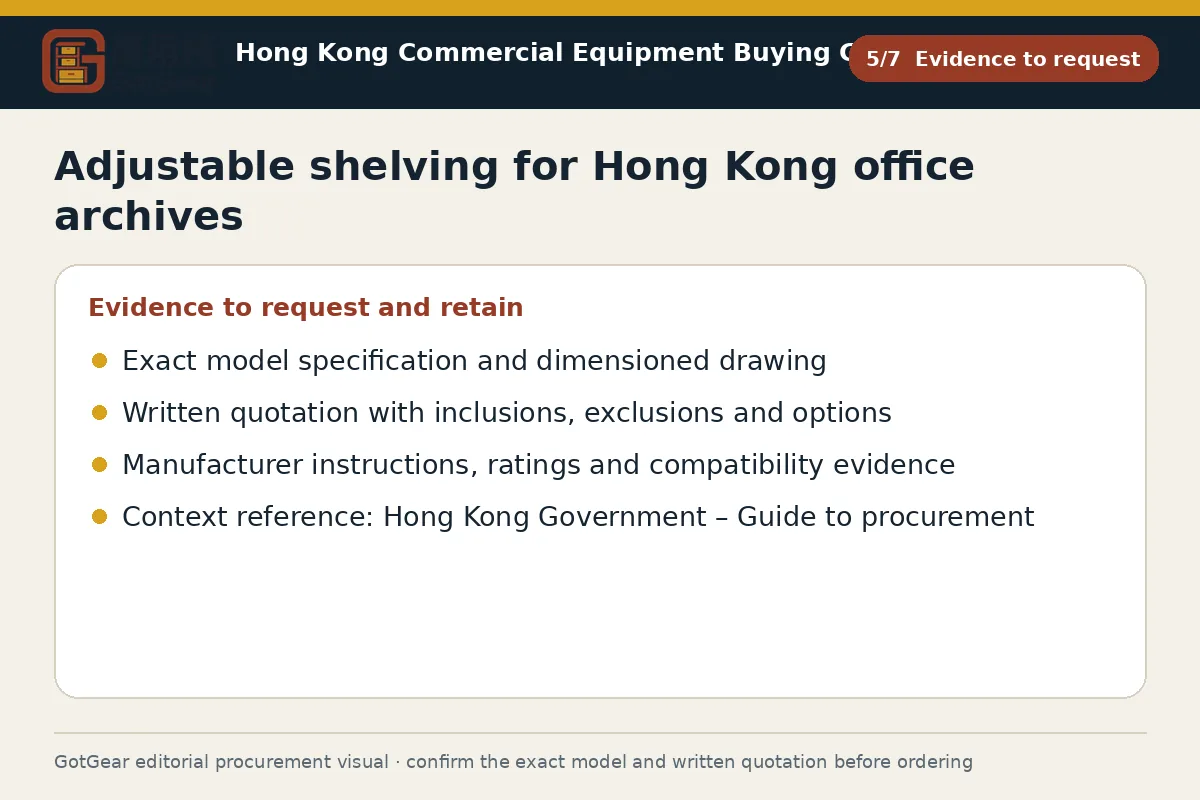
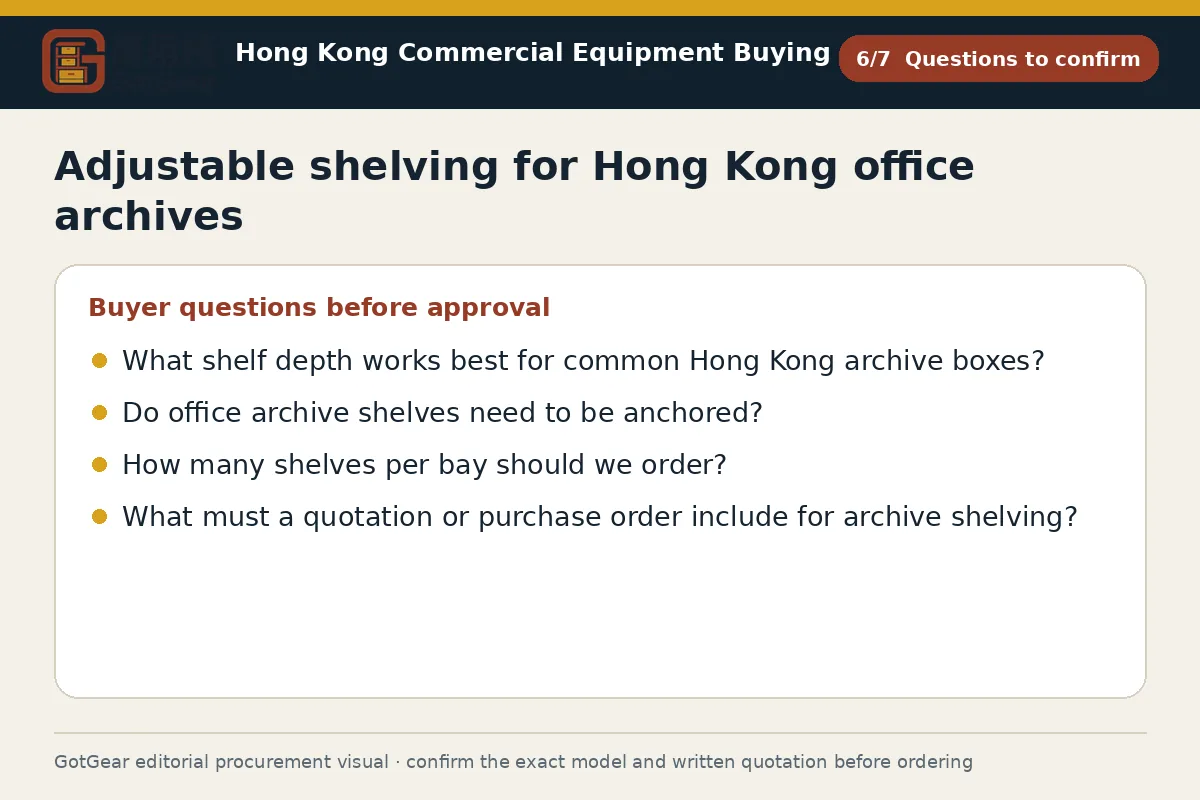
Adjustable shelving for Hong Kong office archives decision checklist
Confirm what you store: measure real box sizes, weigh filled samples and calculate linear metres by series with documented growth. Translate that into bay dimensions, usable depth and shelf pitch, then pick a sensible number of levels with headroom for handling. Verify floor capacity and stability method with the building manager and manufacturer. State access limits, delivery windows and service-lift sizes in your enquiry. Compare written quotations line-by-line for model numbers, material and finish, per-shelf and per-bay loads, bracing, adjustability increment, included levels, accessories and documentation language. Before approving, request drawings that show clear openings and anchoring points. On receipt, inspect finish, counts and hardware, then retain instructions and a parts list. Record bay numbering and labels, and set a review timetable.
- Operating use, quantity and expected frequency
- Dimensions, capacity, material and accessory requirements
- Delivery address, floor, goods lift and loading window
- Required documents, acceptance checks and after-sales arrangements
Key points for adjustable shelving for Hong Kong office archives
Hong Kong offices often rely on tight service lifts and narrow corridor turns, so flat-pack dimensions and the heaviest single component should be confirmed before delivery. Loading-bay access commonly requires advance booking with the management office, and weekend or evening windows may be necessary. Humidity peaks in wet months can accelerate corrosion if finishes are poorly specified. Top-of-load to ceiling services or sprinkler clearances should be checked with the landlord or competent adviser. This summary highlights practical constraints only and is not legal advice; your building’s rules, insurer guidance and the manufacturer’s written specification prevail.
Questions about adjustable shelving for Hong Kong office archives
What shelf depth works best for common Hong Kong archive boxes?
Choose a depth that matches the longest box edge so boxes sit fully supported with minimal overhang. As an example starting point, many archive cartons suit 400–450 mm depths, but you should verify against your own measured boxes and clear openings. If you’re refining options and orientations, our warehouse shelf depth guide Hong Kong explains the trade-offs to confirm in writing.
Do office archive shelves need to be anchored?
Often yes for tall, closely loaded bays or where vibration and trolleys are present, but confirm with the building manager and the manufacturer’s stability guidance. Some layouts use floor anchors; others rely on back-to-back bracing or, if permitted, wall ties. Raised floors and landlord rules can limit fixing options, so request a written anchoring recommendation for your site and model.
How many shelves per bay should we order?
Derive the count from your box heights plus a small handling clearance and the system’s pitch increment. As an example starting point, a bay around 2.0–2.2 m high may deliver five to six usable levels, but this varies by model, footer height and headroom. Ask the manufacturer to confirm the safe load per level and per bay after any reconfiguration.
What must a quotation or purchase order include for archive shelving?
Insist on the model reference, bay width/depth/height, clear openings, shelf pitch increment, load per shelf and per bay, finish/coating, bracing/anchoring method, included levels and accessories, and documentation language. Add site services: delivery window, service-lift data, packaging removal and installation scope if applicable. The supplier’s formal written quotation and the building manager’s conditions should govern the final specification.
Continue with closely related procurement topics
These pages share equipment, operating or decision-stage signals with this guide.
Shelving for humid storerooms Hong Kong
Choose shelving for humid storerooms Hong Kong by comparing finishes, cleaning methods and load capacity to suit your environment. For cold storage shelving selection Hong Kong, check temperature and hygiene with GotGear.
Read the guide
Warehouse shelf depth guide Hong Kong
GotGear presents the warehouse shelf depth guide Hong Kong, which outlines tests for carton size, weight, reach, rotation and overhang to aid shelf selection. Use it when planning shelving for boxed inventory Hong Kong.
Read the guide
Shop display layout for seasonal products Hong Kong
GotGear presents a shop display layout for seasonal products Hong Kong covering zones, circulation and replenishment. Follow the retail display changeover checklist Hong Kong to sequence stock, fixtures and handover.
Read the guide
How many recycling bins does a Hong Kong office need
GotGear explains how many recycling bins does a Hong Kong office need, covering collection frequency and zone sizing, plus office recycling station setup Hong Kong and clean recycling bin placement in Hong Kong offices.
Read the guideRelated topic indexOpen more English procurement pages2 topics
Browse additional equipment families, applications and procurement questions relevant to a wider buying brief.