
For canopy tent weight distribution per leg Hong Kong, use the manufacturer’s instructions for the complete configuration and confirm how each leg, connection and fixing point is treated. Before use, verify sidewall changes, linked layouts, site and weather conditions, venue directions and applicable Hong Kong requirements, escalating any unresolved case to a competent person.
Manufacturer data for canopy tent weight distribution per leg Hong Kong
Treat the frame, feet, connectors and fixings as a single engineered system. For canopy tent weight distribution per leg Hong Kong, request the manufacturer’s leg-reaction data for the exact size, frame series, number of legs, footplate type and any accessories to be installed. Ask for reaction values for the proposed substrate options (e.g., concrete pads, interlocking pavers, compacted ground), the permitted fixing methods, and any sidewall or linking adjustments. Ensure drawings and instructions are available in bilingual format if your team or venue requires it.
Before enquiry, capture a scaled plan showing leg locations, clearances to kerbs and walls, fire routes, overhead hazards and surface type. Measure access points: door and corridor widths, turning spaces, and goods-lift car size and rating, noting if weights or plates must be split. Specify requested data fields in writing: per-leg uplift and shear, tie-down angle range, ballast type and placement diagram, footplate dimensions, and permitted alternative fixings. When comparing written quotations, line up model codes, configuration notes, sidewall status, linking kits, and whether supervision or sign-off services are included. State that the model specification and the supplier’s formal written quotation prevail. On receipt, inspect labels, footplate holes, welds, fasteners and any ballast hardware against the quoted configuration, and file all instructions with the site plan for operational use.
Sidewall changes: Canopy tent weight distribution per leg Hong Kong and canopy tent sidewalls wind anchoring Hong Kong
Sidewalls change the aerodynamic behaviour of a canopy and often the per-leg reactions. Confirm, in writing, whether the quoted anchoring is valid with no walls, partial walls, or full enclosure, and whether door openings alter the assumed exposure. For canopy tent sidewalls wind anchoring Hong Kong, ask for the manufacturer’s addendum that shows revised uplift, shear, and tie-down angles with walls fitted, plus any extra ballast or fixings required.
Record site specifics that affect wind and rain loading: funnelling between buildings, podium-level gusts, and gutter water accumulation. Note wall material (PVC, mesh, clear, insulated) and attachment method. Verify the length and rating of straps or ratchets and whether quick-release is required for emergency egress. If your venue bans ground penetration, request the sidewall-valid ballast scheme and reference it in the order. Where malls or schools require protective layers, align the ballast plan with canopy tent weight floor protection Hong Kong and ensure mats or plates are included. For strap, D-ring and anchor hardware, ask suppliers to state compatibility with the proposed walls and provide a diagram. Use the same terminology across quotations so you can directly compare canopy tent weights and tie down straps Hong Kong and avoid mismatched parts on delivery.
What should buyers compare for canopy tent weight distribution per leg Hong Kong?
| Criterion | Straightforward requirement | More complex requirement | Evidence to provide |
|---|---|---|---|
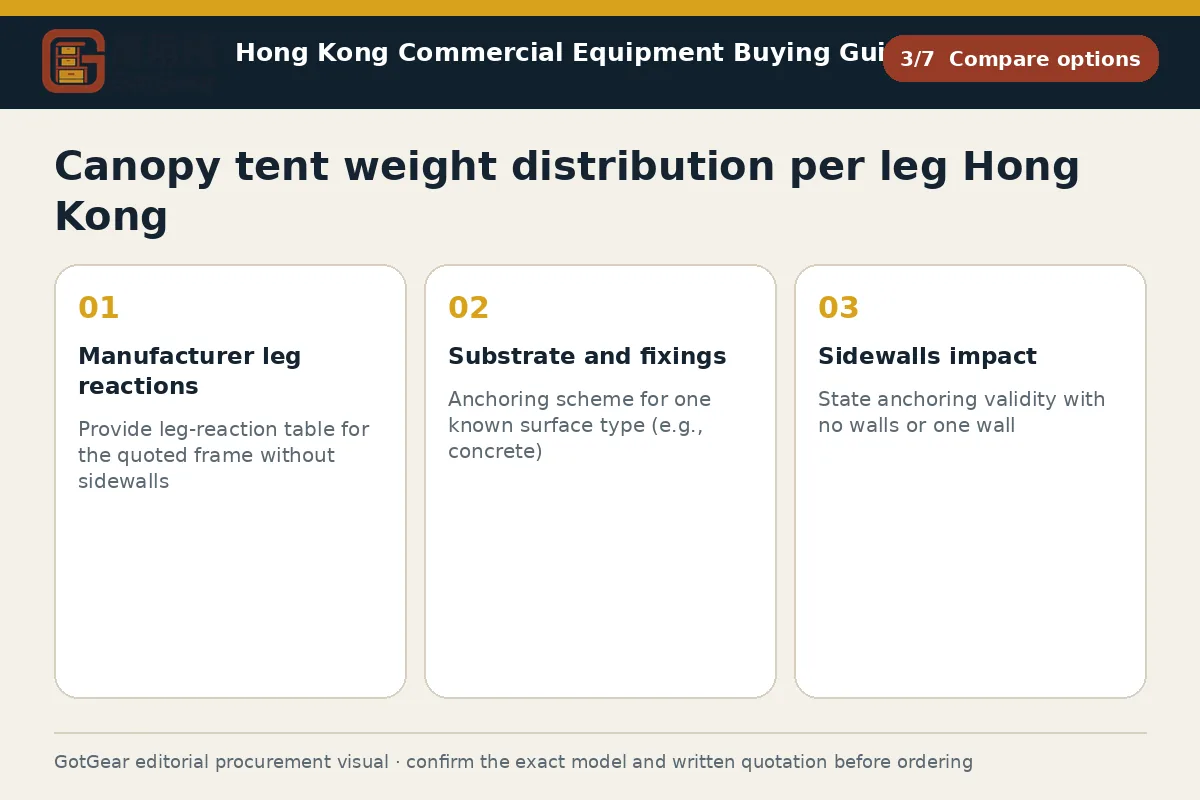
| Manufacturer leg reactions | Provide leg-reaction table for the quoted frame without sidewalls | Provide leg-reaction tables covering sidewalls, doors and linked spans | Model code, configuration notes, per-leg uplift/shear values, drawing references |
| Substrate and fixings | Anchoring scheme for one known surface type (e.g., concrete) | Multi-surface plan with permitted alternatives and non-penetrative options | Surface description, fixing method per leg, footplate diagram, venue restrictions |
| Sidewalls impact | State anchoring validity with no walls or one wall | Full wall matrix (materials, openings) with revised ballast/angles | Wall materials, attachment method, airflow plan, updated reaction tables |
| Linked layouts | Simple 2-canopy connection with standard clamps | Grid plan with gutters, inner/perimeter leg rules, shared vs separate ballast | Link kit part numbers, maximum bays, consolidated anchoring diagram |
| Handover and sign-off | Basic instruction sheet and parts list | Bilingual method statement, acceptance checklist, photo evidence requirements | Named competent person, sign-off process, venue submission needs |
This framework helps buyers create comparable written enquiries. Final model specifications, availability, delivery and commercial terms must be confirmed in a formal quotation.
Configuration sign-off for canopy tent weight distribution per leg Hong Kong
Before first use or after any configuration change, adopt a documented acceptance process. Obtain the manufacturer’s method statement for assembly, anchoring and verification for the stated configuration, including wall status and any links. Agree who is the competent person to review leg reactions, check fixings match the permitted methods, and sign the site plan. If your venue, insurer or institution requires it, prepare bilingual operating notes and an emergency take-down procedure aligned to local weather warnings.
At enquiry stage, ask suppliers to confirm what evidence they will provide at handover: torque values, strap settings, ballast placement diagram, and a completed checklist. Keep a change log: “as-built” leg positions, ballast split where goods-lift limits apply, and substitutions approved in writing. If new information emerges (e.g., a different surface or an added wall), pause use until the anchoring is revalidated. For repeat events, standardise your paperwork with a folding tent anchoring checklist Hong Kong to ensure the correct fixtures, mats and accessories are loaded each time. Finally, schedule a brief on-site sign-off with venue management where required, presenting drawings, instructions and photographs of anchors or weights in place.
Multi-booth review: Canopy tent weight distribution per leg Hong Kong and linked canopy tent anchoring Hong Kong
Linked layouts introduce additional loads at connectors and shared legs. Confirm with the manufacturer which connection kits are approved, the maximum number of bays per run, and whether ballast may be shared or must remain per-leg. Provide a combined plan view and elevation showing gutter lines, eaves heights, slopes and any uneven ground. For linked canopy tent anchoring Hong Kong, request reaction data that covers inner legs, perimeter legs and corners, noting if bracing or cross-tying changes uplift.
Measure the available footprint for queuing and egress aisles and mark where legs cannot move because of handrails, planter boxes or utilities. Ask for rules on rain gutters and sidewall continuity between units, and whether windward exposure changes with openings between stalls. Where passages are created between buildings, capture the potential wind-tunnel effect and seek revised anchoring if needed. When comparing quotations, check the exact part numbers for linking clamps, gutters, infill panels and any mid-row ballast guidance. For events with multiple check-in points or concessions, align the plan with multi canopy event registration layout Hong Kong and request a consolidated anchoring diagram that labels each leg and fixing method so crews can build consistently across the entire grid.
Canopy tent weight distribution per leg Hong Kong decision checklist
Start by confirming the exact frame model, accessories, sidewall status and any linked spans, then request per-leg reactions, fixing methods and ballast diagrams for that configuration. Survey the site, measuring surface type, clearances, egress routes, and goods-lift limits. Align your enquiry wording across suppliers so quotations are comparable on model code, anchoring, walling and linking kits. Before delivery, coordinate loading windows and floor protection. On receipt, verify labels, footplates, straps and hardware against the quotation and drawings. Build to the diagram, then check strap angles, ballast placement and clear routes. Photograph every leg and file the sign-off. If weather, layout or walls change, stop and revalidate with the manufacturer or a competent person before use.
- Operating use, quantity and expected frequency
- Dimensions, capacity, material and accessory requirements
- Delivery address, floor, goods lift and loading window
- Required documents, acceptance checks and after-sales arrangements
Key points for canopy tent weight distribution per leg Hong Kong, canopy tent sidewalls wind anchoring Hong Kong, linked canopy tent anchoring Hong Kong
Hong Kong venues frequently restrict drilling, chemical anchors and penetrations, so many canopies must rely on approved ballast schemes. Management offices often require advance submission of plans, bilingual instructions and proof that emergency routes stay clear. Loading bays and goods-lift access can be time-limited, making staged delivery of weights and plates necessary. Coastal gusts, podium exposure and humid conditions can change how straps, buckles and fabric behave on the day. Always match the accepted anchoring to the specific venue directions, current weather advisories and the manufacturer’s written configuration for your frame, sidewalls and any linked spans.
Questions about canopy tent weight distribution per leg Hong Kong
How do I determine ballast per leg for my frame in Hong Kong?
Use the manufacturer’s leg-reaction table for your exact model, surface and configuration, and follow their approved ballast or fixing options. As an example starting point only, some 3 m frames without walls may use modest ballast per leg, but enclosed or linked layouts can require substantially more. Always confirm in the written quotation and venue directions before deployment.
Are water barrels acceptable as anchors at public venues?
Only if the manufacturer lists them as approved anchors for your model and the venue permits their use. Many Hong Kong sites restrict water storage, spillage risks and unstable masses. If allowed, request barrel size, fill level, tie-off method and spill containment in writing, and verify that the goods-lift and route can safely handle the barrels or an alternative ballast format.
What if my goods-lift is too small for the specified weights or plates?
Discuss alternative ballast formats, smaller plates in greater quantity, or split deliveries that match lift ratings and door widths. Request a revised ballast diagram that preserves the approved per-leg reactions. Coordinate with the management office on loading windows and floor protection, and confirm whether substitutions are accepted in writing before the event build begins.
Which documents should accompany a quotation for a canopy with walls or links?
Request model drawings, leg-reaction tables for the exact configuration, permitted fixings, ballast diagrams, and the method statement for assembly and verification. Where required by your venue or insurer, ask for fire-retardant fabric information, bilingual instructions, and evidence that the proposed sidewalls and linking kits are compatible with your frame series and anchoring plan.
Continue with closely related procurement topics
These pages share equipment, operating or decision-stage signals with this guide.
Canopy tent rooftop anchoring Hong Kong
GotGear offers guidance on approval, structural input, exposure, ground conditions and permitted fixing methods for canopy tent rooftop anchoring Hong Kong. It also covers measures for canopy tent anchoring on sand Hong Kong.
Read the guide
Canopy tent artwork bleed guide Hong Kong
Refer to the GotGear canopy tent artwork bleed guide Hong Kong to set bleed and safe areas. Also review canopy tent seam artwork Hong Kong and test custom canopy small text printing Hong Kong on a final-size proof.
Read the guide
Canopy tent weights for concrete Hong Kong
See the GotGear guide to canopy tent weights for concrete Hong Kong, pop up gazebo weights for tiled floor Hong Kong and canopy tent ground anchors for grass Hong Kong. Check venue approval and installation requirements.
Read the guide
Canopy tent weight floor protection Hong Kong
GotGear provides a checklist to record floor finish, ballast and pad materials, pre-setup checks and venue sign-off for canopy tent weight floor protection Hong Kong.
Read the guideRelated topic indexOpen more English procurement pages1 topics
Browse additional equipment families, applications and procurement questions relevant to a wider buying brief.