
For custom canopy QR code placement Hong Kong, position the code where a visitor can pause without blocking the queue, preserve a clear margin around it and avoid competing graphics. Test the final destination and a print-size sample on the intended surface from several realistic angles and distances before artwork sign-off.
Visitor approach and sightlines for custom canopy QR code placement Hong Kong
Map how visitors actually approach your canopy before they choose any panel. Stand at the main aisle, at secondary aisles and at likely queue entry points; take eye-level photographs and note the angles where the valance, peak and sidewalls first become visible. In busy Hong Kong concourses, oblique sightlines are common, so select a face that is visible at a glance as people slow down. Teams planning custom canopy QR code placement in Hong Kong should record places where a person can pause safely without narrowing circulation.
Turn those observations into measurable inputs for your enquiry. As an example starting point (to be confirmed in your written brief), note typical approach distances such as 1–2 metres on narrow aisles or 2–4 metres on open plazas, and whether people will be seated or standing. Define a “primary scan side” and an “intended scan distance range” so suppliers can advise on panel selection and QR code size. Mark any obstructions such as bunting, lights, speaker stands and guy ropes. If you expect a queue, sketch an outdoor concession canopy queue layout in Hong Kong that shows where the front-of-queue pause point sits relative to each panel. Include guidance from management offices on keeping aisles clear, and identify any fire exits or barriers that restrict where a scan prompt can be placed or read comfortably.
Choosing a reachable scan position for custom canopy QR code placement Hong Kong
Prioritise a panel where a visitor can reach or comfortably hold a phone without craning. For walk-by discovery, the valance on the primary approach side often works because it faces eye level as people slow down. For in-queue engagement, position the code on a sidewall or counter-facing valance at the point where staff hand over samples, literature or receipts. As an example starting point only, many teams find a centre height around 1.3–1.6 metres readable for mixed-height crowds; confirm the final height in your brief and with venue sightlines.
Avoid panels that move, flex or open frequently. If your sidewall includes a doorway, align with your printed gazebo sidewall door layout Hong Kong so the code never straddles a zip or rolled panel. Specify in quotations: the exact panel name, target centre height from ground, QR code side length (millimetres), minimum quiet-zone width (in “modules”), and any fixing method if a removable patch is used. Also request clear space around the code for a short call-to-action and landing-page language note, so staff can invite scans without blocking the queue.
What should buyers compare for custom canopy QR code placement Hong Kong?
| Criterion | Straightforward requirement | More complex requirement | Evidence to provide |
|---|---|---|---|
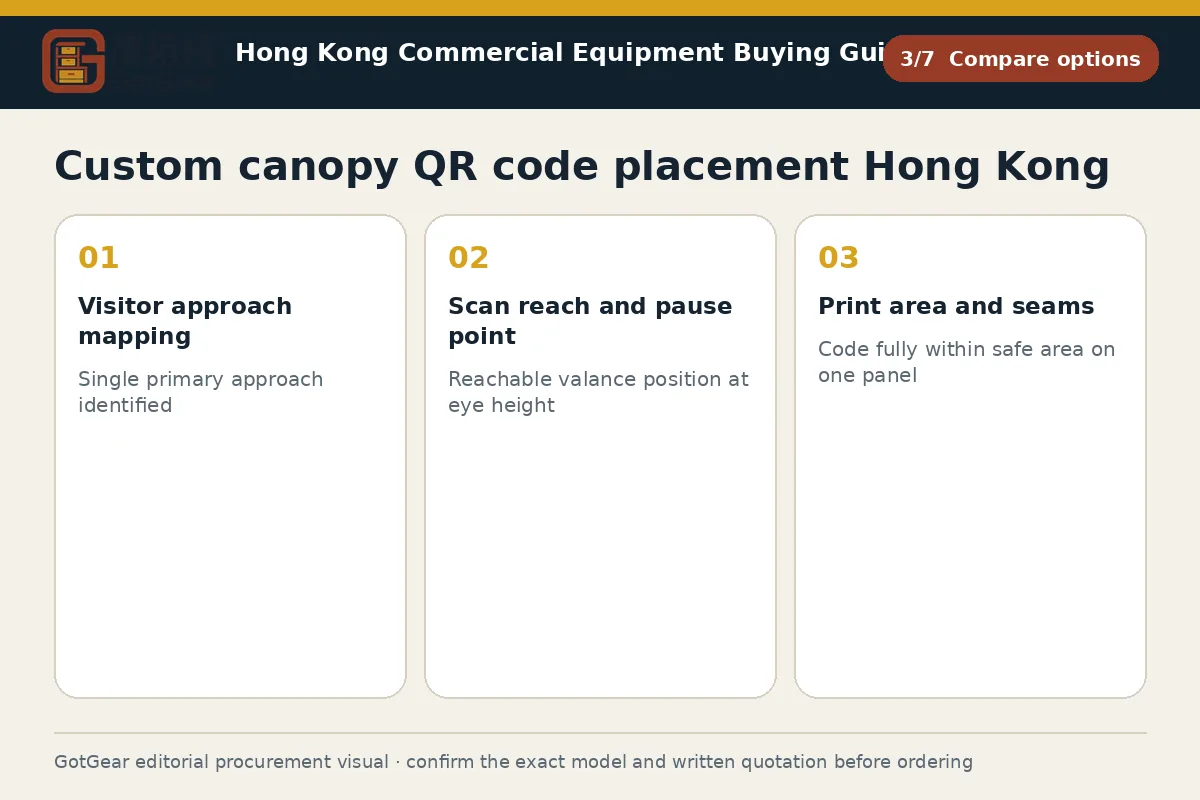
| Visitor approach mapping | Single primary approach identified | Multiple approaches with queue and cross-traffic mapped | Floor plan with marked approach paths, photos at eye level, defined primary scan side |
| Scan reach and pause point | Reachable valance position at eye height | Queue-based sidewall position at handover with staff flow considered | Measured centre height, intended scan distance range, annotated queue sketch |
| Print area and seams | Code fully within safe area on one panel | Multi-panel layout avoiding zips, windows and corner tapers | Supplier template version, seam/stitch map, artwork with safe/bleed annotations |
| Contrast and finish | High-contrast code on plain light field, matte finish | Complex background or brand colours with swatch-verified contrast | Pantone/CMYK aims, finish specification, signed colour/swatches proof |
| Testing and approval | Paper full-size test passed; pre-press proof signed | On-fabric swatch test at venue with photos and tolerances agreed | Test photos, device list, final module count, stated tolerances in quotation |
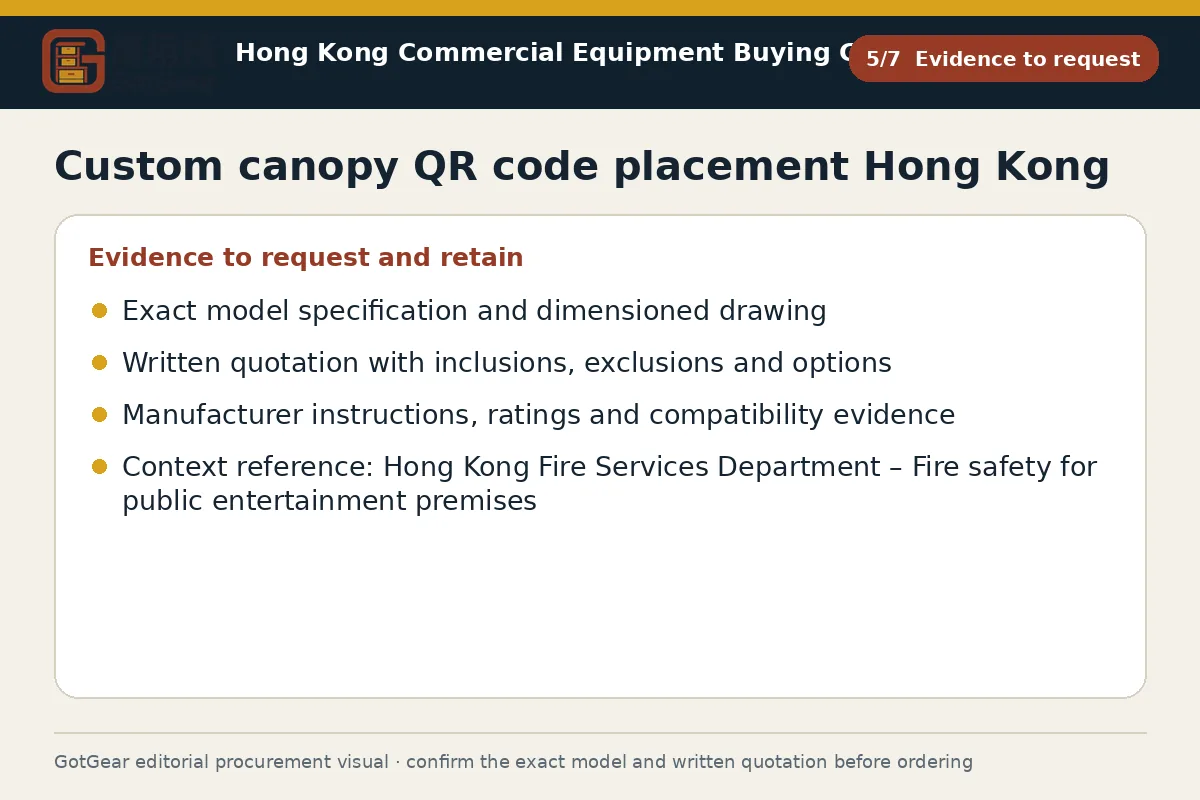
This framework helps buyers create comparable written enquiries. Final model specifications, availability, delivery and commercial terms must be confirmed in a formal quotation.
Print-area limits and contrast in custom canopy QR code placement Hong Kong
Work within the real print-safe areas of each canopy panel. Request the manufacturer’s current panel template and a seam/stitch map before artwork. Refer to your canopy tent artwork bleed guide Hong Kong so the code sits well inside the safe margin and never crosses a seam, webbing, window, vent or folding edge. Ask the supplier to label: print method (for example, dye sub or UV as applicable), fabric finish (matte or gloss), stitch allowances (example starting point values only), and any panel-join tolerances. The written quotation and model specifications provided by the supplier must always prevail.
Maximise contrast and module clarity. A black code on a plain light field is most forgiving; avoid gradients, photos and complex patterns behind the modules. Humid Hong Kong conditions and bright atrium lighting can produce glare on glossy coatings, so consider a matte fabric or a matte-appliqué patch to reduce reflections. Provide Pantone or CMYK aims for the background, and request a printed colour proof or small swatch if the background is not plain white. Confirm in writing that the quiet zone will remain completely free of logos, taglines, seams or stitching, and that no eyelets, tension straps or corner tapers intrude into the code boundary.
Final-size testing of custom canopy QR code placement Hong Kong
Validate the destination and the physical scan before artwork sign-off. Print a 1:1 test of the QR on paper or a similar fabric swatch, tape it to the intended panel and check it with multiple phones from realistic angles at example starting distances such as 0.5 m, 1 m and 2 m. Test in the venue or a space with comparable lighting and reflections. Load the destination page on local networks, and confirm that language handling matches your bilingual canopy tent printing Hong Kong approach if you expect both Chinese and English audiences.
Ask the supplier for a pre-press proof that shows QR version, error-correction level and final module count, and verify the code scans after any scaling they apply. In your purchase documents, state the required panel, code size, centre height and minimum clear margin, plus tolerance (example starting point figures only) and that the printed sample or swatch was approved. On receipt, inspect crispness of the modules, edge definition, contrast against the background, and the measured distance from nearest seam or fold. Photograph the installed panel from the documented approach angles to confirm it matches your agreed scan plan.
Custom canopy QR code placement Hong Kong decision checklist
Walk the site and photograph the main approach angles; note where people can pause without blocking circulation. Select the panel that faces those sightlines and record a target centre height and distance span as example starting points, then confirm them with the venue. Request current templates and a seam map, and place the code well inside the safe area with a defined quiet zone. Specify in your enquiry: panel name, code side length in millimetres, fabric finish, background colour aims, minimum contrast, and seam clearances. Compare quotations on the same template version, proof method, colour swatch availability and stated tolerances. Test a full-size sample on the intended surface and confirm the landing page renders bilingually and loads on local networks. Before print, approve a pre-press proof; on receipt, inspect module sharpness, contrast and placement against seams. The supplier’s model specification and formal quotation prevail.
- Operating use, quantity and expected frequency
- Dimensions, capacity, material and accessory requirements
- Delivery address, floor, goods lift and loading window
- Required documents, acceptance checks and after-sales arrangements
Key points for custom canopy QR code placement Hong Kong
Hong Kong venues often control queue layout, aisle width and promotional graphics, so coordinate early with the building manager or event organiser on where visitors may pause to scan and what messaging is permitted. Tight goods lifts, narrow stair cores and short loading windows can affect when and how canopies are brought to site for test fitting. High humidity and glossy atrium lighting can increase glare, so confirm fabric finish and test at the venue when possible. This is practical guidance, not legal advice; always follow your venue, insurer and manufacturer instructions.
Questions about custom canopy QR code placement Hong Kong
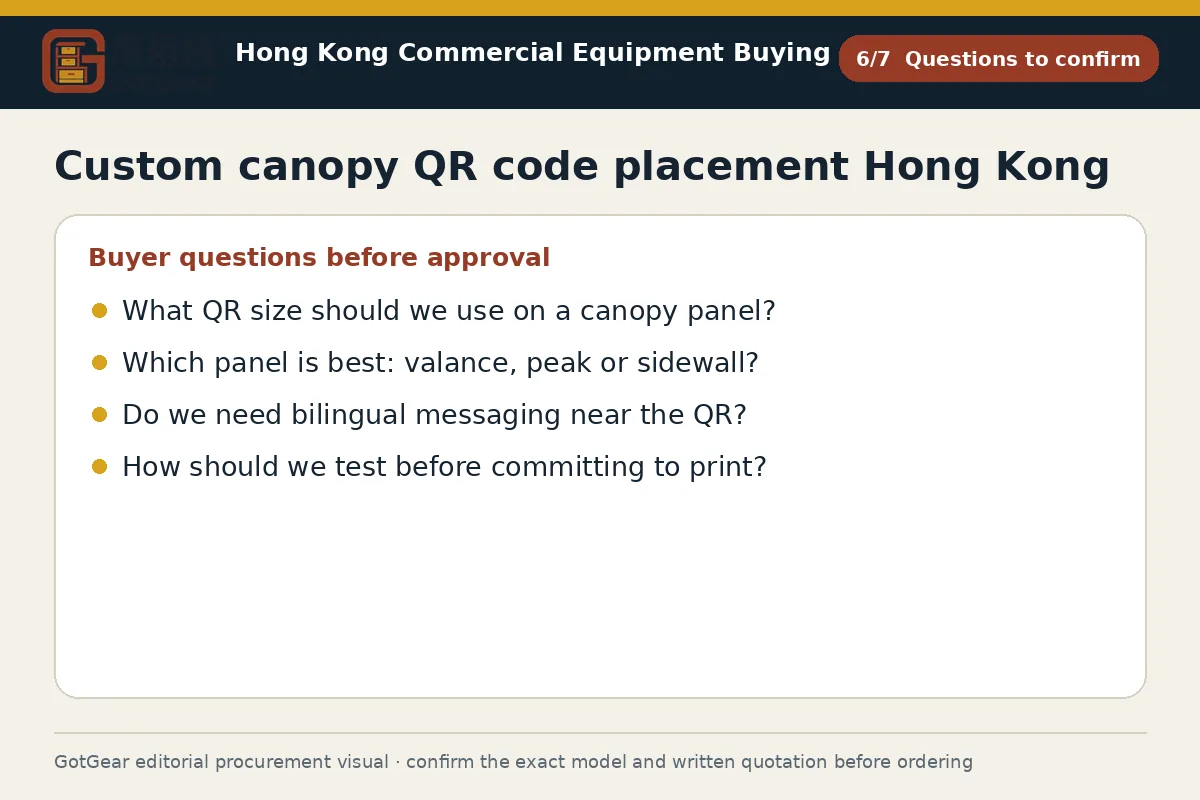
What QR size should we use on a canopy panel?
Size for the farthest intended scan. As an example starting point, many teams test a code side length around one-tenth of the maximum scan distance, then adjust for lighting, finish and phone quality. Confirm the final size in your written brief and the supplier’s template. Request a defined quiet zone, vector artwork and pre-press proof to verify scaling and contrast.
Which panel is best: valance, peak or sidewall?
Choose the panel that faces the pause point. For walk-by traffic, a valance on the primary approach side is often ideal; for queues, a sidewall near the handover point works well. Avoid peaks that sit too high or move in wind. If a sidewall has a zip opening, coordinate with your printed gazebo sidewall door layout Hong Kong to keep the code clear of seams.
Do we need bilingual messaging near the QR?
If your audience includes both Chinese and English speakers, provide a short bilingual prompt and ensure the landing page handles language cleanly. Some venues or institutions may also ask for a privacy notice or approval if data capture is involved. Confirm any wording requirements with the organiser or management office and include them in your artwork proof.
How should we test before committing to print?
Print a full-size sample and tape it to the chosen panel location. Check scans with several phones at realistic distances and angles under similar lighting, noting any glare from glossy finishes. Verify the destination page loads on local networks and renders correctly. If colours are critical, request a fabric swatch. Document results with photos and written approvals.
Continue with closely related procurement topics
These pages share equipment, operating or decision-stage signals with this guide.
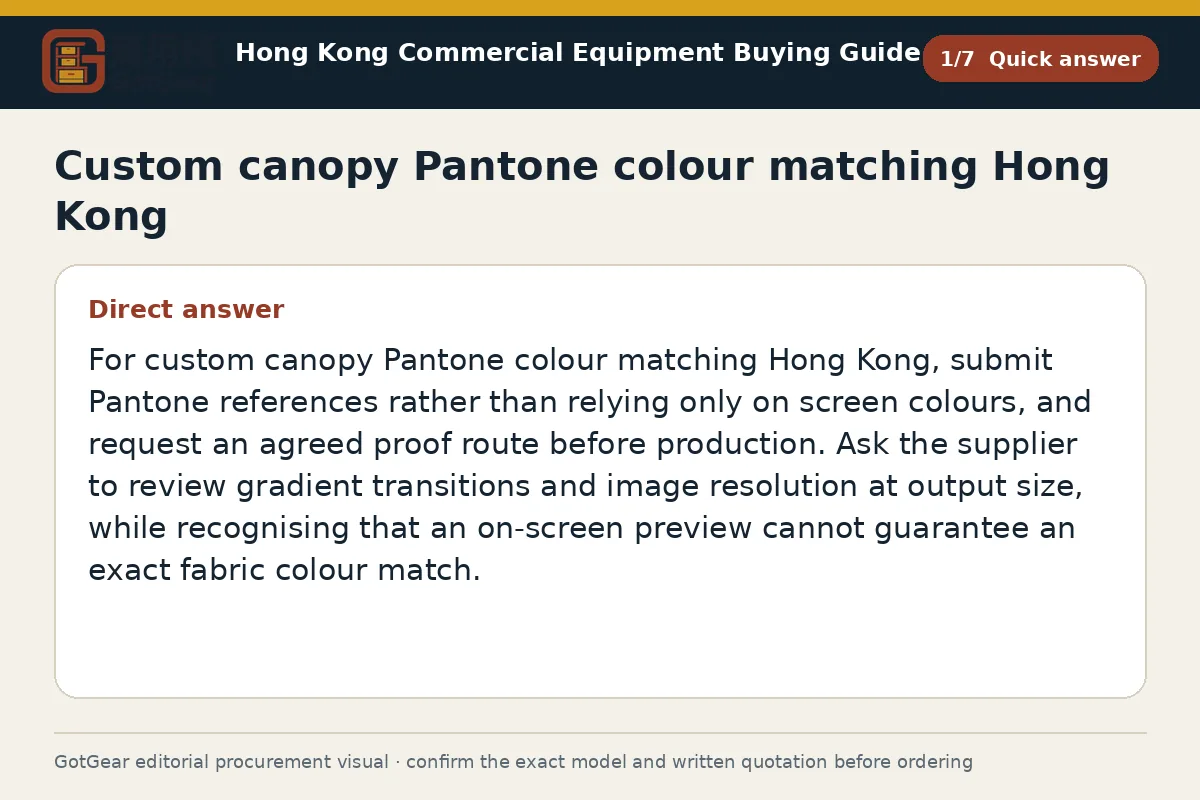
Custom canopy Pantone colour matching Hong Kong
GotGear explains how to prepare files and request proofs for custom canopy Pantone colour matching Hong Kong. It also covers custom canopy gradient printing Hong Kong and custom canopy photo resolution printing Hong Kong.
Read the guide
Canopy tent artwork bleed guide Hong Kong
Refer to the GotGear canopy tent artwork bleed guide Hong Kong to set bleed and safe areas. Also review canopy tent seam artwork Hong Kong and test custom canopy small text printing Hong Kong on a final-size proof.
Read the guide
Canopy tent weights for concrete Hong Kong
See the GotGear guide to canopy tent weights for concrete Hong Kong, pop up gazebo weights for tiled floor Hong Kong and canopy tent ground anchors for grass Hong Kong. Check venue approval and installation requirements.
Read the guide
Canopy tent weight floor protection Hong Kong
GotGear provides a checklist to record floor finish, ballast and pad materials, pre-setup checks and venue sign-off for canopy tent weight floor protection Hong Kong.
Read the guide