
For a cleaning trolley with brakes Hong Kong, check which wheels are controlled, how the brake is applied and whether staff can reach it in normal use. A brake is not a substitute for safe parking or handling procedures; verify manufacturer instructions, site conditions and applicable Hong Kong requirements.
Identify parking risks for cleaning trolley with brakes Hong Kong
Start by mapping every location where the trolley may be parked, paused or left unattended: lift lobbies, ramp landings, loading docks, corridor corners, guest floors and back-of-house pinch points. Walk the full route at the times it will be used. Record surface materials, drainage falls, joints and threshold lips. Measure gradients with a digital level or an inclinometer app and note the angle; for planning, use an example starting point such as 3–6 degrees to frame tests, then confirm actual site values. Log lip heights and gaps (As a starting point, 10–20 mm) and whether the brake must hold on smooth tiles versus textured concrete.
If you intend to source a cleaning trolley with brakes Hong Kong, ensure it can be deployed across mixed environments by your operations team and include people-flow and visibility risks. Note where the public or visitors could interact with a parked trolley, and any areas with wind or stack effect that might pull doors. In humid months or during rain, floors at dock‑in points and under canopies can be damp, increasing rollback risk. Add lift car sizes, door clear widths and lobby turning space; Hong Kong goods lifts and service corridors are often tight, and parking may be near traffic routes. Photograph risky spots and assign each a unique reference so suppliers can respond precisely in writing.
Test loaded operation of cleaning trolley with brakes Hong Kong
Replicate real work. Load the trolley to the representative in-service mass stated in your method statement, aligning weight as it will be carried. Confirm any test limit with the manufacturer or a competent supervisor. On each identified gradient, push to a controlled stop, then apply the brake exactly as staff would. Observe any rollback, swivel-caster swing and whether the brake can be reached without twisting the torso or leaving the handle. Note the reachable side (left/right), shoe types in use and if gloves affect grip on hand levers.
Document the surface, measured angle, load description and the outcome in a simple matrix with photos. Where lift thresholds are involved, practise the approach on a flat rehearsal area that mimics the threshold, never in a moving lift. Check if a directional lock helps tracking on long corridors, and whether total-lock brakes prevent rotation on shiny tiles. Listen for scraping or chatter; vibration over grout lines can reveal marginal grip. If feasible under site policy, request a supervised on-site demonstration or acceptance test, and state the pass/fail criteria in the written enquiry so all quotations address the same conditions.
What should buyers compare for cleaning trolley with brakes Hong Kong?
| Criterion | Straightforward requirement | More complex requirement | Evidence to provide |
|---|---|---|---|
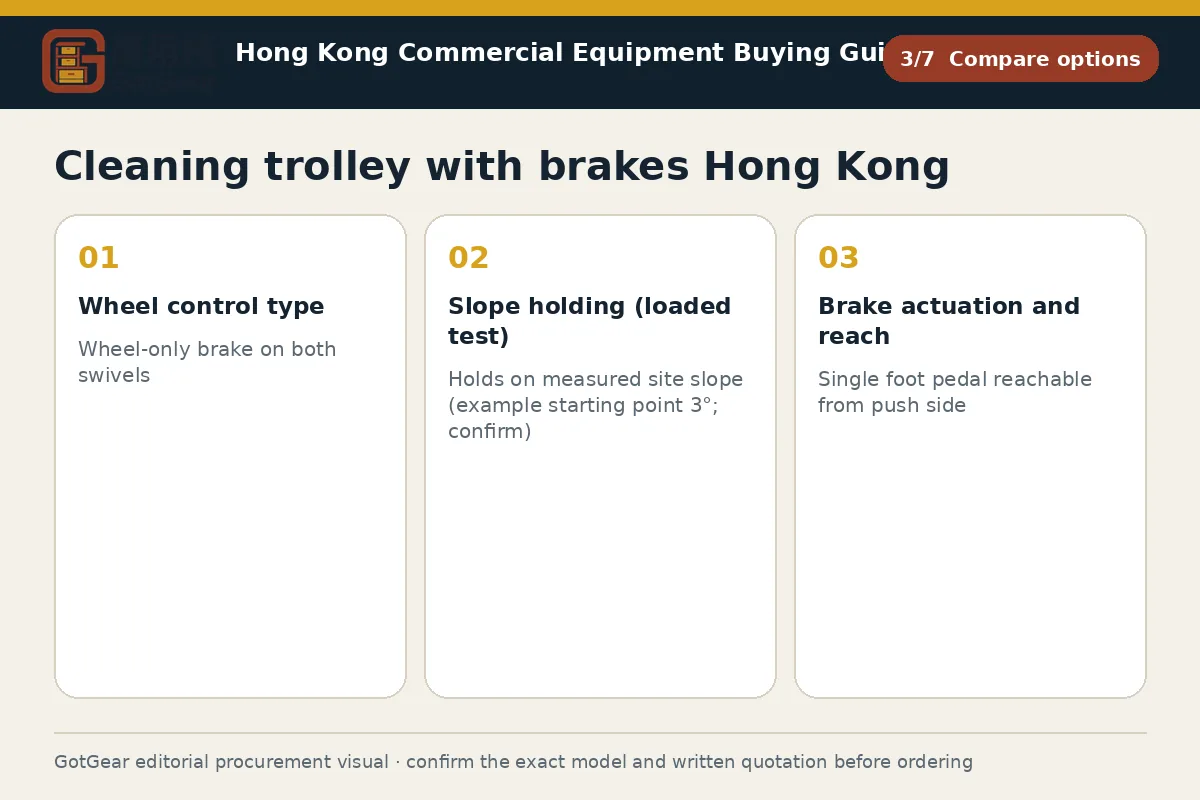
| Wheel control type | Wheel-only brake on both swivels | Total lock on both swivels plus optional directional lock | State model, datasheet and which wheels are braked |
| Slope holding (loaded test) | Holds on measured site slope (example starting point 3°; confirm) | Holds on higher-risk slopes or smooth tiles (example starting point 6°; confirm) | Provide photos, load description and inclinometer reading |
| Brake actuation and reach | Single foot pedal reachable from push side | Dual-side or central pedal with declared actuation force | Give control location dimensions and operator reach notes |
| Caster layout and clearance | 2 fixed + 2 swivel, brakes on swivels | 4 swivel with linked brake or diagonal braking | Attach plan sketch with wheelbase and overall width (mm) |
| Maintenance and spares | Basic inspection steps and replaceable components | Parts list, wear items identified and site spares agreed | Submit manual, parts list and supplier confirmation |
This framework helps buyers create comparable written enquiries. Final model specifications, availability, delivery and commercial terms must be confirmed in a formal quotation.
Check brake position and wheel layout on cleaning trolley with brakes Hong Kong
Brake effectiveness depends on which wheels are controlled and how operators reach the control. Clarify the wheel layout: two fixed plus two swivel casters are common; some models use four swivels. Ask whether the brake is a total lock (wheel and swivel) or wheel-only, and if it is fitted on both swivel casters or just one side. Central pedal linkages are tidy but need a clear step zone; corner-mounted pedals are simple but may be hard to reach if bins or bags overhang. A hand-lever brake can suit operators who wear safety shoes with stiff soles, but it must be reachable from the normal push side in narrow Hong Kong corridors.
In your enquiry, request a drawing showing wheelbase, caster offset, overall width and turning radius, and the exact brake control locations with dimensions from floor and handle centreline. Ask for the number and diameter of braked wheels, declared actuation force (for comparison only; confirm with the supplier), and whether a directional lock is available for long, straight routes. Note any conflict with kickplates, skirtings or door closers, and confirm pedal width and profile to reduce toe-catching. Specify that labels and instructions identify the braked wheels and control in English and Traditional Chinese.
Set inspection routines for cleaning trolley with brakes Hong Kong
Build routine checks around the manufacturer’s guidance and your site risk profile. Before first use on each shift, operators should confirm that the brake engages positively, releases fully and returns without sticking. Inspect cables or linkages (if fitted) for fraying, springs for fatigue and pedals for loose fixings. Hong Kong’s humidity can accelerate corrosion; look for rust at caster forks and brake drums and clear grit from wheel treads that could reduce grip. If a model includes total-lock casters, verify that both rotation and rolling are immobilised when applied.
On receipt, verify the model and brake configuration against the written quotation and datasheet. Confirm which wheels are braked, that controls are reachable from the working side and that warning markings are present. Perform a simple hold test on a known gradient (use an example starting point such as 3 degrees for comparison; confirm acceptance criteria in writing). Record outcomes with photos and tag the trolley with an internal ID. Request the operating manual, parts list and maintenance instructions in English and Traditional Chinese. If a venue, insurer or client requires it, obtain a manufacturer letter stating the brake type and the trolley’s rated load, and keep a small stock of wear parts agreed with the supplier.
Cleaning trolley with brakes Hong Kong decision checklist
Confirm all parking and pause locations along the route, measure actual gradients and threshold lips, and photograph each risk point. Define the representative in-service load and test brake holding on the real surfaces. Choose a wheel layout and brake type that operators can reach from the normal push side, and state which wheels must be braked. Request drawings with wheelbase, caster size and brake control dimensions, plus declared actuation method and force for comparison. Ask for bilingual instructions, parts lists and acceptance criteria. In quotations, require model numbers, brake type, braked wheel count and any directional lock. On receipt, verify configuration, perform a hold test on a known slope and document results. Let the supplier’s formal specification and your written enquiry prevail.
- Operating use, quantity and expected frequency
- Dimensions, capacity, material and accessory requirements
- Delivery address, floor, goods lift and loading window
- Required documents, acceptance checks and after-sales arrangements
Key points for cleaning trolley with brakes Hong Kong
Hong Kong facilities face mixed gradients at dock areas, drainage falls in service corridors and tight goods-lift and doorway clearances. Brakes that are easy to reach on the push side help in narrow lift lobbies where turning space is limited. Summer humidity, rain ingress and polished tiles can reduce friction, increasing rollback risk, especially near public routes. Coordination with building management for lift booking windows and event schedules is common, and bilingual (English/Traditional Chinese) instructions support multi-shift teams. Treat any references to regulations as general guidance only and confirm site-specific requirements.
Questions about cleaning trolley with brakes Hong Kong
Do all cleaning trolleys in Hong Kong need brakes?
No. Brakes are selected based on route gradients, surfaces, load and exposure to public traffic. Use a site-specific risk assessment to decide where a brake adds control. Confirm the decision with the building manager, your safe-working procedures and the manufacturer’s instructions, and document acceptance criteria in the written enquiry and quotation.
Is a foot pedal or a hand-operated brake better for staff?
A foot pedal is common and keeps both hands on the handle; a hand-operated control can suit users wearing rigid footwear or working on stairs landings. Choose the control that staff can reach from the working side without twisting, and verify with a loaded trial on real surfaces. State the chosen control and reach dimensions in your brief.
Can I retrofit brakes to my existing trolley fleet?
Sometimes. Feasibility depends on the caster type, mounting plate size and frame clearance. Ask the OEM or a competent supplier to confirm compatible braked casters or kits, and whether retrofitting affects warranty or load rating. Trial one unit under supervision and update your SOPs if control characteristics change after the retrofit.
How should I compare quotations for braked trolleys fairly?
Require written confirmation of brake type (wheel-only or total lock), number and diameter of braked wheels, directional lock options, handle-to-control reach and drawings. Ask for model numbers, load rating method and bilingual manuals. Where possible, define an acceptance test on a stated gradient so suppliers propose against the same conditions.
Continue with closely related procurement topics
These pages share equipment, operating or decision-stage signals with this guide.
Decorative refuse bins Hong Kong
Compare decorative refuse bins Hong Kong with lobby litter bins Hong Kong to assess capacity, opening style, finish, liner concealment and cleanability, and to confirm required floor area with GotGear, Hong Kong.
Read the guide
Waste bins with ashtray Hong Kong
Compare waste bins with ashtray Hong Kong and cigarette butt bins Hong Kong for placement, waste separation, emptying and hot-ash risk at local sites. Find guidance and options from GotGear.
Read the guide
Housekeeping cart with doors Hong Kong
Assess a housekeeping cart with doors Hong Kong for room-turn routes, item protection, access needs and corridor clearance. Compare a housekeeping cart protective hood Hong Kong and consult GotGear, Hong Kong for assistance.
Read the guide
Flat mopping trolley Hong Kong
Compare a flat mopping trolley Hong Kong and a Kentucky mopping trolley Hong Kong across pad preparation, water handling, storage, footprint and lift or door clearances, with insights from GotGear.
Read the guideRelated topic indexOpen more English procurement pages2 topics
Browse additional equipment families, applications and procurement questions relevant to a wider buying brief.