
For a floor squeegee Hong Kong, match blade material and working width to the surface and the route used to move liquid towards drainage or collection. For glazing or elevated work, use a site-approved access method and verify tool instructions, site conditions and applicable Hong Kong requirements.
Choose blade and width for floor squeegee Hong Kong
When purchasing a floor squeegee in Hong Kong, start by considering the liquid you must move and the surface it travels over. For smooth resin or vinyl, a single natural-rubber blade gives clean contact and quick drying with plain water or mild detergent. For kitchens, car parks or workshops exposed to oils, degreasers or solvents, request EPDM or nitrile rubber, or a closed‑cell foam blade that maintains contact on micro‑texture. Where splashing is a concern, a twin-blade frame can improve capture; ask if blades are replaceable to reduce future waste.
Size matters for productivity and access. Narrow heads suit corridors and around equipment; wider heads clear open floors fast but can be tiring and may skip over deep grout lines. As an example starting point only, some teams compare 400–450 mm options for tight spaces and 600–750 mm for halls; confirm the exact working width after measuring clearances between benches, racking and columns. In your enquiry, include blade material and hardness if stated, working width, frame material (aluminium or stainless steel for corrosion resistance), splash‑guard or curved ends, and whether end‑caps are included. Record floor type, texture and the typical liquid. When comparing quotations, line up like‑for‑like blade materials and widths, confirm blades are compatible with your cleaning chemicals, and request bilingual data sheets where your team needs Chinese and English references.
Match handle connection and reach to floor squeegee Hong Kong
Handle connections determine both reach and compatibility. Before ordering, note whether your heads require a tapered press‑fit, European or ACME thread, or a quick‑lock cone. If multiple tools must share one handle (for example, with a commercial broom in Hong Kong day rooms), confirm adaptor availability in writing. For upper‑wall rinsing and long aisles, a telescopic cleaning pole in Hong Kong can reduce changeovers and improve posture; ask about anti‑twist locks and whether spare cones are included or sold separately.
Measure maximum reach from a safe standing point to the furthest water you must pull, then check ceiling height, goods‑lift cab length and store‑room depth so stowed handles do not foul doors. In your specification, state minimum and extended handle lengths (example ranges to be confirmed in the brief), grip material for wet hands, and whether non‑conductive fibreglass is preferred near electrical equipment subject to your site rules. Request confirmation of compatibility between the chosen head and handle model numbers. On receipt, inspect threads or cones for burrs, test the lock fully extended, and ensure the head seats without wobble. For institutional sites, keep bilingual assembly and maintenance instructions with the janitorial SOPs and record any site approvals for working at height tools.
What should buyers compare for floor squeegee Hong Kong?
| Criterion | Straightforward requirement | More complex requirement | Evidence to provide |
|---|---|---|---|
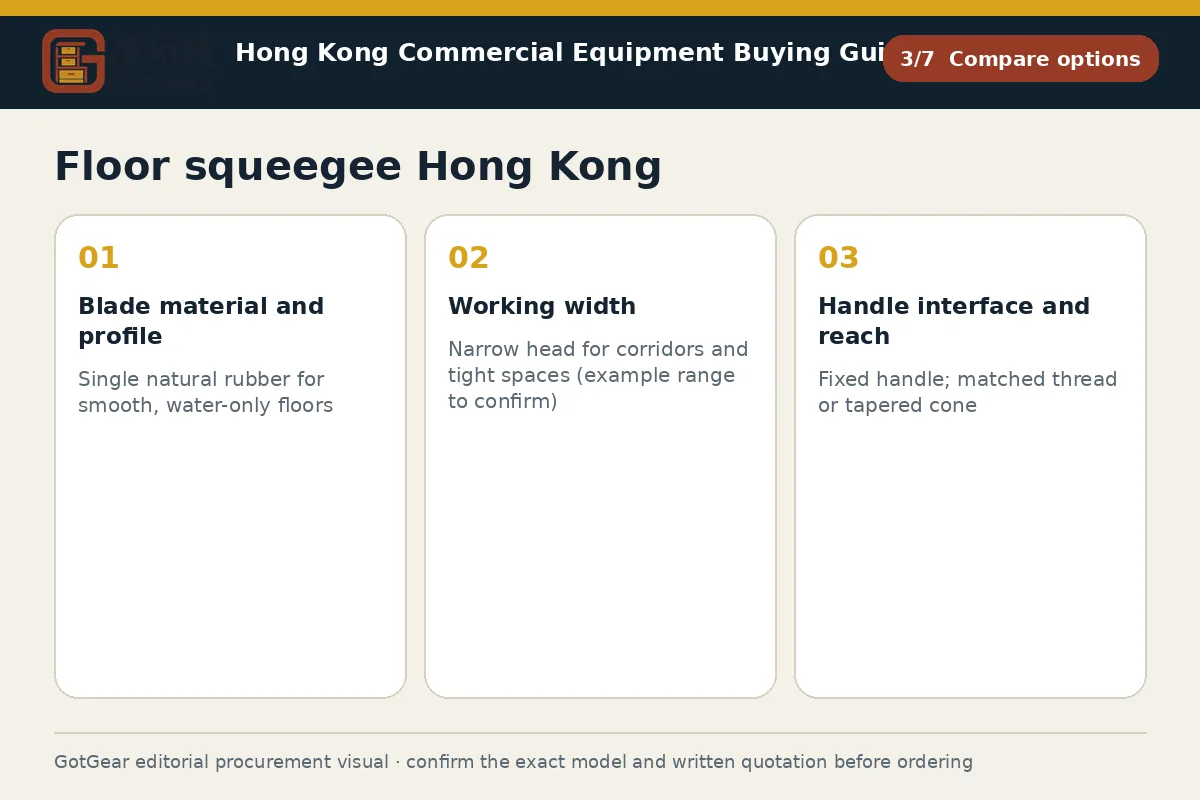
| Blade material and profile | Single natural rubber for smooth, water-only floors | EPDM/nitrile or closed-cell foam; twin blade with splash guard for oils/texture | Floor type/texture, liquids present, photos of sample areas; request chemical-compatibility note |
| Working width | Narrow head for corridors and tight spaces (example range to confirm) | Wide head for open halls; curved ends for wall guiding (example range to confirm) | Measured clear width between fixtures, turning space, drain spacing |
| Handle interface and reach | Fixed handle; matched thread or tapered cone | Mixed-brand heads via adaptor; telescopic pole; non-conductive handle if site requires | Max reach from safe stance, handle model numbers, lift/ceiling clearance |
| Hygiene and chemical exposure | Washable frame; fresh water and mild detergent | Grease/solvent exposure; site colour-coding policy; request sanitising guidance | Cleaning agents to be used, hygiene policy, written chemical-resistance statement |
| Drainage and movement route | Short push to nearby gully on clear slope | Long runs to interceptor/trench; intermediate pickup with wet vac or carts | Sketch of route, drain locations and permissions, event/public-area control notes |
This framework helps buyers create comparable written enquiries. Final model specifications, availability, delivery and commercial terms must be confirmed in a formal quotation.
Why window squeegee Hong Kong needs differ from floor squeegee Hong Kong
Window cleaning imposes different edges, pressures and risks than floor work, so a window squeegee should not be treated as interchangeable with floor equipment. Glazing requires a precise rubber profile, consistent channel tension and a handle angle that keeps the blade flat across the glass without chatter. Floors benefit from wider frames and more forgiving compounds to ride over grout, expansion joints and flakes.
Access methods also diverge. Windows often require applicators, holsters and controlled water use to avoid drips onto public walkways, while floors prioritise drainage routes and slip warnings. Window channels are lighter and narrower; floor frames are robust to resist impacts. In your enquiry, separate glazing and floor tasks. For glazing, list pane sizes, frame depths, preferred channel widths, rubber replacement availability and any swivel requirement. Confirm the site‑approved access method before ordering long poles or belts, and request manufacturer instructions in bilingual format where your team needs them. Pair glass work with lint‑free detailing using a microfibre cleaning cloth, and log any building‑management constraints for façade work, including time windows, staging areas and public‑area controls to be confirmed by the venue.
Check drainage routes before using floor squeegee Hong Kong
Drainage planning determines whether water moves cleanly or just relocates the hazard. Walk each route from the wettest point to the gully, trench or interceptor before specifying tools. Note slopes, thresholds, door sweeps and lift lobbies that could trap liquid. Where drains are distant, plan an intermediate pickup using a wet vacuum or a flat mopping trolley Hong Kong to avoid pushing contaminated water through occupied areas. For retail or event venues, coordinate cordons, signage and spill-response timing with the management office.
Translate this survey into procurement language. State the primary liquid (rainwater, wash water, grease‑laden rinse), floor type and average run length to drainage. If you must steer along walls, ask for curved blade ends; if passing over louvres or expansion joints, request a twin blade for better contact. Where chemicals or degreasers are present, ask the manufacturer for a written statement of blade chemical resistance and cleaning‑agent compatibility. On receipt, sight along the blade for straightness, check that the frame is square, confirm all fixings are tight, and verify end‑caps and splash guards are included as quoted. Record any building‑manager instructions on discharge points so operators do not push water into lift shafts or public exit routes.
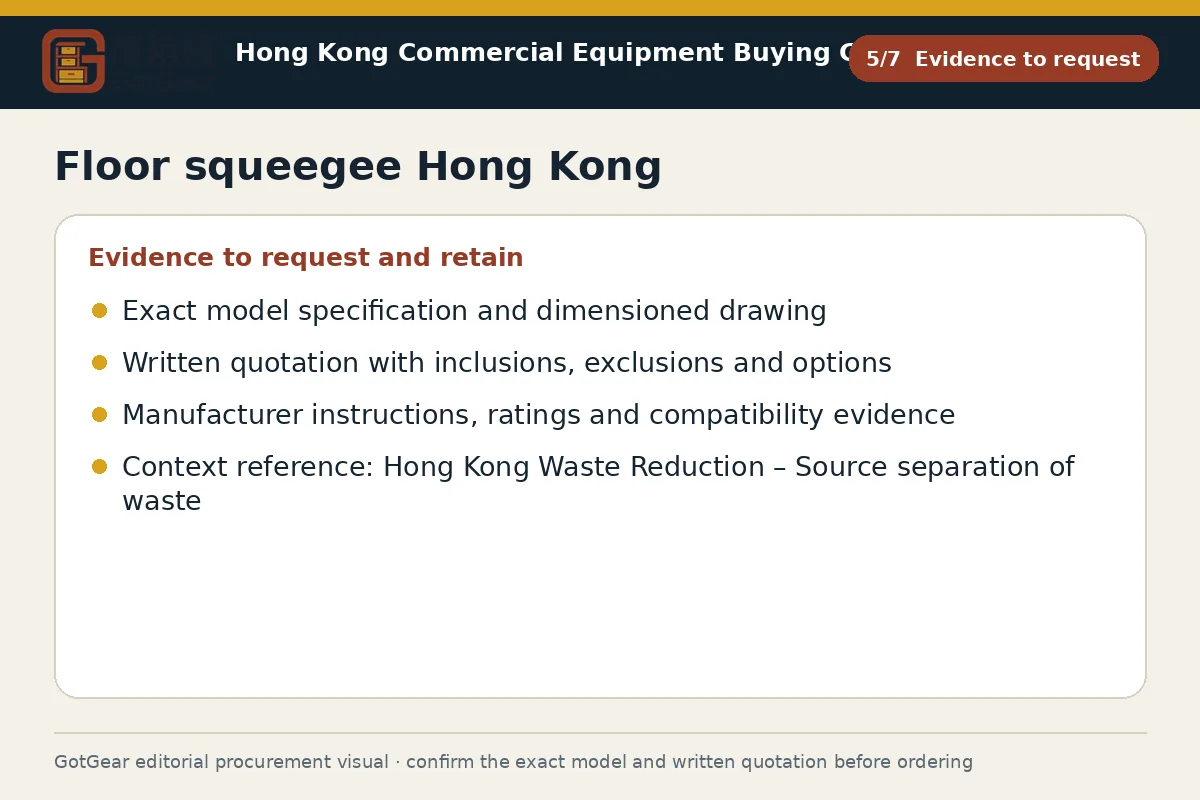
Floor squeegee Hong Kong decision checklist
Start by listing each area: floor type, texture, typical liquid, and the nearest approved drain. Measure the narrowest clearance between fixtures to set a practical squeegee width, and note the longest reach needed from a safe stance. Record goods‑lift and storeroom dimensions so handles and frames fit on delivery and in daily storage. In your enquiry, specify blade material, width, frame material, handle interface, and any splash‑guard or curved ends. Ask for confirmation of chemical resistance where degreasers or sanitisers are used. Compare written quotations like‑for‑like on blade compound, replaceable blades, frame material, and handle compatibility by model number. On receipt, inspect edge straightness, frame alignment, and the lock on telescopic sections. Keep bilingual instructions on file and confirm any management‑office conditions for wet work before first use. Written model specifications and the supplier’s formal quotation should prevail over drafts.
- Operating use, quantity and expected frequency
- Dimensions, capacity, material and accessory requirements
- Delivery address, floor, goods lift and loading window
- Required documents, acceptance checks and after-sales arrangements
Key points for floor squeegee Hong Kong, window squeegee Hong Kong
Hong Kong sites combine humid conditions, tight goods‑lift cars, narrow back‑of‑house corridors and busy public interfaces. For floor work, confirm the building‑management office’s approved discharge points and time windows for wet operations, especially around lobbies and loading areas. For glazing, many façades sit directly over pavements and vehicle lanes; coordinate access and drip control before buying long poles or belts. Bilingual documentation eases multi‑language teams, and compact frames store better in small cleaners’ rooms. Always reconcile equipment dimensions with lift and doorway constraints before placing an order.
Questions about floor squeegee Hong Kong
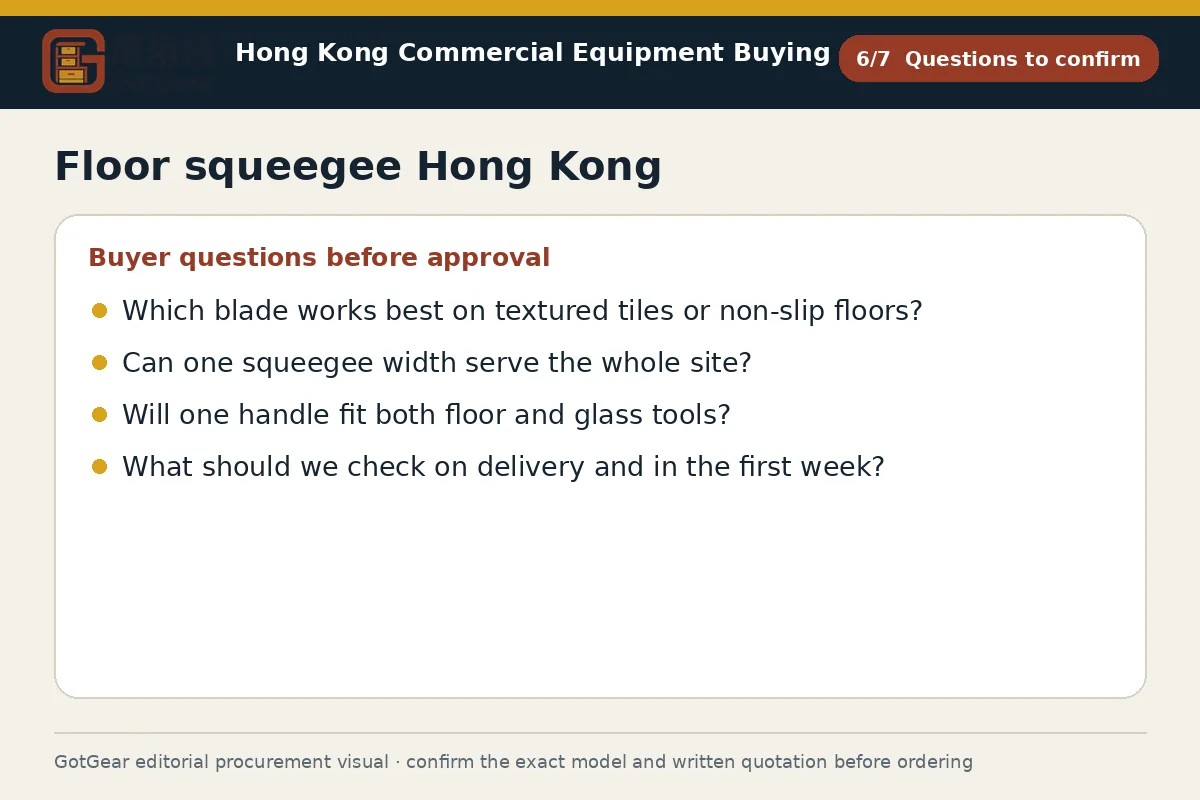
Which blade works best on textured tiles or non-slip floors?
Closed-cell foam or softer synthetic rubber typically maintains better contact on textured surfaces, improving water removal. Where oils or degreasers are present, request EPDM or nitrile and ask the manufacturer to confirm chemical compatibility. If splash-back occurs, a twin-blade frame can help. Always test a small area first and base final selection on the written model specification and the supplier’s quotation.
Can one squeegee width serve the whole site?
Often you will need two widths: a narrower head for corridors and tight spaces and a wider head for open halls. As an example only, teams may compare around 400–450 mm and 600–750 mm; confirm after measuring clearances and drain spacing. Productivity gains from wider heads can be lost if operators must constantly angle around fixtures, so size to the route.
Will one handle fit both floor and glass tools?
Some handles accept adaptors for different cones or threads, but compatibility is brand- and model-specific. If you intend to share one handle across floor heads and glass tools, request written confirmation of the interface and any required adaptor part numbers. Inspect fit on arrival and keep a spare cone or adaptor in stores to avoid downtime if one is damaged.
What should we check on delivery and in the first week?
On delivery, sight the blade for straightness, check frame squareness, and test the handle lock and thread fit. Verify all quoted parts—end-caps, splash guards, adaptors—are included. In the first week, confirm operators can move liquid to the intended drain without pooling, and log any chemical softening or blade wear for supplier review against the quoted model.
Continue with closely related procurement topics
These pages share equipment, operating or decision-stage signals with this guide.
Wet mop and handle Hong Kong
Compare wet mop and handle Hong Kong by floor type, liquid load and wringing method. Discover when dust mop and handle Hong Kong or Kentucky mop Hong Kong suit the task with GotGear.
Read the guide
Commercial broom Hong Kong
Commercial broom Hong Kong: GotGear compares bristle stiffness, head width and handle length. Dustpan and brush Hong Kong: Review lip and storage options.
Read the guide
Decorative refuse bins Hong Kong
Compare decorative refuse bins Hong Kong with lobby litter bins Hong Kong to assess capacity, opening style, finish, liner concealment and cleanability, and to confirm required floor area with GotGear, Hong Kong.
Read the guide
Hooded waste bins Hong Kong
GotGear compares hooded waste bins Hong Kong and wall mounted waste bins Hong Kong by aperture, floor clearance, fixings and cleaning access to help foodservice buyers assess suitability.
Read the guideRelated topic indexOpen more English procurement pages2 topics
Browse additional equipment families, applications and procurement questions relevant to a wider buying brief.