
To evaluate a no dirty water system trolley Hong Kong, compare the proposed sequence with the site’s current floor-care method from preparation through final disposal. Verify manufacturer instructions, chemical and surface compatibility, available facilities and applicable site requirements before adopting a workflow.
Map water and pad movement for no dirty water system trolley Hong Kong
Begin by sketching a scaled plan of each cleaning zone, marking where solution is prepared, where fresh pads are staged and where used liquid or pads are isolated. Note the exact distances and door widths along the intended route so a no-dirty-water system trolley used on Hong Kong sites can be manoeuvred without breaching clean–used segregation. Record lift car and doorway clear openings, floor transitions and any thresholds that could catch wheels or create splash risk when tanks are near full.
Request from suppliers a footprint drawing showing turning radius, wheelbase and maximum handle height, and ask for empty and full weights as separate fields. Ask whether the separating mechanism is twin-tank, diaphragm or pre-impregnated-pad workflow, and where valves, caps and pad caddies sit relative to the user. If your team already operates a flat-mopping trolley or a flat-mop system on Hong Kong sites, map how pad loading and unloading will change. For pad-based methods, specify the number of sealed caddies required per shift and where they will be parked to avoid cross-traffic with food service or patient movement. In humid plant rooms, identify ventilated drying space for launderable textiles or confirm sealed-liner disposal for soil-laden items. If switching to microfibre flat-mop textiles for Hong Kong sites, record pad sizes, rail compatibility and any site laundry constraints.
Test route capacity for no dirty water system trolley Hong Kong
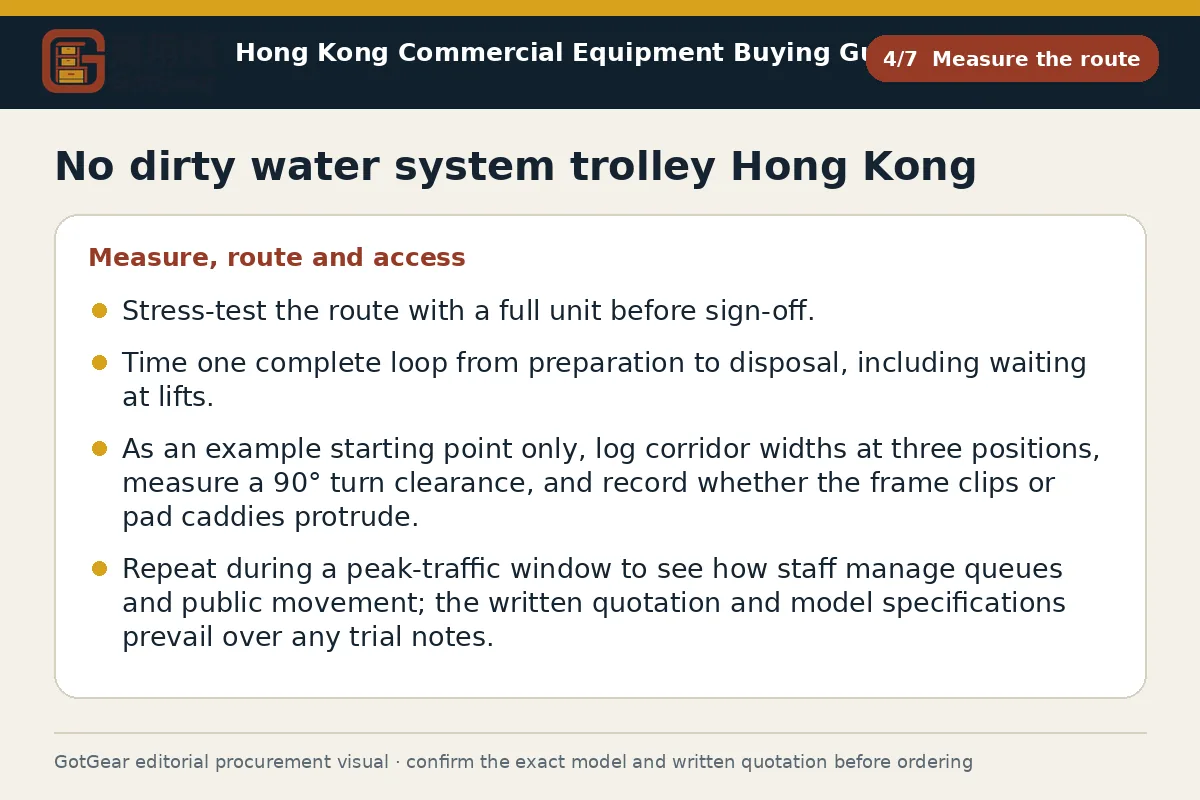
Perform a stress test of the route with a fully loaded unit before sign-off. Time one complete loop from preparation to disposal, including any waiting at lifts. For an example starting point only, record corridor widths at three positions, measure the clearance for a 90° turn, and note whether the frame clips or any pad caddies protrude. Repeat the exercise during a peak-traffic period to observe how staff manage queues and public movement; the written quotation and model specifications take precedence over any trial notes. Where gradients or ramps are present, verify brake hold and wheel grip on a wet surface, and document the measured ramp length and rise.
Ask the vendor to state wheel diameter and material, caster type (swivel or locking), brake configuration and rated load, and then verify these with a live push–pull test. If a cleaning trolley with brakes is proposed in Hong Kong, observe brake engagement with one hand while the other steadies a loaded caddy, and confirm the pedal does not foul skirting or lift sills. Request an example starting point for “area per refill” or “pads per shift” and validate it under your own soil load. Weigh the trolley when filled with solution to confirm operator handling is realistic and safe within your team profile, and note any need for two-person movement on slopes or over thresholds as advised by your competent assessor.
What should buyers compare for no dirty water system trolley Hong Kong?
| Criterion | Straightforward requirement | More complex requirement | Evidence to provide |
|---|---|---|---|
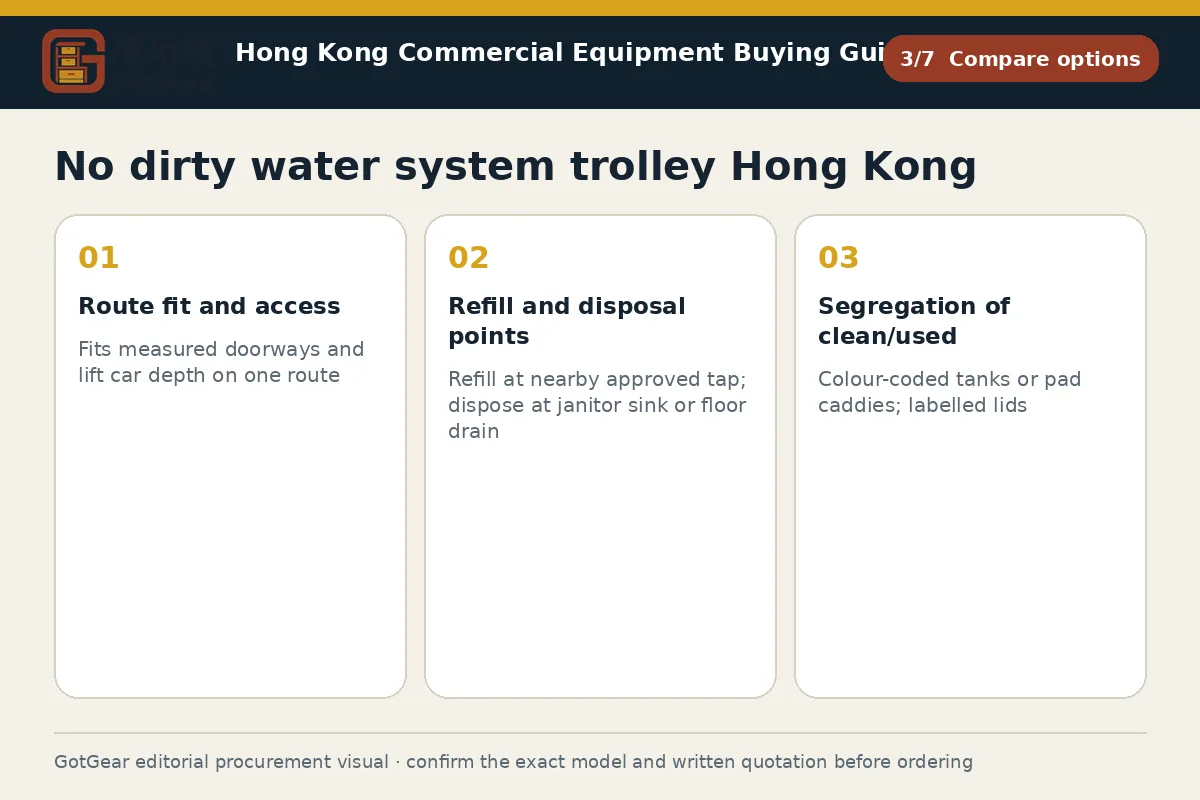
| Route fit and access | Fits measured doorways and lift car depth on one route | Navigates multi-floor routes with thresholds and shared goods-lift queuing | Provide corridor and lift measurements, threshold heights, and photos of tight turns |
| Refill and disposal points | Refill at nearby approved tap; dispose at janitor sink or floor drain | No in-zone decanting allowed; use sealed caddies/tanks and transfer to approved room | Supply plan of water points, disposal locations, and manager confirmation emails |
| Segregation of clean/used | Colour-coded tanks or pad caddies; labelled lids | Audited segregation with sealed liners and staged collection from sensitive areas | Attach draft SOP and any infection-control sign-off requirements |
| Throughput per shift | Single-floor area with one refill or pad set | Multiple zones and peaks; capacity proven under public/ward traffic | State area, peak windows, example starting point yields, and timing logs |
| Documentation and training | English manual and quick-start card included | Bilingual SOP, method statement and training record templates available | Request sample pages and specify languages required for approval |
This framework helps buyers create comparable written enquiries. Final model specifications, availability, delivery and commercial terms must be confirmed in a formal quotation.
Compare refill and disposal steps for no dirty water system trolley Hong Kong
List every refill and disposal step in order, along with the rooms and fixtures used. Identify the nearest cold-water source with a backflow-protected tap if mixing on site, or the storage bench used for pre-impregnated pads. Record whether a janitor sink, slop hopper or floor drain is available for used liquid, and where used pads or liners are sealed and staged for removal. If decanting is not allowed at the floor in question, plan a sealed transfer in secondary containment to the approved point; confirm this with the building manager or infection-control lead if in healthcare.
In your enquiry, ask for tank capacities (fresh/used stated separately), valve type (non-drip, quick-connect), access for cleaning, and whether the frame accepts closed-lid pad caddies. For a pad-based flat mop system Hong Kong, request a written pad yield at an example starting point soil level, plus compatibility with your chemicals and flooring. Note bilingual labelling requirements for chemical names, dilution and hazard statements. Set inspection points for end-of-shift decontamination of caps, seals and gaskets, and ask for guidance on drying or disinfecting the separation chamber. Where waste is classed as clinical or food-contact adjacent, confirm any additional bagging or route restrictions required by your venue, insurer or competent adviser.
Write the operating sequence for no dirty water system trolley Hong Kong
Write a clear operating sequence that a new team member can follow unaided. Start with pre-start checks, including confirming clean solution volume or pad count against the mapped zone, inspecting seals and brakes, and verifying the correct caddies are latched. In loading bays with short time windows, stage pre-prepared pads and spare liners so the trolley can depart promptly, and ensure bilingual quick steps are fixed to the frame at eye level. Build in a check that used liquid valves are shut before movement, and that pad caddies are segregated by colour or label.
Describe the in-zone cycle: move from low to high sensitivity areas if required by your site, change pads or isolate used solution at the defined checkpoints, and record any deviations. As an example starting point, swap pads after a set number of passes on heavy soil, then confirm or adjust with the manufacturer’s advice and your own trial. End-of-shift steps should cover emptying at the approved point, rinsing or disinfecting the separation chamber, drying lids and gaskets, and logging any leaks, sticky valves or wheel issues for supplier follow-up. Request the supplier’s operating manual and SOP in English and Traditional Chinese, and obtain written confirmation that your chemicals and surfaces are within their stated compatibility before final approval.
No dirty water system trolley Hong Kong decision checklist
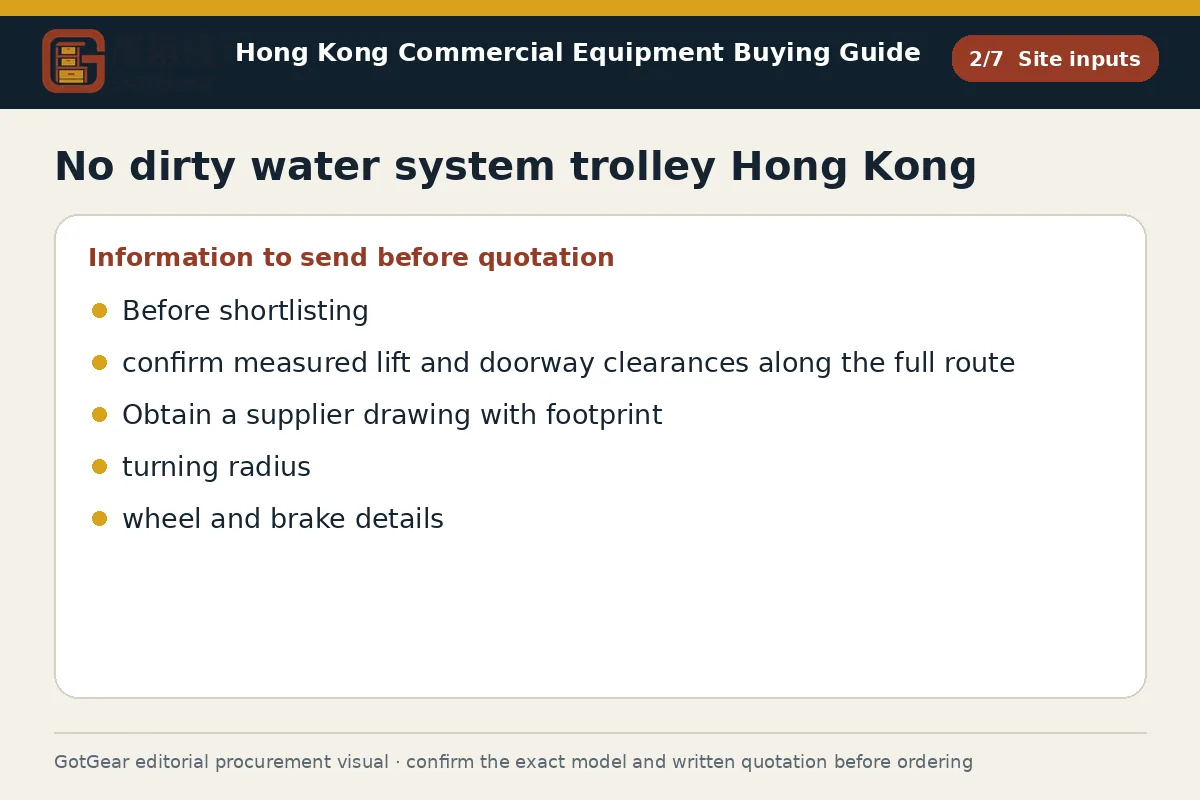
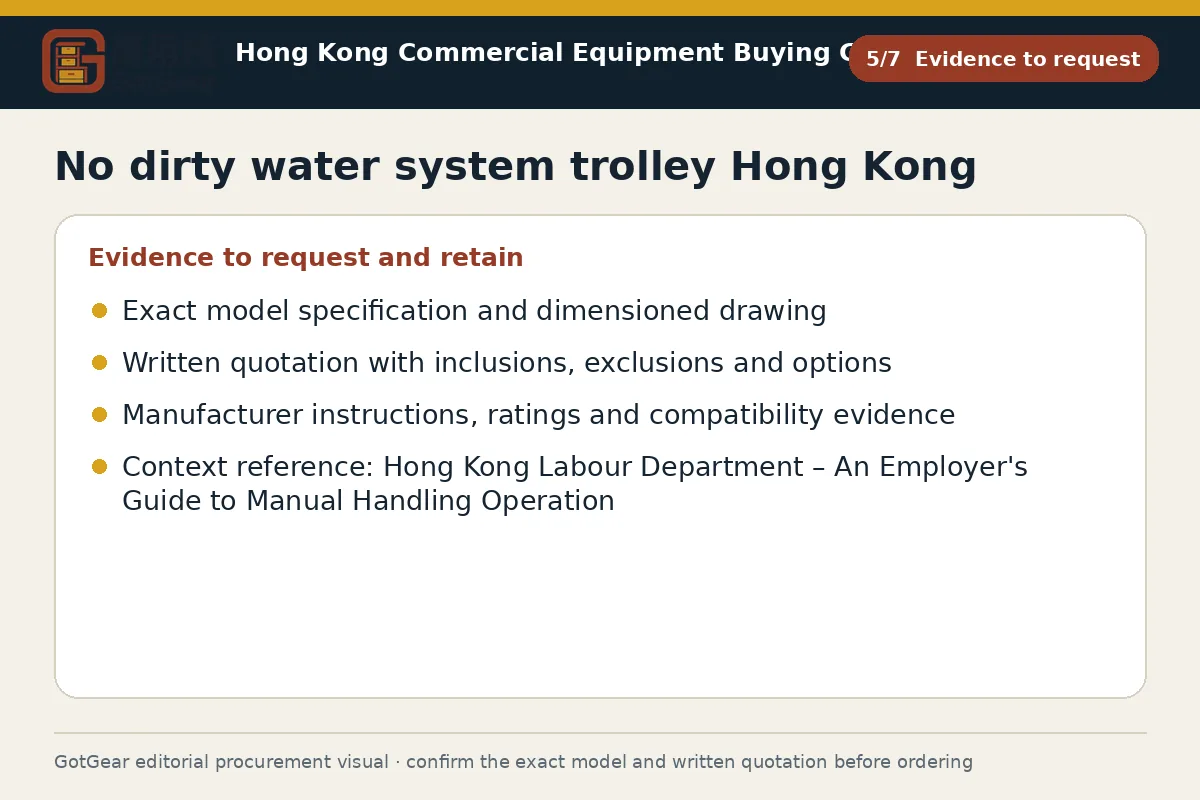
Before shortlisting, confirm measured lift and doorway clearances along the full route. Obtain a supplier drawing with footprint, turning radius, wheel and brake details, plus separate fresh and used tank capacities. Verify where solution is prepared and where disposal is authorised; document any prohibition on decanting in the zone. Request pad yield or area-per-refill example starting points and validate in a witnessed trial. Ensure manuals, quick guides and labels are available in English and Traditional Chinese. Inspect seals, caps and valves for tool-free cleaning, and note spare parts availability. Record who signs off infection-control or facilities approval, and reconcile the chosen sequence with cleaning rosters. The model specification and formal written quotation should prevail in all comparisons.
- Operating use, quantity and expected frequency
- Dimensions, capacity, material and accessory requirements
- Delivery address, floor, goods lift and loading window
- Required documents, acceptance checks and after-sales arrangements
Key points for no dirty water system trolley Hong Kong
Hong Kong sites often rely on tight goods lifts, narrow back-of-house corridors and short, fixed loading windows controlled by the building manager. Plan whether the trolley fits lift cars and queuing areas without blocking fire doors, and where refilling or disposal can occur without crossing public or patient routes. Humid storerooms complicate textile drying; allow ventilated space or sealed liners. Some venues require bilingual signage and prior method statements for works near food or care areas. Always confirm site rules with the manager or competent adviser before committing to a workflow.
Questions about no dirty water system trolley Hong Kong
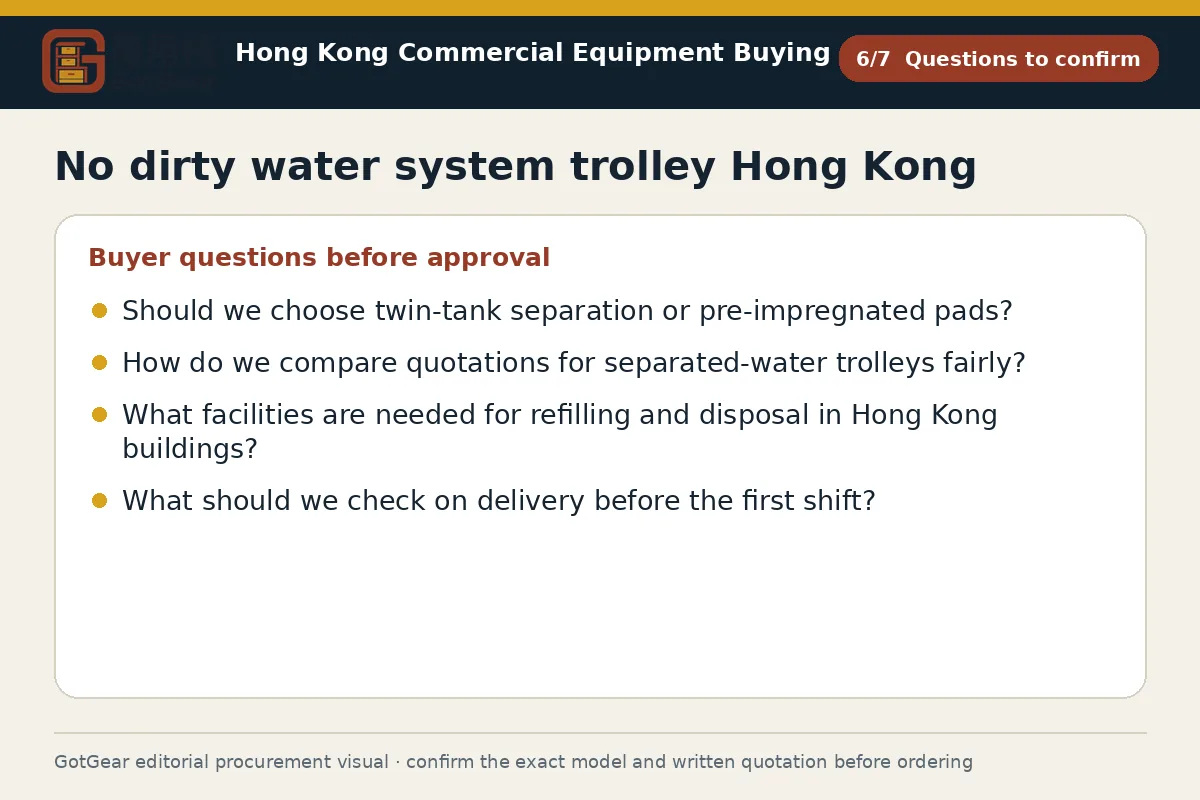
Should we choose twin-tank separation or pre-impregnated pads?
Pick the method that fits your refill and disposal points. Twin-tank suits sites with an approved drain nearby; pre-impregnated pads reduce liquid handling where decanting is restricted. Trial both on your floors and soils, and verify chemical compatibility and pad yield with the manufacturer. Your building manager or infection-control lead may guide the final choice for sensitive zones.
How do we compare quotations for separated-water trolleys fairly?
Ask all bidders to state footprint, turning radius, fresh and used tank capacities, empty/full weights, wheel and brake specifications, and pad yield or area-per-refill example starting points. Request drawings and bilingual manuals. Compare inclusions such as caddies, seals and spare gaskets. Base evaluation on your measured route and facilities constraints; the written quotation and model specification prevail.
What facilities are needed for refilling and disposal in Hong Kong buildings?
Ideally, an approved janitor sink, slop hopper or floor drain near the work zone, plus a safe water source for mixing if used. Where decanting is prohibited, use sealed tanks or pad workflows and transfer to the designated disposal point. Confirm locations, access hours and any escort needs with the property manager, and document approvals in your method statement.
What should we check on delivery before the first shift?
Verify the frame is square, wheels spin freely, and brakes hold on a slight slope. Inspect tank mouldings, caps, gaskets and valves for defects or leaks, and confirm caddies latch securely. Check that manuals and labels are bilingual, and record the serial number. Report any nonconformity in writing and request the supplier’s corrective plan per their quotation terms.
Continue with closely related procurement topics
These pages share equipment, operating or decision-stage signals with this guide.
Waste bin replacement lids Hong Kong
For waste bin replacement lids Hong Kong, photograph the bin, record its make and model, measure the rim and fixings, and check the hinge, opening and colour coding to confirm the fit. Guidance is from GotGear.
Read the guide
Waste stream labels Hong Kong
When specifying waste stream labels Hong Kong, confirm accepted materials, wording, colours, visibility and bin location. Pair recycling bin stickers Hong Kong with larger recycling bin signage Hong Kong for guidance from GotGear.
Read the guide
Recycling station Hong Kong
GotGear explains a recycling station Hong Kong, outlining accepted streams, signage, staff checks, volumes and transfer routes. We connect front of house recycling bins Hong Kong with back of house recycling bins Hong Kong.
Read the guide
Paper recycling bins Hong Kong
GotGear explains the differences between paper recycling bins Hong Kong, plastic recycling bins Hong Kong and glass recycling bins Hong Kong in contamination risk, filled weight, handling route and written collection rules.
Read the guideRelated topic indexOpen more English procurement pages2 topics
Browse additional equipment families, applications and procurement questions relevant to a wider buying brief.