
To compare a flat mopping trolley Hong Kong, draw the workflow from preparation to disposal or laundering and list every container and tool required. A Kentucky configuration should be assessed separately for bucket, wringer, mop and water-handling needs rather than treated as the same layout.
Map clean and used materials on a flat mopping trolley Hong Kong
Start by sketching the journey of materials on the trolley from preparation room to disposal point. Place sealed, clearly labelled clean-pad containers at the highest, most protected level; keep used pads in a separate, lidded bin or bagged module below to prevent drip-back. Use colour-coded caddies for detergents and disinfectants, and park the flat mop frame in a locking clip so it cannot swing during transport. Add a small tray or micro-bucket for spot work, kept away from clean textiles.
For procurement, request drawings that show overall trolley footprint, the exact location and volume of each clean and used textile container, and whether lids are gasketed. Ask for liner compatibility (bag sizes and tie points), pad-box internal dimensions, and whether modules are removable for sink loading. Specify requirement for leak-resistant bases, splash guards, and a parking-brake system. If you operate multiple hygiene zones, note the colour standard and language requirements for labels. Where humid conditions are common, ask for material data (grade of stainless steel or polymer) and cleaning guidance. Before issuing a purchase order, record the route’s waste-drop points and laundering handover so your written quotation can confirm container counts and whether warning-sign holders, hooks for dusters, and bottle holsters are included as listed items, not implied accessories.
Test lift and doorway access for flat mopping trolley Hong Kong
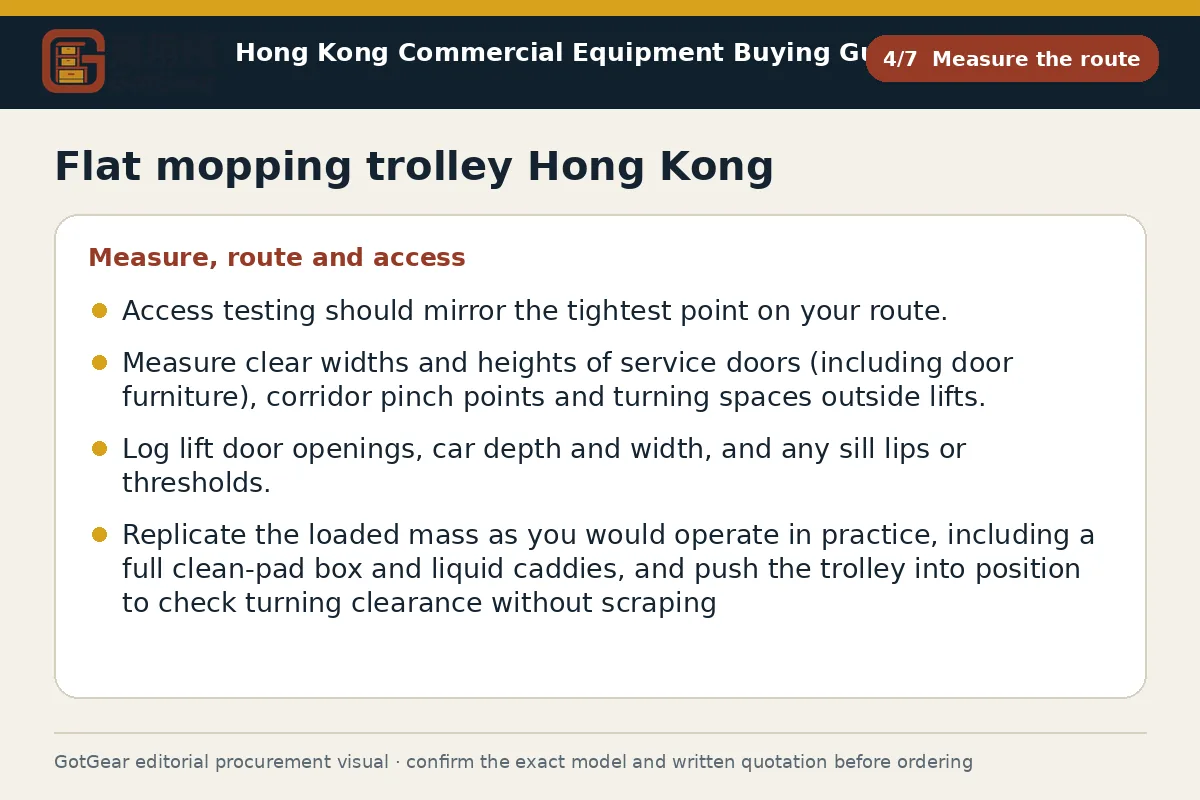
Access testing should mirror the tightest point on your route. Measure clear widths and heights of service doors (including door furniture), corridor pinch points and turning spaces outside lifts. Log lift door openings, car depth and width, and any sill lips or thresholds. Replicate the loaded mass as you would operate in practice, including a full clean-pad box and liquid caddies, and push the trolley into position to check turning clearance without scraping bumpers or labels. When testing a flat mopping trolley Hong Kong, teams should also confirm the brake can hold on mild ramps and that the wheels roll quietly for night operations.
Include in your enquiry the trolley’s overall length, width and height, stated turning radius, wheel diameter, tread material, and the type of castor locks (swivel, directional and total-stop) offered. If the supplier proposes adjustable handles or folding frames for storage or lift access, ask how they are secured in movement. Request noise data and a note on bumper materials if you pass finished walls or glass. As a practical trial, many buyers use a taped floor outline or a temporary cardboard mock-up; treat any dimensions as an example starting point only and confirm by on-site demonstration before you commit. Record all test photos and measurements in your file and reference them in the written quotation.
What should buyers compare for flat mopping trolley Hong Kong?
| Criterion | Straightforward requirement | More complex requirement | Evidence to provide |
|---|---|---|---|
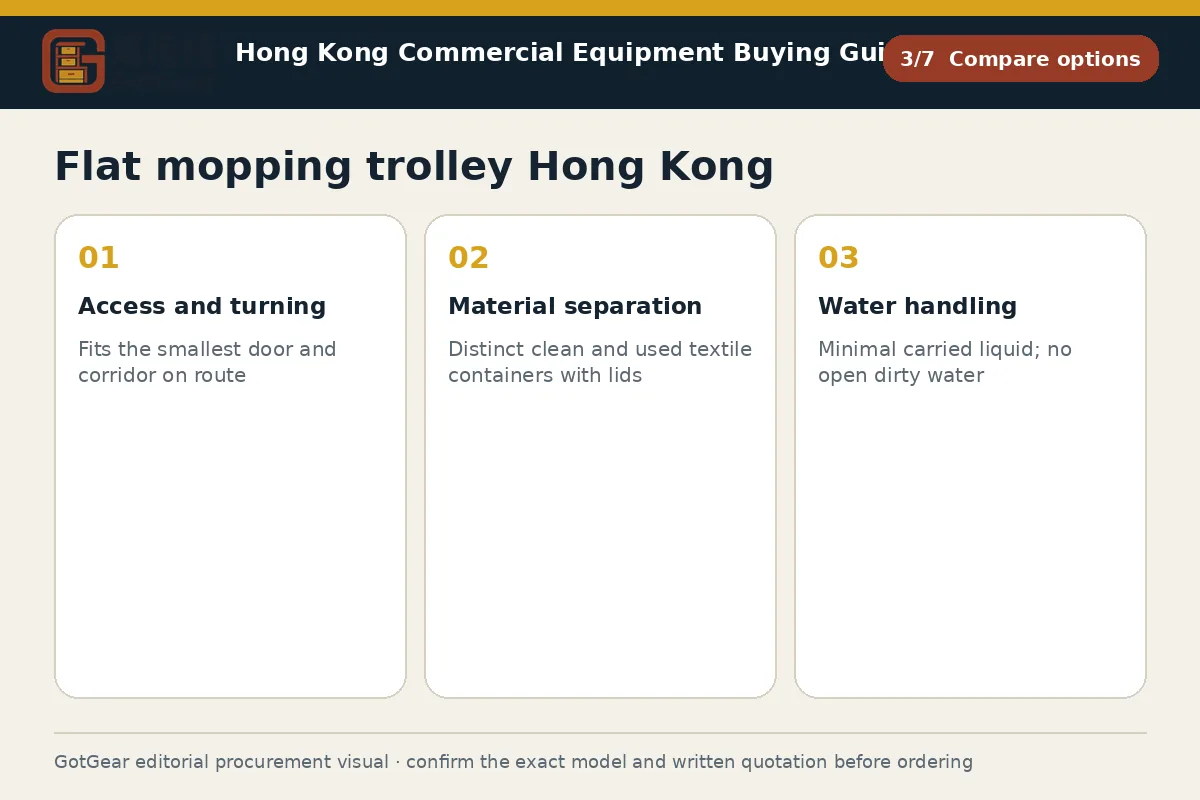
| Access and turning | Fits the smallest door and corridor on route | Clears lift doorway and rotates within the car without scuffing | Measured widths/heights, lift car dimensions, test photos |
| Material separation | Distinct clean and used textile containers with lids | Colour-coded, leak-resistant modules with liners and gasketed lids | Module volumes, liner sizes, colour scheme, location on trolley |
| Water handling | Minimal carried liquid; no open dirty water | Double-bucket with wringer and defined drain/empty procedure | Bucket volumes, wringer type, drain method and route notes |
| Stability and brakes | Two locking castors for parking | Directional lock plus total-stop brake; tip resistance when fully loaded | Wheel diameter and tread, brake type, any test observations |
| Consumable capacity | Holds a full round’s pads and cloths | Modular bins sized for staged replenishment along the route | Pad count plan, tray/internal dimensions, replenishment points |
This framework helps buyers create comparable written enquiries. Final model specifications, availability, delivery and commercial terms must be confirmed in a formal quotation.
Comparing Kentucky mopping trolley Hong Kong and flat mopping trolley Hong Kong
A side-by-side comparison works best when you focus on soil load, hygiene separation and operator time. Kentucky rigs are familiar and handle heavy, wet soil with a wringer and bucket system, while flat systems excel at pre-dosed, low-water cleaning and faster area coverage with reduced re-soiling. If your floors see frequent spills or gritty debris, a Kentucky mopping trolley option for Hong Kong, with a suitable wringer and double-bucket, may be simpler to train and service. If your priority is cross-contamination control and quick drying, the flat approach keeps clean and used textiles apart in sealed containers.
From a procurement perspective, compare water handling: written quotations should show bucket capacities and drain method for Kentucky, versus pad-box volumes and dosing approach for flat. Specify required wringer type and handle height adjustment for Kentucky; specify pad-frame compatibility and lidded textile bins for flat. For multi-floor routes with tight lifts, the smaller footprint and lower carried water of flat systems may be preferable, but confirm by on-site access testing and timing a typical round. Record any venue or insurer rules on chemical carriage or waste water disposal and ask the manufacturer for cleaning and maintenance guidance relevant to your chosen materials. Let model specifications and the formal quotation govern the final selection rather than assumptions.
Count pads, tools and supplies carried on flat mopping trolley Hong Kong
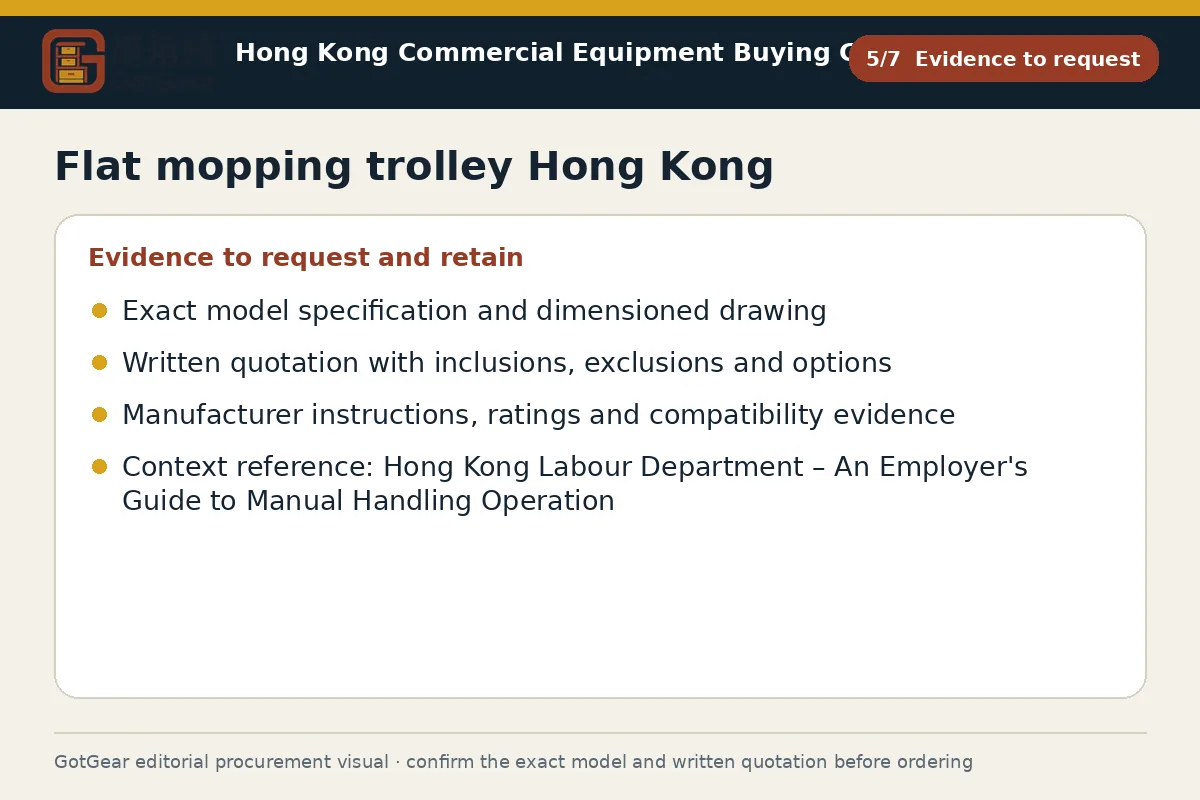
Count what must travel with the operator for one uninterrupted round. Record the number of pads needed by floor type, soiled area and interval between recharges. As an example starting point, some sites plan one microfibre pad per 25–40 square metres, or 10–15 pads per hour, but this must be confirmed with your supplier, building manager or competent adviser in a written brief. Add spare frames, a telescopic handle, warning sign, bin liners, cloths for edges and a small caddy for spot treatment, then verify each item has a secure place.
Ask for specification fields that make counting easy: nominal pad-box capacity in litres and recommended pad stack height; number and size of bottle holsters; dimensions of utility trays; presence of a sign clip; and hooks for dusters or a scraper. Request a list of included accessories and fasteners so quotations can be compared line by line. Note replenishment points and whether you will exchange full and empty pad boxes mid-route. On receipt, inspect that lids seal properly, caddies latch without wobble, frame clips hold under movement, and castors and brakes function smoothly. Where hygiene segregation is critical, ask the manufacturer for compatibility charts (pad-to-frame) and care instructions, and check bilingual labelling matches your internal standard.
Flat mopping trolley Hong Kong decision checklist
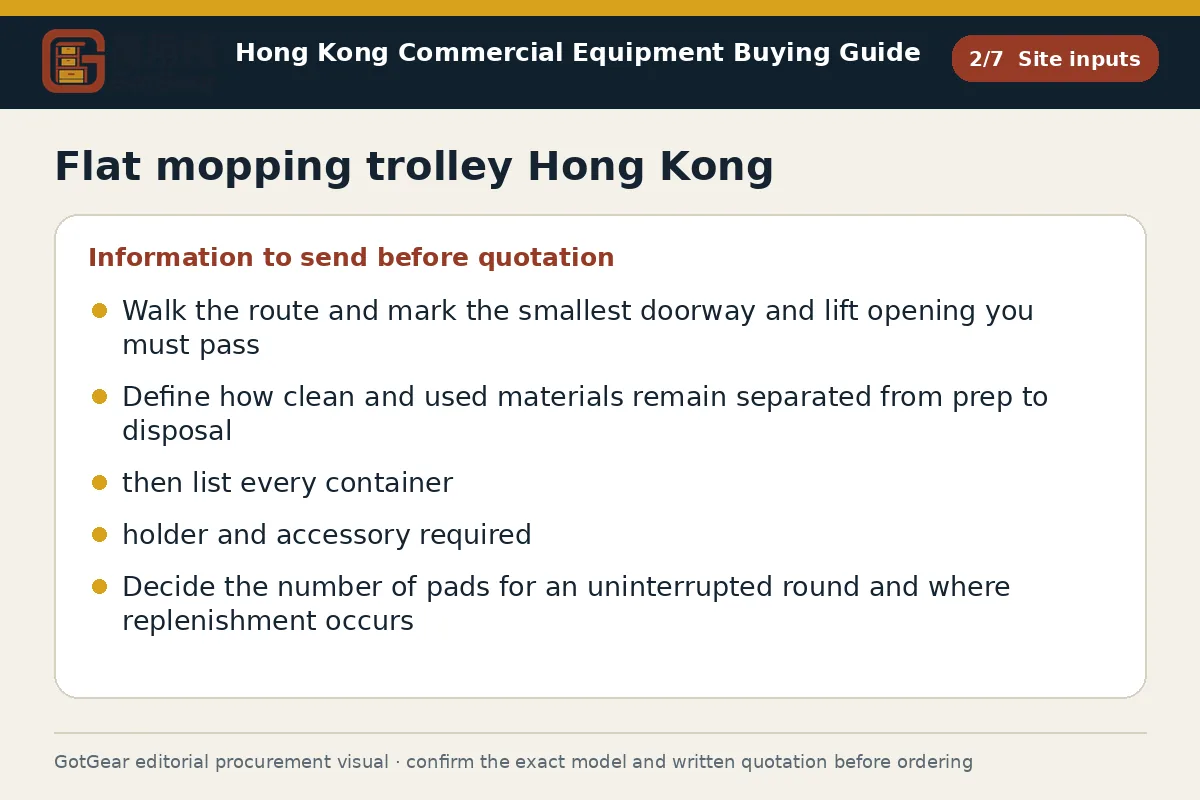
Walk the route and mark the smallest doorway and lift opening you must pass. Define how clean and used materials remain separated from prep to disposal, then list every container, holder and accessory required. Decide the number of pads for an uninterrupted round and where replenishment occurs. Request drawings with overall dimensions, turning radius, wheel and brake type, and exact volumes for pad boxes, buckets and bins. Specify material grades suitable for humid areas and ask for maintenance guidance. Compare quotations line by line, checking that lids, clips, signs and liners are included, not assumed. Conduct an on-site access test with a loaded trolley before ordering. On delivery, verify dimensions, brakes, wheel smoothness, lid seals and frame integrity, and confirm bilingual labels against your standard.
- Operating use, quantity and expected frequency
- Dimensions, capacity, material and accessory requirements
- Delivery address, floor, goods lift and loading window
- Required documents, acceptance checks and after-sales arrangements
Key points for flat mopping trolley Hong Kong, Kentucky mopping trolley Hong Kong
Hong Kong buildings often mix narrow service doors, compact lift cars and busy loading windows, so measure the tightest points along real cleaning routes before selecting a trolley. Humid conditions and salt air can accelerate corrosion in coastal districts, so confirm material grades and cleaning advice in writing. Multi-tenant industrial buildings may require coordination with the management office for waste handling and lift booking; ensure your plan reflects those constraints. Bilingual labelling is commonly expected for shared equipment. This summary highlights operating realities, not legal advice—always confirm site rules and any authority or insurer requirements with the responsible parties and let written model specifications and quotations prevail.
Questions about flat mopping trolley Hong Kong
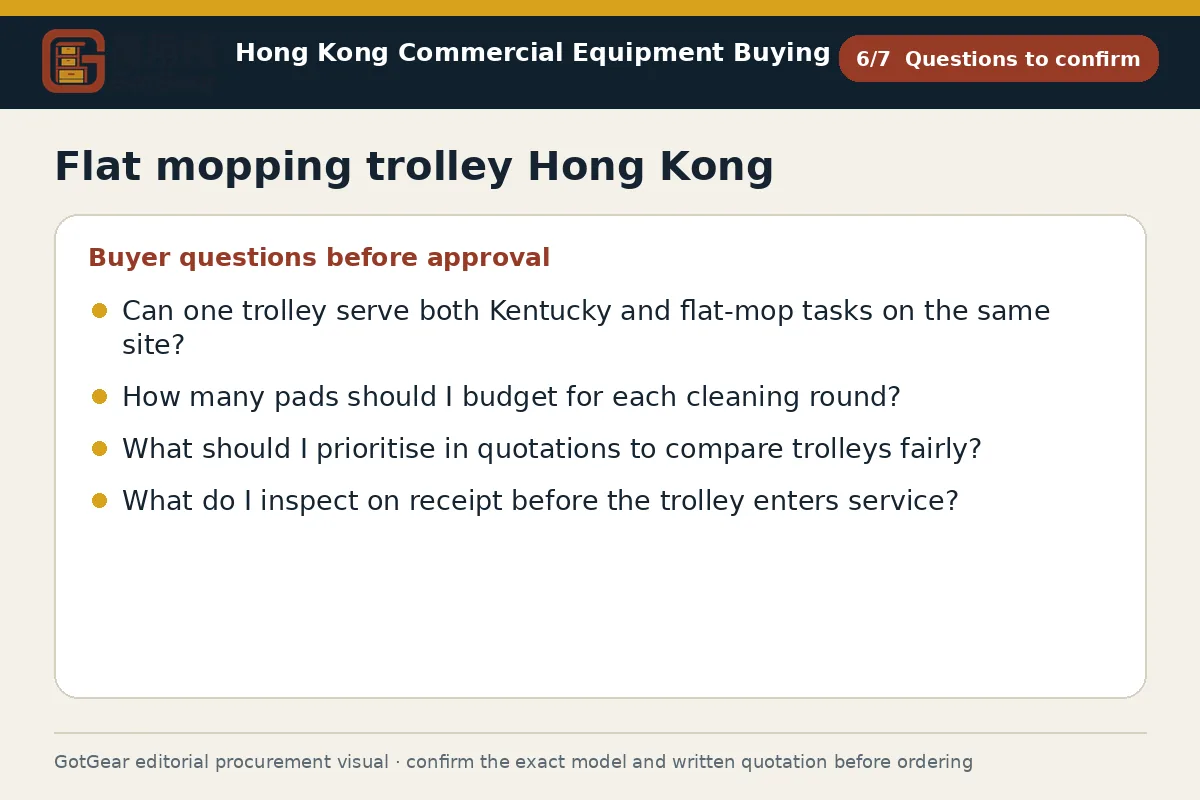
Can one trolley serve both Kentucky and flat-mop tasks on the same site?
Sometimes, if the frame accepts modular buckets or pad containers and the handle fits both tools. However, hybrids can compromise capacity or ergonomics. Ask suppliers to show how modules lock during movement, whether wringers or pad bins can be removed quickly, and what accessories are included. Confirm in writing which components are supplied and which are optional before comparing quotations.
How many pads should I budget for each cleaning round?
Plan pad quantity by soil level, floor texture and recharge points. As an example starting point, sites may allow one pad per 25–40 square metres or 10–15 pads per hour, but this must be confirmed with your supplier, building manager or competent adviser in a written brief. Match pad-box capacity to that count and ensure used textiles can be sealed away from clean items.
What should I prioritise in quotations to compare trolleys fairly?
Ask for overall dimensions, turning radius, wheel diameter and tread, brake type, container volumes, lid designs, frame clips, and list of included accessories. For Kentucky, add wringer type and bucket capacities; for flat, add pad-box volumes and frame compatibility. Insist that each supplier confirms materials and maintenance guidance. Base decisions on the written specification, not images or general claims.
What do I inspect on receipt before the trolley enters service?
First confirm overall dimensions and that the trolley clears your trial route. Test castors for smooth, quiet rolling and verify the parking brake holds on mild ramps. Check lids and bins seal without leaks, frame clips secure the mop head, and all specified accessories are present. If your venue has hygiene or insurer requirements, verify bilingual labels and request relevant manufacturer guidance.
Continue with closely related procurement topics
These pages share equipment, operating or decision-stage signals with this guide.
Cabinet cleaning trolley Hong Kong
This guide summarises access, route width, load and lift limits and door clearances for cabinet cleaning trolley Hong Kong. Compare roll top cleaning trolley Hong Kong and compact cleaning trolley Hong Kong with GotGear.
Read the guide
Flat mop system Hong Kong
Flat mop system Hong Kong: GotGear compares frame design, pad attachment, trolley compatibility, preparation, separation, laundering and pad quantities.
Read the guide
Cleaning trolley with brakes Hong Kong
Consult the GotGear checklist for cleaning trolley with brakes Hong Kong when planning use and storage. Assess gradients, loading, parking, wheel layout, brake access and staff reach, and follow the manufacturer guidance.
Read the guide
Microfiber cleaning cloth Hong Kong
GotGear compares microfiber cleaning cloth Hong Kong and microfiber flat mop Hong Kong across cleaning surfaces, chemical compatibility, colour coding and laundering cycles, and provides guidance on selection and care.
Read the guideRelated topic indexOpen more English procurement pages2 topics
Browse additional equipment families, applications and procurement questions relevant to a wider buying brief.