
Before selecting waste bins with ashtray Hong Kong, decide whether the site can manage ash and general refuse safely within one servicing routine. Confirm manufacturer instructions, the property’s fire and smoking-area procedures, actual site conditions and applicable Hong Kong requirements before placement or use.
Waste bins with ashtray Hong Kong: Should two waste streams be combined
When assessing whether to combine streams, begin by reviewing people flow and the waste profile at each designated location. High volumes of drink and food packaging increase odour and pest risk if ash and refuse share a single container; conversely, quiet perimeters may be better served by fewer pedestals to maintain. Consider the ember risk from smouldering butts, wind exposure on podiums, and how rain will enter apertures. If you intend to use waste bins with ashtrays intended for Hong Kong use, check the ash insert’s cooling and snuffing design, whether the general-waste aperture is baffled away from the ash chamber, and how easily each stream can be isolated during servicing.
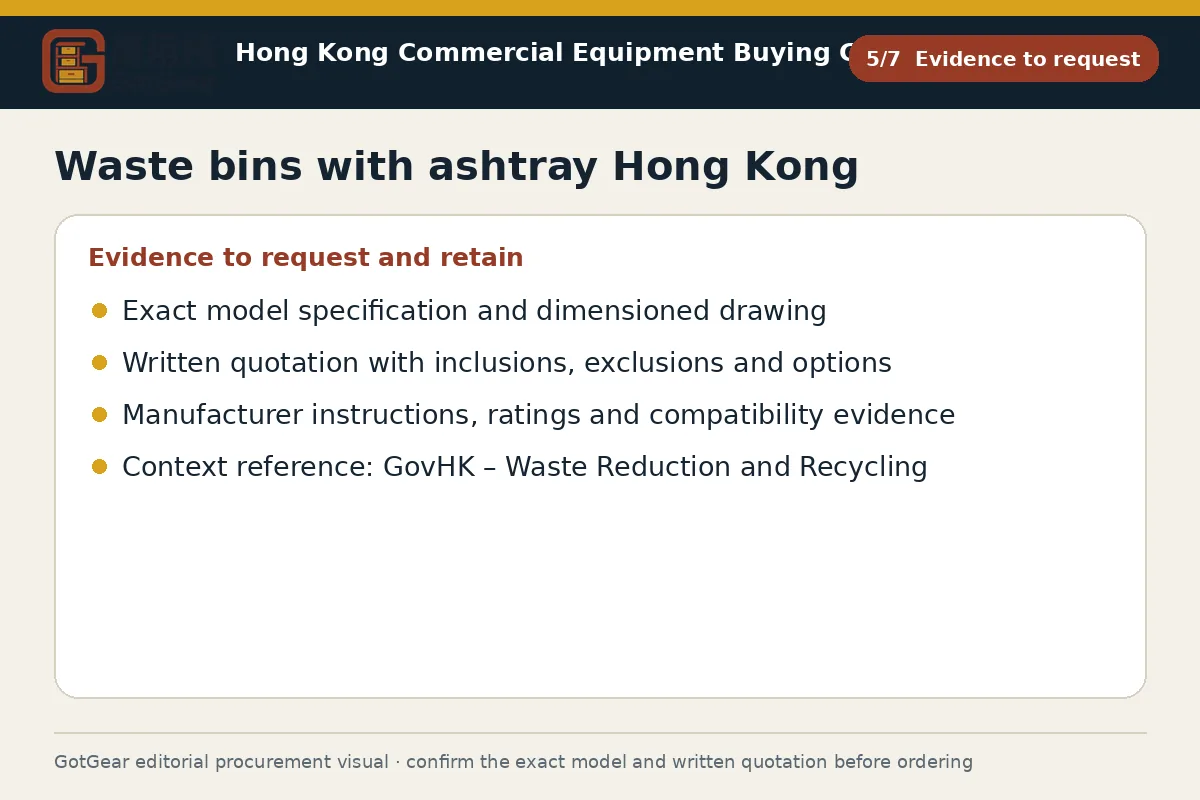
Request written specifications covering total and segregated capacities, liner compatibility, ash insert volume, snuffer plate or perforated snuffing details, and whether the lid or door interlocks to prevent access while hot materials are handled. Confirm stainless grade or coating system, anti-rust treatment for coastal sites, and anchoring or ballast options. Measure doorway and goods lift clearances, trolley routes and turning spaces to avoid damage during deliveries. Ask for photos or drawings of chute geometry, hinge types and locks, and whether waste stream labels for Hong Kong can be fitted in a bilingual format. Ensure quotations state replacement-part availability for ash cassettes, locks and hinges, with lead-time commitments subject to the supplier's written offer.
Plan emptying and inspection for waste bins with ashtray Hong Kong
Servicing plans should separate ash handling from general refuse and specify who, when and how. Establish PPE, tools and an ember-safe metal container with a fitted lid, then agree the sequence: isolate the ash insert first, secure it away from pedestrian paths, and only then address the refuse liner. As an example starting point, some venues trial a check at the end of each shift, then adjust to actual loading; final routines must follow the manufacturer’s instructions and the property’s fire procedures. Humid conditions accelerate corrosion, so include checks of snuffer plates, hinges and seals, especially after heavy rain or salt spray.
When comparing quotes, ask for drawings showing how the ash cassette removes, whether it is fully metal, and if spare inserts are offered for rotation. Confirm compatibility with waste bin liners Hong Kong and if tapered bodies accept standard liner sizes. Request cleaning and maintenance guidance, approved chemicals, and any limits on water use inside the ash area. On receipt, inspect welds, door alignment, latch function, fit of ash components, and the stability when doors are open. Verify that bilingual service labels, snuffer icons and any caution panels have been supplied as ordered, and record serial numbers for your asset register.
What should buyers compare for waste bins with ashtray Hong Kong?
| Criterion | Straightforward requirement | More complex requirement | Evidence to provide |
|---|---|---|---|
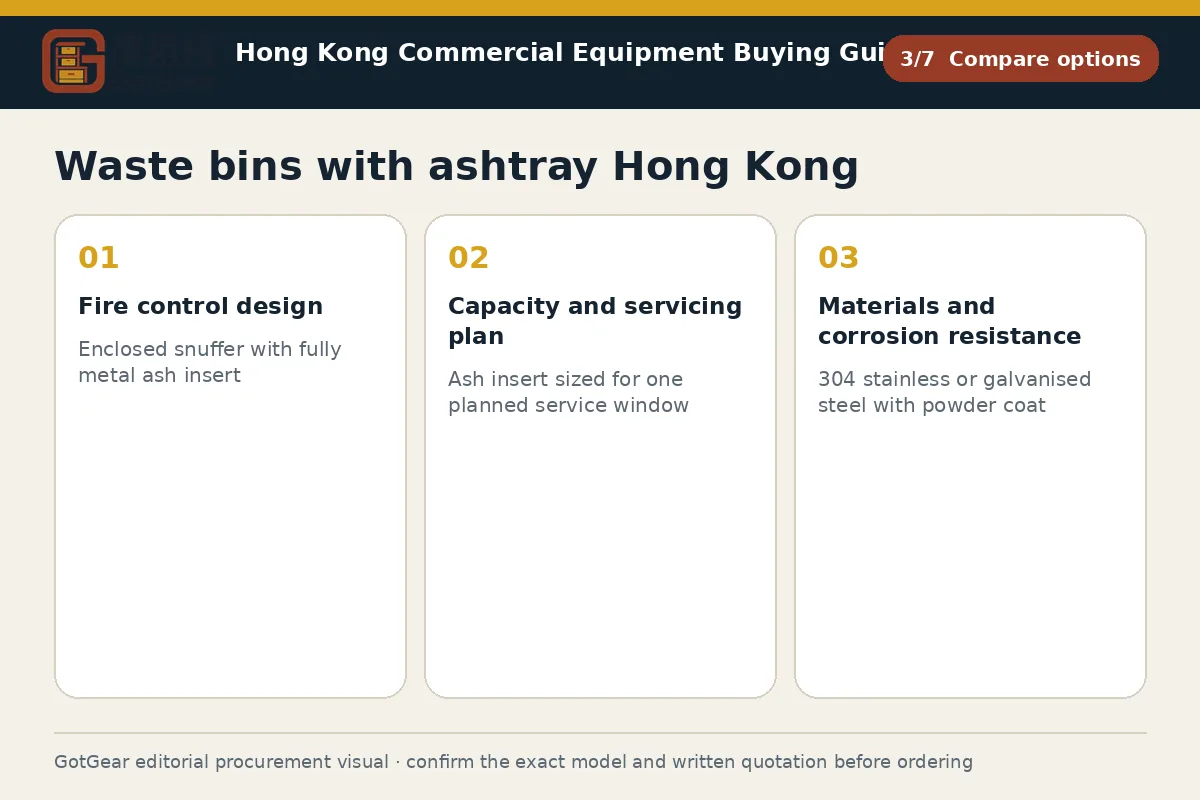
| Fire control design | Enclosed snuffer with fully metal ash insert | Separate butt receptacle with flame‑quenching path and thermal isolation | Datasheet, close‑up photos of snuffer and ash chamber design |
| Capacity and servicing plan | Ash insert sized for one planned service window | Footfall‑based capacity model with rotation of spare cassettes | Estimated peak usage and proposed emptying frequency (to be confirmed) |
| Materials and corrosion resistance | 304 stainless or galvanised steel with powder coat | 316 stainless or enhanced coating for coastal podiums | Material grade, coating system, finish sample or swatch |
| Access, liner and security | Front door, standard liner size, basic key | Tamper‑resistant lock, anti‑vandal hinges, anchored base | Lock type, liner dimensions, fixing method and included hardware |
| Placement and approvals | Sheltered siting with clear access for servicing | Site‑specific clearances per property and insurer procedures | Annotated site photos, plan mark‑ups and approval emails |
This framework helps buyers create comparable written enquiries. Final model specifications, availability, delivery and commercial terms must be confirmed in a formal quotation.
Waste bins with ashtray Hong Kong and cigarette butt bins Hong Kong: Compare disposal layouts
Dedicated receptacles suit sites where you want to keep hot material completely isolated from general rubbish, while combined units reduce street furniture and can simplify wayfinding. Busy entrances to offices or malls often see light litter but heavy smoking traffic; in those cases, cigarette butt bins Hong Kong keep embers separate and can be placed where general-waste servicing is impractical. Integrated models work well in compact podium corners where one pedestal is easier to supervise, particularly when rain shelters and CCTV fields are already fixed.
For hospitality terraces and events, separation reduces the chance of drinks and food scraps contaminating the ash chamber, and lets cleaning teams clear packaging more often without opening the butt container. In landscaped precincts, coordinate finishes with decorative refuse bins Hong Kong to maintain visual standards, while in narrow arcades wall mounted waste bins Hong Kong may pair with a slim butt receptacle to save floor space. In procurement, ask for mounting options (freestanding, post or wall), demonstrated flame-quenching paths, liner and cassette part numbers, and bilingual label sets. Compare written quotations on materials, anchoring hardware included or excluded, availability of spare ash cassettes, and whether the supplier provides installation drawings with fixing loads to be confirmed by your building manager.
Check placement controls before using waste bins with ashtray Hong Kong
Before placement, map pedestrian routes, emergency egress, housekeeping access and prevailing winds. Keep units visible to smokers but outside pinch-points, queue lines and door-swing arcs. Confirm clearances and proximity to combustibles with the property’s procedures and any insurer guidance; do not rely on generic distances. Check canopy drip-lines and drainage so rain does not flood ash areas, and assess glare, lighting and CCTV sightlines for supervision. Where food service operates nearby, agree with catering managers how to avoid cross-use for food waste.
Plan logistics from the loading bay to site: goods-lift dimensions, lift lobby turns, kerb ramps and any time-restricted loading windows. If anchoring, request baseplate templates, fixing details and torque guidance, and confirm slab thickness or landlord approval where required. For temporary event sites, discuss non-penetrative ballast only if the model is designed for it and the venue accepts it. Specify bilingual “ash” and “general waste” panels sized to your brand guidelines, ensuring compatibility with waste stream labels Hong Kong. Ask for the installation manual, maintenance schedule and any recommended consumables to be supplied in writing, and record the final as-placed locations on a site plan.
Waste bins with ashtray Hong Kong decision checklist
Define whether ash and general refuse can be managed safely within one route by mapping footfall, wind exposure and shelter. Measure doorway, lift and access constraints, and record trolley paths and storage space for spare ash cassettes. Request specifications for segregated capacities, snuffer design, liner sizes, locks, anchoring and materials. Ask for installation drawings, maintenance instructions and bilingual labels. Compare quotations on identical fields and list any exclusions, especially fixing hardware and spare parts. On receipt, inspect stability, hinge alignment, ash insert fit and finish quality, and verify that documentation matches the quoted model. Agree a servicing method with PPE, a metal ember-safe container and escalation steps, then document responsibilities and inspection frequency to be confirmed by site management.
- Operating use, quantity and expected frequency
- Dimensions, capacity, material and accessory requirements
- Delivery address, floor, goods lift and loading window
- Required documents, acceptance checks and after-sales arrangements
Key points for waste bins with ashtray Hong Kong, cigarette butt bins Hong Kong
Hong Kong smoking areas are frequently on podium edges, building perimeters and ferry or stadium approaches, where wind, driving rain and salt-laden air affect servicing and corrosion. Property management offices may set loading and goods-lift windows, and many towers have tight lift cars and narrow lobbies that limit body size and trolley choice. Before installation, confirm the venue’s fire and smoking-area procedures and any insurer requirements; building managers may ask for drawings, fixing details and bilingual signage proofs. This summary is operational guidance only and not legal advice. Always follow the manufacturer’s instructions and locally applicable directions confirmed in writing.
Questions about waste bins with ashtray Hong Kong
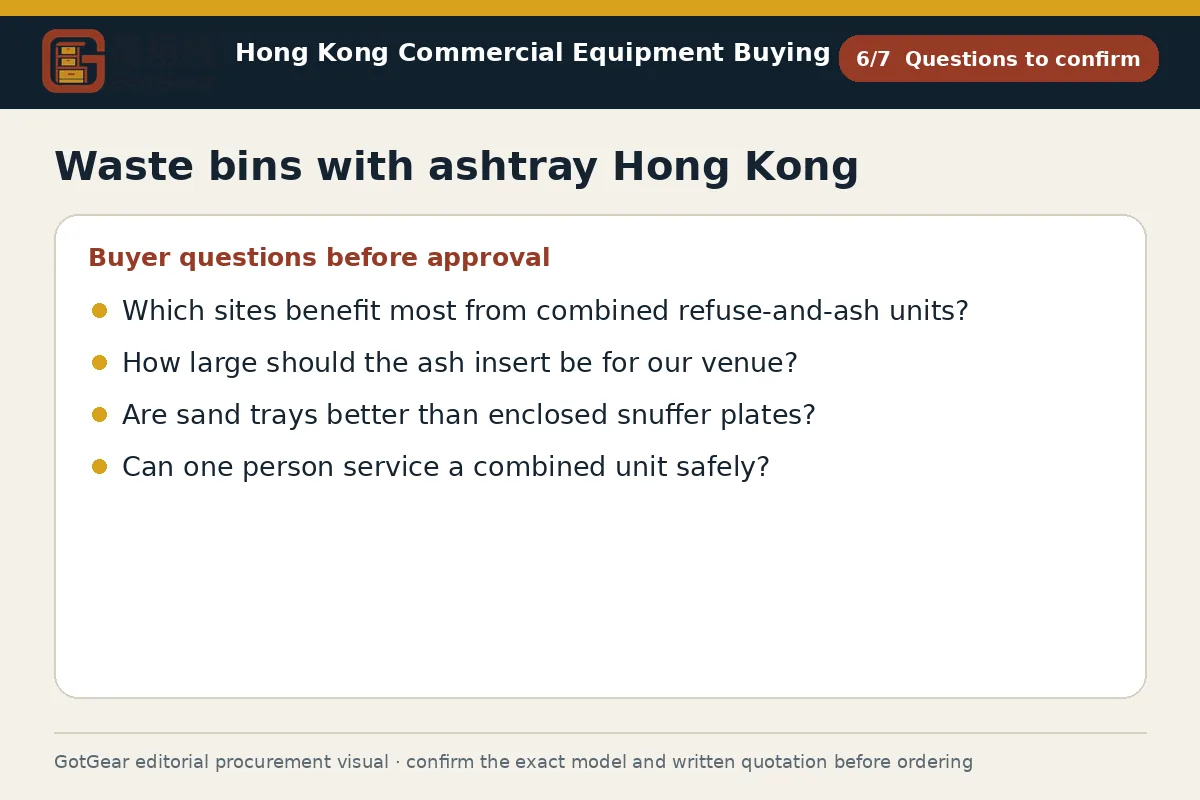
Which sites benefit most from combined refuse-and-ash units?
Compact podiums and locations with moderate litter and smoking often gain from a single pedestal, reducing clutter and simplifying servicing. Where hot material risk is low and inspection is frequent, an integrated body can work well. If footfall is high or packaging waste is heavy, separation may be safer and cleaner; confirm with site procedures and the supplier’s guidance.
How large should the ash insert be for our venue?
Size the insert to expected butt volumes and your practical emptying interval. As an example starting point, some planners model peak-hour usage and ensure one insert covers at least one service window, then refine after trials. Final capacity and routine must be confirmed against the manufacturer’s instructions and the property’s risk controls.
Are sand trays better than enclosed snuffer plates?
Enclosed metal snuffer designs generally reduce mess and rain ingress, and keep embers contained. Sand requires topping-up and controlled disposal, which some teams prefer to avoid. The best choice depends on the specific model and site conditions; follow the manufacturer’s written method and your fire procedures before adopting either approach.
Can one person service a combined unit safely?
Yes, if the model allows safe isolation of the ash insert, the operative has PPE and uses a metal, lidded container for hot material. Some sites require two-person attendance during busy hours or in exposed locations. Agree staffing, equipment and sequence with your manager, and follow the unit’s manual and venue procedures.
Continue with closely related procurement topics
These pages share equipment, operating or decision-stage signals with this guide.
Decorative refuse bins Hong Kong
Compare decorative refuse bins Hong Kong with lobby litter bins Hong Kong to assess capacity, opening style, finish, liner concealment and cleanability, and to confirm required floor area with GotGear, Hong Kong.
Read the guide
Slim waste bins Hong Kong
Select slim waste bins Hong Kong by considering footprint, lid movement and easy liner removal. Compare swing top waste bins Hong Kong with push top waste bins Hong Kong for clearance and staff access with GotGear.
Read the guide
Hooded waste bins Hong Kong
GotGear compares hooded waste bins Hong Kong and wall mounted waste bins Hong Kong by aperture, floor clearance, fixings and cleaning access to help foodservice buyers assess suitability.
Read the guide
Housekeeping cart with doors Hong Kong
Assess a housekeeping cart with doors Hong Kong for room-turn routes, item protection, access needs and corridor clearance. Compare a housekeeping cart protective hood Hong Kong and consult GotGear, Hong Kong for assistance.
Read the guideRelated topic indexOpen more English procurement pages2 topics
Browse additional equipment families, applications and procurement questions relevant to a wider buying brief.