
For decorative refuse bins Hong Kong, measure the available floor area and estimate the waste volume between planned emptying rounds. Then compare opening design, liner concealment, cleanability and appearance against the interior brief.
Where decorative refuse bins Hong Kong need to work hardest
In entrances, lift lobbies and reception zones, decorative refuse bins Hong Kong must cope with peaks in use while maintaining a tidy, quiet presence. Positioning is critical: place units within natural walking lines but away from door-swing arcs, queue rails and concierge desks to avoid obstruction and noise. Where sightlines are long, select heights and silhouettes that look intentional alongside planters, sign stands and furniture. Overflow risk rises around shift changes, lunch and events; plan capacity and aperture visibility so guests can see where to discard without hesitation.
Cleaning teams need fast, safe access during short windows. Record the route from lobby to back-of-house, noting steps, ramp gradients and goods-lift size; older buildings may have narrow lift cars and tight corners. If the corridor is shallow, consider compact forms or slim waste bins Hong Kong to retain clearance. Where mopping is frequent, specify corrosion-resistant bases and non-marking feet, and confirm how the base is protected from wash water. If the site hosts public events or school intakes, choose concealed-bag designs to preserve presentation, and request sample photographs of the bin against surfaces similar to your stone, timber or metal finishes before you sign off a scheme.
Balance capacity and emptying access for decorative refuse bins Hong Kong
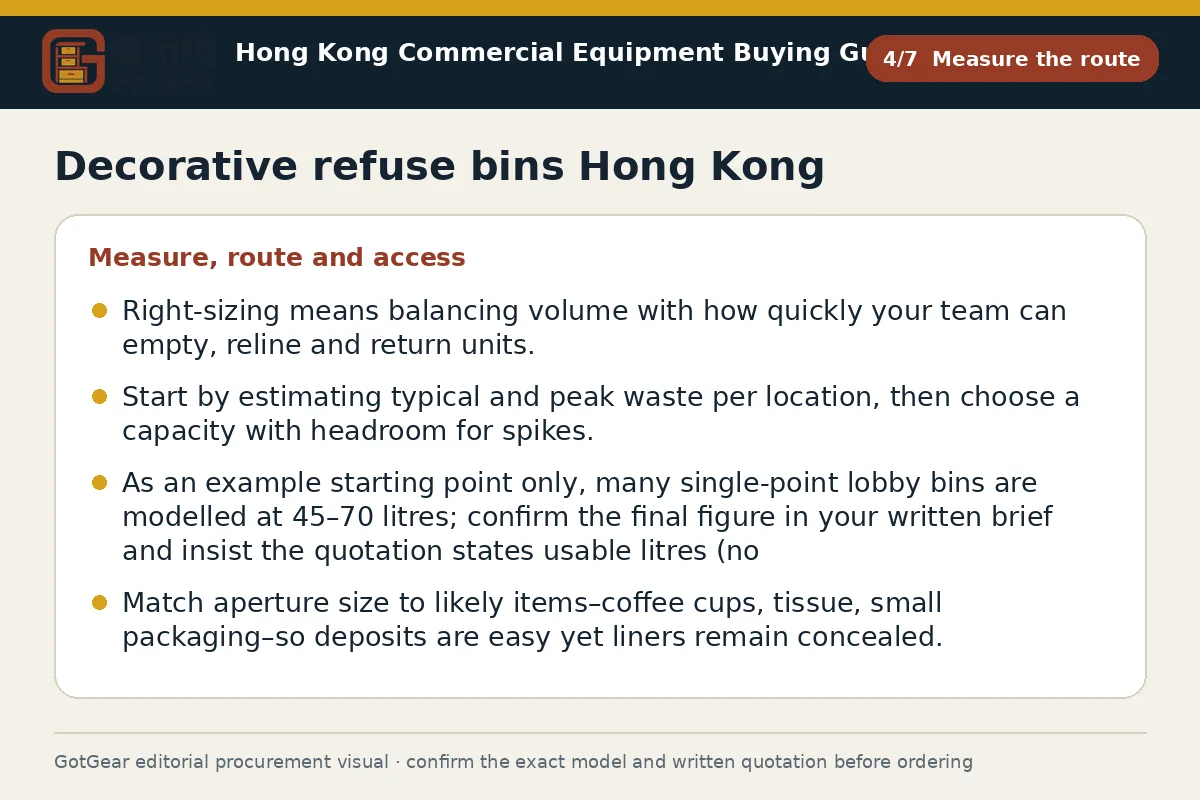
Right-sizing means balancing volume with how quickly your team can empty, reline and return units. Start by estimating typical and peak waste per location, then choose a capacity with headroom for spikes. As an example starting point only, many single-point lobby bins are modelled at 45–70 litres; confirm the final figure in your written brief and insist the quotation states usable litres (not nominal shell volume). Match aperture size to likely items—coffee cups, tissue, small packaging—so deposits are easy yet liners remain concealed.
Emptying access is as important as volume. Top-empty designs with bag rings are quick where staff can lift safely; side-door models with rigid liners suit teams using trolleys and avoiding overhead lifts. Map the path to your waste room, measuring door clear openings and goods-lift dimensions; request maximum bin height and door-swing clearance from suppliers. Specify the liner method, bag gauge guidance and the largest compatible bag size in writing; to avoid mismatches, ensure your purchase aligns with your waste bin liners Hong Kong.
When requesting quotes, ask suppliers to confirm hinge duty, base weight or anti-tip features, and any finger-safe rim. If odour or pests are concerns, compare soft-close lids versus open tops. Where space is constrained, shortlist narrow footprints or modular tiles that can be split across two positions rather than forcing one oversized unit into a pinch point.
What should buyers compare for decorative refuse bins Hong Kong?
| Criterion | Straightforward requirement | More complex requirement | Evidence to provide |
|---|---|---|---|
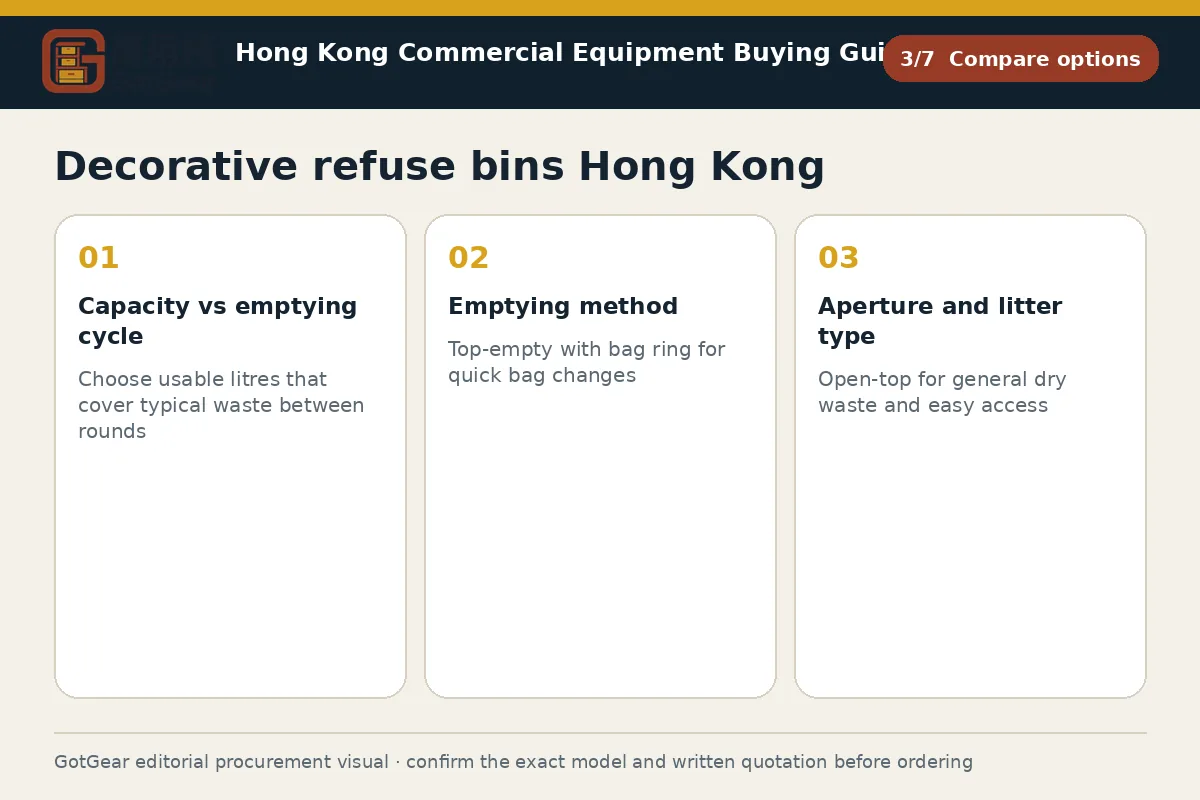
| Capacity vs emptying cycle | Choose usable litres that cover typical waste between rounds | Add buffer for event peaks and delayed servicing | Provide footfall estimates, peak times, planned rounds, and usable-litre target |
| Emptying method | Top-empty with bag ring for quick bag changes | Side-door with rigid liner compatible with trolleys and tight routes | State staff route, door/lift sizes, preferred method, bag size and gauge |
| Aperture and litter type | Open-top for general dry waste and easy access | Shaped or lidded apertures to guide streams and limit odour | List common items, aperture size/shape, and signage plan |
| Footprint and placement | Fits measured clearances without obstructing flow | Anti-tip base, wall protection and alignment with furniture lines | Submit site sketches, obstruction notes and minimum clear zones |
| Finish and resilience | Stainless or powder coat with fingerprint resistance | Veneer/laminate or textured wraps with edge protection and care guide | Request samples, cleaning chemicals list, and corrosion/repair details |
This framework helps buyers create comparable written enquiries. Final model specifications, availability, delivery and commercial terms must be confirmed in a formal quotation.
How decorative refuse bins Hong Kong compare with lobby litter bins Hong Kong
Both categories serve public-facing spaces, but their emphases differ. Decorative models prioritise form and discreet liner concealment; hotel receptions often favour textured coatings or veneer wraps with subtle apertures. By contrast, lobby litter bins in Hong Kong are frequently optimised for heavy daily traffic, larger apertures and rapid servicing. Neither is inherently better; pick according to peak footfall, servicing time and how prominent the unit is in photographs and guest flow.
If your brief includes sorting, look at modular combinations that read as a single piece. Decorative refuse bins in Hong Kong can be grouped with matching apertures and waste-stream labels to guide behaviour without visual clutter, while more functional sets can present bolder openings and colours. For schemes planning a larger recycling station in Hong Kong, confirm that single bins can later be clipped together with connector kits to build a bank with consistent heights, plinth lines and signage.
When comparing quotations, request identical evidence: finish samples, usable capacity, aperture dimensions, liner change method and stability notes. Check the base design for floor protection on polished stone. For back-of-house compatibility, ask whether rigid liners are interchangeable across models, and whether spare parts—lids, trim rings, glides—are listed with part numbers in the supplier’s documentation.
Specify finishes for decorative refuse bins Hong Kong without losing practicality
Finish choice must meet cleaning realities while supporting the interior story. Brushed stainless steel with anti-fingerprint treatment or durable powder coat usually cleans quickly and resists Hong Kong humidity; request the manufacturer’s cleaning guide and compatibility with your detergents. Timber-look wraps and real veneers can soften corporate spaces; protect edges with metal trims and specify colour code, grain direction and repair approach in writing. Where near coastal air or frequent mopping, ask for corrosion-resistance details; if any lab testing is cited, have the supplier identify the method for your records.
Stones, high-pressure laminates and textured coatings can look striking but add weight or seam complexity. Confirm how seams are sealed, how bottoms are shielded from standing water, and whether replacement panels are field-serviceable. If the venue or insurer prefers lids or self-closing apertures for appearance or odour reasons, ensure the soft-close hardware is service-rated and replaceable. On delivery, inspect finish consistency under lobby lighting, check all edges for burrs, verify that glides are fitted and non-marking, and keep the supplier’s finish datasheets with your housekeeping manual so shifts can clean correctly without voiding any finish warranty stated in the model specification and quotation.
Decorative refuse bins Hong Kong decision checklist
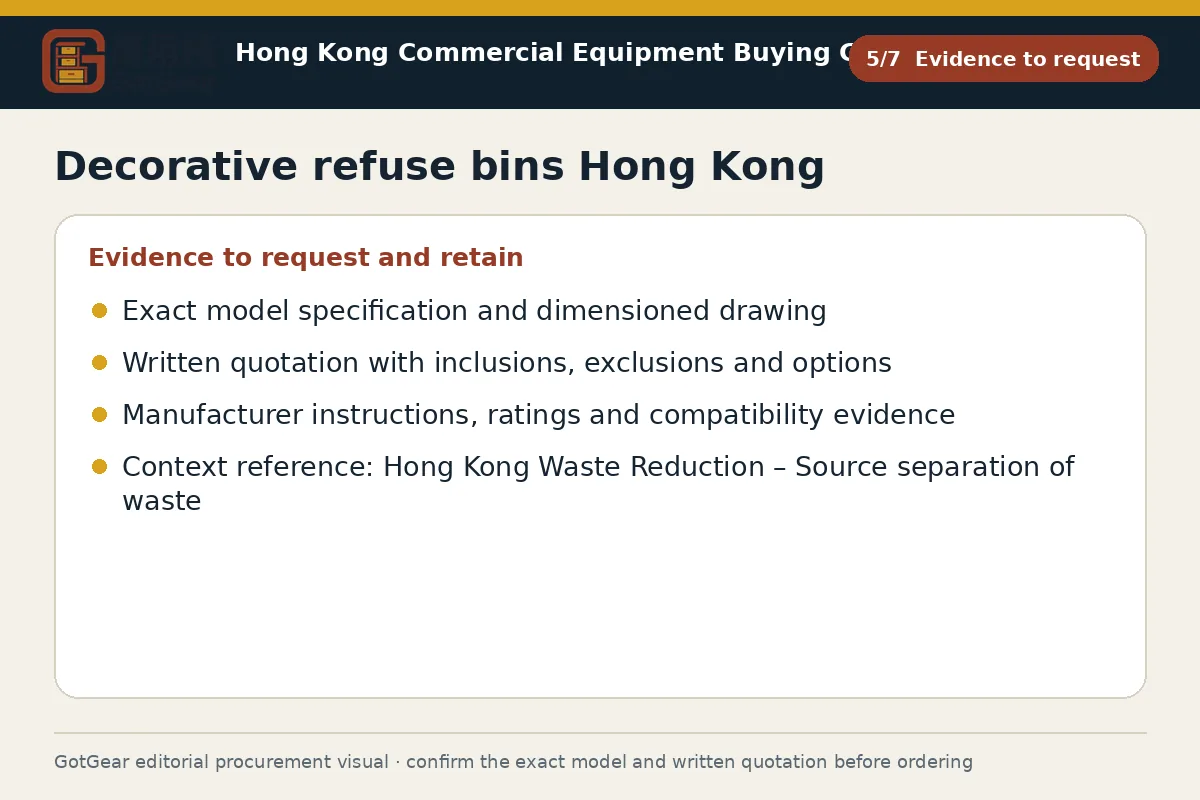
Walk each location and measure the available footprint, including clearance from door swings, concierge desks and queue rails. Estimate typical and peak waste volumes, then choose capacities with headroom for service delays. Define the emptying method—top-lift with a bag ring or side-door with a rigid liner—and confirm the staff route, door widths and goods-lift sizes. Specify aperture shape, liner concealment and signage plan in writing. Request finish samples under lobby lighting and the manufacturer’s cleaning guide. Compare quotations line by line for usable litres, aperture dimensions, base protection and spare-part availability. On receipt, inspect finish quality, stability, glides and liner fit before deployment, and file any documentation your venue or insurer may later request.
- Operating use, quantity and expected frequency
- Dimensions, capacity, material and accessory requirements
- Delivery address, floor, goods lift and loading window
- Required documents, acceptance checks and after-sales arrangements
Key points for decorative refuse bins Hong Kong, lobby litter bins Hong Kong
Hong Kong sites often combine premium lobbies with tight back-of-house routes. Book loading-bay access in advance and verify goods-lift and corridor clear openings before committing to bin heights or rigid-liner sizes. Humid conditions, frequent mopping and typhoon rain tracked indoors call for corrosion-resistant bases and non-marking feet. Many property managers require tidy, bilingual waste stream graphics; confirm preferred wording and colours before ordering. Waste-room layouts, bag sizes and removal schedules vary by building—align specifications with your manager’s directions and your contractor’s cleaning plan, rather than assuming a standard approach.
Questions about decorative refuse bins Hong Kong
What capacity suits a lift lobby without constant overflow?
Model the peak period, then choose a bin with headroom for that window and your staffing plan. As an example starting point only, many sites test 45–70 litres per single point, adjusting to footfall, coffee-cup traffic and emptying frequency. Final capacity should be confirmed in the written brief and matched to your waste room process and bag sizes.
Should we choose open-top or covered apertures for public areas?
Open tops are quick to use and service; covered or self-closing lids improve concealment and odour control. Pick based on litter type, cleaning intervals and how visible the bin is in photographs. If lids are specified, ask for service-rated hinges or dampers and check replacement parts are listed, then confirm compatibility with your housekeeping chemicals.
Which materials handle Hong Kong humidity and daily cleaning best?
Brushed stainless or quality powder coat with anti-fingerprint treatment are robust and easy to clean. Veneers and laminates can be used if edges are well protected and cleaning methods are controlled. For coastal or mop-prone areas, request corrosion-resistance details, seam sealing, and care guides. Approvals should be based on samples viewed under your actual lobby lighting.
Can one bin type handle recycling as well as general waste?
Yes, if apertures and graphics are clear and the servicing plan supports sorted removal. Consider modular units that can be grouped with matching heights and plinths, or plan single bins that later link into a bank. Confirm availability of connectors, consistent finishes, and bilingual labels before ordering, and align with your building manager’s waste-room setup.
Continue with closely related procurement topics
These pages share equipment, operating or decision-stage signals with this guide.
Slim waste bins Hong Kong
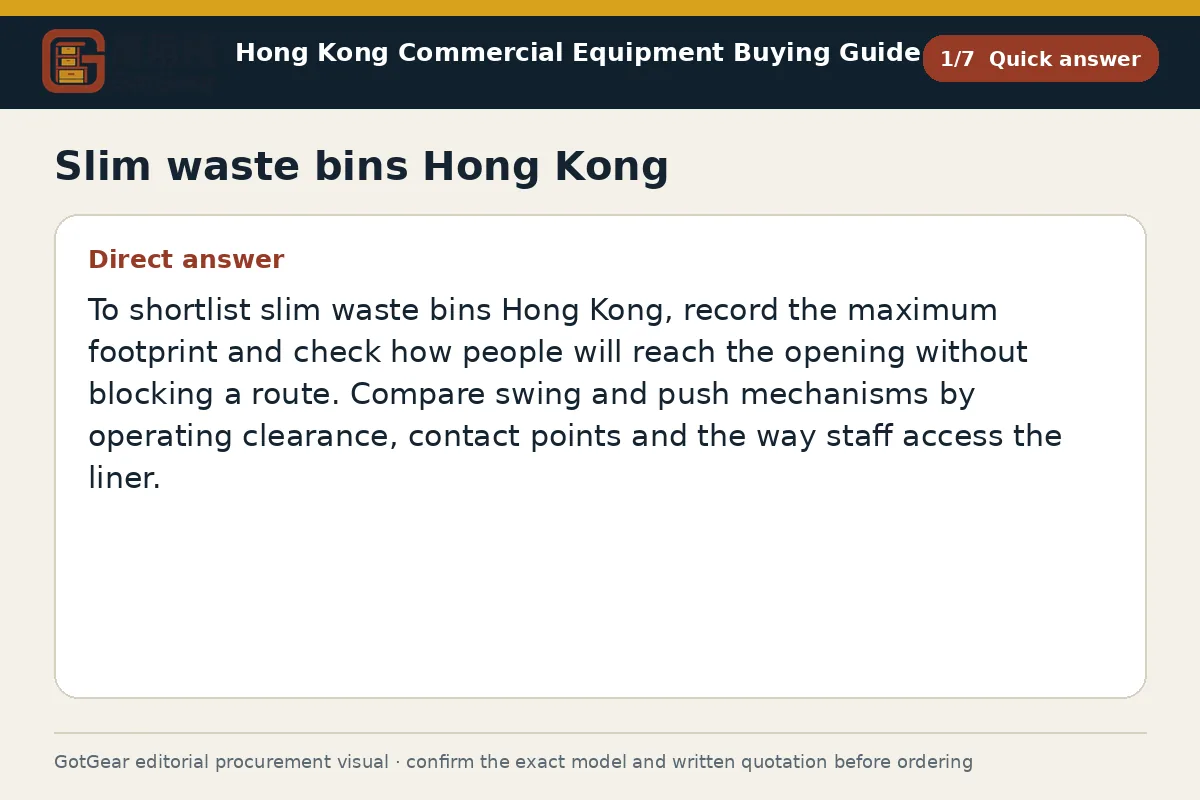
Select slim waste bins Hong Kong by considering footprint, lid movement and easy liner removal. Compare swing top waste bins Hong Kong with push top waste bins Hong Kong for clearance and staff access with GotGear.
Read the guide
Hooded waste bins Hong Kong
GotGear compares hooded waste bins Hong Kong and wall mounted waste bins Hong Kong by aperture, floor clearance, fixings and cleaning access to help foodservice buyers assess suitability.
Read the guide
Waste bins with ashtray Hong Kong
Compare waste bins with ashtray Hong Kong and cigarette butt bins Hong Kong for placement, waste separation, emptying and hot-ash risk at local sites. Find guidance and options from GotGear.
Read the guide
Bin dollies Hong Kong
Use this checklist to assess bin dollies Hong Kong for bin-base fit, expected load, wheel behaviour, threshold clearance and turning space. It also helps plan routes and restraint methods and includes information from GotGear.
Read the guideRelated topic indexOpen more English procurement pages3 topics
Browse additional equipment families, applications and procurement questions relevant to a wider buying brief.