
For institutional equipment delivery requirements Hong Kong, verify current site rules, manufacturer handling instructions and applicable Hong Kong requirements. Name who may accept, inspect, quarantine exceptions and hand the item to its user department.
Site rules within institutional equipment delivery requirements Hong Kong
Begin with the building’s published rules and how contractors access the estate. Confirm whether the management office requires advance registration, crew names for visitor passes, certificate of insurance, induction, or a permit to move large items through common areas. A clear statement of institutional equipment delivery requirements Hong Kong keeps vendors aligned with on-site expectations such as loading-bay booking, lift reservation, escort arrangements, PPE, and bilingual labelling on crates and delivery notes. Ask whether photography is restricted and whether escorts are needed to cross teaching, patient or public areas.
Survey the route from kerb to room. Measure doorway clear widths, heights, and handle protrusions; lobby turning circles; corridor pinch points; ramp gradients; floor load limits; and goods-lift door and cabin dimensions. As an example starting point only, record the tightest clear width and height you see, plus a turning space sketch; confirm all values with the building manager. Request from the supplier the packed crate length, width, height, gross weight, pallet footprint, centre of gravity if known, and any lifting points. Ask whether the crate permits tilting, and the minimum turn radius. If common areas must be protected, arrange floor and wall protection with times approved by the management office. For mixed-use industrial buildings, verify vehicle height and queueing rules so the truck can enter the bay without delay.
Access and safeguarding in institutional equipment delivery requirements Hong Kong
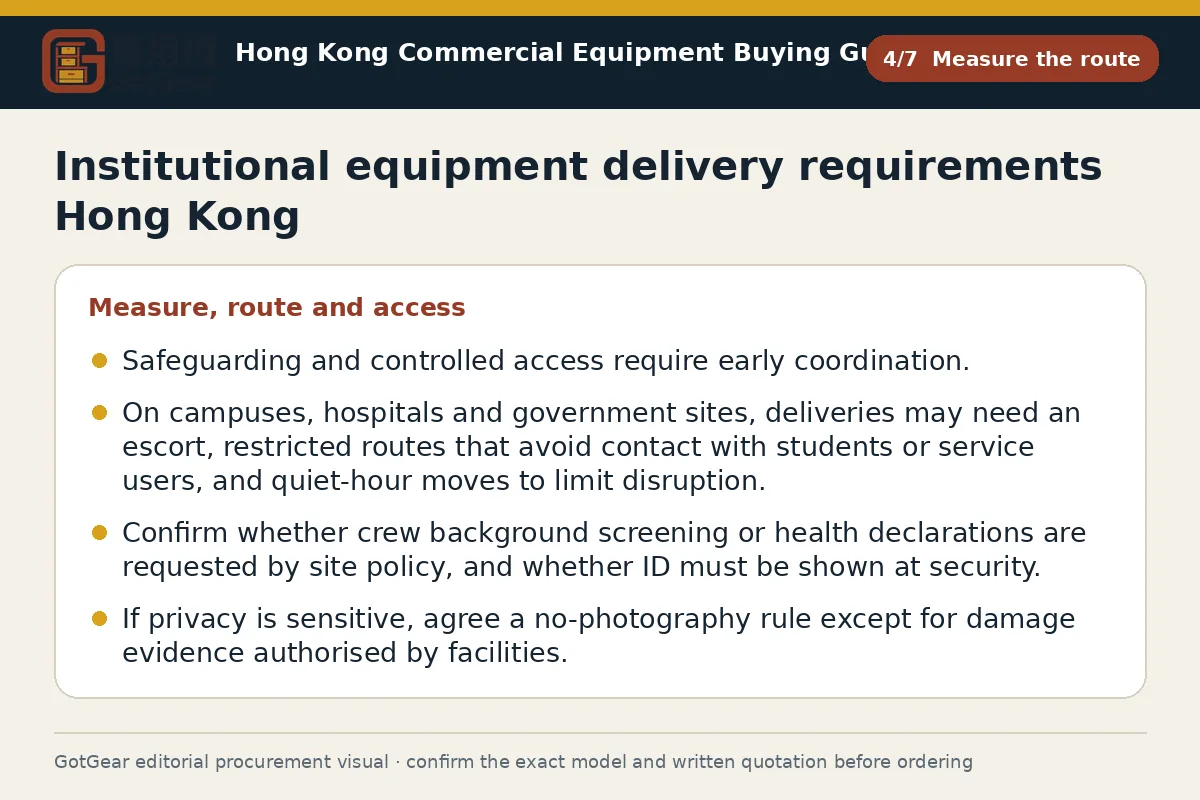
Safeguarding and controlled access require early coordination. On campuses, hospitals and government sites, deliveries may need an escort, restricted routes that avoid contact with students or service users, and quiet-hour moves to limit disruption. Confirm whether crew background screening or health declarations are requested by site policy, and whether ID must be shown at security. If privacy is sensitive, agree a no-photography rule except for damage evidence authorised by facilities. Pre-approve a clean staging zone where packaging can be removed without exposing bystanders to sharp staples, fumes, or solvent odours.
Ask the supplier for manufacturer handling instructions and whether specific tools, stair aids or dollies are recommended. If the building manager or institution requires a method statement and risk assessment, obtain these in advance with named supervisors and a call-ahead protocol. Agree maximum crew size permitted in corridors and goods lifts. As an example starting point only, you might plan for a minimum corridor clear width equal to the crate width plus a 100–150 mm margin; confirm the actual margin needed for your model with the manufacturer or installer. Nominate an emergency stop decision-maker for any unexpected risk, and verify that insurance coverage is adequate for the move if the institution or venue requests evidence.
What should buyers compare for institutional equipment delivery requirements Hong Kong?
| Criterion | Straightforward requirement | More complex requirement | Evidence to provide |
|---|---|---|---|
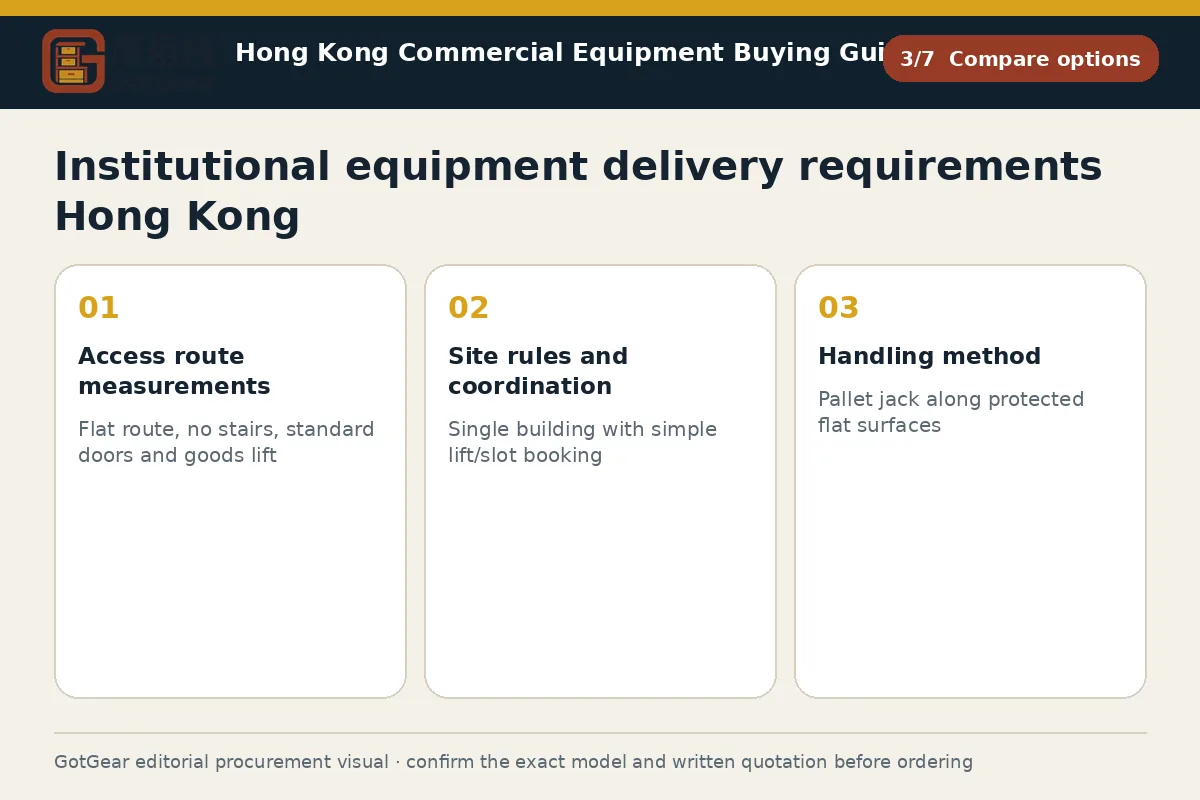
| Access route measurements | Flat route, no stairs, standard doors and goods lift | Tight turns, low lintels, or stairs requiring aids | Measured widths/heights, turn sketches, gradients, lift door and cabin sizes, photos |
| Site rules and coordination | Single building with simple lift/slot booking | Campus or hospital with escorts and safeguarding controls | Written site rules excerpt, booked slot, escort contact names and phone numbers |
| Handling method | Pallet jack along protected flat surfaces | Hoist, stair climber, or rigging with lift plan | Manufacturer handling instructions, weight/COG, lifting points, RAMS if required |
| Receiving authority and checks | One authorised receiver signs after visual check | Dual sign-off with user department; quarantine exceptions | Named roles, inspection checklist, exception/quarantine process |
| Handover documentation | Delivery note and serial capture only | Installation/commissioning record, training log, warranty registration | Required document list, field set (model, serial, room, photos), repository/location |
This framework helps buyers create comparable written enquiries. Final model specifications, availability, delivery and commercial terms must be confirmed in a formal quotation.
Receiving roles for institutional equipment delivery requirements Hong Kong
Define who can accept, who inspects, and who hands over to the user department. Name an Authorised Receiver who may sign delivery documents, plus an Inspector from facilities or engineering to assess the condition before uncrating. Identify the User Department contact to verify the correct model variant and accessories. If IT, electrical or plumbing connections are planned, ensure a competent person is present or on call to confirm service points and isolation procedures. Clarify where exceptions are quarantined and how long items may remain in staging.
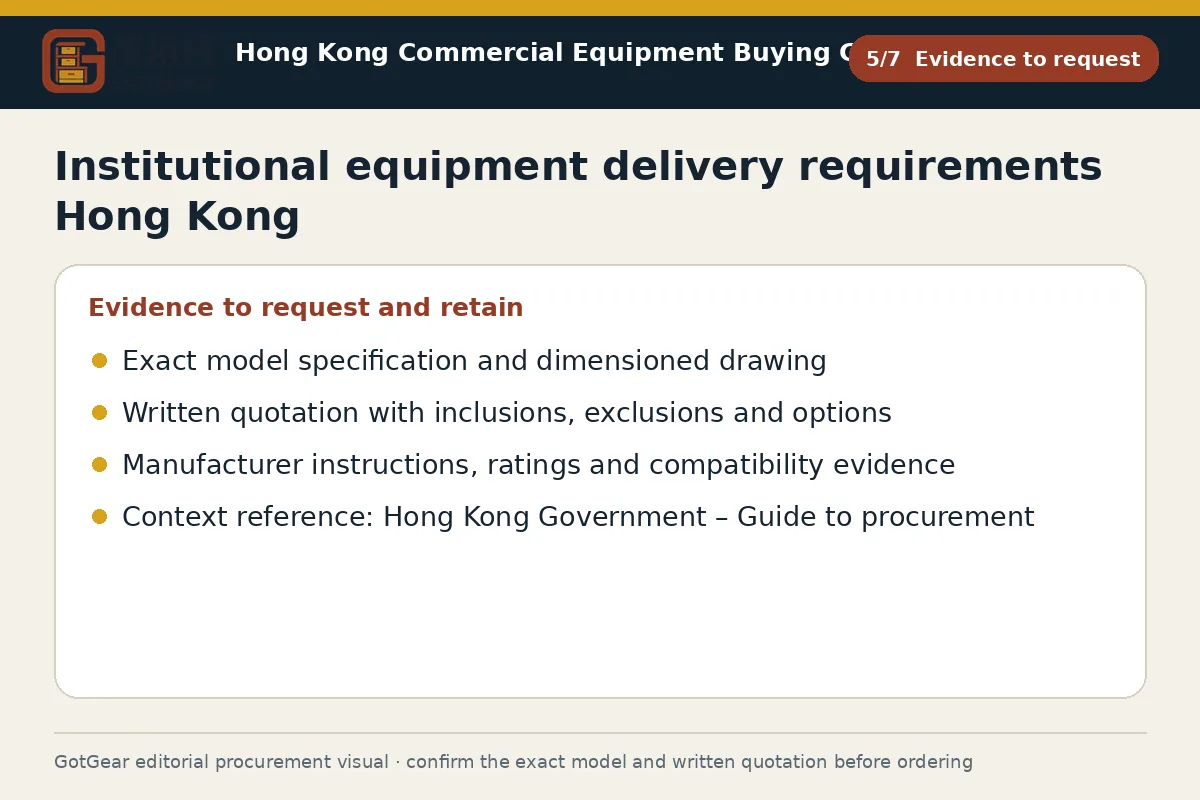
On receipt, compare the shipment to the written quotation and purchase order line by line. Check model code, options, quantity, and any serial numbers on the carton against the packing list. Before power-on, confirm the rating plate matches your supply (voltage, frequency, plug type or hardwire notes) and that ventilation clearances and floor bearing appear adequate; consult a qualified person where your institution requires. Inspect shock or tilt indicators, seals, and packaging damage, and photograph as evidence if needed. Request the manufacturer’s installation and operating manuals, a commissioning checklist if the model needs one, and any product statements your insurer or institution asks for. Always follow the model specification and the supplier’s formal quotation where details differ from preliminary notes.
Handover records for institutional equipment delivery requirements Hong Kong
Create concise handover records that connect the shipment to your asset register. Capture purchase order, delivery note, model, serial numbers, power requirements, dimensions, gross weight, final room, and the names of those present at acceptance. Add photographs of the unit in position showing clearances and services. Where training is included, record attendee names and departments, the trainer’s details, and topics covered. File document titles in bilingual form if your institution requires it for audits or frontline reference.
If installation or commissioning is part of the scope, request the installer’s completion record and any start-up readings that the manufacturer recommends for baseline maintenance. Where your site policy demands it, retain waste-handling dockets for pallets, crates or protective boards, and note if any components are held back for warranty assessment. Provide the user department with a brief operating-safety summary and the service contact stated in the supplier’s documentation. Agree who keeps spares or consumables and how reordering will be triggered by your CMMS. Timescales, forms and acceptance criteria should match the supplier’s written quotation, the manufacturer’s instructions and your building manager’s approvals.
Institutional equipment delivery requirements Hong Kong decision checklist
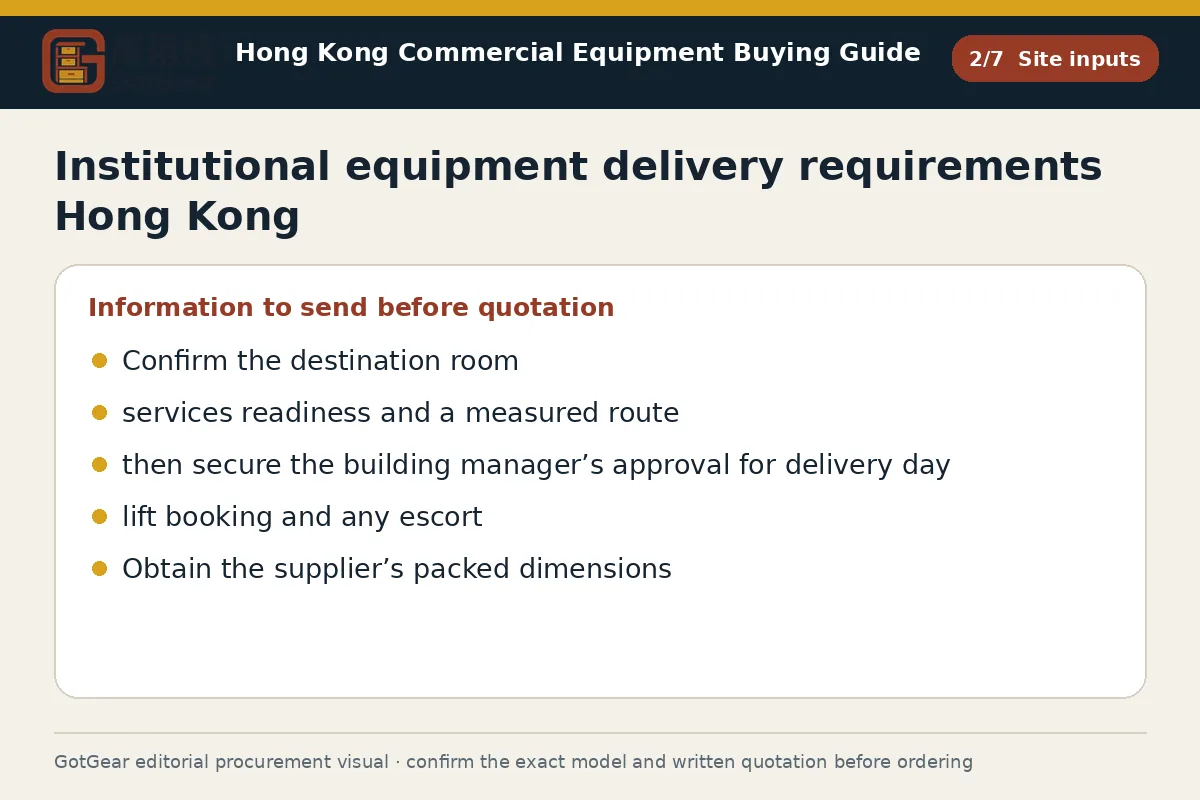
Confirm the destination room, services readiness and a measured route, then secure the building manager’s approval for delivery day, lift booking and any escort. Obtain the supplier’s packed dimensions, gross weight, pallet or skid type, centre of gravity if known, and handling instructions. Prepare a safeguarding plan covering crew identification, restricted routes and a staging zone. Name the Authorised Receiver, the Inspector and the User Department contact, with a quarantine process for exceptions. At receipt, check crate condition, model codes and serials against the purchase order and quotation, and verify electrical or utility compatibility before power-on. Capture photographs and bilingual records, and only sign when discrepancies are addressed or noted. File manuals, commissioning notes if applicable, and waste dockets as your policy requires.
- Operating use, quantity and expected frequency
- Dimensions, capacity, material and accessory requirements
- Delivery address, floor, goods lift and loading window
- Required documents, acceptance checks and after-sales arrangements
Key points for institutional equipment delivery requirements Hong Kong
Hong Kong institutions often operate with tight loading-bay windows, advance lift bookings and management-office control of common areas. Many industrial buildings have narrow goods-lift doorways and long transfer routes, so measured surveys and confirmed crate sizes prevent failed attempts. Typhoon or amber–black rain signals can pause moves at short notice, and humidity may affect packaging and floor traction. Bilingual crew lists and delivery notes ease gatehouse checks. Always coordinate with the building manager for current procedures; this is operational guidance, not legal advice.
Questions about institutional equipment delivery requirements Hong Kong
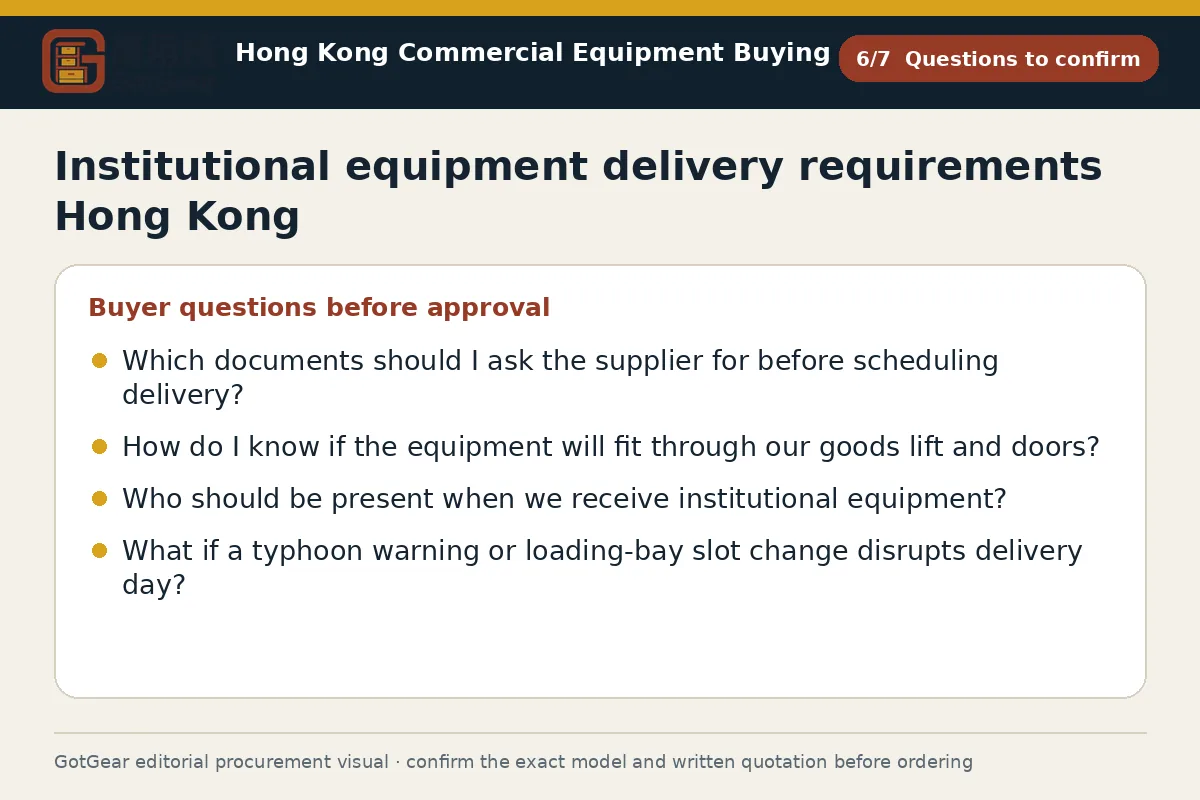
Which documents should I ask the supplier for before scheduling delivery?
Request packed dimensions, gross weight, pallet or skid type, lifting points, and manufacturer handling instructions. If your building manager or institution needs it, obtain a method statement, risk assessment, crew list for passes, and evidence of insurance. Where installation or commissioning is included, ask for the proposed checklist and who will sign it. Always treat the model specification and written quotation as the controlling sources.
How do I know if the equipment will fit through our goods lift and doors?
Measure the tightest clear width and height along the route, plus turning spaces, ramp gradients and lift car depth. Compare these to the supplier’s packed crate dimensions, adding an agreed margin for manoeuvre. As an example starting point only, many teams test a small mock-up frame to validate turns. Confirm the clearance you need with the manufacturer or installer for your specific model.
Who should be present when we receive institutional equipment?
Have an Authorised Receiver to sign documents, an Inspector from facilities or engineering to assess condition, and a User Department representative to confirm the correct model and accessories. If services are involved, ensure a competent electrician or technician is available. Roles vary by institution and model; follow your site policy and the supplier’s written scope, especially where commissioning is included.
What if a typhoon warning or loading-bay slot change disrupts delivery day?
Pause the move and rebook with the building manager and supplier, keeping lift reservations, escorts and waste-handling revised. Protect staged items from humidity or water ingress and document new timings for the gatehouse. Where the institution requires, issue an updated method statement. Rescheduling rules and fees depend on your venue and supplier terms, so rely on their written confirmations.
Continue with closely related procurement topics
These pages share equipment, operating or decision-stage signals with this guide.
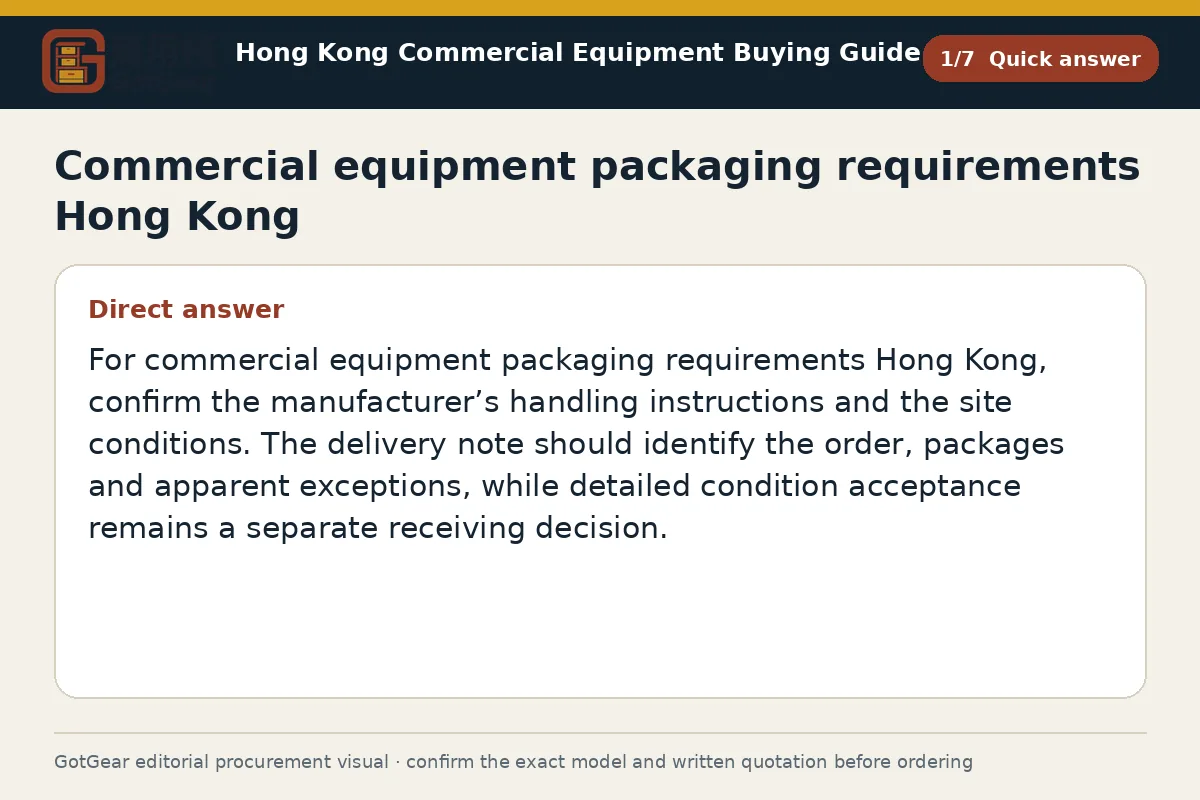
Commercial equipment packaging requirements Hong Kong
The GotGear guide to commercial equipment packaging requirements Hong Kong explains protection, marking and identification. Use the commercial equipment delivery note Hong Kong to record order details and any visible exceptions.
Read the guide
Commercial equipment delivery Hong Kong
For commercial equipment delivery Hong Kong, confirm equipment dimensions, access routes and building regulations, and provide a receiving contact and inspection records. Contact GotGear.
Read the guide
Commercial equipment delivery access checklist Hong Kong
Use GotGear commercial equipment delivery access checklist Hong Kong to verify routes and dimensions. Check commercial equipment delivery loading bay Hong Kong and commercial equipment delivery lift access Hong Kong limits.
Read the guide
Commercial equipment safe handling Hong Kong
GotGear provides guidance for commercial equipment safe handling Hong Kong. Begin with a commercial equipment manual handling risk assessment Hong Kong and a commercial equipment workplace safety checklist Hong Kong.
Read the guideRelated topic indexOpen more English procurement pages1 topics
Browse additional equipment families, applications and procurement questions relevant to a wider buying brief.