
For institutional equipment procurement Hong Kong, follow the institution’s current purchasing rules and delegated authorities. Keep the approval trail, bids, evaluation, order and receipt evidence together, with any conflicts or exceptions recorded.
Approval and budget control for institutional equipment procurement Hong Kong
Robust approval and budget control keeps institutional equipment procurement Hong Kong defensible. Start by confirming the user need, budget line and delegated authority before any supplier contact. Map value thresholds and who can approve, then document any exception route for urgent, safety‑critical or grant‑funded purchases. Avoid order‑splitting; instead raise a single, fully scoped request with all accessories, installation and training identified. Record the approval sequence in writing and make sure only authorised staff can commit the institution.
Define what success looks like in measurable terms: capacity, duty cycle, uptime expectations, energy profile, training needs and end‑of‑life considerations. As an example starting point only, you might estimate a three‑year consumables budget and a nominal service allowance, to be confirmed in the written brief and supplier quotation. Log site constraints early—doorway widths, lift car size, staircase turns, floor loading and any booking requirements with the management office. When you later issue the institutional equipment purchase order Hong Kong, ensure it matches the approved specification, quantities and delivery window. Keep bilingual records where useful, and ensure the budget holder, procurement and end user sign off that the chosen offer meets the documented requirement and evaluation outcome.
Stakeholder roles in institutional equipment procurement Hong Kong
Clarity on stakeholder roles prevents rework and disputes. The requester describes the use case and desired outcomes; the technical lead or facilities team drafts the specification and confirms site services; procurement manages the sourcing process and ensures policy compliance; finance confirms budget and payment terms; IT or estates validates power, network and drainage needs; and the safety or compliance officer flags any training, guarding or hygiene considerations. Where building management controls access, appoint a coordinator to book loading bays, goods lifts and lift lobbies, and to brief security.
Nominate one point of contact to issue clarifications to suppliers and to keep a dated log of all Q&A in both English and Chinese where appropriate. In the context of Hong Kong government equipment quotations, additional governance such as conflict-of-interest declarations or stricter bid-opening protocols may apply under your institution's rules. Agree who will witness demonstrations, who can accept alternates, and who signs the evaluation report. If equipment affects public areas or events, consult the venue manager on noise, heat, and crowd-flow implications before inviting bids. All parties should confirm the acceptance test criteria and the receipt evidence they expect to see at delivery.
What should buyers compare for institutional equipment procurement Hong Kong?
| Criterion | Straightforward requirement | More complex requirement | Evidence to provide |
|---|---|---|---|
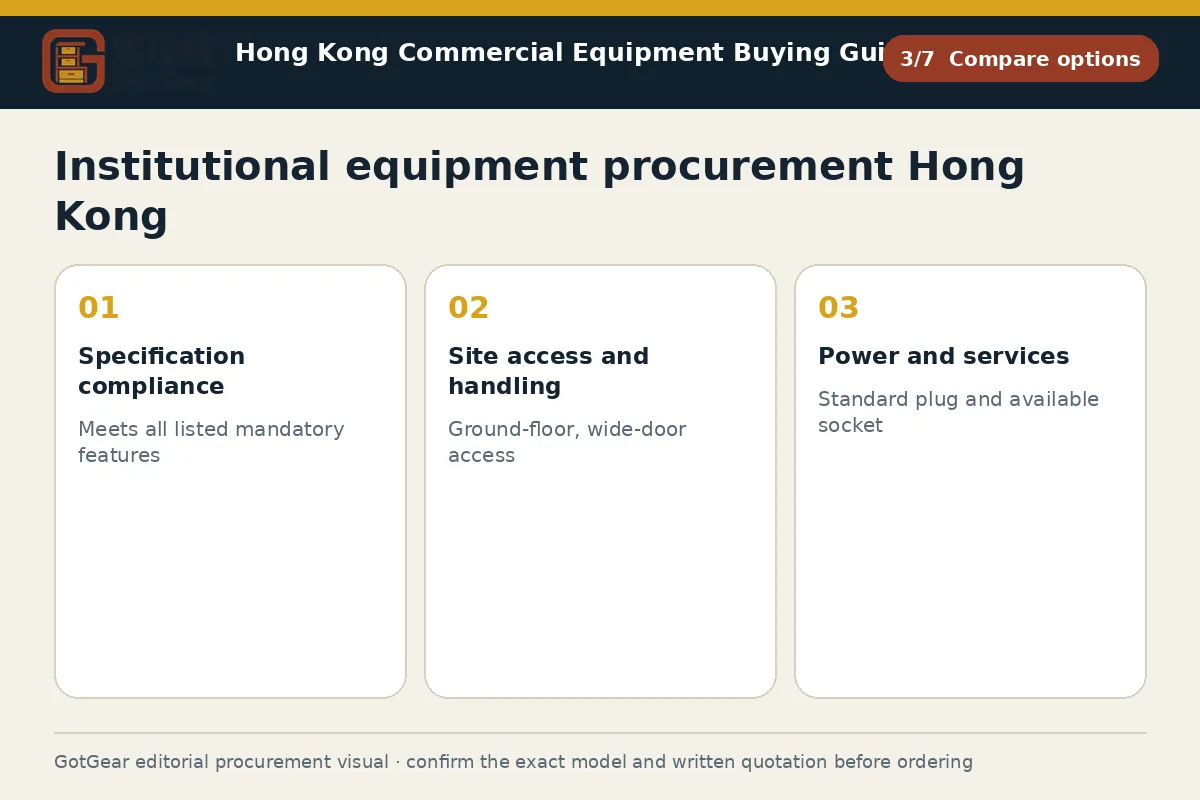
| Specification compliance | Meets all listed mandatory features | Proposes approved alternate meeting performance target | Datasheet page refs; deviation list with rationale |
| Site access and handling | Ground‑floor, wide‑door access | Goods‑lift or stair carry with protection and booking | Measured door/lift sizes; route photos; booking rules |
| Power and services | Standard plug and available socket | Dedicated circuit, drainage, ventilation or network point | Power rating; plug type; service drawings; who connects |
| Delivery and scheduling | Single trip within office hours | Multiple drops, evening or weekend, tight loading windows | Proposed schedule; vehicle size; waiting‑time terms |
| After‑sales and training | Basic user briefing included | Formal training, spares plan and response commitments | Training outline; warranty term; spares list; contacts |
This framework helps buyers create comparable written enquiries. Final model specifications, availability, delivery and commercial terms must be confirmed in a formal quotation.
Institutional equipment procurement Hong Kong: Use an institutional equipment quotation request
A request for an institutional equipment quotation in Hong Kong should be submitted as a complete, consistent enquiry pack. Include a clear scope; the operating environment (temperature and humidity ranges); performance targets; dimensions and footprint; weight; required consumables; duty cycle; acceptable materials and finishes; power and plug type; and any mounting or clearance needs. Ask for datasheets, lead‑time indications, warranty terms, training inclusions, after‑sales contacts and parts availability. Tell suppliers exactly how you will evaluate compliance, whole‑life cost, delivery and other financial factors so like‑for‑like offers arrive. If value or complexity increases, state whether a commercial equipment tender in Hong Kong may be considered by your governance.
Site information is decisive. Measure doorways, corridor pinch points, lift car depth, turning radii and ramp gradients. As a starting example only, record a sample lift car size such as 1.3 m × 1.5 m and a doorway clearance such as 0.85 m, then ask the building manager and the supplier to confirm these measurements in writing. State the hours when deliveries can be made, any security registration requirements and whether protection boards are required. Reference any institutional equipment delivery requirements in Hong Kong so suppliers include portering, stair carries, hoisting, waiting time and disposal of packaging in their offers. Use this guide to compare specifications and prepare a written enquiry so each invited supplier responds to the same unambiguous requirement.
Audit trail for institutional equipment procurement Hong Kong
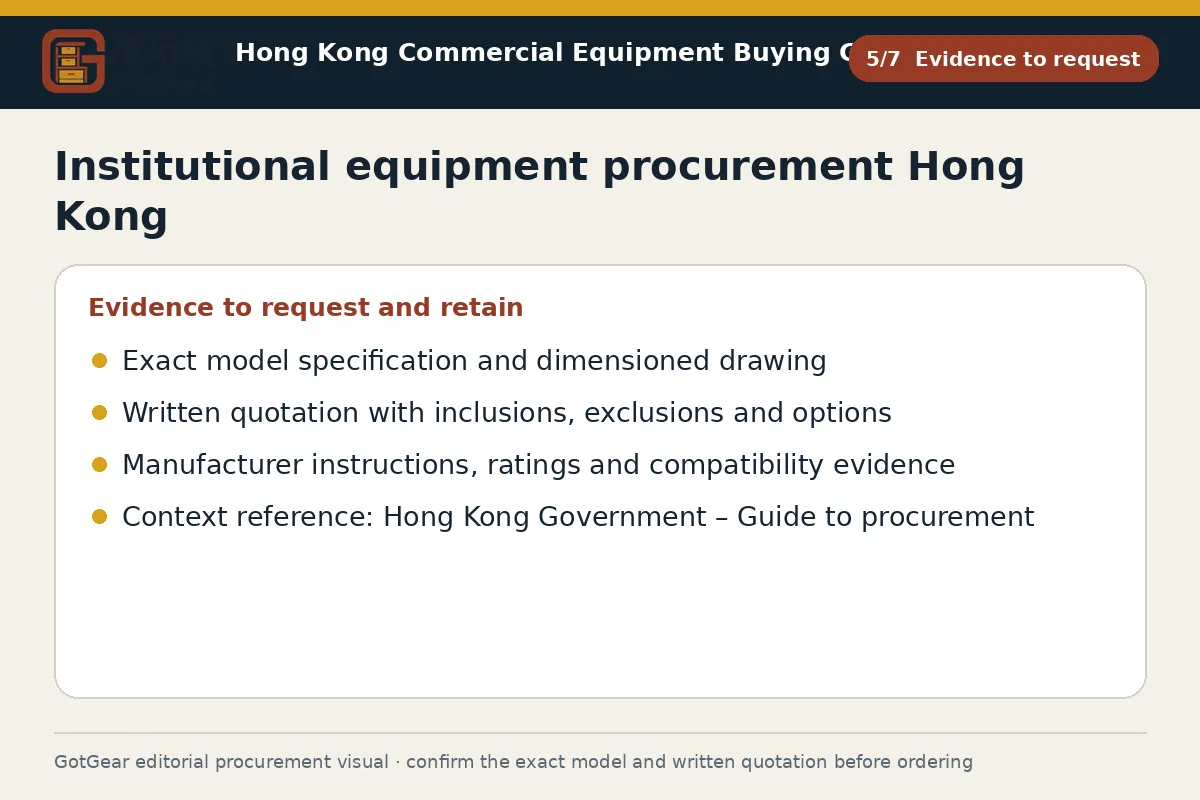
A disciplined audit trail shows that the process was fair, competitive and within authority. Keep the requisition, approvals, final enquiry pack, supplier invitations, dated clarification log, received quotations, evaluation notes, conflict‑of‑interest statements and award recommendation together. Use a side‑by‑side comparison that checks specification compliance line by line, plus arithmetic, inclusions (delivery, installation, training) and exclusions. Record reasons for any deviation. File the approved purchase order, supplier order acknowledgement and any agreed change notes with signatures and dates.
On receipt, create a goods‑received record linked to the order: delivery note, quantities, serial and model numbers, photographs of condition, and acceptance test results. Inspect safe operation, labelling, accessories, and that bilingual manuals are included where needed. As an example starting point only, you may request a manufacturer’s conformity note, food‑contact statement or test report if the model and your venue require it; confirm with the supplier, building manager, insurer or relevant authority. Where electrical connection, ventilation or fire performance is implicated, ensure any competent‑person certificates required by your site are obtained. File training attendance, warranty registration and any snagging or non‑conformance report, then close out with a signed acceptance record.
Institutional equipment procurement Hong Kong decision checklist
Confirm the approved need, budget line and delegated authority, then write a measurable specification with operating environment, dimensions, power and duty cycle. Capture site constraints with photos and measurements, and clear them with the building manager. Decide evaluation criteria and weightings before inviting bids, and specify what must be included in the quotation. Issue a single, consistent enquiry pack to all suppliers with a named clarifications contact. Compare written quotations line by line for compliance and arithmetic. Secure formal approvals and ensure the purchase order matches the awarded offer. At delivery, check serials, condition and operation against acceptance criteria, record any exceptions, and file any model‑specific certificates, training notes and warranty registration with the order file.
- Operating use, quantity and expected frequency
- Dimensions, capacity, material and accessory requirements
- Delivery address, floor, goods lift and loading window
- Required documents, acceptance checks and after-sales arrangements
Key points for institutional equipment procurement Hong Kong, institutional equipment quotation Hong Kong
Hong Kong institutions often operate in buildings with tight goods‑lifts, narrow doorways and booked loading bays, so access planning is essential. Management offices may require advance registration of workers, lift protection boards and set delivery windows; missed slots can delay installation. Humid conditions and salt air can affect finishes and electronics, so specifications should state environmental limits. Bilingual documents help mixed teams. Public‑facing sites may add crowd, noise and fire‑safety constraints. This summary highlights operating realities only and is not legal advice; confirm requirements in writing with your venue, building manager and competent advisers.
Questions about institutional equipment procurement Hong Kong
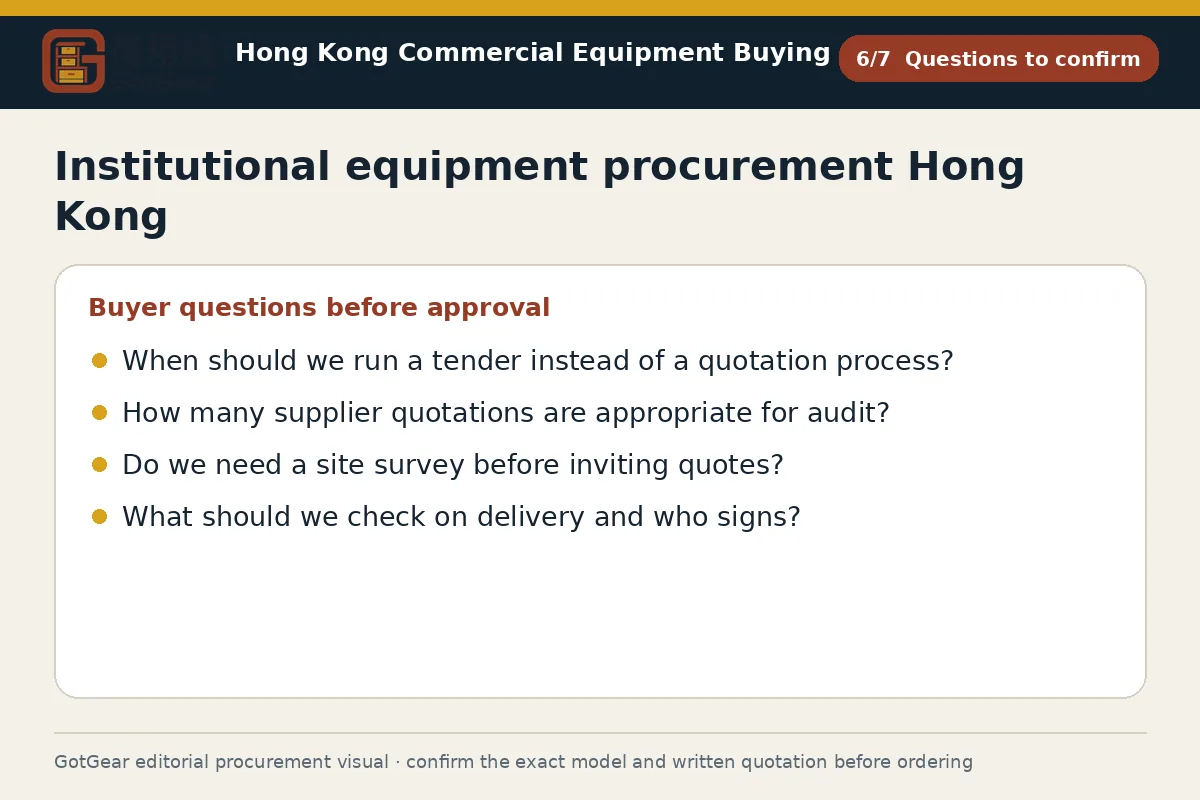
When should we run a tender instead of a quotation process?
Use your institution’s thresholds and governance. If value, risk, multi‑site delivery or market complexity is high, a formal tender can provide structure and transparency. If scope is simple and time is tight, a well‑specified quotation process may suffice. Always follow your current purchasing rules and confirm the chosen route with procurement and the budget owner.
How many supplier quotations are appropriate for audit?
Obey your policy first. As an example starting point, three written quotations provide competitive tension and a comparison baseline, but the required count may differ by category or value. Where there is a single viable source, document market soundings and approvals. The final model specification and formal written quotation prevail over any informal benchmarks.
Do we need a site survey before inviting quotes?
Arrange one when access, services or installation method are uncertain. For straightforward replacements, annotated photos, measured drawings and building‑management notes can be enough. If lifts, stair carries, ventilation or drainage are marginal, ask the supplier to confirm feasibility in writing. Any survey scope and delivery window should be agreed with the venue, contractor and building manager.
What should we check on delivery and who signs?
Check quantities, model and serial numbers, condition, included accessories, operation against acceptance criteria, and that manuals and training are supplied. If the model or venue requires evidence, collect certificates or test reports. The end user or technical lead should witness functionality, with procurement or stores confirming documentation. Close with a dated acceptance record and file it with the order.
Continue with closely related procurement topics
These pages share equipment, operating or decision-stage signals with this guide.
Institutional equipment purchase order Hong Kong
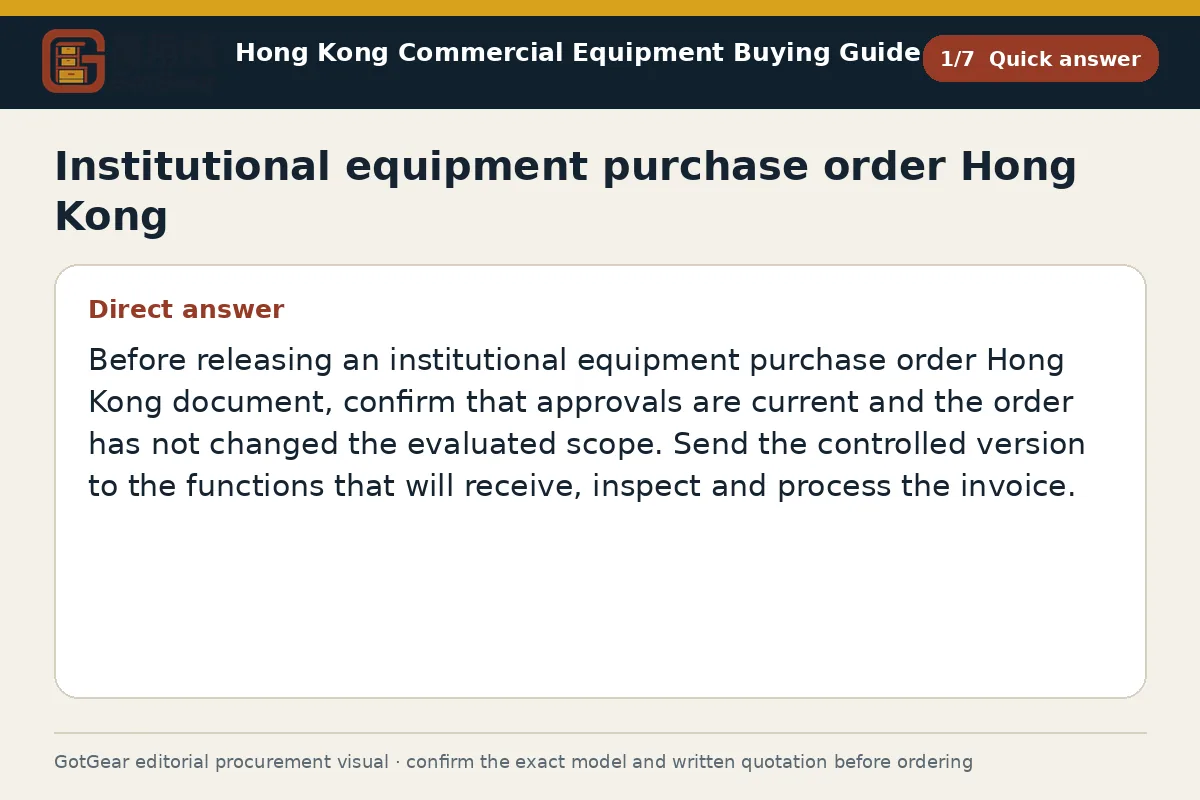
This checklist for an institutional equipment purchase order Hong Kong helps confirm the approved supplier, scope, fund reference, authority, delivery location and document hierarchy. It is provided by GotGear.
Read the guide
Commercial equipment quotation Hong Kong
GotGear offers a practical guide to commercial equipment quotation Hong Kong. Standardise scope and responses by issuing one commercial equipment RFQ Hong Kong for each request for quotation commercial equipment Hong Kong.
Read the guide
Commercial equipment written quotation Hong Kong
GotGear provides a checklist for supplier, date and scope of the commercial equipment written quotation Hong Kong. Confirm commercial equipment quotation validity Hong Kong and commercial equipment quotation terms Hong Kong.
Read the guide
Commercial equipment supplier quotation comparison Hong Kong
GotGear provides a commercial equipment supplier quotation comparison Hong Kong with a traceable table that aligns scope, identifies gaps and records cost, delivery basis and validity for client review.
Read the guideRelated topic indexOpen more English procurement pages1 topics
Browse additional equipment families, applications and procurement questions relevant to a wider buying brief.