
How should the checklist be built? Start with manufacturer instructions and documented food-safety controls, then specify safe isolation, permitted products, dismantling limits, contact times, rinsing and sign-off under applicable Hong Kong requirements.
Commercial kitchen equipment cleaning checklist Hong Kong — Set frequencies by food-contact risk
Set task frequency by food-contact risk and actual use. Map every asset and surface into three groups: direct food-contact (prep benches, slicer blades, mixer bowls, grill plates), splash/adjacent (controls, guards, handles, undershelves) and non-food-contact (exteriors, casings, floors around equipment). Assign higher frequencies to items that touch ready-to-eat food and to high-heat, high-grease equipment. As a practical start, state example schedules that must be confirmed against the model manual and your food-safety plan: per shift for benches and slicers, between batches for allergen-handling tools, end-of-day for grills and fryers, and planned deep-cleans for hoods and condensers. In humid Hong Kong kitchens, add drying checks before reassembly to avoid corrosion and odour carry-over.
Use your asset register to estimate cleaning time windows against production peaks and building rules. Industrial-building loading windows and management-office restrictions can affect when heavy dismantling or extraction-cleaning is possible. Name the responsible role by shift, not just a department. Record surface materials (e.g., 304 stainless, aluminium, polymer guards) beside each task so staff can select compatible products. Include at least one line that references commercial kitchen equipment cleaning checklist Hong Kong in your document index, so supervisors can locate the latest bilingual copy quickly and retire superseded versions.
Commercial kitchen equipment cleaning checklist Hong Kong — Specify products, tools and contact times
Write out the approved product, tool and contact time for each task. For food-contact sanitising, specify the product family, in-use concentration, contact time, rinse requirement and the surface/material. As a starting point only, request the manufacturer’s dwell-time guidance for grill degreasers, food-contact sanitisers used on prep benches and slicer blades, and descalers for steam appliances. Confirm that products are suitable for stated materials; many caustic cleaners can dull aluminium and some descalers attack galvanised parts. Ask for SDS and technical data sheets, plus bilingual labels and wall charts where available.
Define tools precisely: colour-coded brushes (medium-bristle PBT for general use; stainless scrapers only on non-food-contact grills), squeegees, microfibre cloths, dosing pumps with test strips, and PPE suitable for the chemistry proposed. Measure site constraints before buying: largest item dimension against sink compartments and dishwasher racks (example check: a 530 mm tray against a 500 mm basin; confirm on site), clearance in goods lifts and corridors if you intend to wheel equipment to a wash bay, available hot-water temperature, drainage and ventilation for drying. Compare written quotations on product compatibility statements, contact-time tables, replenishment lead-time confirmation by the supplier, and inclusion of training aids. Record batch numbers and expiry on receipt and reject unlabelled or damaged packaging.
What should buyers compare for commercial kitchen equipment cleaning checklist Hong Kong?
| Criterion | Straightforward requirement | More complex requirement | Evidence to provide |
|---|---|---|---|
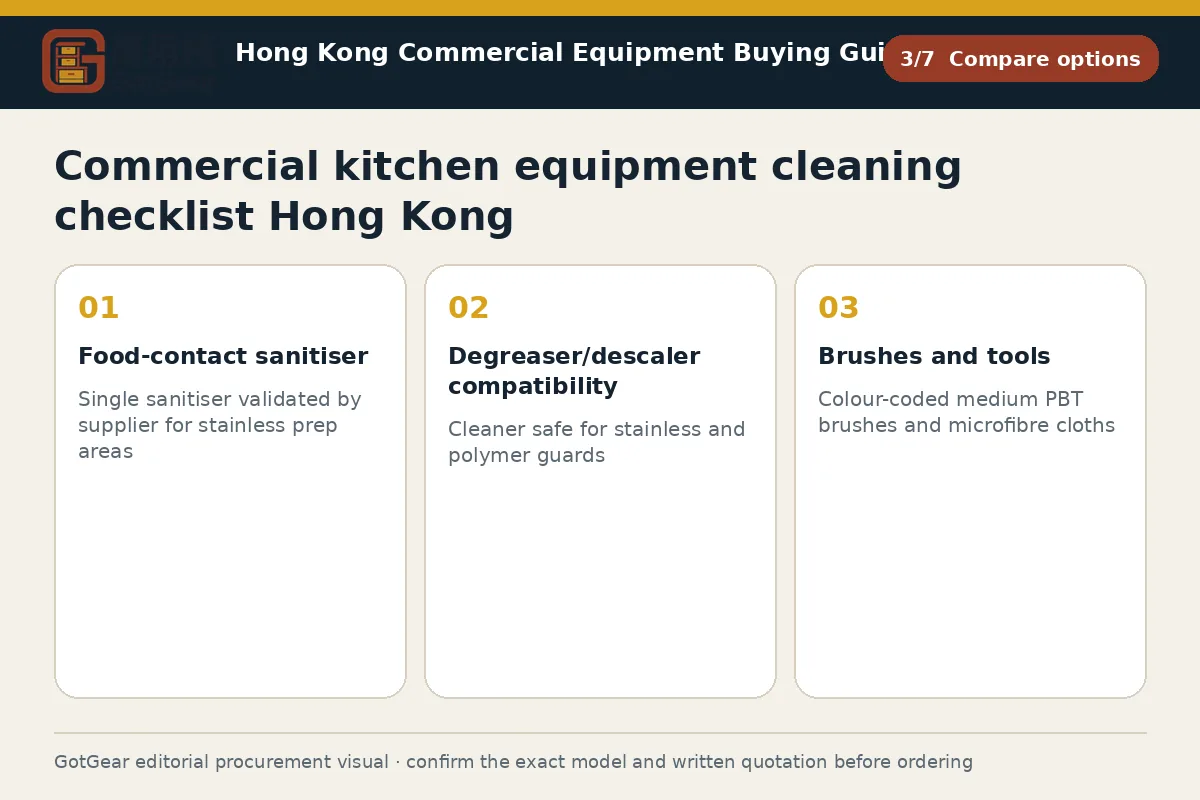
| Food-contact sanitiser | Single sanitiser validated by supplier for stainless prep areas | Different sanitisers for raw, RTE and allergen zones with defined changeover | Product name, in-use concentration, contact time, rinse instruction, SDS; zones of use |
| Degreaser/descaler compatibility | Cleaner safe for stainless and polymer guards | Separate products for aluminium, coated plates and steam circuits | Surface materials list by asset; supplier’s compatibility statement per model |
| Brushes and tools | Colour-coded medium PBT brushes and microfibre cloths | Full set including scrapers, long-handle tools, dosing pumps and test strips | Quantities, colour code, handle lengths, storage rail length and wall space |
| Isolation and dismantling | User tasks limited to guards, trays and baskets with isolator off | Documented lock-off points, cool-down times and technician-only components | Isolator photos/IDs, cool-down notes, list of user-removable parts by model |
| Bilingual documentation | English/Cantonese task sheets for daily cleans | Full bilingual pack: manuals links, wall charts, labels and sign-off logs | Languages required, formats (print/app), sample page, approval contact |
This framework helps buyers create comparable written enquiries. Final model specifications, availability, delivery and commercial terms must be confirmed in a formal quotation.
Commercial kitchen equipment cleaning checklist Hong Kong — Define isolation and dismantling limits
State how to make equipment safe to clean, and where staff must stop. For each asset, list the isolation point (electrical isolator, gas cock, water or steam valve), cool-down time, and whether a tool is required to reach panels. Photograph isolator locations and tag them in your asset records. In mixed-use venues and schools, check whether a permit-to-work or supervision is required during isolation, and plan signage to keep pupils and visitors away during dismantling. In high-rise kitchens, coordinate with the management office for access to plant rooms or risers before scheduling extraction-duct cleaning.
Set dismantling limits by model and training: user-removable items (guards, trays, burner caps, fryer baskets) versus technician-only parts (sealed bearings, hardwired panels, gas-valve assemblies). Keep fasteners, gaskets and O-rings in labelled trays to prevent loss; order spare sets with the supplier’s part numbers and material specifications. Example starting point: staff may remove slicer blades with supplied tools if the manual describes the method, but bearing replacement remains a technician task. Include reassembly torque or “hand-tight only” notes where specified by the manual. When seeking quotations for new equipment, ask for isolation schematics, a list of user-removable parts, recommended cleaning chemicals by material, and availability of on-site training. Model specifications and the supplier’s formal written quotation prevail over any general schedule.
Commercial kitchen equipment cleaning checklist Hong Kong — Record inspection and sign-off
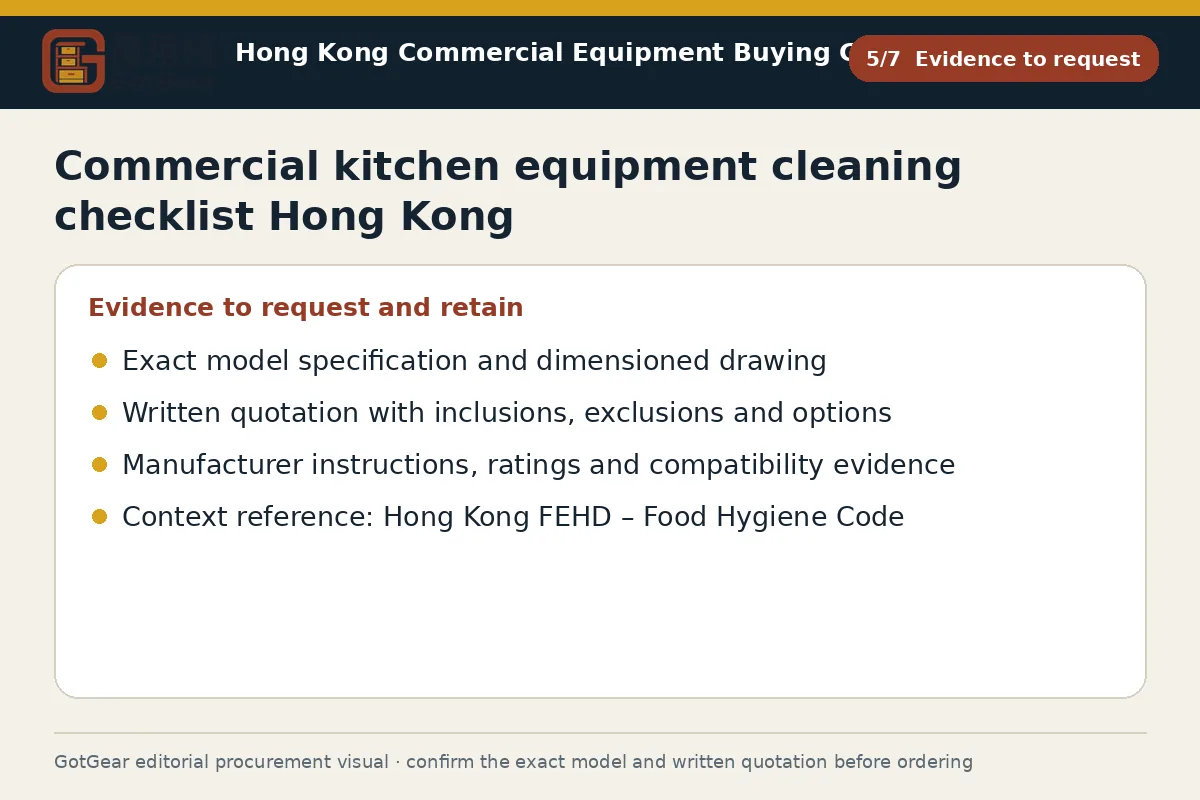
Design your record so a supervisor can verify completion at a glance. Use clear fields: date/time, equipment ID, task description, product used and concentration, stated contact time, rinse status, dismantled parts count-out/count-in, reassembly check, test run result, initials and supervisor sign-off. Where helpful, add photo capture or a QR code linking to the current manual page. Keep bilingual forms so mixed Cantonese/English teams can follow identical steps. Store originals or digital exports in a location accessible during an FEHD visit, and archive superseded versions.
Choose a durable medium for wet areas: waterproof clipboards, tear-resistant paper or tablets with splash protection, plus timed alarms to meet dwell periods. On receipt of cleaning chemicals and tools, inspect: correct part numbers, intact seals, matching SDS, bilingual labels, and adequate shelf life as stated by the supplier. Periodically spot-check with test strips or ATP swabs if your plan calls for it, and recalibrate timers used to manage contact times. Cross-reference related controls—how to store food off the floor in a Hong Kong commercial kitchen, where should waste containers be placed in a Hong Kong commercial kitchen, and your food delivery container checklist Hong Kong—to keep sign-off aligned across shifts and outlets.
Commercial kitchen equipment cleaning checklist Hong Kong decision checklist
Confirm your asset list and surface materials, then group each item by food-contact risk and usage. Allocate per-shift, daily and planned deep-clean frequencies after reading the model manual. Specify compatible products, in-use concentrations, contact times and rinse steps; request SDS, technical sheets and bilingual labels. Measure sink compartments and racks against the largest removable parts and note goods-lift constraints before buying tools or carts. Define isolation points and staff dismantling limits, keeping service-only tasks separate. Compare written quotations on compatibility statements, test strips, training aids and delivery windows. Prepare bilingual records with fields for product batch, contact time and sign-off, and verify on receipt that labels and seals are intact. Trial the checklist on a quiet service before rolling out.
- Operating use, quantity and expected frequency
- Dimensions, capacity, material and accessory requirements
- Delivery address, floor, goods lift and loading window
- Required documents, acceptance checks and after-sales arrangements
Key points for commercial kitchen equipment cleaning checklist Hong Kong
In Hong Kong, many commercial kitchens operate in high-rise industrial buildings with tight goods-lift and corridor dimensions, and specific management-office rules on loading and plant-room access. Deep cleans of extraction, combi ovens or dishwashers must often be scheduled around those windows and late-night noise limits. Humid conditions slow drying and can accelerate corrosion if rinsing is incomplete, so include drying checks before reassembly. Bilingual team communication and documentation reduce errors across shifts. This is practical guidance, not legal advice; confirm requirements with your venue, building manager, supplier and competent adviser.
Questions about commercial kitchen equipment cleaning checklist Hong Kong
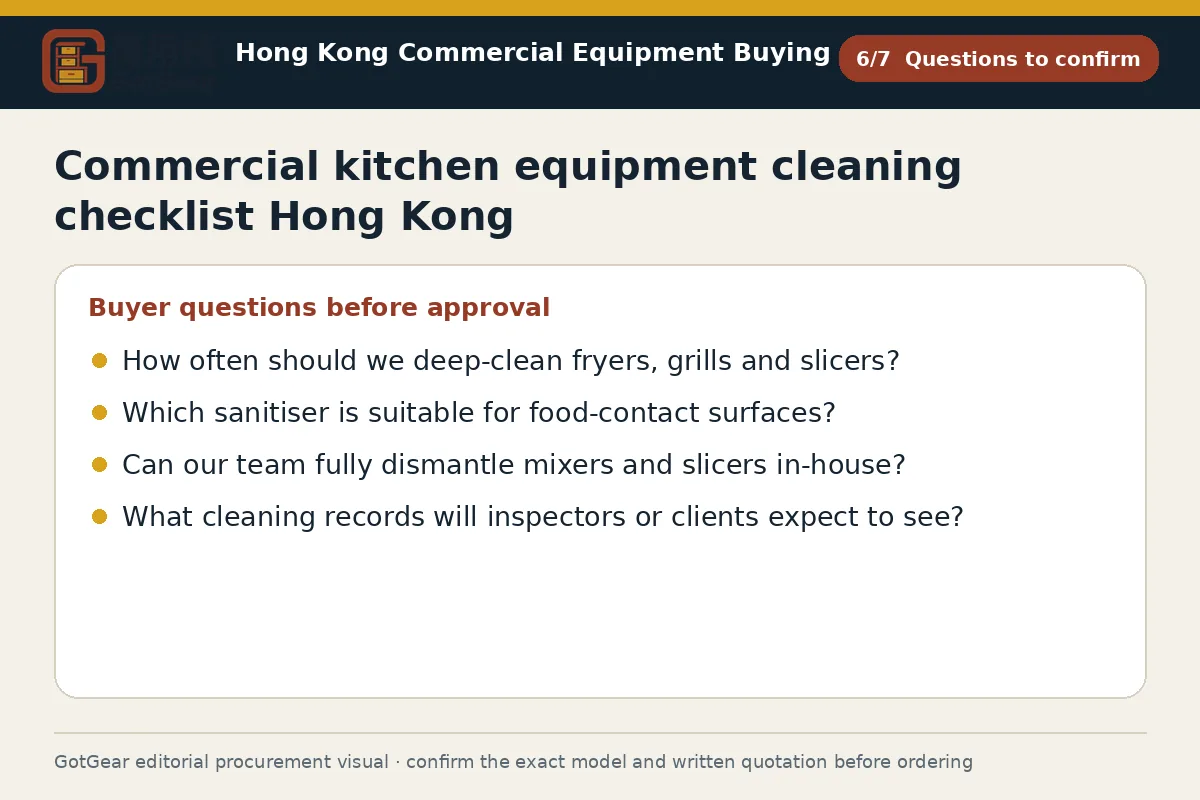
How often should we deep-clean fryers, grills and slicers?
Set a schedule by usage and manufacturer guidance. As example starting points only, fryer boil-outs may be weekly for heavy use, grills de-greased daily with a monthly deep-clean, and slicers stripped and sanitised each shift. Confirm against the model manual, ventilation performance, and oil quality checks. Adjust for humidity and staffing levels.
Which sanitiser is suitable for food-contact surfaces?
Choose a product the manufacturer states as food-contact suitable for stainless prep areas and utensils, then follow its in-use concentration, contact time and rinse instruction. Request SDS, technical data and bilingual labels, and ask for test strips or dosing controls. Check compatibility with aluminium, seals and plastics used on your specific equipment before purchase.
Can our team fully dismantle mixers and slicers in-house?
Only to the extent described in the model’s instructions and your risk assessment. Define user-removable parts and stop before sealed bearings, fixed guards or hardwired panels. Keep dismantling tools and fasteners organised and record reassembly checks. Where unsure, ask the supplier for on-site training or a service visit, and document the agreed limits.
What cleaning records will inspectors or clients expect to see?
Maintain clear, current records showing task, date, product used, contact time, rinse status, reassembly check and supervisor sign-off. Keep manuals, SDS and product batch details accessible, ideally in bilingual formats. Requirements vary by venue, contract and authority; confirm with your building manager, client specification and competent adviser before audits.
Continue with closely related procurement topics
These pages share equipment, operating or decision-stage signals with this guide.
How to store food off the floor in a Hong Kong commercial kitchen
GotGear explains how to store food off the floor in a Hong Kong commercial kitchen with raised shelving. Use the commercial kitchen food storage checklist Hong Kong to plan your restaurant back-of-house storage layout Hong Kong.
Read the guide
Where should waste containers be placed in a Hong Kong commercial kitchen
Where should waste containers be placed in a Hong Kong commercial kitchen? This GotGear guide explains how to map prep, service, wash-up and refuse flows and how to check access, cleaning and collection.
Read the guide
Food delivery container checklist Hong Kong
GotGear outlines the food delivery container checklist Hong Kong, covering capacity, closure, cleaning and loading, and explains hot and cold food delivery separation Hong Kong with monitoring and handover steps.
Read the guide
Warehouse shelving access aisle planning Hong Kong
Consult our practical guide to warehouse shelving access aisle planning Hong Kong to review inventory handling, aisle clearances and emergency access. View the warehouse shelving layout checklist Hong Kong at GotGear.
Read the guideRelated topic indexOpen more English procurement pages3 topics
Browse additional equipment families, applications and procurement questions relevant to a wider buying brief.