
How should the assessment be tested? Observe representative loads across gradients, thresholds, turns, congestion and stopping points, then check the trolley’s rated configuration and instructions against site conditions and applicable Hong Kong occupational-safety requirements.
Manual handling risk assessment for warehouse trolleys Hong Kong — Assess loads, users and handling forces
A practical manual handling risk assessment for warehouse trolleys in Hong Kong should start with the task and the actual items being moved. Weigh representative and worst‑case loads, include packaging and dunnage, and record dimensions, stack height and likely shift in the centre of mass when the trolley turns or brakes. Note fragility, leakage risk and whether strapping, nets or bins will be used. Capture frequency by shift, distance per move and any loading‑window pressures that accelerate pace. Confirm the actual users, PPE worn and whether pushing space allows neutral wrist and straight‑back postures.
Measure push and pull forces on your current or sample trolley with a calibrated force gauge at handle height. As an example starting point to discuss with a competent adviser, aim for an initial rolling force below 180 N and a sustained force below 100 N; confirm what your organisation, insurer and site accept. Ask suppliers to state rated capacity for the intended configuration, recommended maximum gradient, wheel diameter and tread compound, bearing type, handle height options, and available brakes or directional locks. Request bilingual instructions for use, inspection guidance and spare‑parts availability. In Hong Kong’s humidity, ask about corrosion‑resistant hardware and sealed bearings, and verify any anti‑rust claims in writing within the model specifications and formal written quotation.
Manual handling risk assessment for warehouse trolleys Hong Kong: Test the Full Warehouse Trolley Route
Walk the entire route from pick to drop with a loaded sample, timing peak‑congestion periods. Measure door and lift clear openings, lift car depth, and turning radii at corners and in aisles. Use an inclinometer to log ramp gradients and a ruler to record thresholds, cable protectors and floor joints. Photograph pinch points, downhill approaches to edges and busy cross‑aisles. Effective warehouse trolley route planning Hong Kong relies on these specifics, not assumptions. Where moves cross public or mixed‑use corridors, check building‑management rules for escorts, noise and floor protection.
Translate findings into procurement data. Specify floor types (epoxy, tiled, external concrete), maximum measured gradient, and threshold heights. Ask vendors to propose wheel diameter, tread material, bearing type, swivel offset, bumper protection and confirmed brake suitability for the gradient. State the lift sill gap and any dock‑leveller lips so caster selection reflects real obstacles. Plan a witnessed site trial with representative loads, including stops on slopes and controlled reversals. For deeper wheel choices, see how to choose trolley wheels for Hong Kong warehouse floors, and coordinate clearances with warehouse shelving access aisle planning Hong Kong. Require bilingual operating and maintenance instructions and confirmation that recommended checks match your route conditions.
What should buyers compare for manual handling risk assessment for warehouse trolleys Hong Kong?
| Criterion | Straightforward requirement | More complex requirement | Evidence to provide |
|---|---|---|---|
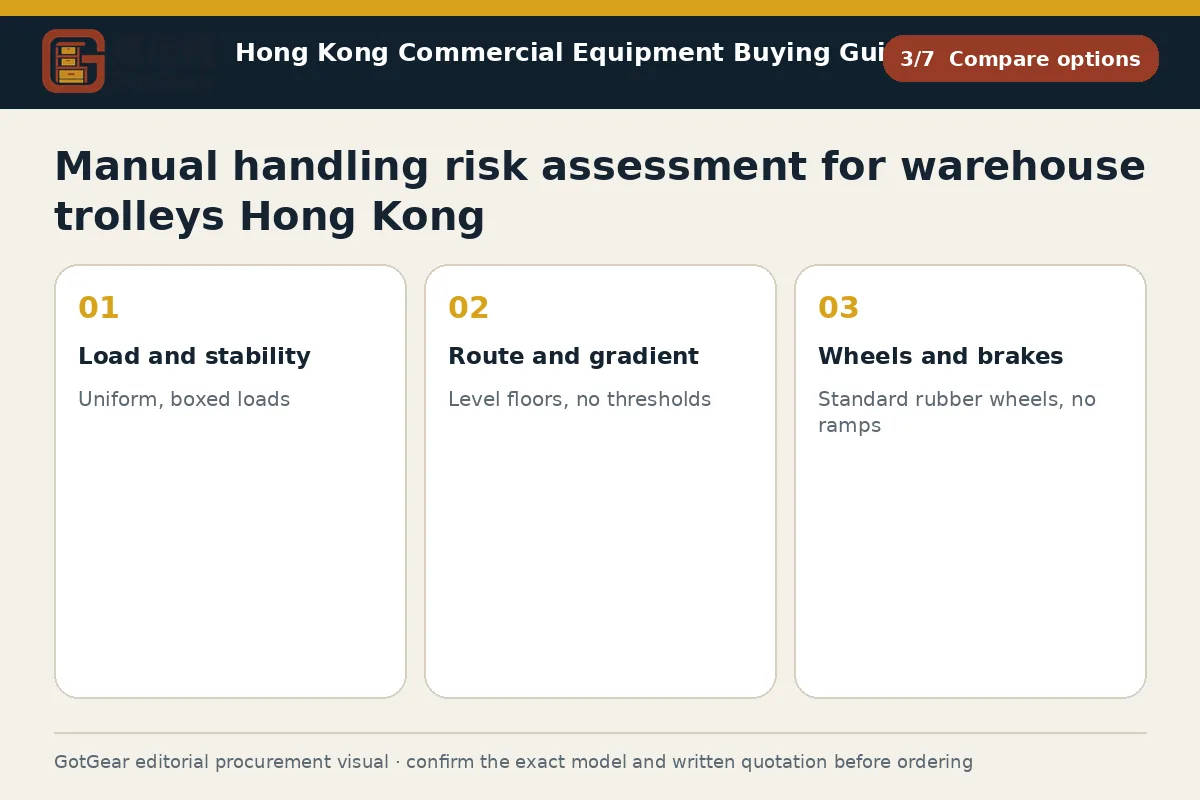
| Load and stability | Uniform, boxed loads | Mixed sizes or tall, unstable stacks | Weights, dimensions, centre of mass, containment plan |
| Route and gradient | Level floors, no thresholds | Ramps, lift sills, public corridors | Gradient %, threshold height, lift clearances, peak times |
| Wheels and brakes | Standard rubber wheels, no ramps | Larger polyurethane, sealed bearings, parking brake | Wheel size/material, bearing type, brake spec |
| Ergonomics and forces | Waist‑height handle, occasional moves | Varied users, frequent cycles, force limits | User heights, measured N forces, task frequency |
| Documentation and approval | Basic instructions and rating plate | Bilingual manuals, maintenance plan, building approval | Instruction sheets, service plan, approval emails |
This framework helps buyers create comparable written enquiries. Final model specifications, availability, delivery and commercial terms must be confirmed in a formal quotation.
Manual handling risk assessment for warehouse trolleys Hong Kong: Decide Between Trolley Use and Manual Carrying
A clear way to decide whether a warehouse in Hong Kong should use a trolley rather than manual carrying is to compare the task against distance, weight, shape, route and repetition. Trolleys suit repetitive moves, stable loads, level floors and routes free from steps. Short, infrequent transfers of light, compact items over cluttered paths may be safer to carry by one or two people, provided a competent risk review confirms posture and grip are acceptable. Stairs without compliant ramps or lifts remain a natural limit for most flat‑bed trolleys.
Document your reasons. Where the load is awkward, faintly leaking, tall or brittle, trolley containment and brakes often outweigh carrying. Where the route has ramps, specify a parking brake and, if long straight runs exist, a directional lock. As an example starting point only, if frequent single‑person carries of heavier boxes are occurring, compare measured carry strain and distance against a trolley option and record the rationale with your adviser. Ask suppliers to confirm stability with your load geometry, propose side rails or bins, and state any gradient or surface limits in writing. The model specifications and formal written quotation prevail.
Manual handling risk assessment for warehouse trolleys Hong Kong — Record controls and review dates
Close the loop by recording the agreed controls, responsibilities and review dates. Keep a task-level log with the assessed load range, route sketch, measured forces, selected trolley model and accessories, inspection frequency proposed by the manufacturer, and training coverage. Note approvals from building management for shared concourses, any quiet-hour restrictions and where trolleys may be staged without blocking exits. Align your records with your internal materials handling equipment checklist for Hong Kong so procurement, operations and safety speak to the same file. If your site also supports guest-facing moves, insights from hotel housekeeping trolley workflow for Hong Kong can help standardise etiquette, signage and speed limits.
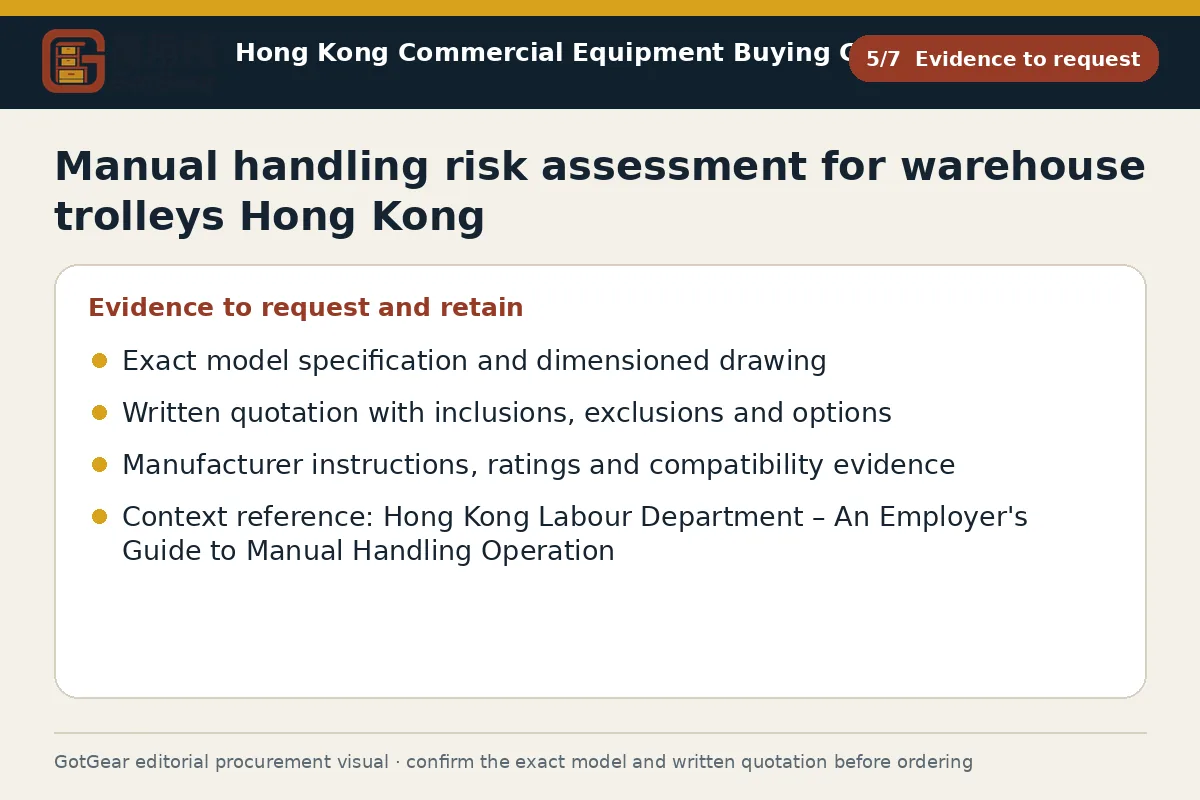
On receipt, inspect rating plates, serial numbers, wheel size and material, bearings, brake operation, handle fasteners, welds and any corner bumpers. Verify that the delivered model matches the signed quotation, that bilingual instructions and maintenance guidance are provided, and that spare-parts references are listed. File the test-route evidence, photos and measured forces with the purchase record. Set a review date tied to route changes, floor resurfacing, new shift patterns or any incident; adjust sooner if obstacles, gradients or user profiles change materially.
Manual handling risk assessment for warehouse trolleys Hong Kong decision checklist
Before issuing an enquiry, confirm the real load range, frequency and user profiles, then measure push/pull forces with a gauge on a representative trolley. Walk the exact route, capturing door and lift clearances, gradients, thresholds and busy times, and sketch a simple plan. Provide this with your request for wheel diameter and compound, bearings, handle options, brakes and corner protection. Ask for written statements of rated capacity in your configuration, maximum recommended gradient and maintenance guidance, all in bilingual form. Request a supervised site trial with representative loads. Note any building‑management conditions, cleaning expectations and staging areas, and set a provisional review date. The supplier’s model specifications and formal written quotation prevail.
- Operating use, quantity and expected frequency
- Dimensions, capacity, material and accessory requirements
- Delivery address, floor, goods lift and loading window
- Required documents, acceptance checks and after-sales arrangements
Key points for manual handling risk assessment for warehouse trolleys Hong Kong, when should a Hong Kong warehouse use a trolley instead of manual carrying, warehouse trolley route planning Hong Kong
Hong Kong warehouses often work within tight goods‑lift cars, narrow industrial‑building corridors and limited loading windows, so route measurement is critical. Many sites share access with offices or the public; building managers may require escorts, floor protection and noise control. Humid conditions and occasional wet floors call for corrosion‑resistant components and sealed bearings. Bilingual instructions and labels support mixed crews. Treat this page as practical guidance, not legal advice; confirm requirements with your competent adviser, building management and applicable Hong Kong occupational‑safety expectations before purchase.
Questions about manual handling risk assessment for warehouse trolleys Hong Kong
How should we set push/pull force targets for a trolley purchase?
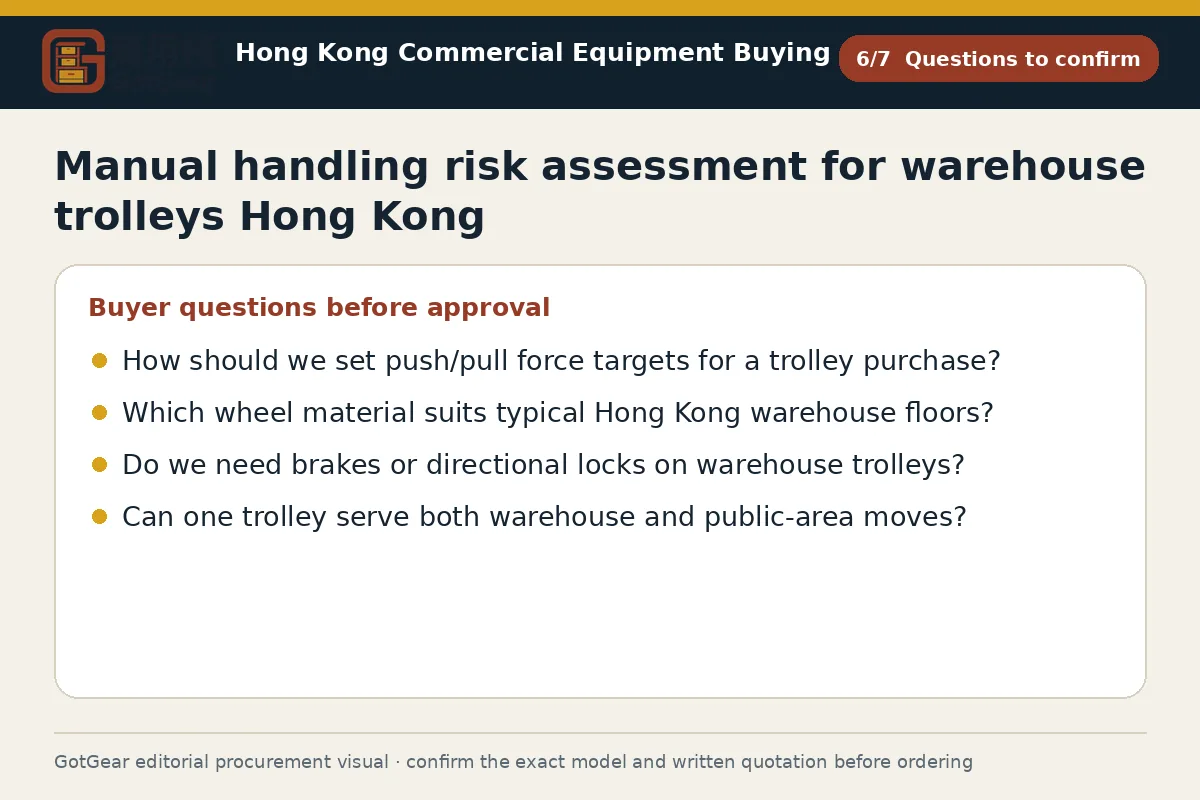
Measure forces with a calibrated gauge on a representative trolley, then agree limits with a competent adviser. As an example starting point only, many sites compare options aiming for initial force below 180 N and sustained below 100 N. Confirm what your organisation, building manager and insurer accept, and ensure the supplier’s specifications and written quotation reflect the task and route.
Which wheel material suits typical Hong Kong warehouse floors?
Match wheels to the measured route. Epoxy floors and longer runs often benefit from medium‑hard polyurethane; tiles and thresholds may need softer, resilient treads. Wet or humid areas point to corrosion‑resistant hardware and sealed bearings. If in doubt, review how to choose trolley wheels for Hong Kong warehouse floors, then request wheel size, tread compound and bearing type in the quotation.
Do we need brakes or directional locks on warehouse trolleys?
Specify a parking brake for ramps, lifts, vehicle interfaces and any staging on slopes; add a directional lock for long straight runs. Confirm suitability against your measured gradient and floor. Some models offer foot or hand‑operated brakes—request confirmation in writing and a site trial with a representative load. Building‑management rules may also influence brake requirements.
Can one trolley serve both warehouse and public‑area moves?
Possibly, if it runs quietly, is clean, has corner bumpers and presents a tidy load. Public‑area moves can require escorts, signage and speed control; check building‑management conditions and event policies first. You may standardise procedures using your materials‑handling checklist and training, and keep a separate, presentable unit for guest‑facing routes to reduce cross‑contamination.
Continue with closely related procurement topics
These pages share equipment, operating or decision-stage signals with this guide.
Event recycling station setup Hong Kong
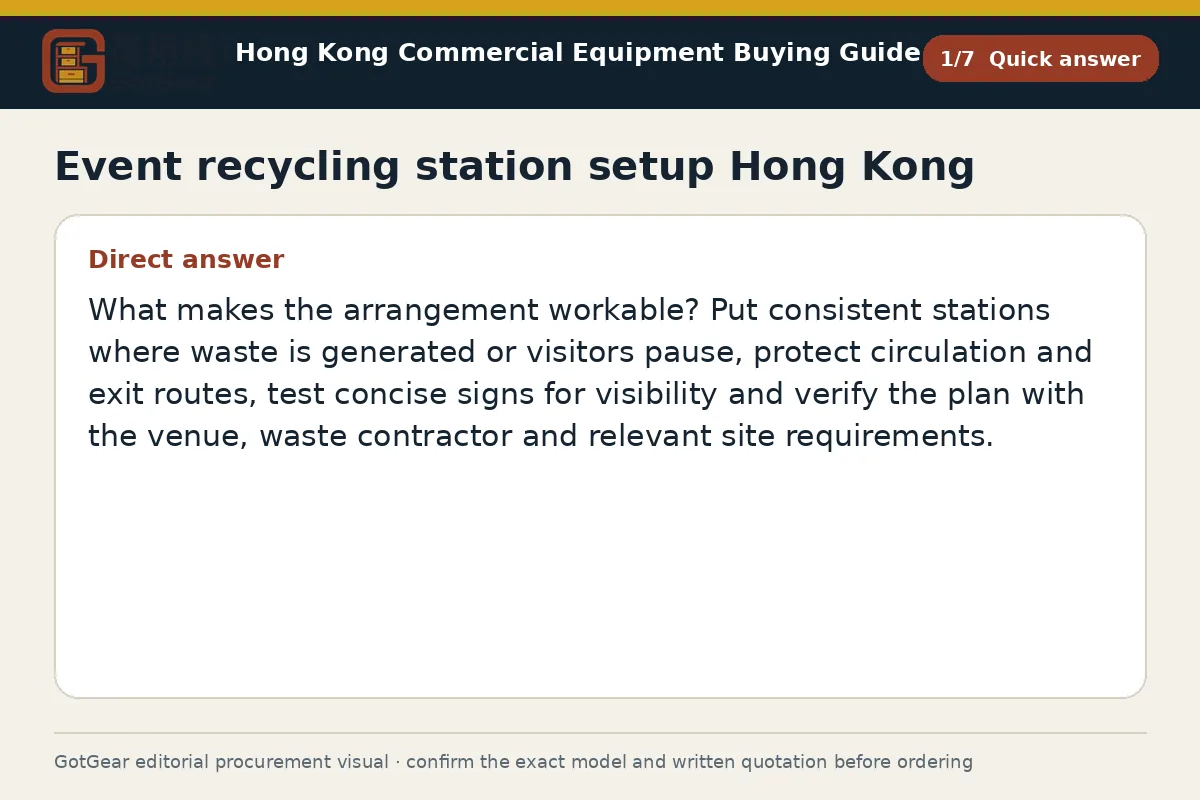
GotGear has a checklist for event recycling station setup Hong Kong covering disposal points, servicing and signage. It includes recycling station signage for Hong Kong events and visitor direction signage for Hong Kong events.
Read the guide
Event recycling and queue management Hong Kong
GotGear covers event recycling and queue management Hong Kong and links peak forecasts and disposal points with queue barrier layout for Hong Kong registration events and exhibition registration flow planning Hong Kong.
Read the guide
Hotel housekeeping trolley workflow Hong Kong
GotGear documents the hotel housekeeping trolley workflow Hong Kong, mapping store-to-service routes, loads, lifts and cleaning checks. The restaurant clearing trolley guide Hong Kong adapts those checks for table collection.
Read the guide
Warehouse shelving access aisle planning Hong Kong
Consult our practical guide to warehouse shelving access aisle planning Hong Kong to review inventory handling, aisle clearances and emergency access. View the warehouse shelving layout checklist Hong Kong at GotGear.
Read the guideRelated topic indexOpen more English procurement pages1 topics
Browse additional equipment families, applications and procurement questions relevant to a wider buying brief.