
How should containers be selected? Check food type, load size, journey duration and intended use, define how hot and cold items will be separated and monitored, and verify the procedure against documented food-safety controls and applicable Hong Kong requirements.
Food delivery container checklist Hong Kong — Check container capacity and condition
Start by mapping menu portions to container volume and shape. Measure the largest dishes, beverage carriers and dessert packs, and request internal length, width and usable height from suppliers, not just external footprints. Confirm the tare weight and a supplier‑stated maximum stacked load per container; run a sample lift‑fit in your tightest doorway and goods lift as an example starting point only, then confirm with building management. For consistency across teams, a Hong Kong food delivery container checklist should underpin measurements and receipt tests.
In your enquiry pack, ask for: internal and external dimensions; usable litres; lid style and gasket material; latch type; stackability rating; handle design and grip width for use with gloves; and temperature tolerance for hot washes. Specify any trolley or racking footprint that the boxes must lock onto. Compare quotations on like‑for‑like fields and request cut‑sheets, photos and bilingual specifications for approval. On receipt, inspect for uniform wall thickness, flush closures, intact hinges and any manufacturing odour. Wipe‑test interior seams to ensure there are no dirt traps. Note any transit damage on the delivery note and photograph serial or batch numbers so that future warranty or spares requests (e.g., replacement gaskets) can reference the correct items as stated in the model specifications and formal written quotation.
Food delivery container checklist Hong Kong — Control loading, handover and returns
Control the loading sequence so heat and moisture do not compromise ambient or cold items. Define where labels sit on the container, which ticket is the job’s master reference, and when tamper-evident seals are applied. Build in bilingual order slips for lobby guards and riders. In tower estates, schedule dispatch against booked goods-lift slots and management-office procedures, and pre-assign a handover point that avoids blocking emergency routes.
In your enquiry, state the need for seal eyelets, flat label areas or card rails, and a scannable panel for QR/manifest tags. Specify handle position for safe two-person lifts, and whether the container must dock to a standard delivery cart. Ask the vendor for example loading and returns SOPs for evaluation, then compare quotations on the availability of spares, seals and compatible racks. On receipt, run a short route simulation: pick-list to loading, lobby handover, rider departure, and returns drop. Keep returns staging off the floor and away from refuse; align with how to store food off the floor in a Hong Kong commercial kitchen and where should waste containers be placed in a Hong Kong commercial kitchen to prevent cross-contact and confusion.
What should buyers compare for food delivery container checklist Hong Kong?
| Criterion | Straightforward requirement | More complex requirement | Evidence to provide |
|---|---|---|---|
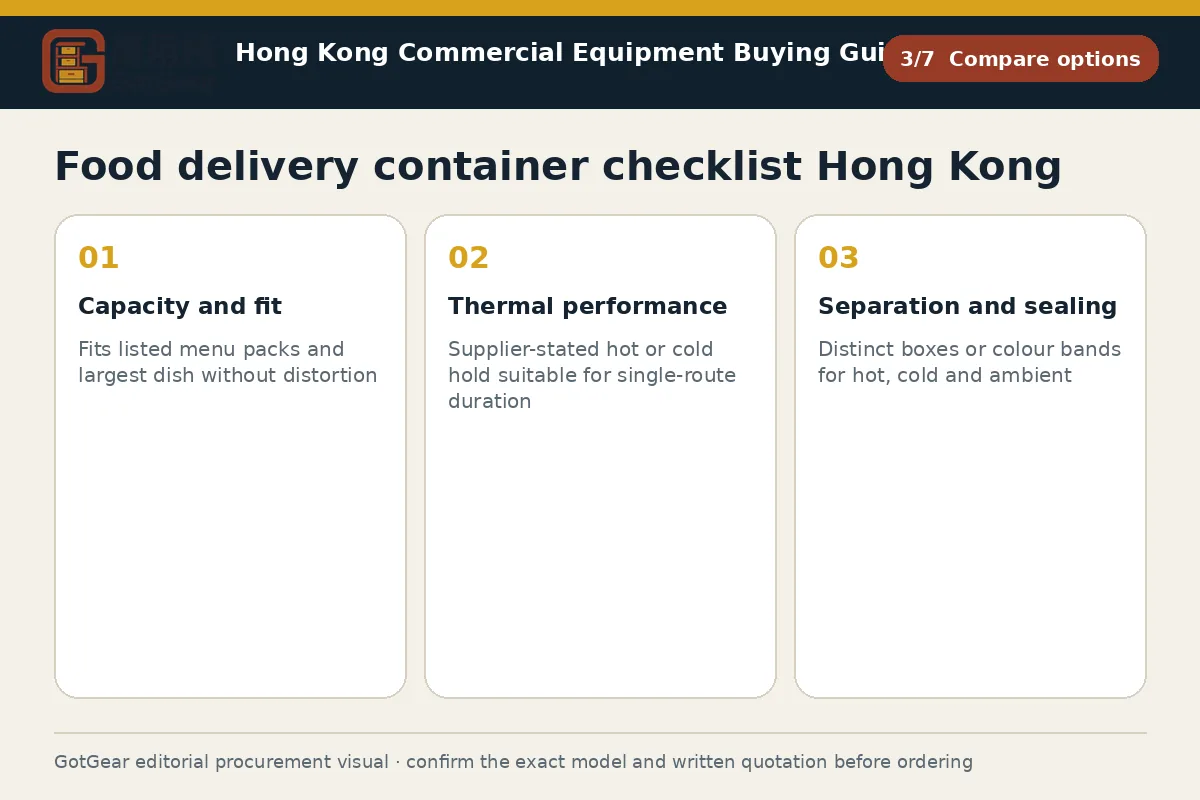
| Capacity and fit | Fits listed menu packs and largest dish without distortion | Modular fit for GN pans, beverage carriers and dessert trays | Provide internal/external dimensions, usable height and drawings; confirm lift/door limits |
| Thermal performance | Supplier-stated hot or cold hold suitable for single-route duration | Validated mixed-load performance with dividers and gel packs | Request test report, method, start/end temps and ambient; run site trial and record readings |
| Separation and sealing | Distinct boxes or colour bands for hot, cold and ambient | Tamper seals, allergen segregation and odour control measures | Specify seal type/eyelet, divider options, colour codes and SOP excerpt for labelling |
| Handling and mobility | Ergonomic handles and stable base for manual carrying | Docking to trolleys; footprint proven to fit lifts and lobbies | Submit trolley footprint, wheel type, turning radius; confirm building constraints in writing |
| Cleaning and documentation | Smooth interiors; cleaning guidance and chemical compatibility | Bilingual manuals, max wash temperature, drying rack provision | Provide manuals, MSDS, max temperature tolerance and sample cleaning record templates |
This framework helps buyers create comparable written enquiries. Final model specifications, availability, delivery and commercial terms must be confirmed in a formal quotation.
Food delivery container checklist Hong Kong: Separate Hot and Cold Food-Delivery Loads
Decide early whether to use fully dedicated boxes for hot, cold and ambient, or to partition within one shell using dividers and gel packs. Separate aromatic foods from delicate desserts, and set stacking rules so hot lids do not sit over chilled trays. In humid weather, condensation can pool: choose designs with smooth interiors and optional drain plugs, and pre-chill cold boxes while keeping hot boxes dry. Many buyers now formalise hot and cold food delivery separation Hong Kong within their written SOPs to reduce temperature abuse and odour transfer throughout multi-drop routes.
Your enquiry pack should request insulation thickness, supplier-declared retention performance for hot and for chilled use (e.g., an example starting point for holding range and duration to be validated on your route), divider compatibility, gel-pack sizing, and colour-coding for fast identification. If allergen or special diets are in scope, ask for dedicated lids or tubs and clear external labelling. Compare quotations on inclusion of dividers, gel packs, spare gaskets and matching trolleys, and require bilingual documentation. At receipt, run a controlled test dispatch with probe readings at dispatch and delivery as an example starting point, then agree acceptance criteria with your competent adviser. For internal approvals, bundle this decision with your catering equipment procurement checklist Hong Kong so separation and capacity decisions are reviewed together.
Food delivery container checklist Hong Kong — Document monitoring and cleaning
Secure the paperwork that proves the containers can be cleaned and monitored in your operation. Ask for manufacturer cleaning instructions, chemical-compatibility statements for food-contact detergents and sanitisers, and maximum wash temperatures. If machine-wash is proposed, confirm rack fit and cycle limits with your stewarding team; if EPP is specified, validate manual-wash steps and drying time in your humid back-of-house. Build checks into your commercial kitchen equipment cleaning checklist Hong Kong so that responsibility and frequency are documented for audits.
Set up monitoring documents that capture dispatch temperatures, seal application, rider handover times and returns condition. Keep bilingual formats so delivery partners and venue managers can read them. If your menu or insurer requires enhanced tracking, include data loggers or calibrated probes and define when to download or review data. Store containers on clean racks between runs to avoid floor contact, and dry thoroughly to prevent mould. For institutions and public-event sites, align the cleaning and documentation pack with venue rules, then file the supplier’s manuals, any test reports and training notes alongside your routine production records for traceability.
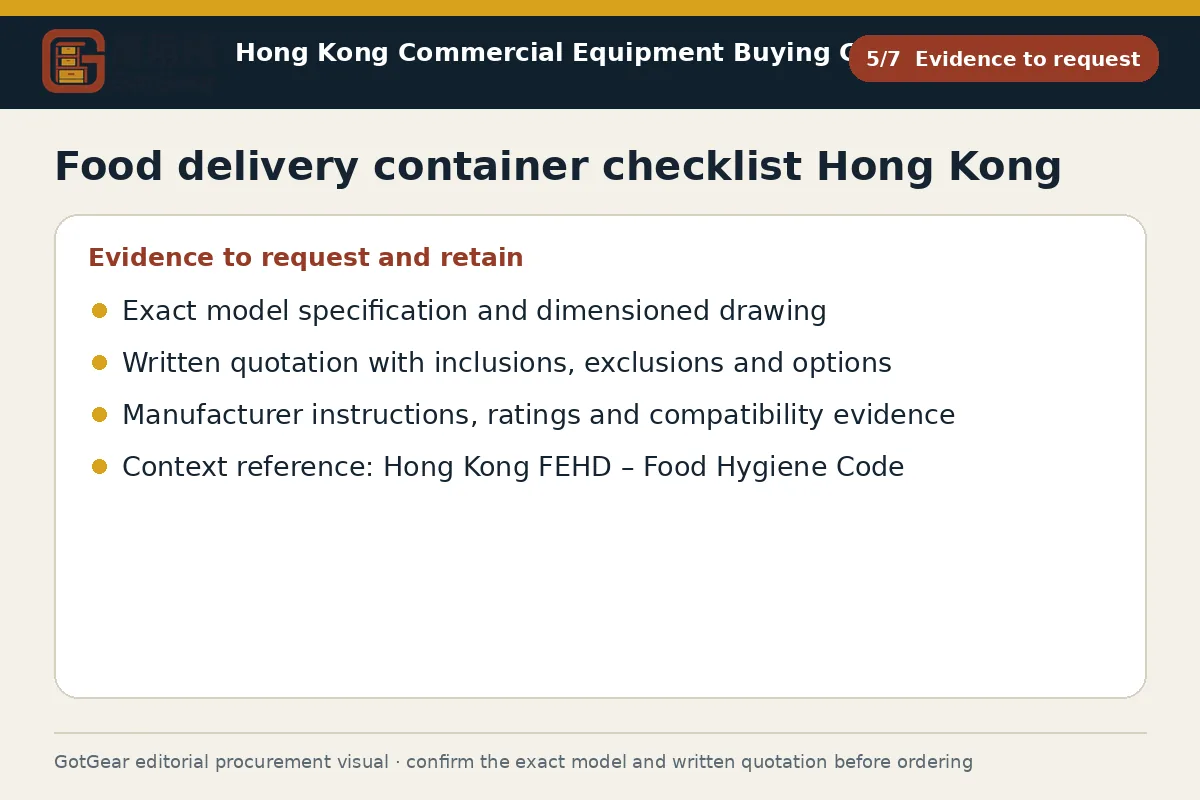
Food delivery container checklist Hong Kong decision checklist
Define menu categories and portion counts, then record internal dimensions, usable volume and stack height that fit your site’s tightest lift and doorway. State whether hot, cold and ambient travel in separate boxes or via dividers and gel packs, and specify seal eyelets, label rails and colour-coding. Request supplier retention data, cleaning guidance, maximum wash temperature and chemical compatibility in bilingual form. Ask for drawings, photos and a sample or trial. Compare written quotations line-by-line on capacity, insulation, accessories, spares, trolley fit and delivery lead time as stated by the vendor. On receipt, inspect closures, gaskets, hinges, surfaces and identification panels, and run a short validation route with documented temperature checks. Keep returns off the floor and segregated from waste, and file all manuals with your internal approval pack.
- Operating use, quantity and expected frequency
- Dimensions, capacity, material and accessory requirements
- Delivery address, floor, goods lift and loading window
- Required documents, acceptance checks and after-sales arrangements
Key points for food delivery container checklist Hong Kong, hot and cold food delivery separation Hong Kong
Hong Kong deliveries often originate in tight back-of-house spaces and pass through managed lobbies and lifts before reaching riders. Book loading bays and goods-lift windows early, and confirm maximum trolley and container dimensions with the building office. Humid conditions increase condensation risk in chilled boxes and slow drying after cleaning; plan for racks and airflow. Many buildings require bilingual delivery papers for guards. Platform riders may queue at peak times, so handover points and tamper-seal steps should be clear, visible and quick to execute without blocking common areas. Treat building rules, insurer demands and your documented food-safety plan as prevailing constraints.
Questions about food delivery container checklist Hong Kong
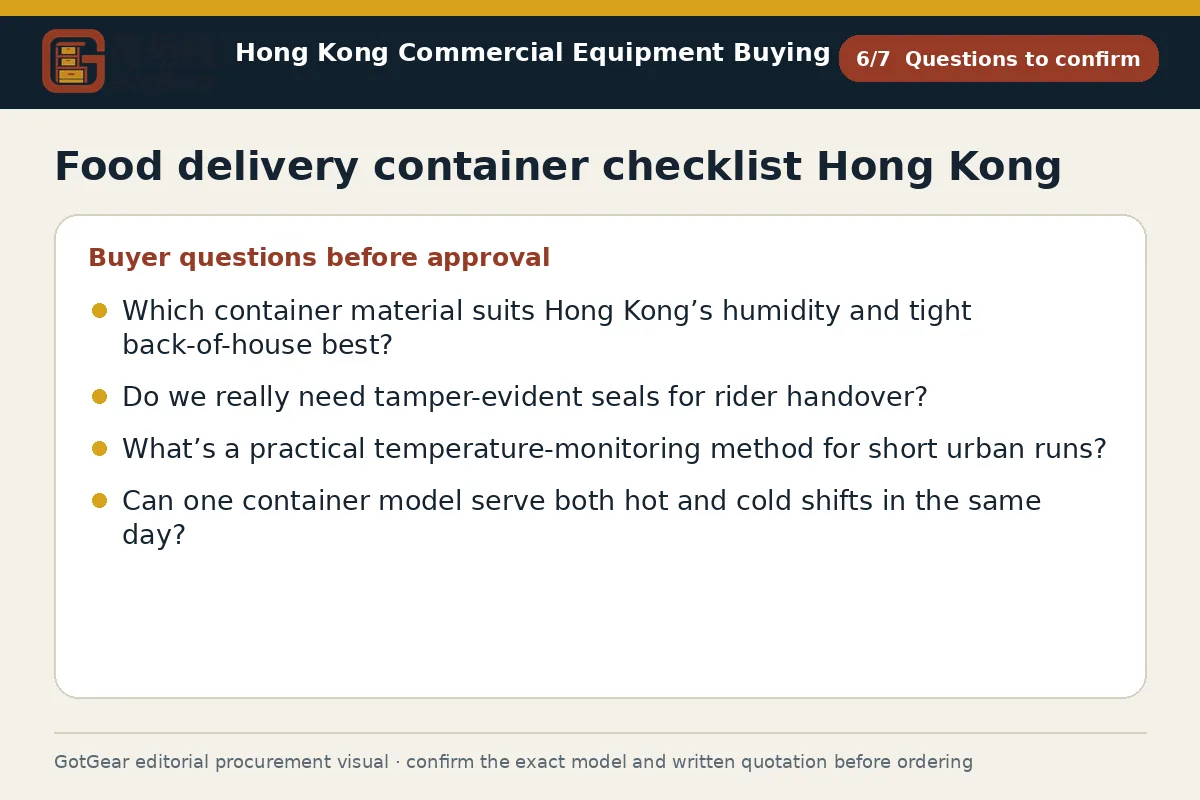
Which container material suits Hong Kong’s humidity and tight back-of-house best?
Rigid plastic shells with removable gaskets are robust and easy to clean; EPP insulated boxes are light and hold temperatures well. Choose based on route length, wash method and trolley compatibility. Validate weight when loaded, lift fit and drying time in your space, and confirm any machine-wash limits with the supplier’s written instructions and your stewarding team.
Do we really need tamper-evident seals for rider handover?
Yes, seals give quick visual assurance and reduce disputes at delivery. If you use them, specify eyelets or latch styles that accept your chosen seal and standardise the seal position in SOPs. Some venues and platforms expect visible tamper control; check requirements with the building office, delivery partners and your insurer before finalising the model.
What’s a practical temperature-monitoring method for short urban runs?
Probe hot and cold items before loading and record readings on the dispatch sheet; spot-check at delivery during trials. For higher assurance, use small data loggers inside one reference pack per route. Define sampling as an example starting point only, then agree the frequency and acceptance criteria with your food-safety lead and confirm device accuracy with the manufacturer.
Can one container model serve both hot and cold shifts in the same day?
Often yes, if you operate strict cleaning, drying and segregation, or use colour-coded lids and dividers. Confirm temperature-retention claims for both modes, and ensure your team can fully dry interiors between shifts in Hong Kong’s humidity. Document the switch-over steps and keep spare gaskets and labels so changeovers don’t delay dispatch or compromise hygiene.
Continue with closely related procurement topics
These pages share equipment, operating or decision-stage signals with this guide.
How to store food off the floor in a Hong Kong commercial kitchen
GotGear explains how to store food off the floor in a Hong Kong commercial kitchen with raised shelving. Use the commercial kitchen food storage checklist Hong Kong to plan your restaurant back-of-house storage layout Hong Kong.
Read the guide
How many recycling bins does a Hong Kong office need
GotGear explains how many recycling bins does a Hong Kong office need, covering collection frequency and zone sizing, plus office recycling station setup Hong Kong and clean recycling bin placement in Hong Kong offices.
Read the guide
Warehouse shelving access aisle planning Hong Kong
Consult our practical guide to warehouse shelving access aisle planning Hong Kong to review inventory handling, aisle clearances and emergency access. View the warehouse shelving layout checklist Hong Kong at GotGear.
Read the guide
Event recycling station setup Hong Kong
GotGear has a checklist for event recycling station setup Hong Kong covering disposal points, servicing and signage. It includes recycling station signage for Hong Kong events and visitor direction signage for Hong Kong events.
Read the guideRelated topic indexOpen more English procurement pages1 topics
Browse additional equipment families, applications and procurement questions relevant to a wider buying brief.