
For Fiberglass step platform Hong Kong, decide first whether the task calls for a step-platform or hop-up layout, then verify dimensions, capacity and material information for the exact model. Do not infer electrical suitability from appearance or material name; check the risk assessment, manufacturer documentation, site conditions and applicable Hong Kong requirements.
Task height and standing area for Fiberglass step platform Hong Kong
Start with the task height, then determine the safe, comfortable standing area. For Fiberglass step platform Hong Kong, measure the highest point you must work on, then subtract a realistic body reach. As an example only, a technician with an average reach may use a 0.7–0.9 m platform for tasks around 2.3–2.6 m, but the confirmed model specification and formal written quotation prevail. Record luminaires, trunking or plant that sit above head height, and note any need to look up for extended periods, which can affect fatigue and posture.
Define the standing area that allows a square, shoulder-width stance without toeing onto edges. Ask for deck length and width in millimetres, usable area minus any upstands, and the surface finish (e.g. grit type and test method) so you can match it to housekeeping standards. If work involves small parts, confirm whether the deck permits a parts bin without crowding the user’s feet; avoid assumptions. When two technicians may approach the same point in sequence, consider a deck large enough to reposition tools without stepping down. If the task involves frequent lateral movement, a rectangular deck can reduce repositioning frequency, provided anti-slip performance and edge visibility are documented for your lighting conditions.
Footprint, handling and access details for Fiberglass step platform Hong Kong
Footprint, handling and access are decisive in Hong Kong buildings. Measure the entire route from loading point to work area: door and corridor clear widths, lift car depth and height, and any turn radii. As an example only, some goods lifts accept around 1,100 mm door width, but confirm your actual path. Request folded dimensions (L×W×H), open footprint (splay and deck overhang), and turning clearance to swing the unit through fire doors without striking frames. If access includes management-office checkpoints, note the need for protective wrapping or corner bumpers to prevent scuffing.
Handling depends on weight, carry points and any wheels. Ask for the stated mass in kilograms, centre-of-gravity when folded, and wheel specification if fitted (material, diameter and whether non-marking). Confirm whether a single person can carry or whether team-carry is advised; this must be stated by the manufacturer, not inferred. For floor protection, specify the foot material and pad area, and request evidence of slip resistance on common surfaces (smooth screed, vinyl, tiled lobby) using a named test method. If access is via public areas, check whether noise from wheels is acceptable during building quiet hours, and schedule movement with building management to avoid crowd traffic.
What should buyers compare for Fiberglass step platform Hong Kong?
| Criterion | Straightforward requirement | More complex requirement | Evidence to provide |
|---|---|---|---|
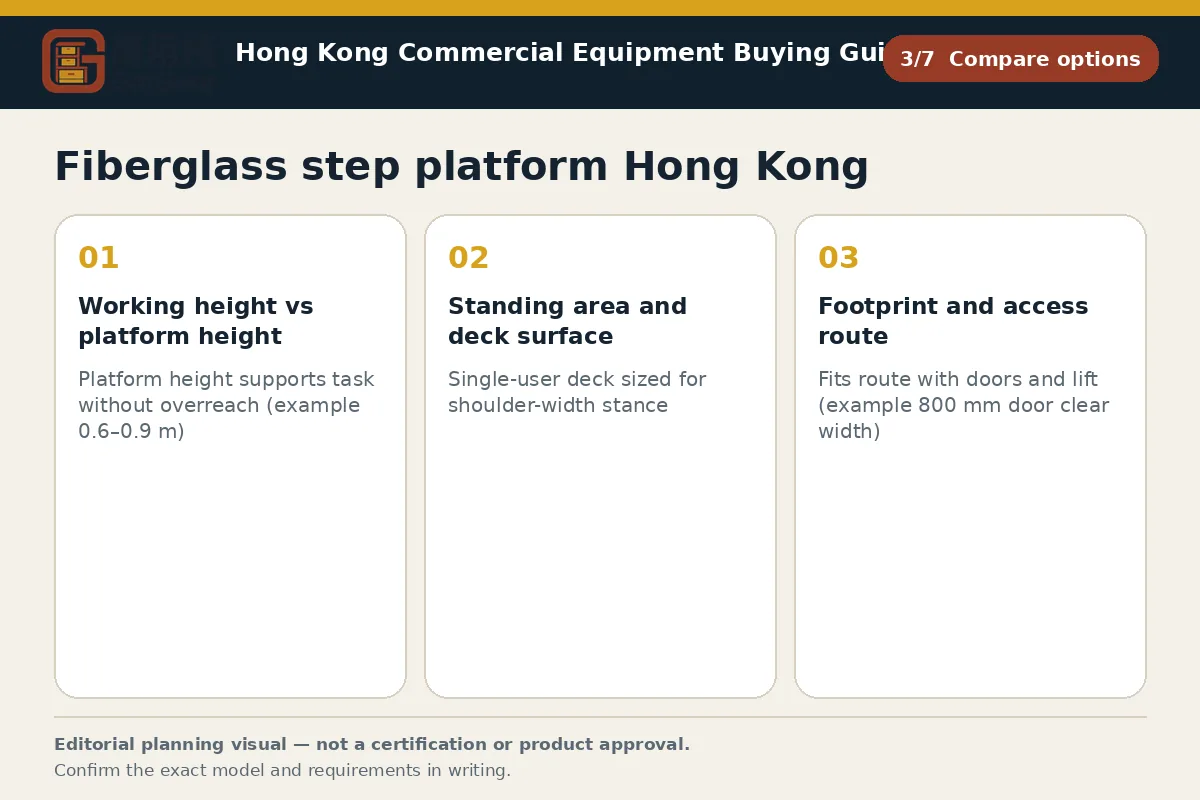
| Working height vs platform height | Platform height supports task without overreach (example 0.6–0.9 m) | Multiple height bands; consider two models or adjustable range if offered | Measured task heights, typical user reach, agreed clearance allowance (example only) |
| Standing area and deck surface | Single-user deck sized for shoulder-width stance | Space for small parts with clear foot room; specify anti-slip test method | Deck L×W (mm), usable area, surface finish and named slip test |
| Footprint and access route | Fits route with doors and lift (example 800 mm door clear width) | Tight turns, fire doors and lift depth constraints mapped and timed | Door, corridor, lift dimensions, turn radii, route photos or sketch |
| Material and electrical evidence | FRP components documented with manufacturer data sheet | Work near live sources requires dielectric test statement and limits | Model code, test standard ID, conditions (dry/wet), maintenance notes |
| Handling and storage | Single-person carry or wheels acceptable for route and floors | Noise-sensitive or delicate finishes need non-marking, low-noise wheels | Weight (kg), folded size, wheel material/diameter, storage bay size |
This framework helps buyers create comparable written enquiries. Final model specifications, availability, delivery and commercial terms must be confirmed in a formal quotation.
Fiberglass step platform Hong Kong: When to compare with Fiberglass hop-up platform Hong Kong
Compare formats when task height, dwell time and repositioning frequency vary through the day. A compact hop-up suits short, repetitive actions close to waist or chest level, while a step-platform layout gives a safer approach for longer, two-hand tasks at a higher reach with reduced tendency to overreach. Use Fiberglass hop-up platform Hong Kong as a reference where the route is tight, work windows are short, and the operator moves every few minutes between points.
Map actual task bands by area: for example only, pantry detectors at 2.2 m, corridor signage at 2.4 m, and distribution boards at 1.6 m. If most interventions fall within a single, low band and the operator must pass through narrow corridors repeatedly, a hop-up can reduce handling burden. If the same operative must access slightly higher points, needs a larger deck for parts, or must stand for more than a few minutes, the step-platform format may reduce step-up/step-down cycles and improve stance stability. Document the number of daily relocations, storage bay size, and whether multiple users of different heights share the equipment. Ask suppliers to quote like-for-like on platform height, deck size, weight and folded dimensions so you can compare both formats side by side in writing.
Material evidence and instructions for Fiberglass step platform Hong Kong
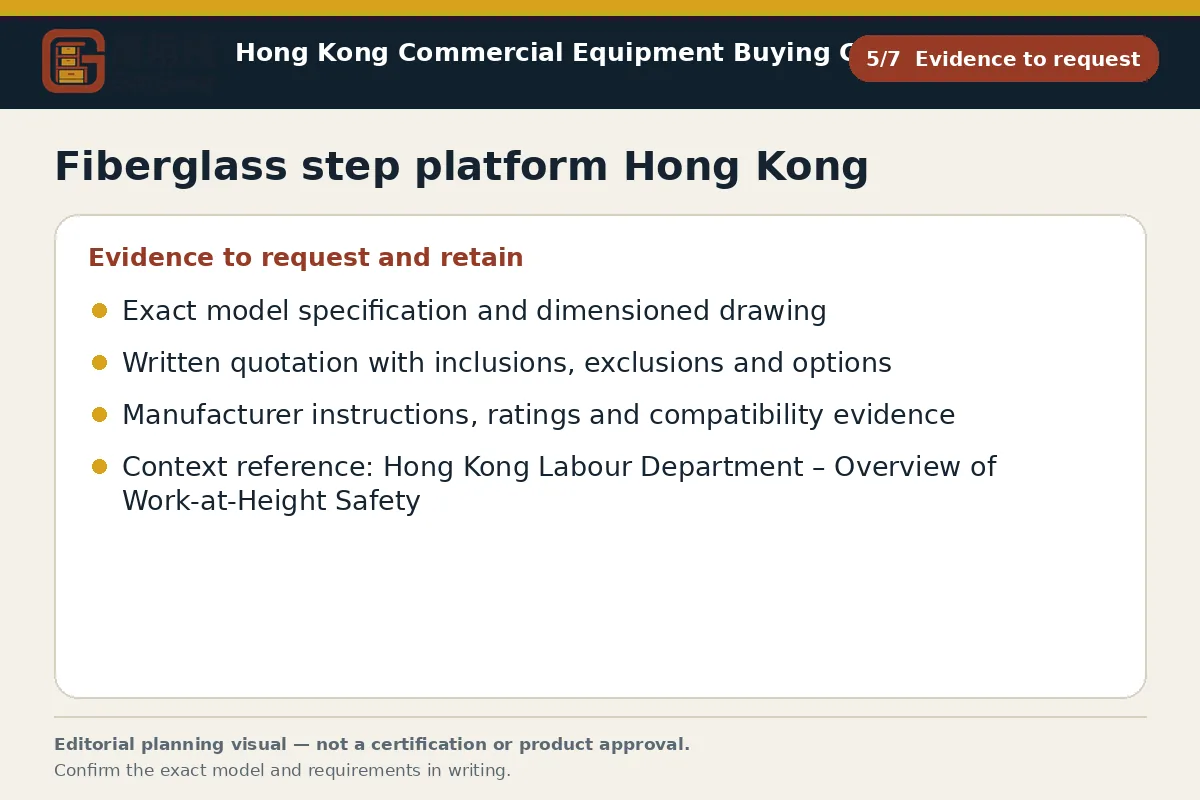
Material verification is essential. Fibreglass (FRP) components can offer electrical and corrosion advantages, but performance is model-specific and condition-dependent. Request the manufacturer’s data sheet stating resin system, glass reinforcement type, UV inhibitors and any dielectric test statement. Where work may occur near energised sources, ask for the exact test method, conditions (dry/wet, clean/contaminated), the measured values, and any limitations; treat this as evidence for your risk assessment and applicable Hong Kong requirements, not a blanket approval.
Confirm hardware materials that contact the floor or user—fasteners, hinges, feet and any braces—and ask for corrosion resistance details suitable for humid, coastal air. Request slip-resistance data with the test name, surface condition and shoe type. Ask for the user manual in bilingual format if required by your organisation, including inspection instructions, cleaning guidance (e.g. compatible detergents that will not degrade FRP) and storage advice out of direct sunlight where space allows. For institutional approval, obtain the formal model code, load rating, platform dimensions, maintenance schedule and a spares list (feet, end caps, treads) so that replacement parts can be ordered without ambiguity. Keep all documentation with the asset ID on site.
Fiberglass step platform Hong Kong decision checklist
Confirm the highest task point per area and the operator’s practical reach, then calculate the platform height allowing comfortable, neutral posture with an example safety margin agreed in writing. Define the standing area in millimetres and the anti-slip finish. Measure the full access route, recording door, corridor and lift dimensions and any management-office controls. Request written quotations that state model code, platform height, deck size, load rating, folded size, weight, foot and wheel materials, and surface test methods. Ask for the FRP data sheet and any dielectric test statement with conditions. On receipt, inspect for transit damage, correct labels, intact feet, rigid joints and clean, undamaged treads; reconcile against the quotation and manual. File bilingual instructions and log the asset ID, inspection steps and spare parts list.
- Operating use, quantity and expected frequency
- Dimensions, capacity, material and accessory requirements
- Delivery address, floor, goods lift and loading window
- Required documents, acceptance checks and after-sales arrangements
Key points for Fiberglass step platform Hong Kong, Fiberglass hop-up platform Hong Kong
Hong Kong sites often involve tight back-of-house routes, goods-lift restrictions and building-management booking procedures. Measure the actual lift car, doorway clear widths and turning spaces along the path; treat any typical figures only as examples until verified on site. Coordinate loading-dock windows and escort rules in advance to avoid delays. Humid, coastal conditions mean hardware and feet should suit moisture and cleaning regimes. Many venues request bilingual manuals and labels; confirm this with the receiving department to ensure acceptance. Nothing here is legal advice—follow your risk assessment and the venue or authority’s written requirements.
Questions about Fiberglass step platform Hong Kong
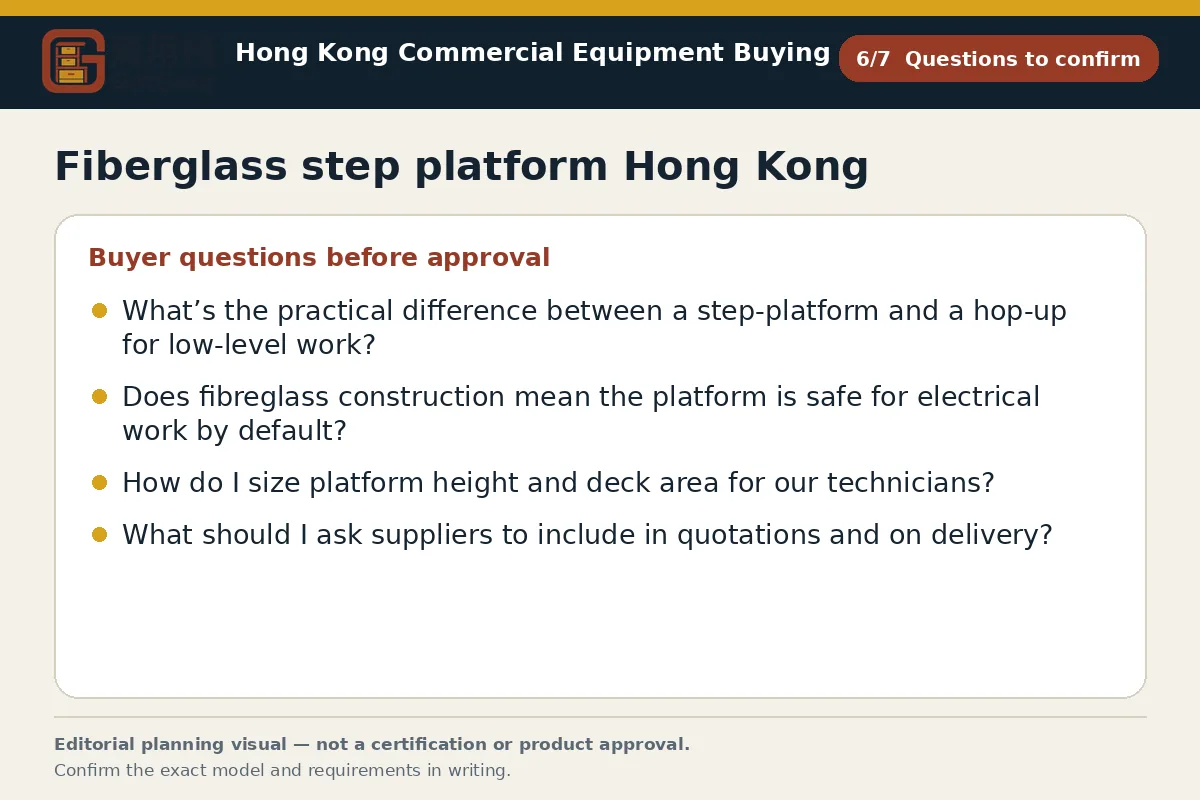
What’s the practical difference between a step-platform and a hop-up for low-level work?
A hop-up is a compact, single-step deck for quick, low tasks and frequent moves. A step-platform provides a higher deck with steps and a larger standing area for longer tasks with reduced overreach. Choose by task height, dwell time, and route constraints. Confirm dimensions, load rating and handling weight in the written quotation before committing.
Does fibreglass construction mean the platform is safe for electrical work by default?
No. Electrical suitability depends on the exact model, its tested dielectric performance and the site conditions. Request the manufacturer’s statement of test method, values and limits, and use it within your risk assessment. Surfaces must be clean and dry if specified. Follow the venue, insurer or authority requirements applicable to your task in Hong Kong.
How do I size platform height and deck area for our technicians?
Measure the task point, note typical user reach and pick a platform height that avoids overreaching. As an example starting point, some tasks around 2.4 m may suit a platform under 1 m, but confirm against the model specification. For deck area, specify length, width and usable space, plus the anti-slip test method relevant to your floor conditions.
What should I ask suppliers to include in quotations and on delivery?
Request model code, platform height, deck size, load rating, folded dimensions, weight, foot and wheel materials, surface test information, and the FRP data sheet with any dielectric statement. On delivery, inspect feet, treads, joints, labels and packaging condition, then match the item to the quotation and manual. File bilingual instructions if required by your organisation.
Continue with closely related procurement topics
These pages share equipment, operating or decision-stage signals with this guide.
Step-up platform Hong Kong
Compare Step-up platform Hong Kong with Mobile two step stool Hong Kong for reach, standing area, movement and footprint. Review dimensions and controls and consult GotGear for full product details.
Read the guide
Low-level access platform Hong Kong
On GotGear, explore Low-level access platform Hong Kong. Compare Portable low-level work platform Hong Kong and Work platform for work below 2 metres Hong Kong.
Read the guide
Industrial step platform Hong Kong
Use a practical checklist from GotGear to compare task, access height, standing area, movement and dimensions for Industrial step platform Hong Kong and Commercial step platform Hong Kong.
Read the guide
Connectable hop-up platform Hong Kong
GotGear checklist covers Connectable hop-up platform Hong Kong and guides you to map the layout, verify component and connector compatibility, and confirm connection methods and operational limits for safe installation.
Read the guideRelated topic indexOpen more English procurement pages2 topics
Browse additional equipment families, applications and procurement questions relevant to a wider buying brief.