
For Low-level access platform Hong Kong, establish the working reach and duration, then compare platform height, standing area, access method, unit mass and deployed dimensions. Verify the exact model against manufacturer instructions, the route and work area, site controls and applicable Hong Kong requirements.
Set the required reach for Low-level access platform Hong Kong
Start by defining the work position rather than relying on the nominal height label alone. Confirm where the hands, tools or fixtures must be supported, the operator’s stance, and whether the task is static or involves small lateral movements. For decisions on Low-level access platform Hong Kong, translate the task into a required platform height plus the user’s comfortable reach, then validate that method with the manufacturer’s instructions for the shortlisted model. As an example starting point only, some teams estimate working reach from user height and arm extension; confirm your calculation against the model data and site method statement.
Record ceiling features, services and obstacles that affect headroom and approach, such as sprinkler heads, signage and soffits. Measure the ground condition where the platform will stand, including slope, joints, drainage grates and thresholds; note if floor protection is needed for sensitive finishes. Capture task duration and frequency to judge whether a standing work surface with guardrails is desirable, and list tools or consumables that need to be carried on the platform. Specify the minimum clear standing area, toe-board or anti-slip requirements if stated by your competent person. For procurement, request written platform height, maximum working load, permitted users per platform, and any user anthropometric assumptions used by the manufacturer. Check that the written quotation reflects your measured reach and that it states the exact model, revision and accessories that deliver the needed working position.
When to consider Low-level access platform Hong Kong for work below 2 metres
Use a work platform when both hands must be free, a stable stance is required, or the task repeats across multiple bays and aisles. Typical cases include lamp replacement, POS screen fitting, wayfinding updates and low-level MEP checks. When considering a low-level access platform in Hong Kong alongside other options, select a standing surface with adequate area and, if required by your risk controls, guardrails or a podium-style enclosure. This is when a work platform for work below 2 metres in Hong Kong is most appropriate compared with a step-stool.
If the job is brief, within easy fingertip reach, and in a clear, flat area, a compact step solution may be acceptable; review your working platform risk assessment for Hong Kong before deciding. Where access is confined between shelving or fixtures, an alternative such as a step-up platform in Hong Kong may suit, provided it meets the same measured reach and stability criteria. Confirm floor strength and surface finish with the building manager, especially in older industrial buildings or retail mezzanines. If public circulation is nearby, factor in barriers, spotters and housekeeping so the platform and user are protected from trolleys or crowd movement. Always verify the final selection against the manufacturer’s instructions, your site controls and supervisor approval.
What should buyers compare for Low-level access platform Hong Kong?
| Criterion | Straightforward requirement | More complex requirement | Evidence to provide |
|---|---|---|---|
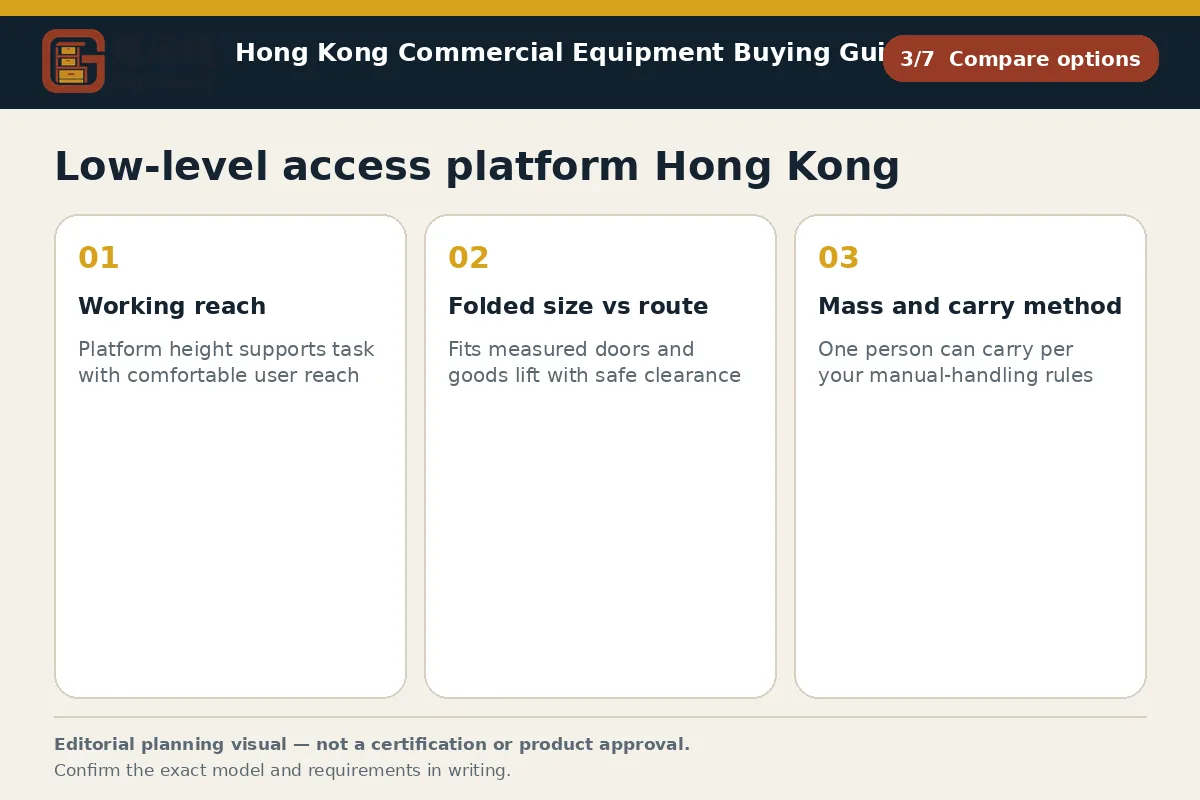
| Working reach | Platform height supports task with comfortable user reach | Guardrails/standing area required for two‑handed work and small lateral moves | Measured task point, user reach method, guardrail need, written model instructions |
| Folded size vs route | Fits measured doors and goods lift with safe clearance | Tight turns or obstacles require verified turning radius and protection | Door and lift measurements, turning spaces, route photos/sketch |
| Mass and carry method | One person can carry per your manual-handling rules | Team carry or trolley with staging areas and building approvals | Stated unit mass, handhold layout, handling plan in writing |
| Deployed footprint/stability | Stable on flat, dry indoor surfaces | Edge protection or floor protection needed in public/finished areas | Floor condition notes, need for bumpers/mats, venue approvals |
| Documentation/markings | Model-matched instructions and legible labels | Bilingual materials and site-specific method statements agreed | Instruction language, label check, management-office acknowledgment |
This framework helps buyers create comparable written enquiries. Final model specifications, availability, delivery and commercial terms must be confirmed in a formal quotation.
Low-level access platform Hong Kong: Portable low-level work platform checks
Plan how the unit will be moved through your building and between sites before you purchase. For portable low-level work-platform checks in Hong Kong, map the full route from storage to the farthest task point: loading bay, management-office sign-in, goods lift, corridors and door swings. Record clear widths and heights in millimetres, turning spaces at corners, and any no-go areas such as passenger lifts or escalators if your building policy restricts them. Note whether one person will carry the unit, or whether team lifting or a trolley is permitted under your manual-handling procedure.
Request the exact folded dimensions, unit mass, handhold locations and wheel or castor type in the written quotation, matching them to your route survey. In humid plantrooms or seafront venues, ask the supplier to confirm any corrosion-resistant finishes and maintenance advice appropriate to the chosen model. In mixed-use malls or schools, plan movement times to avoid peak traffic and agree access windows in writing with the property office. If crossing public areas, confirm that any protective bumpers, edge guards or floor protection mats are compatible with the platform’s feet. On receipt, check that weight markings and handling labels are legible and, where available, bilingual for local staff and contractors.
Dimensions and carrying details for Low-level access platform Hong Kong
Before committing to a model, list the dimensional envelope and handling details you need the supplier to confirm in writing. Capture folded length, width and height; deployed footprint; minimum turning radius when wheeled; and any protrusions such as stabilisers or guardrail clips. Specify the acceptable mass for single-person carry if that is your method, and indicate whether handholds must be centred or offset for stair access. If your route includes a goods lift, state the measured car dimensions and the depth required to rotate the unit safely.
For narrow retail back-of-house routes, confirm whether a configuration suitable for narrow spaces in Hong Kong is available and that its stability envelope still covers your task. Ask for details of wheel material, brake type, toe protection and edge radii where the unit may contact finished surfaces. On delivery, verify the dimensions against your enquiry, ensure handles and latches are secure, and confirm that instructions and labels match the exact model identifier. If transporting between sites, request guidance on tie-down points and packaging to prevent transit damage, and record who is authorised to move the unit.
Low-level access platform Hong Kong decision checklist
Define the task point, user stance and tool needs, then translate this into a required platform height and standing area. Survey the full route from storage to the work area and record clearances in millimetres, noting any restrictions from building management. Decide who will carry or wheel the unit and state the acceptable mass and handhold layout. Request folded dimensions, deployed footprint, wheel type, brake design, maximum working load and any guardrail options in the written quotation. Ask for handling labels and instructions matching the exact model. On delivery, re-measure, verify markings, and confirm that your risk assessment and site permissions align with the stated method. Where the route or venue changes, repeat measurements and reconfirm suitability in writing.
- Operating use, quantity and expected frequency
- Dimensions, capacity, material and accessory requirements
- Delivery address, floor, goods lift and loading window
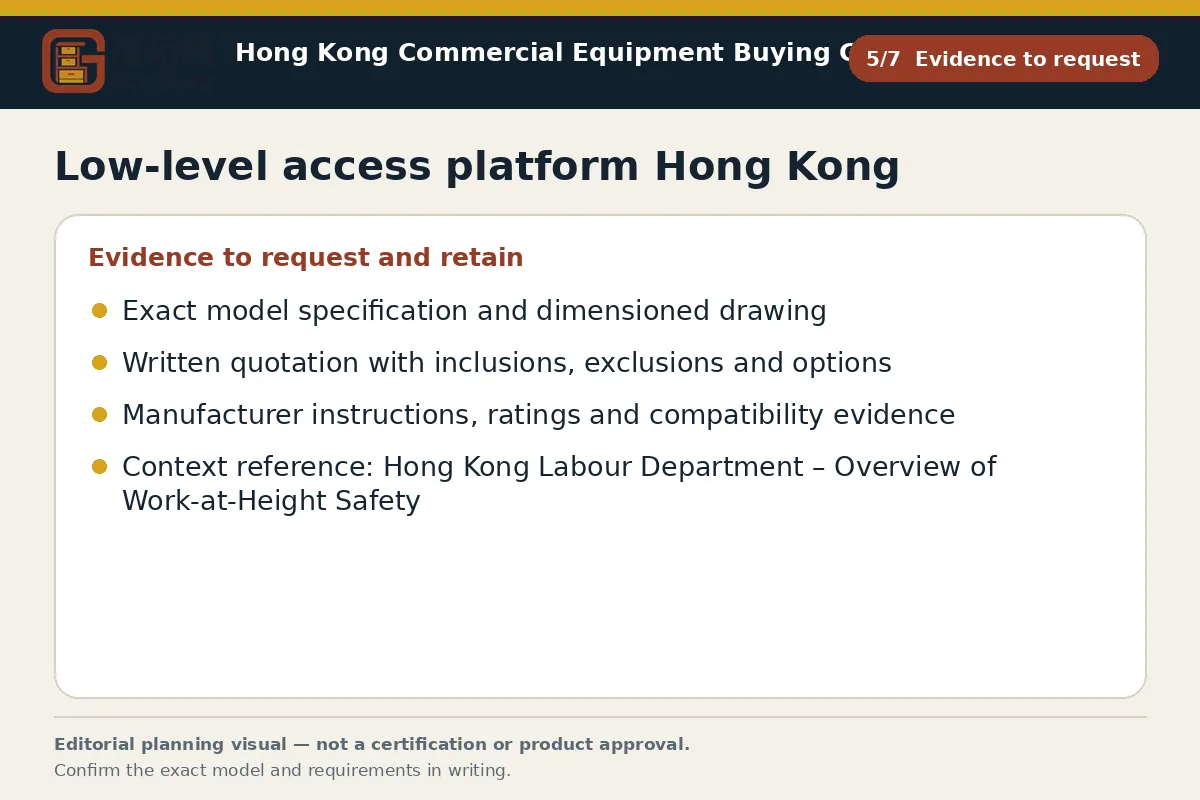
- Required documents, acceptance checks and after-sales arrangements
Key points for Low-level access platform Hong Kong, Portable low-level work platform Hong Kong, Work platform for work below 2 metres Hong Kong
Hong Kong sites often have tight goods lifts, narrow fire doors and complex back-of-house routes. Measure clear widths, lift cars and turning spaces carefully, and agree movement windows with the management office to avoid public peaks. Humidity and coastal exposure can affect finishes, so ask for appropriate care guidance for the chosen model. Where platforms cross public areas, confirm crowd-control and housekeeping provisions with the venue. Always verify your selection and method against the manufacturer’s instructions, site controls and any applicable Hong Kong requirements; this is practical guidance, not legal advice.
Questions about Low-level access platform Hong Kong
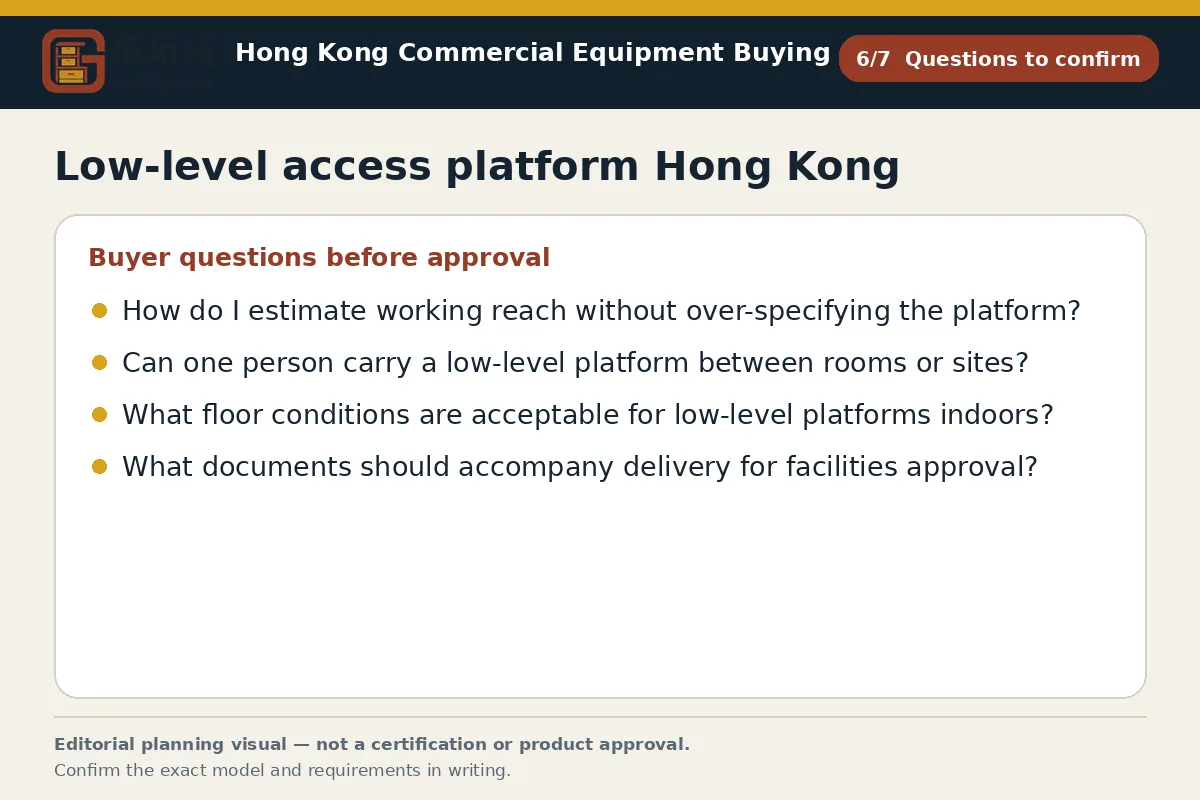
How do I estimate working reach without over-specifying the platform?
Start from the task point and the user’s comfortable reach, then select a platform height that allows a stable stance with both hands free. Treat any calculation method as an example starting point only and confirm it against the chosen model’s instructions, your supervisor’s method statement and local controls. Avoid relying on generic height labels without site validation.
Can one person carry a low-level platform between rooms or sites?
Yes, if the unit mass, handhold positions and your manual-handling procedure allow it, and the route is surveyed for safe clearance. Treat quoted masses as indicative until confirmed in writing for the exact model and accessories. Where the route includes stairs or long distances, consider team carries or a trolley if your risk assessment permits.
What floor conditions are acceptable for low-level platforms indoors?
Use flat, clean, dry, and sufficiently strong surfaces, subject to the model’s instructions and your site risk assessment. Avoid soft coverings, steep ramps, or areas with open grates unless the manufacturer states compatibility. If floors are delicate, request information on foot material and consider protection mats, approved by the venue or building manager before use.
What documents should accompany delivery for facilities approval?
Ask for the model-identified user instructions, maintenance guidance suitable for your environment, and product labels legible to local staff. If your venue or insurer requires, request training guidance, a parts list, and any statements the manufacturer provides for that model. For public-facing premises, confirm bilingual materials where practical and secure management-office acknowledgement before first use.
Continue with closely related procurement topics
These pages share equipment, operating or decision-stage signals with this guide.
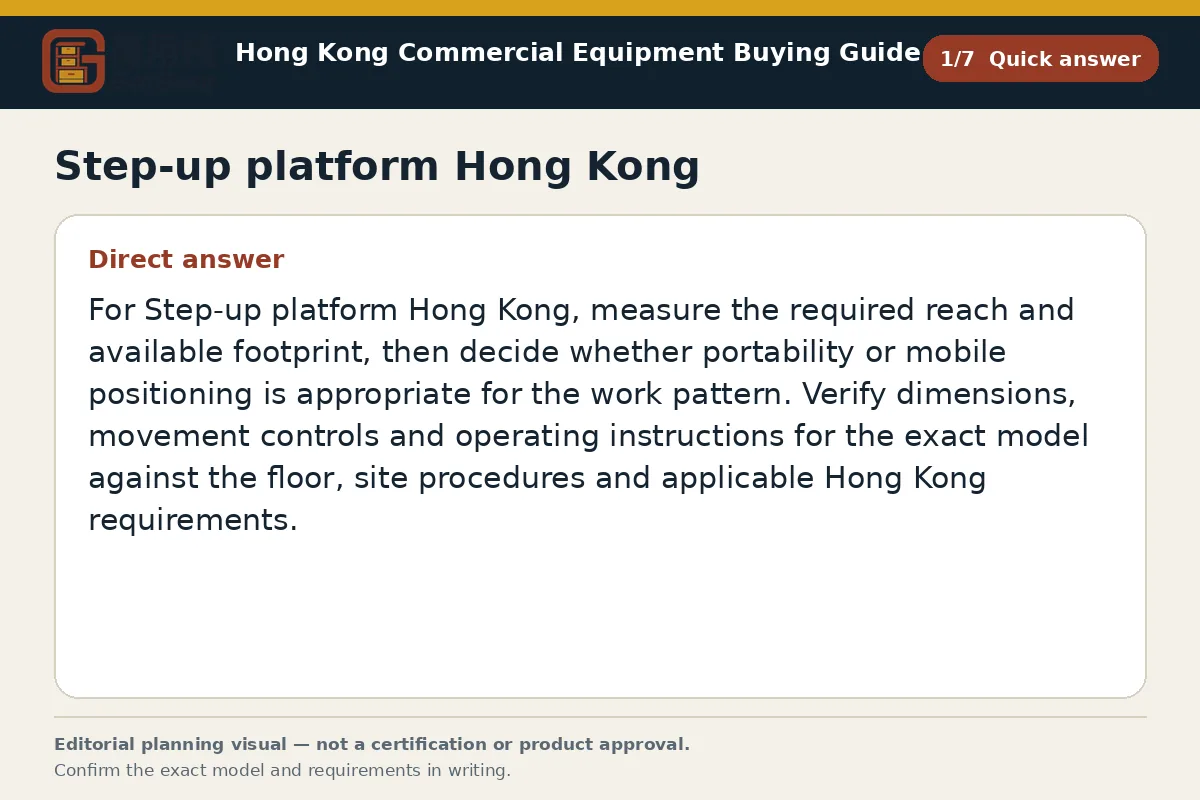
Step-up platform Hong Kong
Compare Step-up platform Hong Kong with Mobile two step stool Hong Kong for reach, standing area, movement and footprint. Review dimensions and controls and consult GotGear for full product details.
Read the guide
Fiberglass step platform Hong Kong
Compare height, standing area, footprint and access between a Fiberglass step platform Hong Kong and a Fiberglass hop-up platform Hong Kong. Choose the option that suits your task with GotGear in Hong Kong.
Read the guide
Aluminium work platform for narrow spaces Hong Kong
When considering an Aluminium work platform for narrow spaces Hong Kong, measure the access route and compare transport and deployed footprints, door and lift dimensions and operator clearance. Contact GotGear for assistance.
Read the guide
Industrial step platform Hong Kong
Use a practical checklist from GotGear to compare task, access height, standing area, movement and dimensions for Industrial step platform Hong Kong and Commercial step platform Hong Kong.
Read the guideRelated topic indexOpen more English procurement pages2 topics
Browse additional equipment families, applications and procurement questions relevant to a wider buying brief.