
For Work platform procurement specification Hong Kong, include the task and location, access and storage constraints, required platform geometry, load basis, configuration details and manufacturer documents to be returned. Compare quotations line by line and clarify all deviations, while separately verifying site conditions and applicable Hong Kong requirements.
Task and site brief for Work platform procurement specification Hong Kong
Begin with a concise task-and-site brief so every bidder quotes the same job. In the Work platform procurement specification Hong Kong, define what will be done at height (lamp changes, stock picking, AV rigging, as examples), who will use the platform, frequency of use and whether it’s for indoor, outdoor or mixed venues. State maximum working height as floor to task, any reach needed, minimum platform area, guardrail preference and entry method. Describe typical tools and materials so the load basis is clear, and list any no-go zones near sprinklers, signage or public areas.
Survey the access route from unloading to storage and work areas. Record goods-lift car size, door width/height and weight limits, corridor widths, turning spaces and thresholds; note constrictions with measurements and photos. As an example starting point, record clear door width (e.g. 820 mm) and lift depth (e.g. 1,400 mm), then have bidders confirm suitability in writing. Include floor type/rating if known, ramps/gradients, management-office loading windows, storage dimensions, power for charging, humidity/saline risks, bilingual notices and supervision arrangements for schools or public events.
Compare offers with Work platform quotation checklist Hong Kong and Work platform procurement specification Hong Kong
Use a structured comparison so quotes are directly comparable. A practical method is to mirror your brief in a line-by-line schedule; many buyers refer to a Work platform quotation checklist Hong Kong to keep fields consistent across bidders. Check model type, working height, platform size, safe working load and permitted persons, plus stabilisers/outriggers, guardrail design and wheel type. Compare stowed dimensions, weight and turning footprint against the measured route; note any deviation or condition that a bidder adds and query it before shortlist.
Expand comparison to service and documents: language of manuals, parts lists, warranty statement, proposed familiarisation, and whether on-site assembly is included. Confirm delivery arrangements that fit Hong Kong buildings, such as pallet size, lift use and booking with property management. Record exclusions in the same schedule so none are overlooked. When values conflict between a catalogue and an email, treat the model specifications and formal written quotation as prevailing, then resolve variances before approval. Keep a risks/actions column to make the decision auditable.
What should buyers compare for Work platform procurement specification Hong Kong?
| Criterion | Straightforward requirement | More complex requirement | Evidence to provide |
|---|---|---|---|
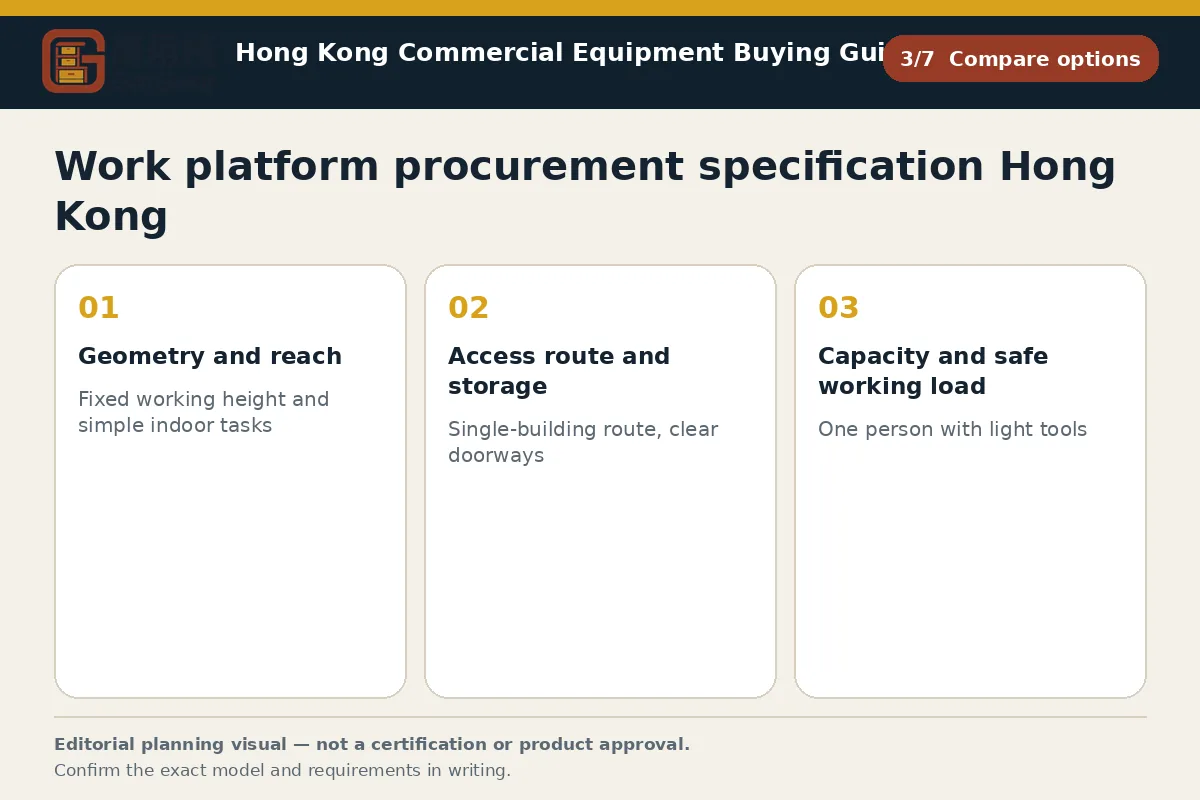
| Geometry and reach | Fixed working height and simple indoor tasks | Variable height, outreach/overhead obstructions | Dimensioned drawing with working height, platform area, guardrail height |
| Access route and storage | Single-building route, clear doorways | Multi-site, tight lifts, booking windows | Measured widths/heights, lift car size/limits, turning radii, storage space photos |
| Capacity and safe working load | One person with light tools | Two persons/materials and point loads | Required S.W.L., persons, typical load case and any point‑load notes |
| Environment and floor | Dry indoor, flat slab | Humid/chemical cleaning, outdoor wind, uneven floors | Floor rating, gradient, wind exposure notes, chemical contact |
| Documents and services | Manuals and warranty statement | Bilingual manuals, on‑site familiarisation, RAMS if required | Document list, language, named contact and date for any site works |
This framework helps buyers create comparable written enquiries. Final model specifications, availability, delivery and commercial terms must be confirmed in a formal quotation.
Configuration and capacity fields in Work platform procurement specification Hong Kong
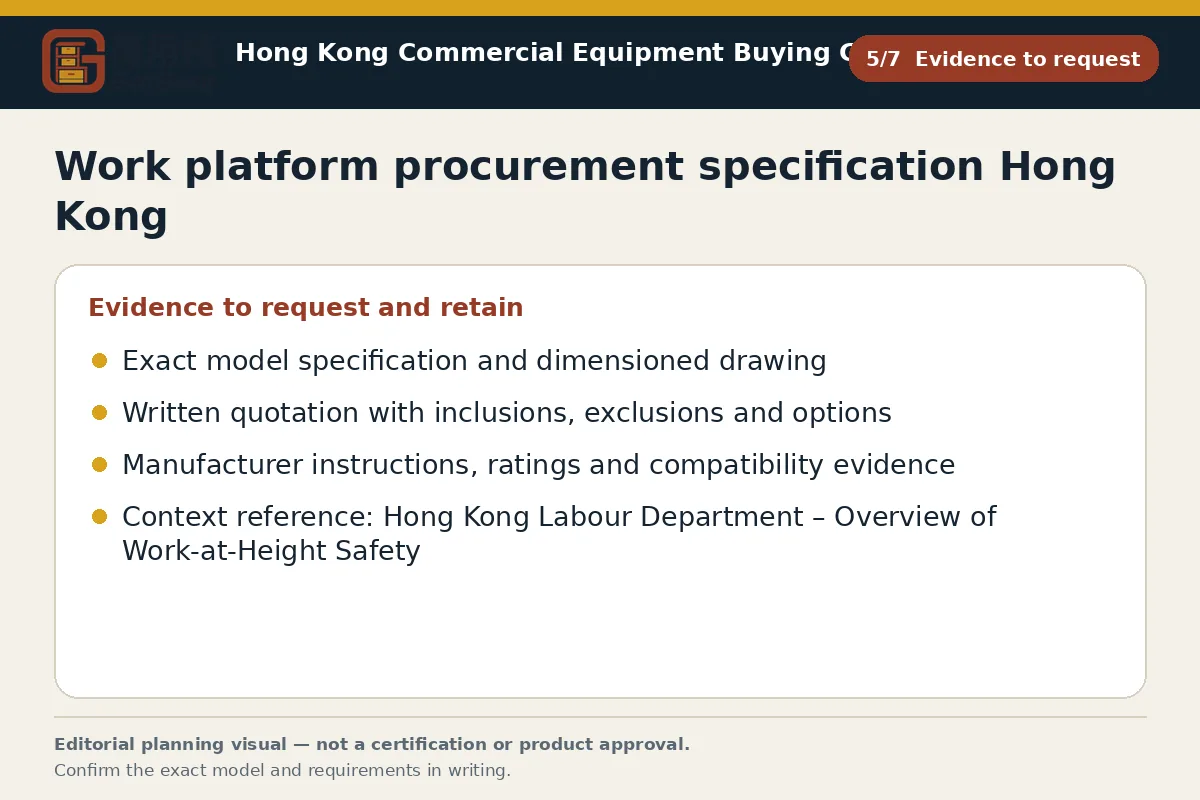
Set out configuration and capacity fields the bidder must complete so selection focuses on suitability. Request product type (podium step, folding platform, mobile tower or push‑around vertical, as examples to be confirmed), intended environment, and platform geometry: clear platform length and width, guardrail height, toeboard provision and entry method. Ask for maximum working height and minimum stowed height, base footprint, any outrigger span and levelling range, and the turning radius or aisle requirement.
Define capacity precisely: safe working load in kilograms, permitted persons, typical load case (e.g. one person plus 10 kg of tools as an example starting point), and any point‑load limits. Capture floor interface and movement details: wheel material (non‑marking if required), brake type, allowable gradient, and maximum floor gap/step. For powered variants, request power source, battery chemistry, charger input and plug type available on site, stated noise level and expected run time (example only). Include durability, labelling languages and serial‑number location. Reference the Work platform procurement specification Hong Kong in the form header so every page of the response is traceable.
Clarify documents and assumptions in Work platform procurement specification Hong Kong
Close the enquiry by itemising documents to return and the commercial/technical assumptions bidders have made. Ask for a current manufacturer datasheet, a dimensioned general‑arrangement drawing, an operating manual in English and Traditional Chinese, a statement of safe working load as marked on the product label, and a basic maintenance schedule. If the venue, insurer or building manager requires them, request a risk assessment/method statement or competency information for any on‑site assembly or familiarisation; do not assume they are universally mandatory.
List assumptions and exclusions explicitly: floor flatness and rating, lift access, booking of loading bays, permitted delivery windows, electrical power for charging, barriers for public areas, waste removal and storage conditions. Require bidders to flag all deviations from your brief in a numbered schedule linked to the quotation.
On receipt, inspect serial number, labelling language, platform geometry, guardrail function, stabilisers and wheel locks against the quotation. Test in a safe area and verify stowed dimensions against the measured route (example: prove lift entry). Record discrepancies promptly for resolution. Where a document and the sample differ, the model specifications and formal written quotation should prevail pending written clarification.
Work platform procurement specification Hong Kong decision checklist
Define the task, users and maximum working height, then measure the full route from unloading to storage and the job location. Write the brief with platform geometry, load basis, environment, power and access constraints. Issue it with a response schedule and request drawings, manuals and a list of assumptions. Compare quotations line by line, challenge deviations and confirm unclear values in writing; treat the formal quotation and model datasheet as controlling. Verify building‑manager rules on lift use, delivery windows and floor ratings before approval. Place the order only when route, capacity and documentation are agreed. On receipt, check labels, serial, dimensions, guardrails, stabilisers, wheels and chargers, run a safe function test, and file documents for institutional sign‑off.
- Operating use, quantity and expected frequency
- Dimensions, capacity, material and accessory requirements
- Delivery address, floor, goods lift and loading window
- Required documents, acceptance checks and after-sales arrangements
Key points for Work platform procurement specification Hong Kong, Work platform quotation checklist Hong Kong
Working at height in Hong Kong often means tight lift cars, narrow service corridors and strict coordination with property management. Many sites limit delivery hours, require advance notices and restrict loading bays, so RFQs and lead times must match those windows. Buildings vary in floor rating; confirm with the manager before allowing heavier equipment. Humid coastal conditions and strong cleaning chemicals can affect finishes and wheels, especially in hospitality and plantrooms. Outdoor work on podiums or event spaces can be windy and crowded; venues may require crowd control and surface protection. Bilingual safety markings and manuals are commonly expected for mixed workforces.
Questions about Work platform procurement specification Hong Kong
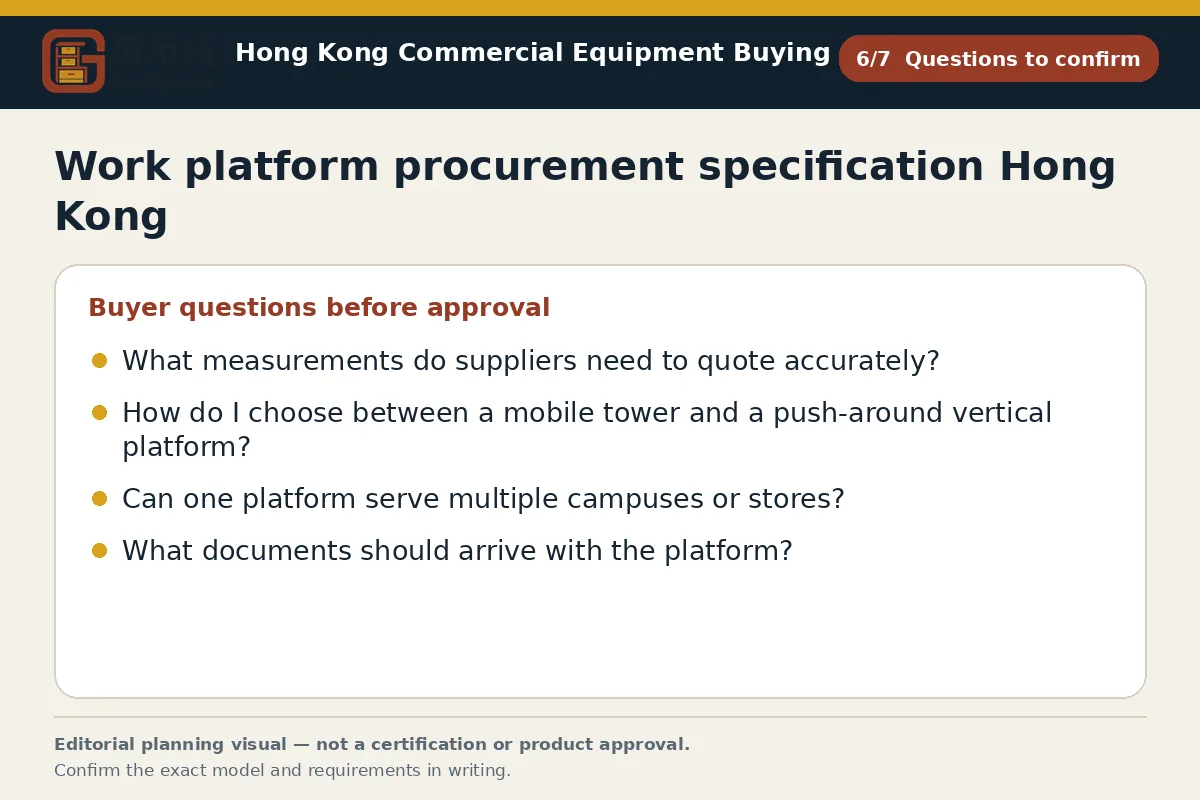
What measurements do suppliers need to quote accurately?
Measure maximum working height (floor to task), minimum platform area needed, and clearance above and around the work zone. Survey the route: lift car size and limits, door widths/heights, corridor widths, turns and thresholds. Note floor type/rating, gradients, storage space and charging power. Photos with labelled dimensions help. Example values must be confirmed by the bidder.
How do I choose between a mobile tower and a push‑around vertical platform?
Decide by task frequency, reach, route constraints and who will assemble or move it. Mobile towers suit varied layouts and low‑tech maintenance; push‑around verticals offer compact stowed size and fast elevation. Check access widths, floor rating and permitted persons on platform. Ask bidders to confirm weight, stowed dimensions and any stabiliser requirements for your site.
Can one platform serve multiple campuses or stores?
Yes, if the stowed dimensions, weight and safe working load suit every building on the route. Confirm lift limits, door sizes and floor ratings for each campus or store, and plan secure storage and charging. Some venues require booking and supervision; align your procedures. Keep a single, traceable log of documents, inspections and user familiarisation for each location.
What documents should arrive with the platform?
Expect a manufacturer datasheet, operating manual and labelling that match the quoted model, plus a statement of safe working load. If agreed, include a drawing, basic maintenance schedule and a familiarisation record. Where the venue or insurer requests it, add a risk assessment/method statement. Always treat the formal quotation as the controlling reference.
Continue with closely related procurement topics
These pages share equipment, operating or decision-stage signals with this guide.
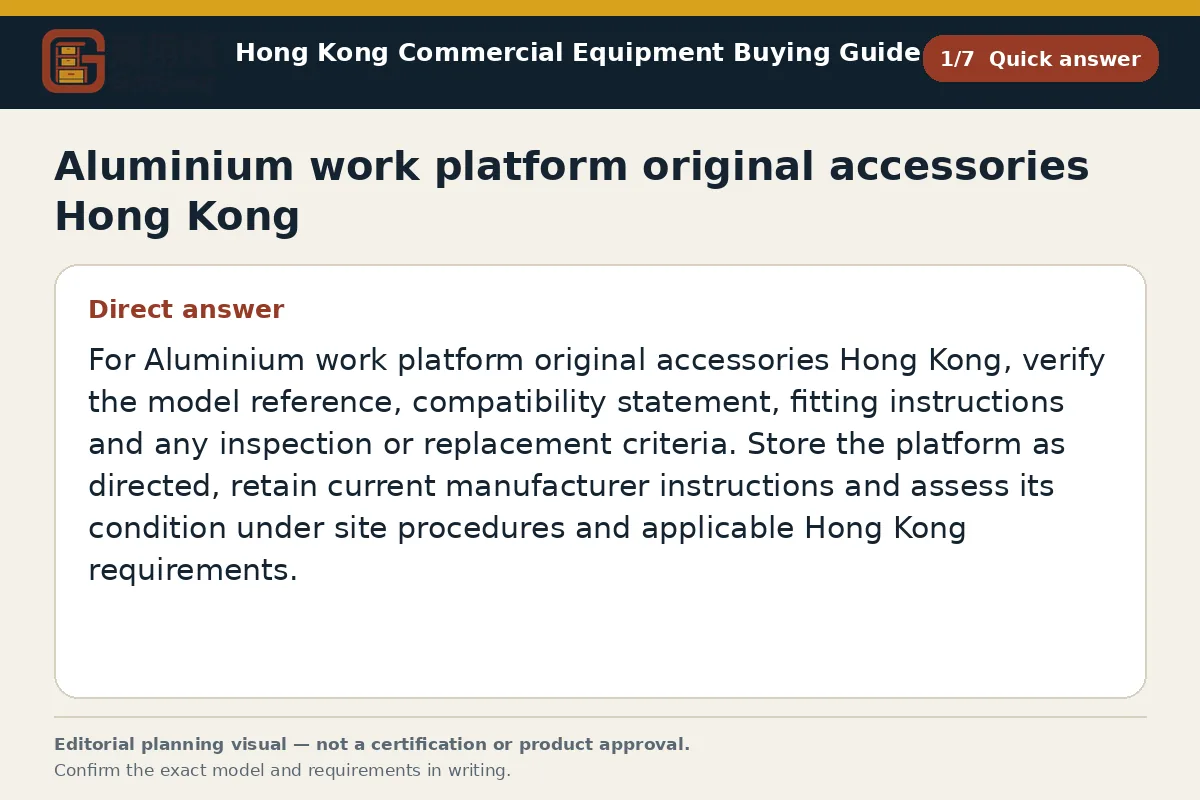
Aluminium work platform original accessories Hong Kong
Check Aluminium work platform original accessories Hong Kong for compatibility and correct fit. Follow Working platform manufacturer instructions Hong Kong and plan Working platform storage and maintenance Hong Kong with GotGear.
Read the guide
Working platform guardrail requirements Hong Kong
GotGear explains Working platform guardrail requirements Hong Kong, covering exposed edges and falling-object risk. It outlines Working platform toe board requirements Hong Kong and Working platform access handrail Hong Kong.
Read the guide
Working platform risk assessment Hong Kong
Working platform risk assessment Hong Kong provides a checklist to define the task, location, users and access, to assess loads and site conditions, and to check manufacturer guidance and site duties. It is published by GotGear.
Read the guide
Platform ladder with self-closing gate Hong Kong
Platform ladder with self-closing gate Hong Kong: GotGear reviews gate return and latch. Platform ladder with back castors Hong Kong and Platform ladder with tool holder Hong Kong: Assess task, floor and route.
Read the guideRelated topic indexOpen more English procurement pages2 topics
Browse additional equipment families, applications and procurement questions relevant to a wider buying brief.