
For Step-up platform Hong Kong, measure the required reach and available footprint, then decide whether portability or mobile positioning is appropriate for the work pattern. Verify dimensions, movement controls and operating instructions for the exact model against the floor, site procedures and applicable Hong Kong requirements.
Match Step-up platform Hong Kong to reach and working position
Choosing a Step-up platform Hong Kong begins with the task, not the catalogue. Measure the floor-to-hand working point for the task, then confirm the vertical gain needed once normal body reach is considered; as an example starting point, many picking or maintenance tasks need an extra 300–600 mm—confirm the exact figure in your written brief. Note whether the user must work face-on, side-on or overhead, and whether tools, scanners or small cartons must be handled. Record the maximum horizontal reach you will permit without overbalancing and the expected dwell time per job.
Translate these observations into specification fields. Ask suppliers to quote the platform height (top standing surface), top-surface dimensions, base footprint, movement method (carry, tilt-and-wheel, castors), tread/anti-slip type, and rated capacity (example starting point only—confirm what your site requires). Identify any environmental constraints such as wet floors, condensation at dock doors, or corrosive cleaners, and whether non-marking feet are needed for retail or school floors. Where work is near live equipment or conductors, confirm with a competent person whether a non-conductive build is appropriate before you request a fibreglass option. Finally, check headroom beneath signage, sprinklers or beams at the proposed work point so the platform height selected can be used without contact, and ensure the model’s instructions can be supplied in both English and Chinese if your institution requires it.
Footprint, storage and standing area for Step-up platform Hong Kong
Footprint and storage determine how practical the unit will be across Hong Kong sites. Map the narrowest doorway, corridor pinch-point and goods-lift door and cabin dimensions on the route from delivery to storage and to the work location. Measure and record storage space, including shelf depth if wall-hung storage is proposed. Note any floor thresholds or slopes on access paths. As an example starting point, confirm whether an operative can safely carry the folded unit unaided—site rules and the model specification must prevail.
In your enquiry, request overall in-use footprint, folded dimensions, weight, top standing area and base frame outline. Ask the manufacturer to specify the mobility system (fixed feet, wheels with brakes, or spring-loaded castors that retract under load), the anti-slip surface material, and the frame and fastener materials and finishes where humidity or cleaning chemicals are present. If the platform will live in a back office or stockroom, non-marking contact points and quiet-rolling wheels can be decisive; if it is shared between departments, ask for a clear asset label space and durable serial marking. For connectable or modular hop-up styles, request drawings showing how units link and any restrictions on side-loading during use so your procedures and floor layouts can be validated by your safety lead before ordering.
What should buyers compare for Step-up platform Hong Kong?
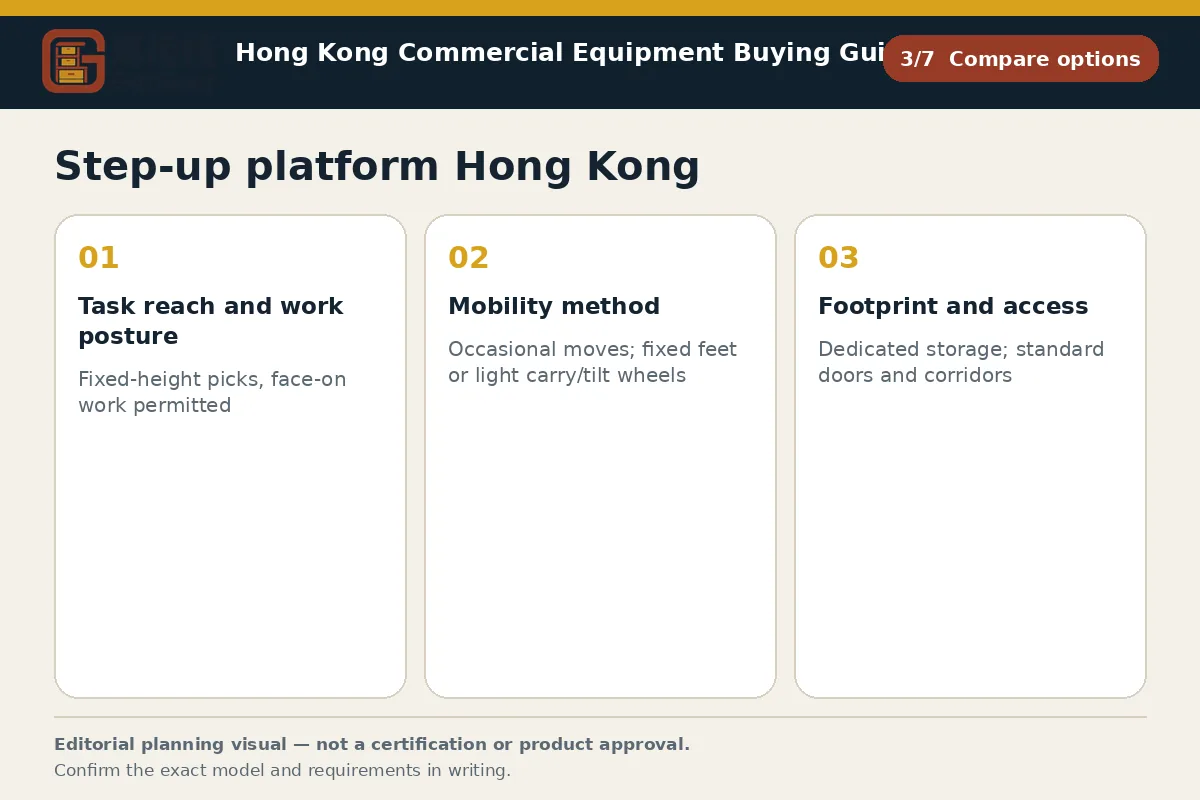
| Criterion | Straightforward requirement | More complex requirement | Evidence to provide |
|---|---|---|---|
| Task reach and work posture | Fixed-height picks, face-on work permitted | Varied bays with lateral reaches or overhead tasks | Measured floor-to-task heights and allowed horizontal reach, with sketches/photos |
| Mobility method | Occasional moves; fixed feet or light carry/tilt wheels | Frequent micro-repositions; brakes or spring-castors that lock under load | Stated moves per hour (example), floor types, slopes/thresholds, public-area crossings |
| Footprint and access | Dedicated storage; standard doors and corridors | Tight goods-lift and corridor pinch-points on multi-floor routes | Door and lift dimensions, turning spaces, storage size, route notes with constraints |
| Standing surface and stability | Compact top for light picking within reach envelope | Larger/deeper top for tools or longer dwell; defined no‑side‑load policy | Top-surface size and anti-slip material; side-load limits from instructions |
| Documentation and approvals | English manual acceptable on closed site | Bilingual manuals, venue sign-off, event or school procedures apply | Required languages, any permits/induction, insurer/authority conditions to meet |
This framework helps buyers create comparable written enquiries. Final model specifications, availability, delivery and commercial terms must be confirmed in a formal quotation.
Movement differences between Step-up platform Hong Kong and Mobile two step stool Hong Kong
Movement pattern is the key difference between a stable step platform and a quick-shift stool. If your operative must work with both hands in a fixed spot for longer tasks—such as scanning, labelling or light tool work—a platform with a larger top surface and positive brakes is usually easier to position precisely and stand on for longer periods. Where aisles are tight, pre-plan turning points and confirm the width available to swing or tilt-roll the unit without obstructing fire egress or shoppers.
By contrast, a Mobile two step stool Hong Kong excels at frequent, short micro-repositions for light picking. Many stools use spring-loaded castors that retract under body weight, letting the user roll the unit by foot between bays and lock it under load; confirm this mechanism and floor compatibility in writing. Stools generally have a smaller top surface and are better for quick, low-risk reaches; they are not a substitute for a wider, deeper working platform when tools, sideways reaches or prolonged tasks are involved. When requesting quotations, state your floor types, any slopes or thresholds, whether public areas will be crossed, and your expected move frequency (for example, moves per hour as a starting estimate). Ask suppliers to detail wheel diameter, tread compound, brake type, and whether bumpers or skirts are fitted to protect fixtures in retail or museum settings.
Positioning and use instructions for Step-up platform Hong Kong
Before first use on site, review the model’s operating instructions and verify they align with your venue procedures. Position the platform on a firm, level surface clear of cables, packaging and spill hazards. Apply wheel brakes or ensure spring-castor retraction is working before stepping up. Face the task, climb while maintaining three points of contact, and step fully onto the top surface. Reposition rather than leaning if the task shifts laterally; do not side-load against shelving edges unless the instructions explicitly allow it and your assessment confirms it.
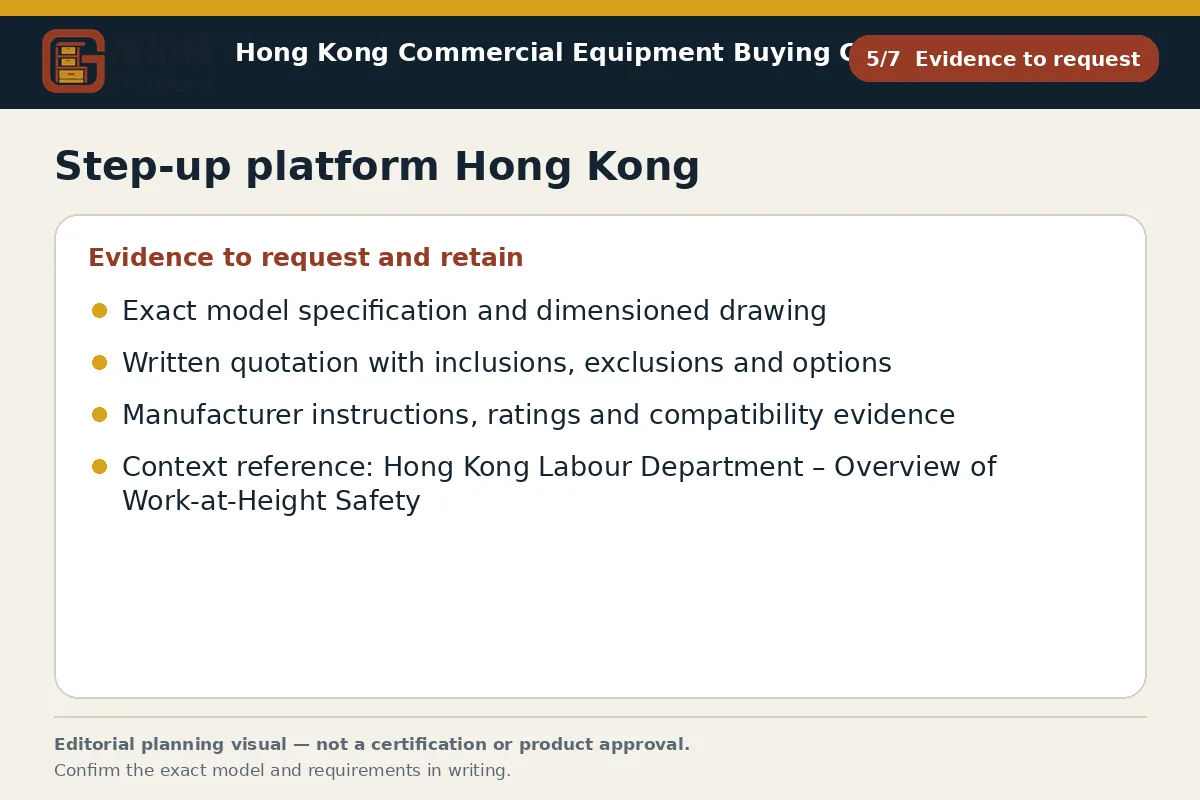
In busy corridors or public zones, place temporary cones or cordon tape if your venue requires it, and coordinate timing with the management office to avoid conflict with cleaners or events. In humid or recently mopped areas, wipe the treads and confirm the anti-slip is effective before use. Request from the manufacturer the latest user manual, maintenance guidance, parts list and any statement of conformity they provide, preferably in English and Chinese if your stakeholders need bilingual documentation. Keep purchase specs, the formal quotation and the instruction set together with a photo of the unit in situ so future checks of footprint, brakes, labels and condition can be evidenced against the agreed model details.
Step-up platform Hong Kong decision checklist
Start by measuring floor-to-task height and allowed horizontal reach, then decide the vertical gain and top-surface size you will permit. Record the narrowest doorway, route pinch-points and goods-lift dimensions, plus the intended storage space. State movement frequency and floor types so suppliers can propose fixed feet, brakes or spring-castor options. In your enquiry, request platform height, top and base dimensions, folded size, weight, anti-slip type, mobility system, rated capacity, materials/finishes and documentation language. Ask for drawings and operating instructions and confirm they match your venue procedures. Compare written quotations line by line against the same fields, noting delivery method to floor, packaging removal and warranty terms where offered. On receipt, inspect labels, serial mark, dimensions, brakes, fasteners, stability and surface condition, and file manuals. Use this guide to compare specifications and prepare a clear written enquiry for this decision.
- Operating use, quantity and expected frequency
- Dimensions, capacity, material and accessory requirements
- Delivery address, floor, goods lift and loading window
- Required documents, acceptance checks and after-sales arrangements
Key points for Step-up platform Hong Kong, Mobile two step stool Hong Kong
Hong Kong buildings often impose tight access and scheduling constraints. Confirm goods-lift door width, cabin depth and headroom, and book loading or delivery windows with the management office where required. Many institutional buyers expect bilingual manuals and labels; request English and Chinese documentation early. Humid conditions at docks, on terraces or near kitchens can affect materials and anti-slip performance, so specify corrosion resistance and tread type accordingly. If the unit is used in public areas, clarify any venue controls on cordons or movement during trading hours. This is a practical summary, not legal advice—your model specification and written procedures prevail.
Questions about Step-up platform Hong Kong
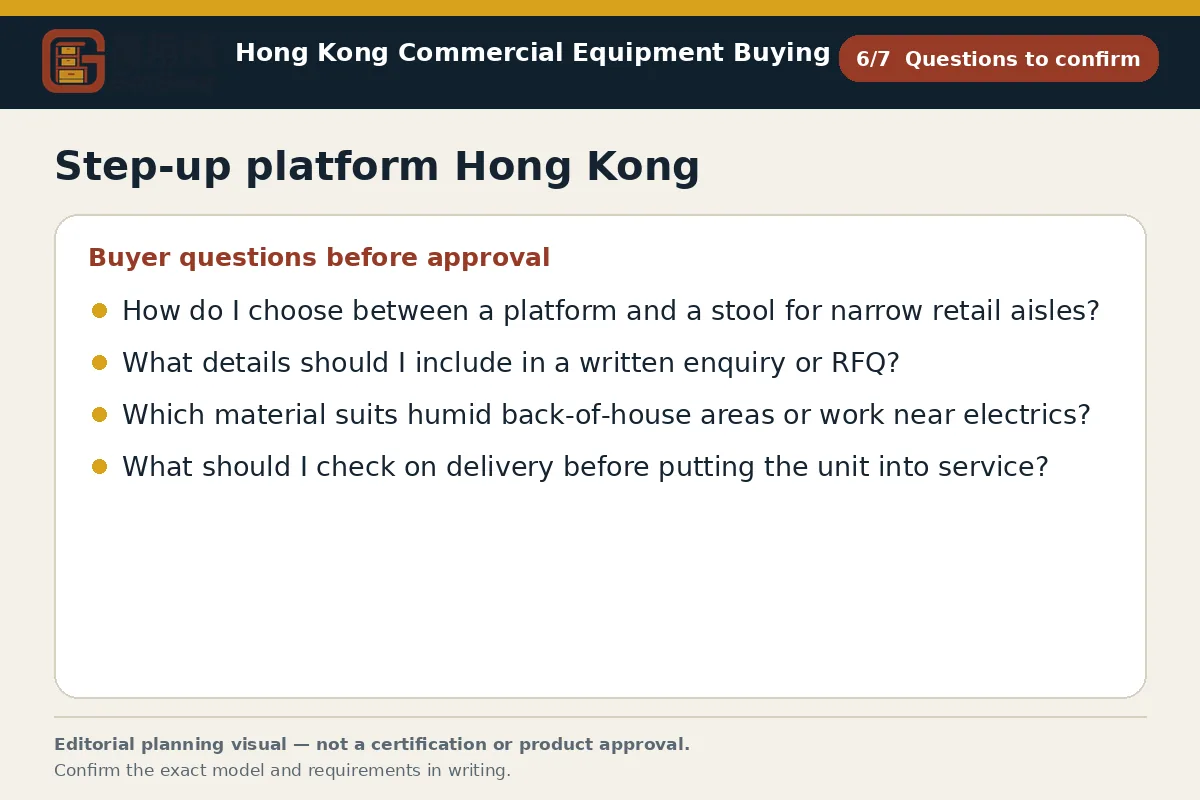
How do I choose between a platform and a stool for narrow retail aisles?
Pick by movement pattern and task duration. For frequent, short picks, a mobile stool’s small footprint can slip between fixtures. For longer, two‑handed work or where sideways stability matters, a platform with a larger standing area and brakes is safer to position. Confirm aisle widths, floor types and public‑area rules first so the model and your procedures match venue constraints.
What details should I include in a written enquiry or RFQ?
Provide measured floor‑to‑task height, maximum allowed horizontal reach, in‑use footprint limit, folded dimensions and storage space. Add movement frequency, floor types, slopes or thresholds, and any public‑area use. Request the platform height, top size, base footprint, weight, mobility system, anti‑slip type, rated capacity, materials/finishes and documentation language. Drawings and the manufacturer’s operating instructions should be supplied and will govern.
Which material suits humid back‑of‑house areas or work near electrics?
Aluminium with corrosion‑resistant fasteners works well in many humid stores, but confirm cleaner exposure and drainage. Where electrical isolation is required by your site, insurer or authority, a fibreglass build may be appropriate—seek a competent person’s advice before specifying it. The model specification and written quotation prevail over examples; request materials and finishes in writing for review.
What should I check on delivery before putting the unit into service?
Verify model and dimensions against the quotation and drawings, and inspect welds/fasteners, anti‑slip surfaces, brakes or castors, bumpers and labels. Check stability on your actual floor and confirm the instructions match your procedures and language needs. Record the serial, photograph the unit in storage and at a typical work point, and file manuals and parts lists. Seek manufacturer guidance on care and inspection frequency if required.
Continue with closely related procurement topics
These pages share equipment, operating or decision-stage signals with this guide.
Fiberglass step platform Hong Kong
Compare height, standing area, footprint and access between a Fiberglass step platform Hong Kong and a Fiberglass hop-up platform Hong Kong. Choose the option that suits your task with GotGear in Hong Kong.
Read the guide
Low-level access platform Hong Kong
On GotGear, explore Low-level access platform Hong Kong. Compare Portable low-level work platform Hong Kong and Work platform for work below 2 metres Hong Kong.
Read the guide
Industrial step platform Hong Kong
Use a practical checklist from GotGear to compare task, access height, standing area, movement and dimensions for Industrial step platform Hong Kong and Commercial step platform Hong Kong.
Read the guide
Mobile working platform on slopes Hong Kong
Note gradient and surface before using Mobile working platform on slopes Hong Kong and review limits for Mobile working platform on uneven ground Hong Kong. Check Working platform suitable ground conditions Hong Kong with GotGear.
Read the guideRelated topic indexOpen more English procurement pages2 topics
Browse additional equipment families, applications and procurement questions relevant to a wider buying brief.