
For Connectable hop-up platform Hong Kong, send the intended layout to the manufacturer or supplier and request a compatible-component list, connection method, configuration limits and set-up instructions. Do not assume units can be joined; verify the documented arrangement against the site, risk assessment and applicable Hong Kong requirements.
Draw the intended layout for Connectable hop-up platform Hong Kong
Start by sketching a scale plan of the task area and the travel route from loading bay to set-up point. Mark working length, target working heights, access points for operatives and materials, and all direction changes. Note aisle widths, turning circles, pillar positions, fire equipment, drains, thresholds and floor expansion joints. Record floor gradients and any soft finishes. Indicate where guardrails, access gates, toe boards and stabilisers will be required. Include photos with a ruler for context, and label each drawing revision clearly so it aligns with written quotations and later site approval.
Add delivery and movement constraints typical in Hong Kong: goods-lift car size, clear door heights, lift booking windows, and door swing directions on office floors. Highlight staging space and waste-handling routes for packaging. If the platform must pass through a management office or public zone, map cordon points and bilingual safety signage locations. State the expected frequency and duration of use, whether cleaning chemicals or humid air may be present, and if the arrangement is static or repositioned daily. If gradients are involved, capture them on the plan and cross-reference the intended approach with any guidance you already use for Mobile working platform on slopes Hong Kong. This plan will let suppliers validate the proposed arrangement for a Connectable hop-up platform Hong Kong.
Connection details to request for Connectable hop-up platform Hong Kong
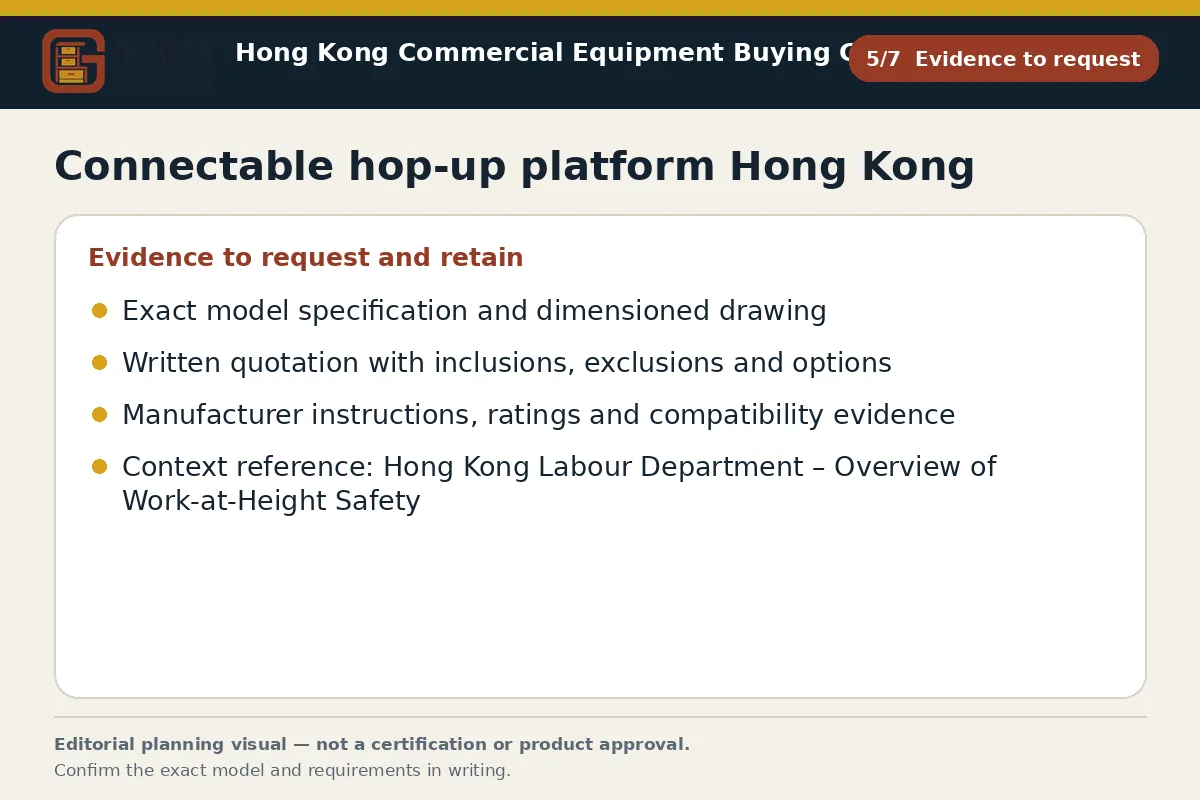
Ask for written, model-specific connection information that matches your drawing. Request exploded connection diagrams showing how platforms, junctions and bridges join, with part numbers, permitted angles, and height transition methods. Specify you need details of anti-lift, anti-spread and anti-slip features, plus how guardrails, midrails, toe boards and gates remain continuous across joins. Where castors are proposed, request the brake engagement sequence and any anti-creep measures when connected units are loaded or side-loaded.
Require the exact connector list with part codes, quantities and revision letters, as well as the tools and torque values (example starting point: a handheld spanner used to the supplier-confirmed torque value) and any consumables. Ask for deck-to-deck maximum gap and level-difference tolerances, how out-of-square walls are accommodated, and whether bridging plates need independent support. For Hong Kong moves, request packaged dimensions and weights per module to verify goods-lift and doorway compatibility, plus recommended team sizes for manual handling according to your competent person’s assessment. Finally, ask for bilingual setup instructions, maintenance notes for humid conditions, corrosion-resistance guidance for coastal districts, and a spares list linked to the part-numbering scheme for reordering.
What should buyers compare for Connectable hop-up platform Hong Kong?
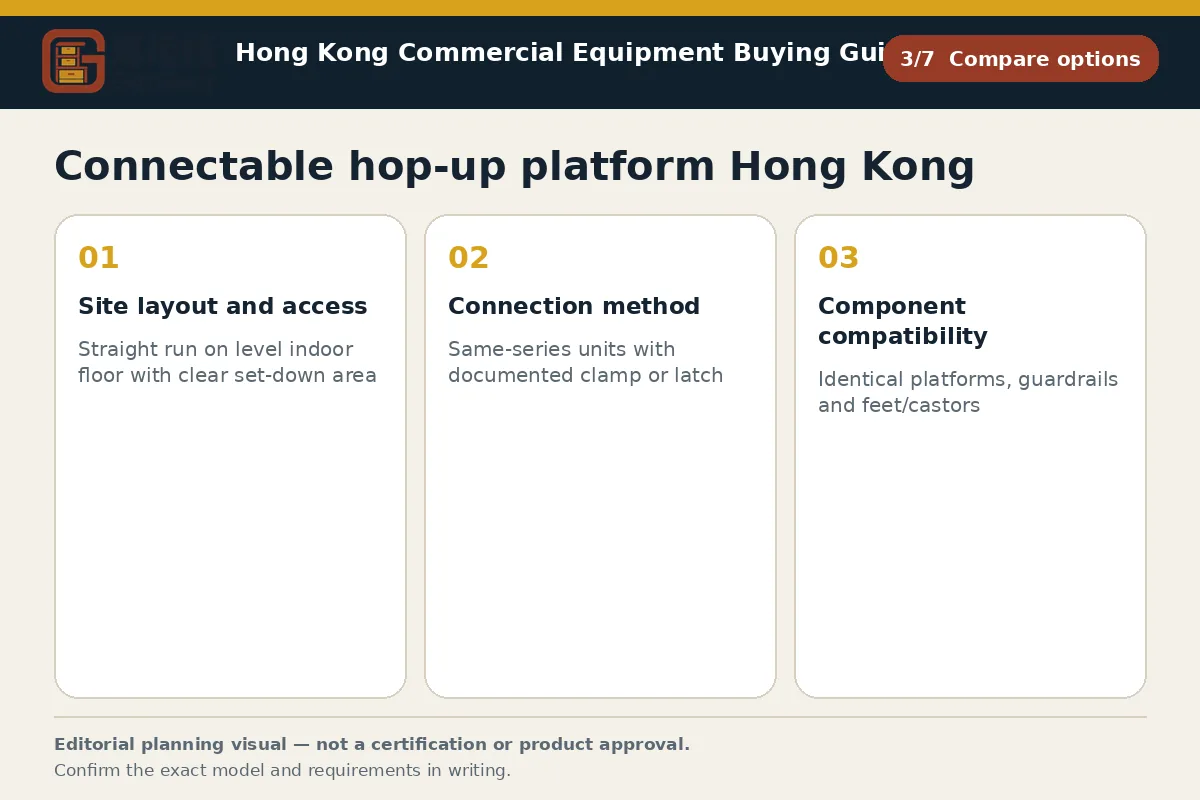
| Criterion | Straightforward requirement | More complex requirement | Evidence to provide |
|---|---|---|---|
| Site layout and access | Straight run on level indoor floor with clear set-down area | Mixed directions, narrow corridors, goods-lift moves and staged assembly | Scale plan with dimensions, lift/door sizes, photos and delivery route |
| Connection method | Same-series units with documented clamp or latch | Angle junctions, bridges, height transitions or anti-lift requirements | Connection drawings, part numbers, torque/tool guidance |
| Component compatibility | Identical platforms, guardrails and feet/castors | Mixed widths, materials or revisions with stated exclusions | Compatibility list with revision letters and supplier confirmation |
| Configuration limits | Short, simple arrangement within basic run length | L/T/U turns, spans, slopes and side-load considerations | Model-specific limits, setup sequence and max joined units |
| Delivery and handling (HK) | Ground-floor access and wide doorways | Goods-lift restriction, booking windows, office-floor moves | Packaged dimensions/weights, booking times, route map |
This framework helps buyers create comparable written enquiries. Final model specifications, availability, delivery and commercial terms must be confirmed in a formal quotation.
Check component compatibility for Connectable hop-up platform Hong Kong
Check that every proposed platform, connector and accessory forms a documented, compatible set. Confirm that the series or family name, width class, deck thickness, leg profile, fastener type and guardrail interface are identical across all units in the quotation. Where a mix is unavoidable, obtain a manufacturer-issued compatibility matrix and written exclusions. Pay particular attention to castor stem sizes and levelling-foot threads, because mismatches can prevent secure joining. If aluminium and fibreglass components are mixed, ask the supplier to address corrosion and joint integrity, and consider whether a fibreglass step platform intended for use in Hong Kong should be kept as a stand-alone line.
Compare written quotations line by line: part codes, revision letters, finish (anodised, powder-coat or fibreglass gelcoat), anti-slip surface type, and any outriggers or bridging plates. Require that substitutes are clearly marked and justified. For accessories, favour documented pairings, such as original accessories for aluminium work platforms used in Hong Kong, to avoid ad-hoc clamps. If the work is truly low height or single-bay, a low-level access platform intended for use in Hong Kong may be more suitable and easier to assess through the buyer’s internal approval process. On receipt, inspect labels against the compatibility list, test-fit a representative junction in a clear area, and photograph the assembled connection before full deployment.
Configuration limits and instructions for Connectable hop-up platform Hong Kong
Obtain written configuration limits tied to the exact models quoted. Ask for maximum number of connected units in a straight run, permitted L, T or U turns, allowable height differences between adjacent decks, and any requirement for intermediate supports. Clarify floor-condition limits: example starting point might be a small gradient allowance that must be confirmed in writing, plus instructions for levelling feet, wheel brakes, or anti-tip devices. Request any side-load precautions for tasks such as lateral pulling or tool tethering that could shift the centre of gravity.
Ask for a step-by-step setup and pre-use check, including who fits the first connection, bracing sequence, brake engagement order, and how to verify guardrail continuity with no unprotected edge. Require instructions covering wet floors and humid conditions, including cleaning of anti-slip treads before handover each shift. For public or event venues, seek venue-management approval steps and crowd-control guidance for exclusion zones. Where institutional approval is needed, attach the supplier’s latest instructions and your site risk assessment to the submission. Finally, agree a simple daily log for configuration used, defects found and parts replaced, so any limit exceedance is quickly traced and rectified.
Connectable hop-up platform Hong Kong decision checklist
Before issuing a purchase order, confirm the scale drawing matches current site conditions and shows every connection, turn and access point. Attach photos, lift and doorway measurements, and any gradients. Request a written connection diagram, full component list with part numbers and revision letters, and a compatibility matrix for any mixed items. Ask for configuration limits that reflect your layout, bilingual setup instructions, and packaged dimensions to fit the agreed delivery route. Compare quotations line-by-line for series, finishes, guardrails and castors, and ask suppliers to declare substitutions. Plan receipt inspection, a test assembly of one junction, and documentation you will submit for venue or institutional approval. State that the final, signed quotation and the manufacturer’s instructions govern setup and use.
- Operating use, quantity and expected frequency
- Dimensions, capacity, material and accessory requirements
- Delivery address, floor, goods lift and loading window
- Required documents, acceptance checks and after-sales arrangements
Key points for Connectable hop-up platform Hong Kong
Hong Kong sites often present tight goods-lift cars, narrow corridors and scheduled loading windows that shape both the module sizes you can accept and the connection sequence on site. Confirm lift car depth, door clearance, turning space and booking times with the building manager before finalising your layout. Humid coastal air can affect grip surfaces and metal fixings, so ask for corrosion-resistance guidance and cleaning instructions. Venue and management offices frequently require bilingual documentation and a traffic-management plan for public-facing moves. Treat these constraints as operational, not legal advice; model specifications and the supplier’s written instructions prevail.
Questions about Connectable hop-up platform Hong Kong
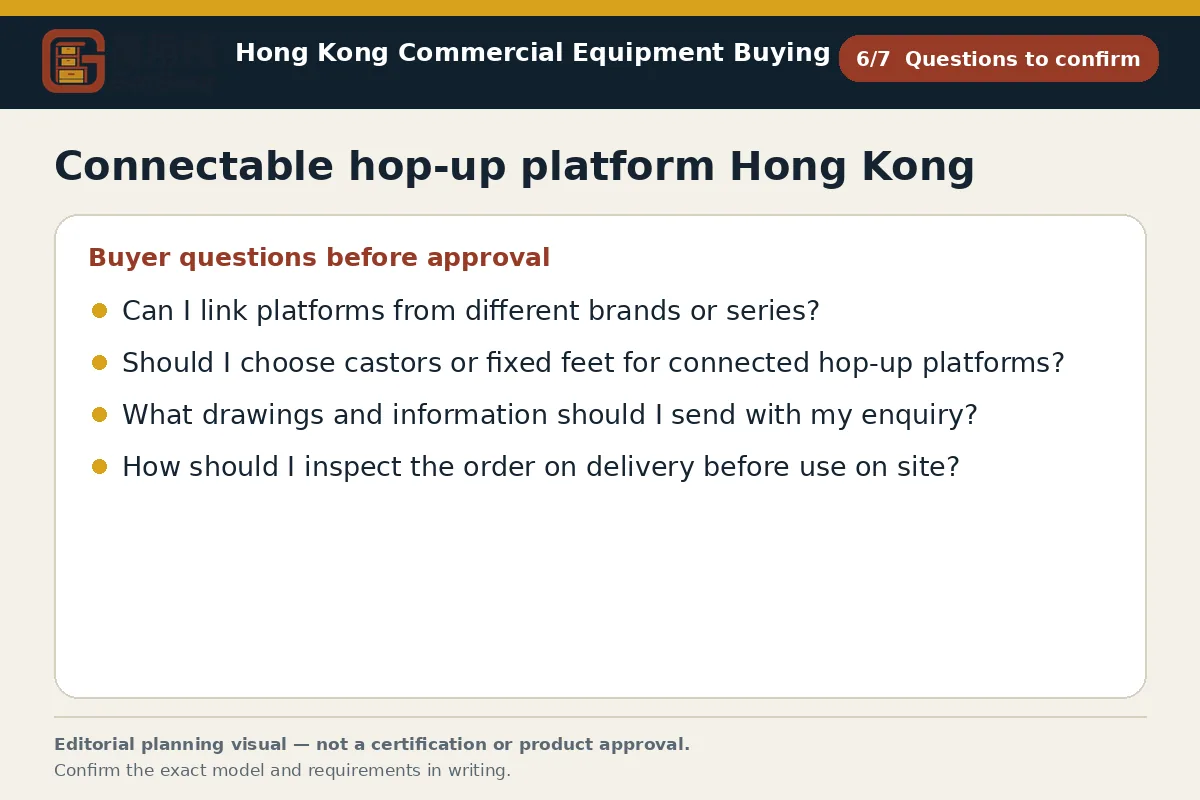
Can I link platforms from different brands or series?
Only if the manufacturer of the intended configuration confirms compatibility in writing, with part numbers, angles, gaps, and setup steps. Without this, mixing is risky and may invalidate the manufacturer’s instructions or insurance cover. If a third-party adapter is suggested, request its data sheet, limits and exclusions, and verify that guardrail continuity and anti-lift features still meet your site’s approval conditions.
Should I choose castors or fixed feet for connected hop-up platforms?
Use fixed feet for static tasks and locking castors where frequent repositioning is planned, provided the supplier supports joined units on castors. Confirm brake type, levelling method and anti-creep measures, and match stem sizes to the frames. Check floor gradients and finishes; if slopes are present, request written limits and the approved method for movement and levelling before use.
What drawings and information should I send with my enquiry?
Provide a scale plan with working length, heights, turns, aisle widths, obstacles and gradients, plus photos. Include goods-lift and doorway dimensions, delivery route sketches, and whether the arrangement is static or moved. Add notes on humidity, cleaning chemicals, and any public or event controls. This lets the supplier issue a component list, connection details and configuration limits for your exact site.
How should I inspect the order on delivery before use on site?
Cross-check part numbers, revision letters and quantities against the quotation and packing list. Examine connection points, anti-slip treads, guardrail joints and fasteners for damage, corrosion or missing items. Test-fit one representative junction in a safe area and photograph it for records. Quarantine any suspect items and request written guidance; the supplier’s instructions and your site’s acceptance process should prevail.
Continue with closely related procurement topics
These pages share equipment, operating or decision-stage signals with this guide.
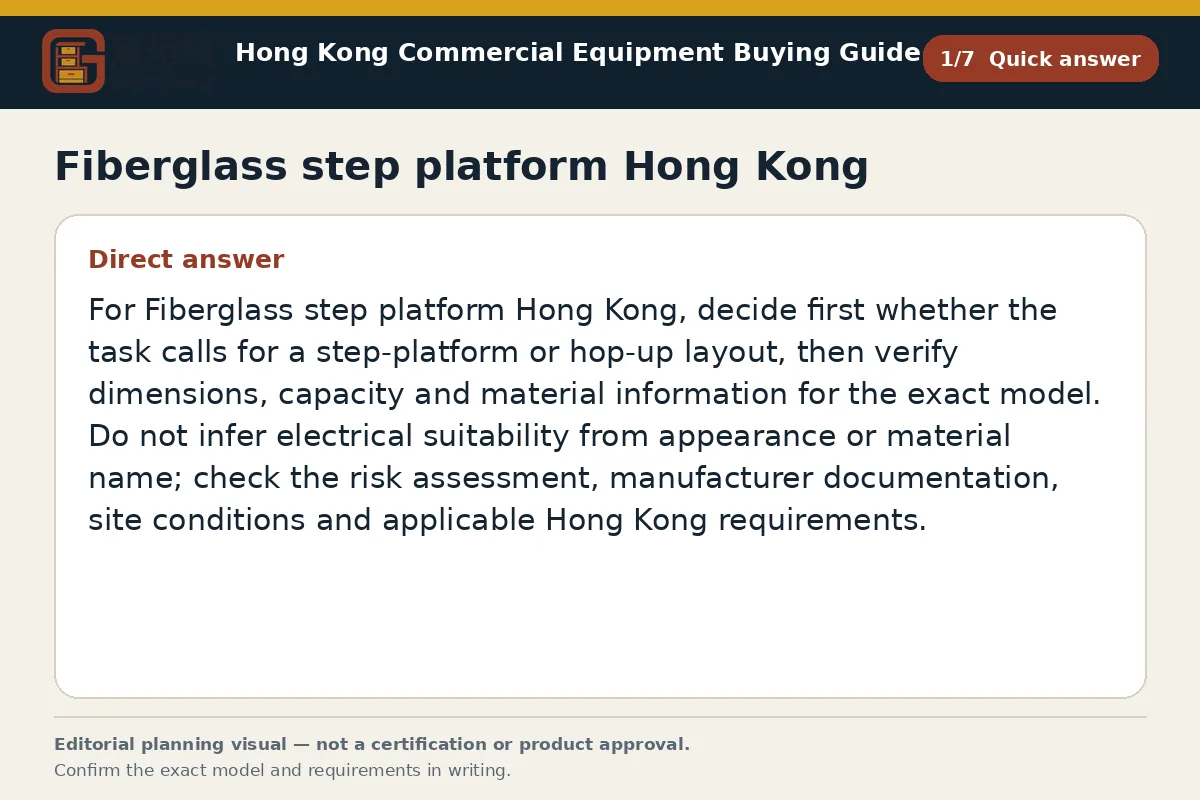
Fiberglass step platform Hong Kong
Compare height, standing area, footprint and access between a Fiberglass step platform Hong Kong and a Fiberglass hop-up platform Hong Kong. Choose the option that suits your task with GotGear in Hong Kong.
Read the guide
Aluminium work platform for narrow spaces Hong Kong
When considering an Aluminium work platform for narrow spaces Hong Kong, measure the access route and compare transport and deployed footprints, door and lift dimensions and operator clearance. Contact GotGear for assistance.
Read the guide
Industrial step platform Hong Kong
Use a practical checklist from GotGear to compare task, access height, standing area, movement and dimensions for Industrial step platform Hong Kong and Commercial step platform Hong Kong.
Read the guide
Step-up platform Hong Kong
Compare Step-up platform Hong Kong with Mobile two step stool Hong Kong for reach, standing area, movement and footprint. Review dimensions and controls and consult GotGear for full product details.
Read the guideRelated topic indexOpen more English procurement pages2 topics
Browse additional equipment families, applications and procurement questions relevant to a wider buying brief.