
For Industrial step platform Hong Kong, define the workplace, task duration, required standing area, access method and movement pattern before comparing models. Verify dimensions, stated capacity and operating instructions for the exact product against site conditions and applicable Hong Kong requirements.
Define the task and setting for Industrial step platform Hong Kong
Start by mapping the task with field notes. Measure the floor-to-work contact point so the chosen platform height places hands within a comfortable working band, rather than at full reach. Note how long a person will stand on the platform, whether both hands must be free, and if tools or small parts are handled. Record who will use it, their typical footwear, and whether a second person is required for supervision or handling. Capture the environment: indoor air-conditioned space, a loading bay with draughts, or a semi-outdoor corridor exposed to humidity and occasional rain splash.
Plan the movement and access path. Sketch the route from storage to the task location, including door widths, corridor pinch points, and the goods-lift car and door clear openings. Confirm any management-office delivery bookings or out-of-hours restrictions. Identify floor types (smooth concrete, tiles, epoxy, gratings) and any slopes or thresholds. For an Industrial step platform Hong Kong, buyers should include these details in the enquiry so shortlisted models can be checked against the real site. Finally, note where the unit will be parked between uses, whether it must fold, and any housekeeping needs such as non-marking wheels to protect finished floors.
Platform format and movement needs for Industrial step platform Hong Kong
Match platform format to how the unit will be used and moved. For quick, low-level tasks with frequent repositioning, compact podium steps or hop-up platforms can be efficient; specify anti-slip treads and positive locks before climbing. Where a user needs a larger standing area and a mid-height handrail, consider a platform ladder or podium with a self-closing gate; request confirmation that the gate action and latch are suitable for your users and space. For longer tasks that require frequent parts handling, a larger guarded platform may reduce fatigue.
Translate movement into specifications. If the unit will travel through lifts or narrow corridors, request folded dimensions, overall weight, wheel size and wheel material. Ask how the brakes are operated (foot, hand lever) and whether two braked castors are standard. For frequent cross-floor moves, non-marking, low-noise wheels and corner bumpers can protect surfaces and fixtures. Where gradients or thresholds are present, ask the manufacturer for the recommended maximum operating slope and technique. If a single person will move the platform, request guidance on push/pull points and any carry handles, and confirm whether one-person manoeuvring is advised for the model.
What should buyers compare for Industrial step platform Hong Kong?
| Criterion | Straightforward requirement | More complex requirement | Evidence to provide |
|---|---|---|---|
| Access height and reach | One consistent working height on a single site | Multiple tasks at different heights across sites/buildings | Measured floor-to-task heights, reach preference, ceiling/fixture clearances |
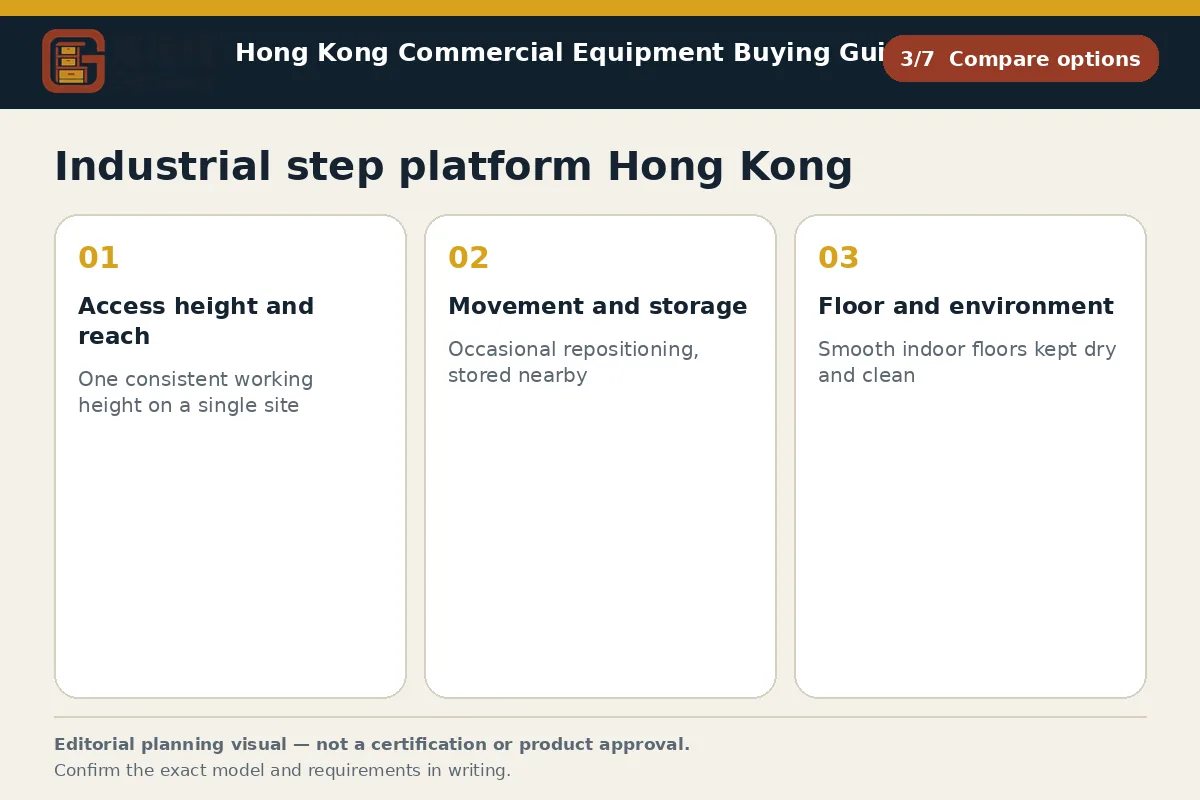
| Movement and storage | Occasional repositioning, stored nearby | Frequent cross-building moves via lifts and narrow corridors | Route sketch with door/lift sizes, folded size limits, storage footprint and handling method |
| Floor and environment | Smooth indoor floors kept dry and clean | Mixed floors, slopes, humid or semi-outdoor areas | Floor types, slopes, thresholds, cleaning regime, request wheel/foot type and corrosion protection |
| User profile and supervision | One trained operator in a controlled area | Multiple teams with varied experience and languages | Number of users, supervision plan, required languages for on-product labels/instructions |
| Documentation and approvals | Basic manual for internal use | Venue or insurer requires method statements or building-management approvals | Requested manuals, sample labels, any venue approval notes and delivery booking requirements |
This framework helps buyers create comparable written enquiries. Final model specifications, availability, delivery and commercial terms must be confirmed in a formal quotation.
Industrial step platform Hong Kong: Comparison with Commercial step platform Hong Kong
When teams compare ranges, the label can mislead. Many “industrial” models emphasise robustness and larger standing areas, while “commercial” lines may prioritise finishes, quiet mobility and appearance for public spaces. In practice, a Commercial step platform Hong Kong catalogue item may meet your workshop duty needs if the load capacity, tread design and guardrails match the task. Conversely, an industrial product can be appropriate in retail back-of-house if its wheels and footprint suit the floors and route. Treat the words as a starting point, not a rule.
Build a side-by-side comparison around duty, movement and environment. Ask each supplier to state safe working load, platform dimensions, rail heights, wheel type, and whether parts touching floors are non-marking. For customer-facing areas, query noise levels and corner protection. For humid plantrooms, discuss corrosion resistance and cleaning frequency. Request bilingual on-product safety labels and user instructions for mixed-language teams. Packaging and delivery constraints matter in Hong Kong: confirm whether the unit ships assembled or flat, the largest piece size, and if building management requires protective wrapping or lift padding. Use this guide to compare specifications and prepare a written enquiry so quotations are directly comparable.
Dimensions, capacity and instructions for Industrial step platform Hong Kong
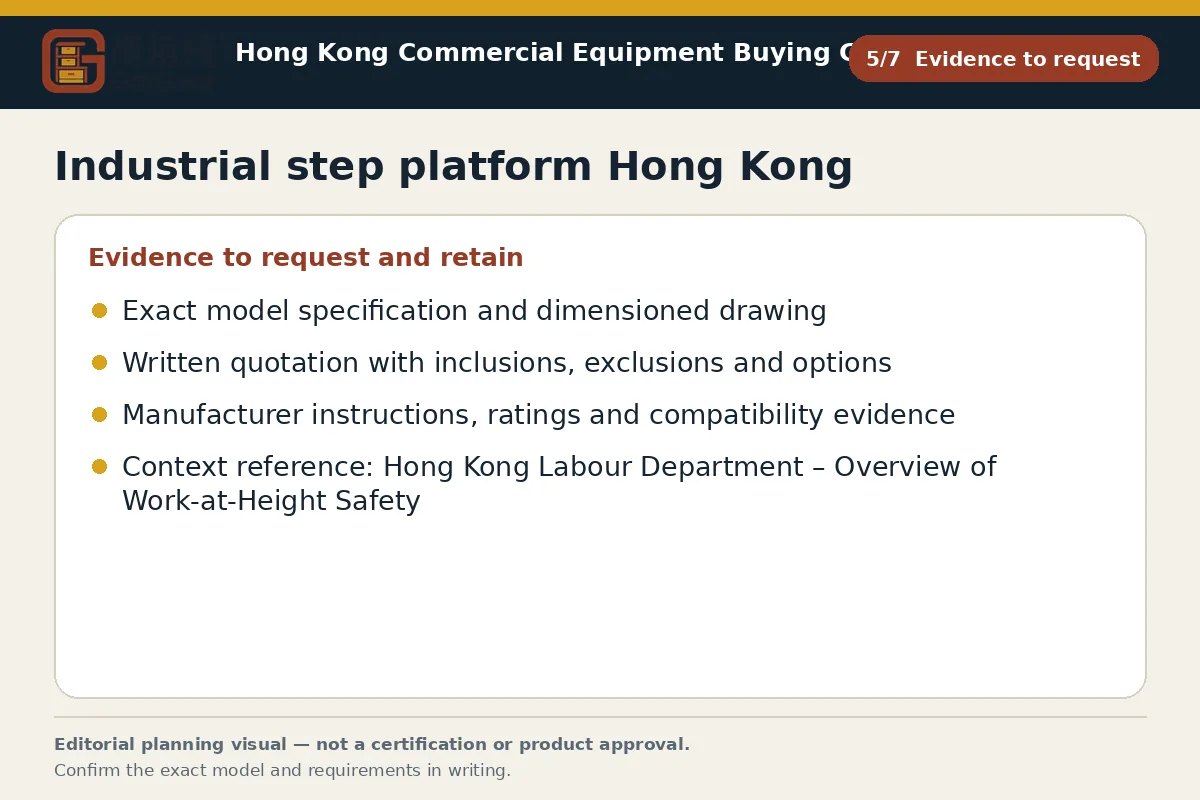
Close gaps with hard data before ordering. Ask for overall footprint, platform length and width, platform height (or adjustable range), and top-rail height. Request the safe working load, the number of people permitted on the platform, and any restrictions on tool or part loads. Specify tread material and depth, anti-slip pattern, and guardrail configuration (including any self-closing gate). Clarify wheel count, diameter and material, brake type, and folded dimensions for storage and lift access. Where corrosion is a concern, ask for material grade and protective finish.
Insist on the current user instructions from the manufacturer and confirm the exact model designation printed on the label will match the paperwork. On receipt, inspect welds, fasteners, castors, stoppers, and locking mechanisms, and verify that labels are legible and bilingual where required. Measure critical dimensions against the written quotation and site notes before first use. Keep the instructions accessible for operators and supervisors. If the venue, insurer or applicable Hong Kong requirements introduce conditions (for example on guardrails or use zones), obtain written confirmation from the responsible party on how the chosen platform should be used at your site.
Industrial step platform Hong Kong decision checklist
Consolidate measurements and route sketches into a one-page enquiry stating platform height, standing-area needs, guardrail preference, wheel type, folded size and total weight. Add floor descriptions, slopes, thresholds and any goods-lift or doorway clearances. State who will operate the unit, movement frequency, storage location and expectations for noise and floor protection. Ask suppliers to confirm model code, safe working load, platform and rail dimensions, and brake type in the written quotation. Request current user instructions and sample labels. On delivery, check the label matches the quoted model and verify dimensions before placing into service.
- Operating use, quantity and expected frequency
- Dimensions, capacity, material and accessory requirements
- Delivery address, floor, goods lift and loading window
- Required documents, acceptance checks and after-sales arrangements
Key points for Industrial step platform Hong Kong, Commercial step platform Hong Kong
Hong Kong sites often impose tight access and handling constraints. Many industrial buildings and malls require delivery bookings through the management office and limit lift car sizes, so folded dimensions and largest piece sizes should be confirmed in writing. Humid, coastal conditions can accelerate corrosion; discuss material grades and cleaning. Public-facing venues may demand quiet, non-marking wheels and protective bumpers. Mixed-language teams benefit from bilingual labels and manuals. Treat these as practical constraints to verify with your venue and supplier, not legal advice.
Questions about Industrial step platform Hong Kong
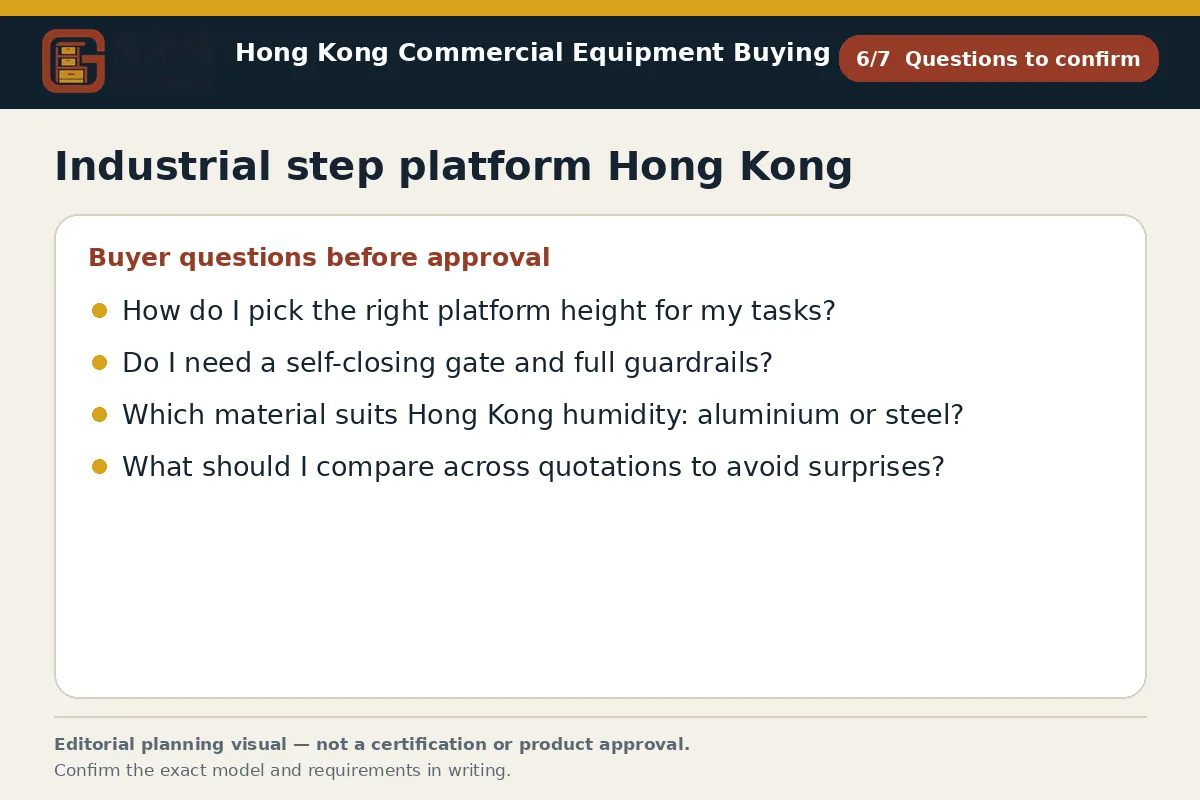
How do I pick the right platform height for my tasks?
Choose a platform height that positions hands comfortably without overreaching; your field measurement from floor to the task is the reference. Suppliers may quote a “working reach” as an example starting point, but assumptions vary. Ask for the model’s exact platform height and confirm on site during a task trial. The written specification and quotation should prevail.
Do I need a self-closing gate and full guardrails?
If the task is prolonged or hands-free work is needed, a guarded platform with a self-closing gate can reduce mis-steps. Short, intermittent tasks at low level may use simpler podiums if your risk assessment supports it. Requirements can depend on the venue, insurer or applicable Hong Kong controls; confirm with the responsible party before purchase.
Which material suits Hong Kong humidity: aluminium or steel?
Aluminium platforms are typically lighter and resist corrosion well; steel can offer robustness and different trade-offs between weight and other factors. The best choice depends on environment, cleaning regime and handling frequency. Request the material grade, protective finish and any maintenance guidance in writing, then confirm suitability with your site conditions and storage location before ordering.
What should I compare across quotations to avoid surprises?
Ensure each quote refers to the same model code and states platform height, platform size, rail height, safe working load, wheel type, folded dimensions and brake mechanism. Ask for the current user instructions and sample labels. Note any exclusions such as delivery, assembly or accessories. Where details differ, seek written clarification; the formal quotation should guide decisions.
Continue with closely related procurement topics
These pages share equipment, operating or decision-stage signals with this guide.
Step-up platform Hong Kong
Compare Step-up platform Hong Kong with Mobile two step stool Hong Kong for reach, standing area, movement and footprint. Review dimensions and controls and consult GotGear for full product details.
Read the guide
Fiberglass step platform Hong Kong
Compare height, standing area, footprint and access between a Fiberglass step platform Hong Kong and a Fiberglass hop-up platform Hong Kong. Choose the option that suits your task with GotGear in Hong Kong.
Read the guide
Low-level access platform Hong Kong
On GotGear, explore Low-level access platform Hong Kong. Compare Portable low-level work platform Hong Kong and Work platform for work below 2 metres Hong Kong.
Read the guide
Mobile working platform on slopes Hong Kong
Note gradient and surface before using Mobile working platform on slopes Hong Kong and review limits for Mobile working platform on uneven ground Hong Kong. Check Working platform suitable ground conditions Hong Kong with GotGear.
Read the guideRelated topic indexOpen more English procurement pages3 topics
Browse additional equipment families, applications and procurement questions relevant to a wider buying brief.