
For a first-step alert on a work platform, obtain a product-specific explanation of the alert, its trigger, expected user response, inclusion status and inspection method. Verify that information in the manufacturer’s instructions and assess it alongside the task, site controls and applicable Hong Kong requirements rather than treating it as a substitute for them.
Define the buyer question for First step alert work platform Hong Kong
Start with a precise buyer question: what does the alert do, when does it trigger, what does the user perceive, and how is it verified before work? When specifying a first-step alert for a work platform, define exactly what the alert does and how it is confirmed before access. Ask the manufacturer to describe the trigger logic in plain language, identify the sensor location, and clarify whether the alert is visual, audible, vibratory or a combination. Request the inclusion status (standard or optional), the part number, and whether disabling, volume or brightness adjustments are possible and controlled. Confirm the power source, low‑battery indication, any environmental rating claimed by the manufacturer, and the documented pre‑use test method.
Gather site data so quotations can be compared fairly. Record background noise (example starting point: 70–80 dB to be confirmed by your measurement method), ambient light at the base step (example starting point: 200–300 lux to be confirmed), humidity and cleaning chemicals likely to contact the step area. Note doorway and goods‑lift clearances, turning circles and loading‑bay rules for demonstrations. Identify management‑office restrictions on alarms sounding, and any requirement for bilingual user information. In your written enquiry, ask for a line‑item description of the alert feature, confirmation that it is supported on the nominated model, and a copy or excerpt of the instructions covering operation, inspection and user response. Make clear that model specifications and the formal quotation prevail.
Operation and inclusion details for First step alert work platform Hong Kong
Translate the feature into practical operation steps. Ask for a sequence‑of‑operations: what condition is sensed, when the alert activates, how long it signals, and how it resets. Common trigger examples (to be confirmed with the manufacturer) include a foot contacting the first tread, weight detected on the first rung, the gate opening while the first step is occupied, or outriggers not set when a step‑on is detected. Request the expected user response stated in the manual, acceptable nuisance‑alarm scenarios, and any fail‑safe behaviour if the sensor or battery fails. For audible alarms, ask for indicative sound level at the operator’s ear (example starting point: 65–85 dB at 1 m, to be confirmed). For visual alerts, request flash rate and conspicuity details (example starting point: 60–120 fpm, to be confirmed).
Clarify inclusion: is the alert factory‑fitted on the quoted model, or an optional kit? If optional, capture the kit code, components (sensor, beacon/buzzer, harnesses, labels), mounting diagram reference, and whether tools or drilling are required. Confirm power (passive, battery, or integrated supply), battery type and life claim (examples must be confirmed in the manual), and any ingress‑protection the maker states. Ask whether the first‑step area must remain free of floor mats, liquids or grease, and what cleaning compatibility is allowed. Request the documented pre‑use check: where to observe the signal, how to simulate the trigger safely, and what constitutes a pass or fault.
What should buyers compare for First step alert work platform Hong Kong?
| Criterion | Straightforward requirement | More complex requirement | Evidence to provide |
|---|---|---|---|
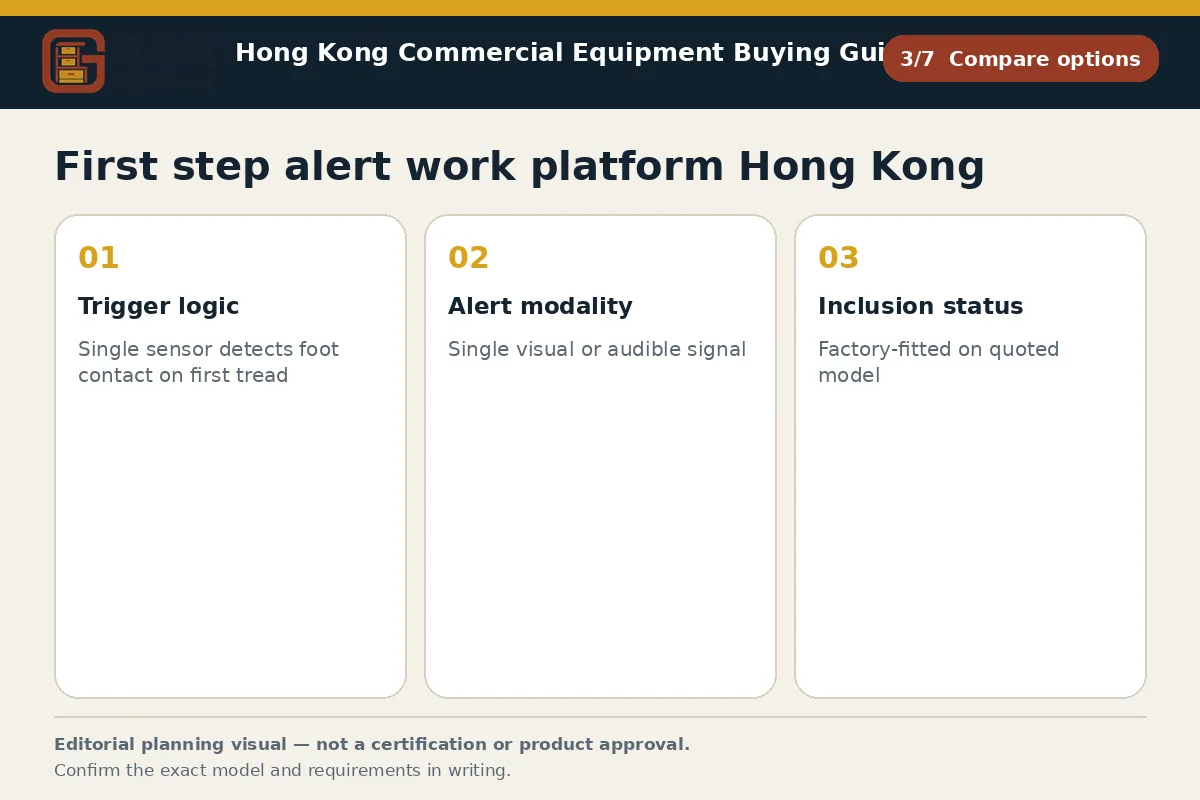
| Trigger logic | Single sensor detects foot contact on first tread | Multiple sensors verify step occupation plus gate/outrigger state | Provide written trigger description and sensor location; include manual excerpt/page |
| Alert modality | Single visual or audible signal | Combined audio‑visual with adjustable intensity/volume under site rules | State type, indicative levels (examples), and proposed settings; include maker’s data |
| Inclusion status | Factory‑fitted on quoted model | Optional kit with defined part number and mounting method | List part/kit code, components, and drawing reference on the quotation |
| Power and environment | Passive or internal battery with maker‑stated limits | Integrated supply with declared ingress protection and service notes | Provide power type, battery spec if any, and environmental statement from manual |
| Inspection/test method | Simple push‑to‑test or step simulation | Documented procedure with pass/fail criteria and records | Attach or cite the manual procedure ID and acceptance criteria examples |
This framework helps buyers create comparable written enquiries. Final model specifications, availability, delivery and commercial terms must be confirmed in a formal quotation.
Match First step alert work platform Hong Kong to the task context
Match the feature to the real task. In quiet facilities, an audible indication may guide new users; in noise‑sensitive sites (schools during exams, libraries, event rehearsals) a visual alert can reduce disturbance if management‑office rules limit sounders. In bright warehouses, a high‑intensity beacon may cut through glare; in kitchens or plantrooms, consider an alert with a manufacturer‑stated ingress rating and cleaning compatibility. Where public interface exists, combine the alert with physical controls such as a self‑closing gate or safety lock so an approaching user is intercepted before a mis‑step. Evaluate how the alert interacts with site controls and supervisor briefings; it should support them, not replace them.
Capture constraints in writing: goods‑lift door width and car height, narrow corridors, turning spaces, ramp gradients and loading‑window times for any on‑site testing. Record institutional approval steps for trials on campus or in healthcare settings, and note the need for bilingual quick‑reference cards. If your platform choice also considers a self‑closing gate or safety lock, reference the same enquiry to compare how the alert complements those mechanisms. Align the feature decision with your working platform risk assessment and confirm that the chosen model’s instructions address your task, surface conditions and housekeeping controls.
Inspection and response instructions for First step alert work platform Hong Kong
Before accepting delivery, inspect the package against the quotation: verify the alert module, sensor, harnesses, labels and any documentation promised by the supplier. Check that the serial/model on the instructions matches the unit. Perform a safe function test in a controlled area: simulate the trigger as per the manufacturer’s method, observe the alert at the indicated position, and confirm reset. Record observations (example starting points: measured ambient noise and distance from the step during the test, to be confirmed with site procedure). Photograph the installed alert and label locations for your asset file. If access for testing requires a management‑office booking, obtain written permission and keep it with the records.
Issue pre‑use instructions: before first climb, users conduct the documented alert test, confirm platform stability, verify gates/locks and clear the step area. If the alert activates unexpectedly, the operator steps down, reassesses footing and stabilisation, and only proceeds if conditions match the manual. Faults, weak signals or damaged components are taken out of service under site rules until checked by a competent person designated by your organisation. Agree where spares (for example, batteries if applicable) are stored, how cleaning avoids damaging the sensor, and how inspection results are logged. Keep the instructions accessible in bilingual form if required by your institution.
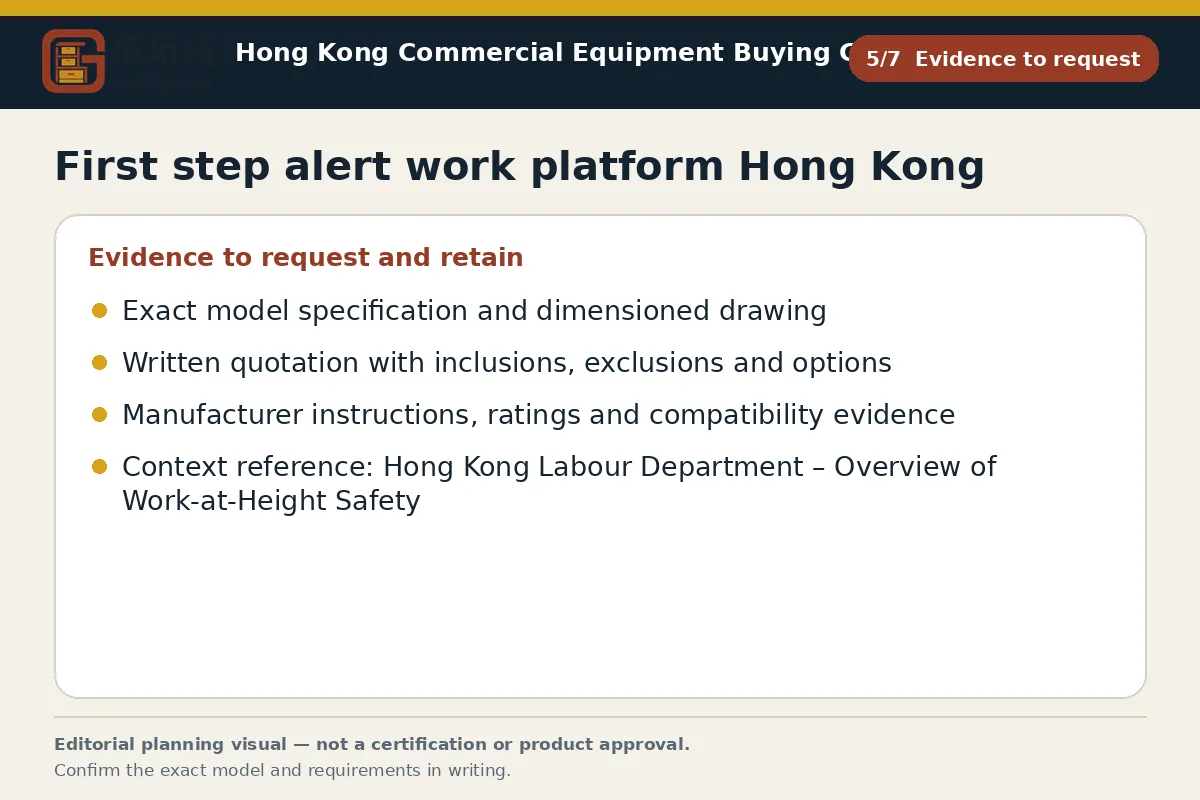
First step alert work platform Hong Kong decision checklist
Define the alert’s purpose, trigger logic and user response in your enquiry, and request the exact inclusion status, part number and any adjustment controls. Measure background noise, lighting and space around the first step, and record goods‑lift and doorway limits. Ask for the pre‑use test method, environmental limits stated by the manufacturer and any cleaning compatibility notes. Compare written quotations line by line: alert components supplied, mounting method, and documentation excerpts. On receipt, cross‑check the model code, labels and function test results before acceptance. Confirm training and record‑keeping arrangements, bilingual materials if needed, and site rules for sounding or disabling alarms. Note that the formal quotation and the manufacturer’s instructions prevail.
- Operating use, quantity and expected frequency
- Dimensions, capacity, material and accessory requirements
- Delivery address, floor, goods lift and loading window
- Required documents, acceptance checks and after-sales arrangements
Key points for First step alert work platform Hong Kong
Hong Kong sites often require coordination with the building’s management office before sounding alarms, even briefly, especially in mixed‑use industrial buildings and malls. Plan any on‑site alert tests during approved loading‑window times and inside tight goods‑lift and corridor dimensions. Humid conditions and frequent cleaning in catering or plant areas mean you should confirm the manufacturer’s stated environmental limits and cleaning compatibility for the alert hardware. Many institutions expect bilingual safety information; request English and Traditional Chinese labels or quick guides where available. Always verify feature details and site controls in writing with the responsible parties.
Questions about First step alert work platform Hong Kong
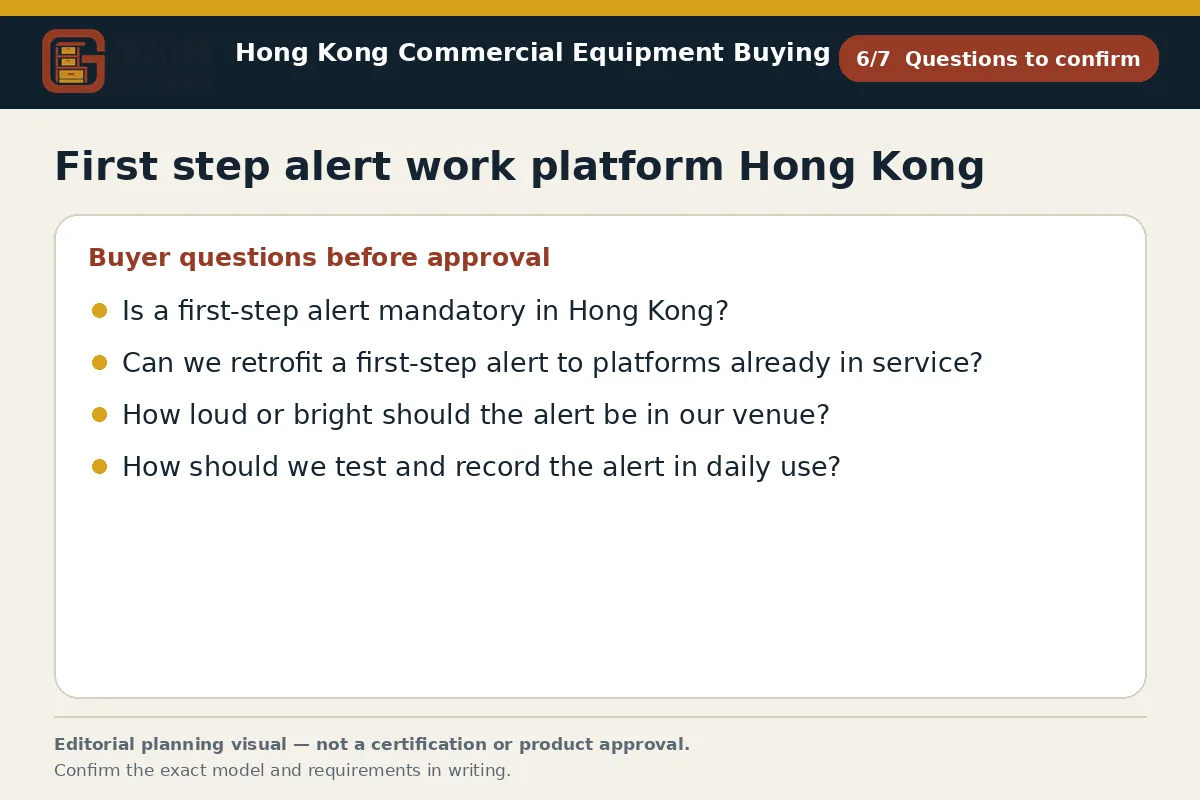
Is a first-step alert mandatory in Hong Kong?
There is no universal rule making it mandatory. Whether you need it depends on the specific platform model, your risk assessment, venue policies, insurer expectations and any authority guidance for the activity. Confirm the requirement in writing with your competent adviser and the manufacturer, and document how the feature supports your existing controls rather than replacing them.
Can we retrofit a first-step alert to platforms already in service?
Retrofit is appropriate only if the manufacturer confirms a compatible, model-specific alert kit and provides a documented installation and inspection method. Confirm whether an alert is required by checking the applicable requirements, exact model instructions and any written direction from your competent adviser or venue. Ask the supplier to identify the compatible option in the formal quotation, and retain the supporting document with the asset record.
How loud or bright should the alert be in our venue?
Set the device levels so users can consistently detect them above ambient noise and lighting, while complying with venue policies. Base your settings on measurements taken in the actual environment, then verify any indicative sound or flash levels against the manufacturer's instructions. In noise-sensitive or public areas, prioritise visual cues where management rules restrict audible sounders, and document the selected settings.
How should we test and record the alert in daily use?
Follow the manufacturer’s stated pre‑use test method and acceptance criteria. Typically this means simulating the trigger and confirming the alert is clearly perceived from the operator’s position. Incorporate the result into your daily checklist with date, unit ID and tester initials. Align intervals and fault escalation with your site procedures and any insurer or venue requirements.
Continue with closely related procurement topics
These pages share equipment, operating or decision-stage signals with this guide.
Aluminium step platform with safety protective bar Hong Kong
Aluminium step platform with safety protective bar Hong Kong: GotGear assesses task access and geometry. Aluminium step platform with fall protection net Hong Kong: Compare manufacturer details and risks.
Read the guide
Platform ladder with self-closing gate Hong Kong
Platform ladder with self-closing gate Hong Kong: GotGear reviews gate return and latch. Platform ladder with back castors Hong Kong and Platform ladder with tool holder Hong Kong: Assess task, floor and route.
Read the guide
Aluminium step platform with platform lock Hong Kong
Aluminium step platform with platform lock Hong Kong and Aluminium step platform with wide non-slip steps Hong Kong should be inspected for lock operation, tread dimensions, surface grip and floor footing, according to GotGear.
Read the guide
Aluminium work platform with adjustable legs Hong Kong
Before selecting or using an Aluminium work platform with adjustable legs Hong Kong, check the ground surface, adjustment range and footprint. Compare Work platform with adjustable stabilisers Hong Kong at GotGear.
Read the guideRelated topic indexOpen more English procurement pages2 topics
Browse additional equipment families, applications and procurement questions relevant to a wider buying brief.