
For Mobile working platform on slopes Hong Kong, measure and document the set-up area, then compare it with the exact manufacturer limits and instructions for the complete platform configuration. Do the same for uneven ground, and verify site controls and applicable Hong Kong requirements; never assume suitability without product and site evidence.
Assess gradient before Mobile working platform on slopes Hong Kong
Start by surveying the intended set-up and travel lines, not just the final working spot. Measure the gradient along and across the route, and document any change in slope near door thresholds, lift lobbies, kerbs, loading-bay crossfalls and gullies. Capture where water runs during rain, whether the surface is polished concrete, pavers, asphalt or steel plates, and note any oil, algae or loose grit. Record the clear space required for the full base or outrigger footprint, including the swing or extension of stabilisers. Mark distances to edges, openings, manholes and soft verges so you can plan exclusion zones or covers.
For a Mobile working platform on slopes Hong Kong, when making a decision, request each vendor to confirm allowable gradients for positioning, levelling, and any movement on a slope, and whether orientation (uphill/downhill) affects limits. Ask for the base footprint for all permitted configurations, the levelling range of jacks or adjustable feet, wheel and foot load data, and whether chocks, soleboards or anti-runaway devices are required. Require written instructions or an extract from the operator’s manual stating these limits to be referenced in the quotation. If the platform must pass through tight goods lifts or doorways, ask the supplier to state the minimum transport configuration and whether slope controls apply during manoeuvring in confined areas. Ensure any site sketch and gradient notes are included with your enquiry so quotations match your actual conditions.
Mobile working platform on slopes Hong Kong: Use working platforms on suitable ground and keep evidence
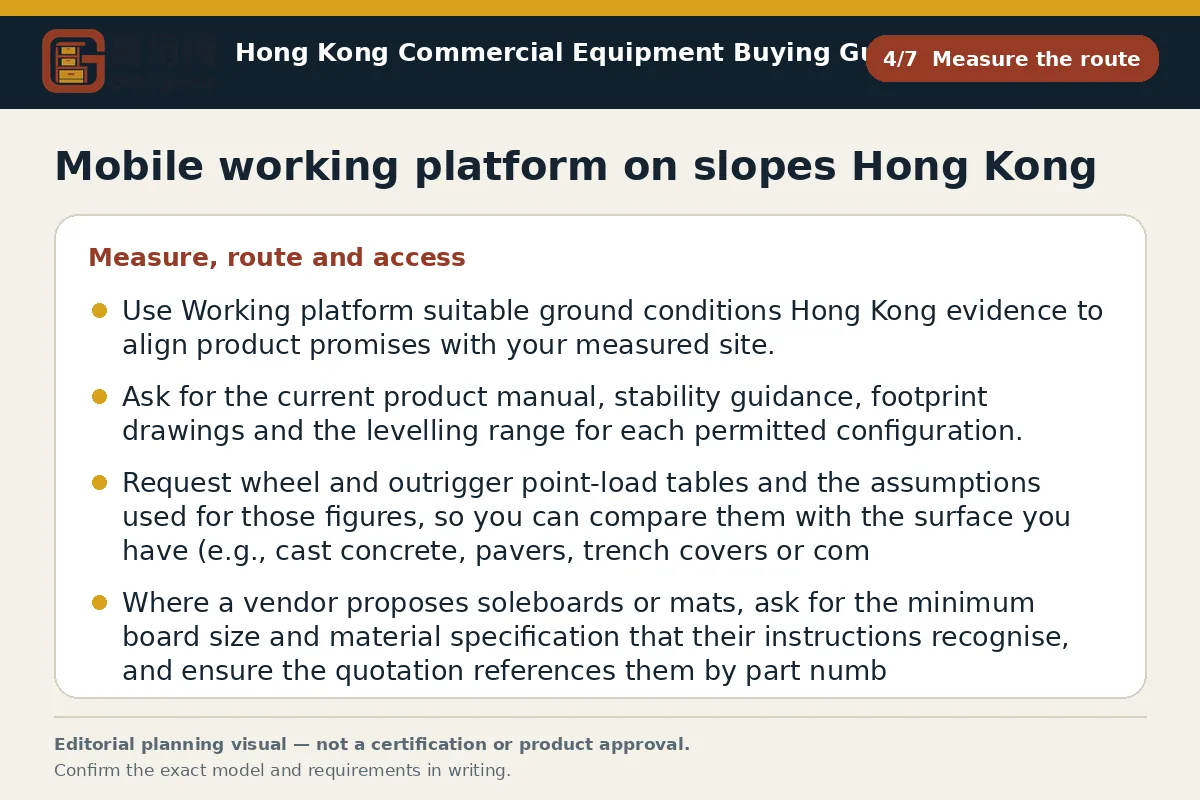
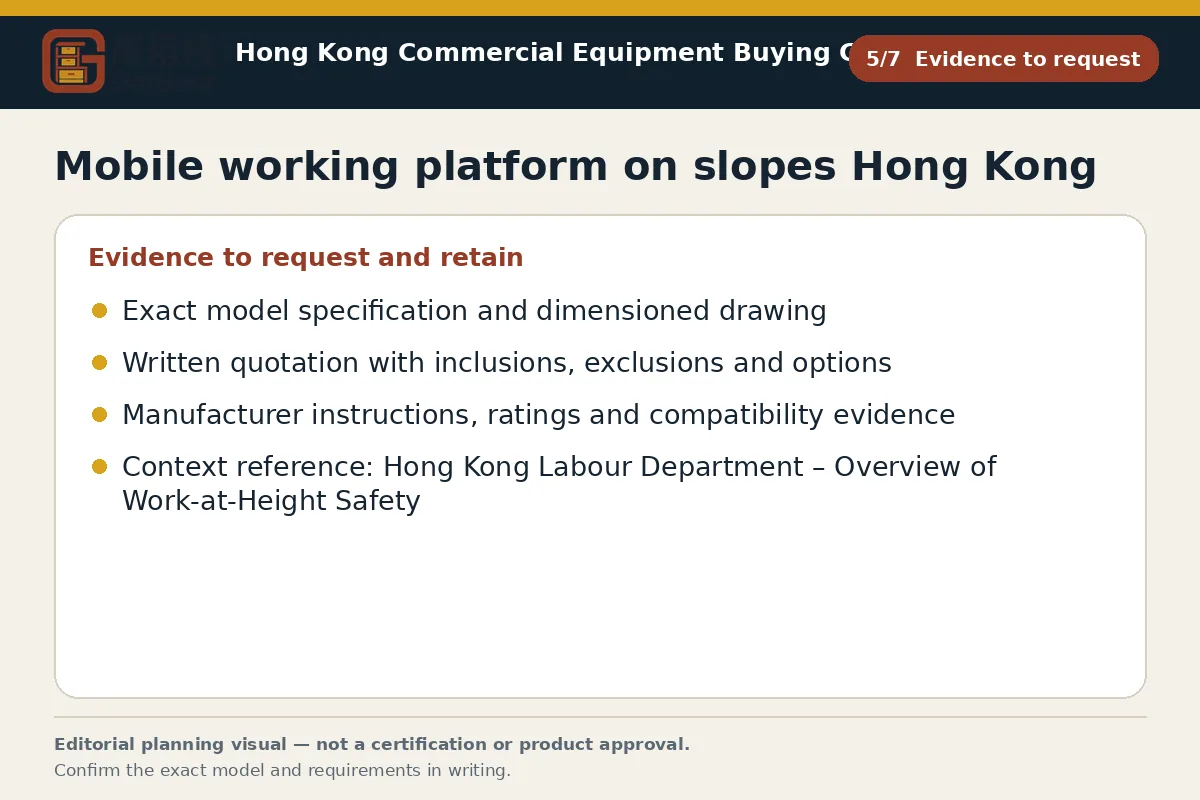
Use evidence that the working platform is suitable for the ground conditions in Hong Kong to align product promises with your measured site. Ask for the current product manual, stability guidance, footprint drawings and the levelling range for each permitted configuration. Request wheel and outrigger point-load tables and the assumptions used for those figures so you can compare them with the surface you have (e.g., cast concrete, pavers, trench covers or compacted fill). Where a vendor proposes soleboards or mats, ask for the minimum board size and material specification that their instructions recognise, and ensure the quotation references them by part number or equivalent description.
In Hong Kong, bilingual documentation helps with building-management approval and toolbox talks. Ask vendors to provide identification labels, serial numbers and warning decals consistent with the manual, plus a list of original accessories that affect stability or ground loading. On receipt, inspect levelling jacks, brakes and castors for positive locking and visible wear, confirm the supplied footprint matches the drawings, and check that all instructions are complete and legible. If the surface is frequently wet or humid, seek confirmation that anti-slip feet, tyre compounds and corrosion protection are suited to those conditions. Where ground capacity is uncertain, ask the building manager or a competent adviser to confirm suitability before you place the order.
What should buyers compare for Mobile working platform on slopes Hong Kong?
| Criterion | Straightforward requirement | More complex requirement | Evidence to provide |
|---|---|---|---|
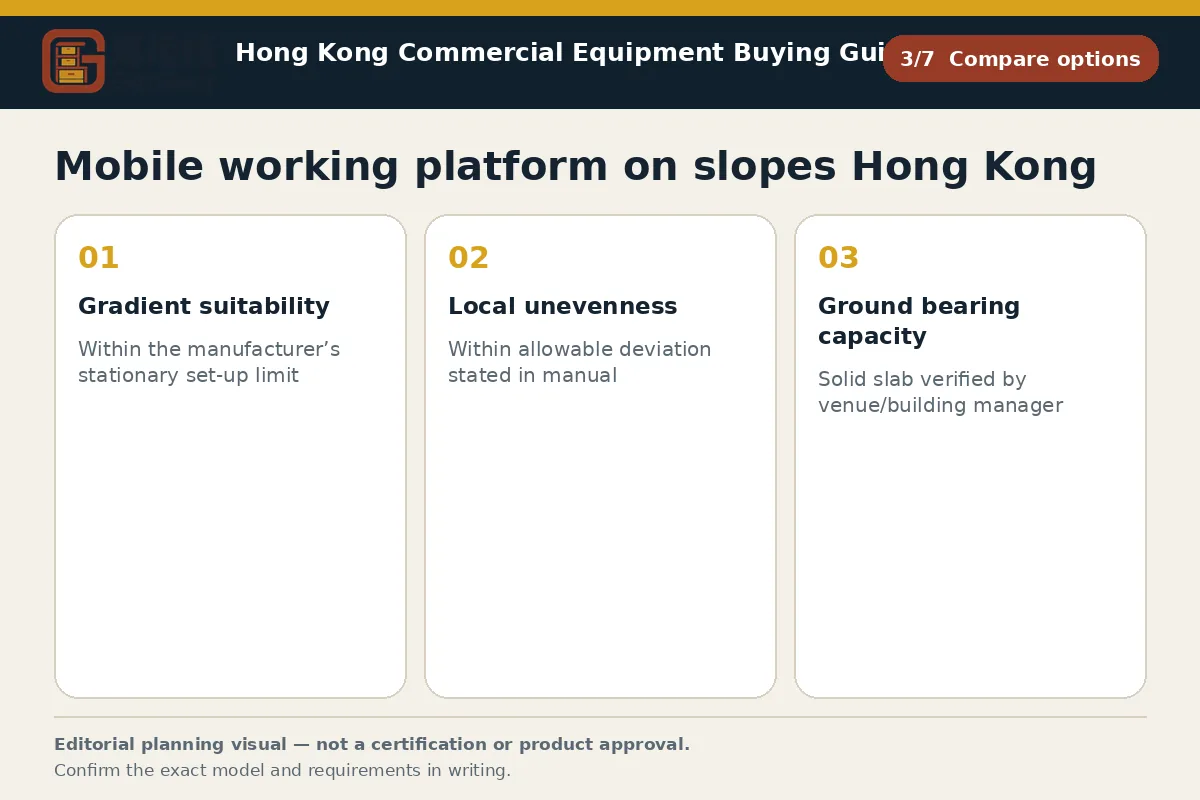
| Gradient suitability | Within the manufacturer’s stationary set-up limit | Different limits for positioning/travel on slope; orientation rules apply | Measured gradient/crossfall map and manual excerpt referenced in quotation |
| Local unevenness | Within allowable deviation stated in manual | Use adjustable legs, jacking castors or soleboards as instructed | Straightedge readings, photos; levelling range and configuration drawing |
| Ground bearing capacity | Solid slab verified by venue/building manager | Unknown/soft ground with specified mats or boards to spread load | Wheel/foot load table; proposed mat spec and building-manager note |
| Footprint and edges | Full footprint clear of openings and edges | Work near pits/drains with documented exclusion distance or rated covers | Scaled sketch with distances; cover rating and fixing method |
| Movement controls | Brakes engaged; chocks if specified | Anti-runaway devices or restraint/tie-in per model on slopes | Device specifications and manual extract; method statement reference |
This framework helps buyers create comparable written enquiries. Final model specifications, availability, delivery and commercial terms must be confirmed in a formal quotation.
Distinguish Mobile working platform on uneven ground Hong Kong from Mobile working platform on slopes Hong Kong
Treat unevenness as different from overall slope. Uneven ground includes local dips, raised gratings, settlement cracks, paving joints and changes in level at thresholds. Walk the intended path and the full set-up rectangle with a straightedge and a level, and log the height differences you find, along with the size of any gaps or slots a wheel could fall into. Photograph conditions and mark where temporary covers or soleboards could remove local irregularities. Confirm that there is enough room to place these boards without blocking fire routes or access doors.
When reviewing a Mobile working platform on uneven ground Hong Kong proposal, ask vendors to state the maximum allowable local unevenness for each configuration and whether adjustable legs, jacking castors or screw jacks can compensate. Any figures they provide should be treated as an example starting point only and confirmed in the model manual and written quotation. Request details of castor articulation, levelling increments, and how users verify that the base is level before climbing. If trench covers or bridging plates are needed, ask for the required capacity rating and how they must be fixed to prevent movement. Where the approach passes over drainage channels or utility covers, confirm minimum edge distances and whether additional exclusion barriers are recommended by the manufacturer or the venue manager.
Manufacturer limits to verify for Mobile working platform on slopes Hong Kong
Before you commit, verify the exact manufacturer limits that apply when working on or near slopes. Seek confirmation of allowable gradient while stationary, while positioning, and during any permitted travel, plus the consequences for stability, wheel loads and height-to-base ratio at those gradients. Check whether the model requires outriggers to be fully deployed or set to a particular orientation on a crossfall, and whether the base must be aligned uphill or downhill. If the instructions prohibit use on slopes, ask for that prohibition to be shown clearly in the quotation so the team can select an alternative method.
Request written guidance on the use of brakes, chocks and restraint devices on inclined surfaces, and whether tie-ins or additional stabilisers are allowed or disallowed on gradients. Ask for any derating notes that may apply in wind, rain or on low-friction surfaces; treat any example figures as a starting point only and confirm them in the model documentation. In Hong Kong’s humid conditions, confirm that braking and levelling mechanisms maintain performance when wet, and that maintenance recommendations cover such environments. Ensure the vendor’s delivery plan recognises tight industrial-building access so the platform reaches the set-up area without breaching the slope limits during manoeuvring.
Mobile working platform on slopes Hong Kong decision checklist
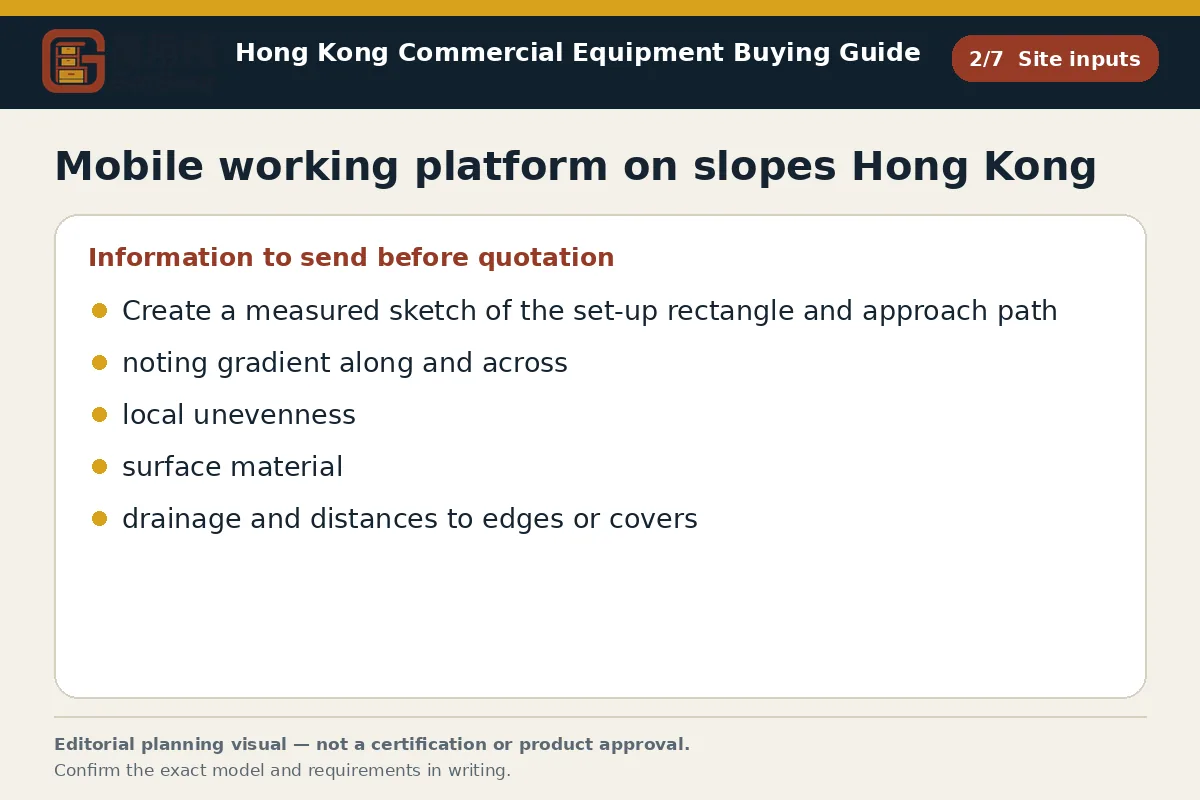
Create a measured sketch of the set-up rectangle and approach path, noting gradient along and across, local unevenness, surface material, drainage and distances to edges or covers. Share this with vendors and request manuals, footprint drawings, levelling ranges, and wheel or outrigger load data. Ask for written slope and unevenness limits, orientation rules, and any soleboards, chocks or restraint devices included in the quotation. Confirm that transport and storage dimensions fit your goods lift and doorways. Check whether the building manager requires bilingual instructions or a method statement. Before placing the order, reconcile every site parameter against the model documentation; ensure exceptions are clearly written. On receipt, inspect identification, brakes, jacks, castors and supplied accessories, then brief users on levelling checks and movement controls in the actual set-up area.
- Operating use, quantity and expected frequency
- Dimensions, capacity, material and accessory requirements
- Delivery address, floor, goods lift and loading window
- Required documents, acceptance checks and after-sales arrangements
Key points for Mobile working platform on slopes Hong Kong, Mobile working platform on uneven ground Hong Kong, Working platform suitable ground conditions Hong Kong
Hong Kong sites often combine tight access, crossfalls at loading bays and steep driveways into industrial buildings. Drainage channels, polished slabs and sudden downpours can reduce friction and introduce run-off that undermines soleboards or mats. Building managers may ask for bilingual instructions and a concise method statement before work near public areas or school corridors proceeds. Confirm how the platform will pass through goods lifts, narrow lobbies and door thresholds without exceeding slope limits. This summary highlights common constraints only; confirm requirements with the responsible manufacturer, venue and competent advisers.
Questions about Mobile working platform on slopes Hong Kong
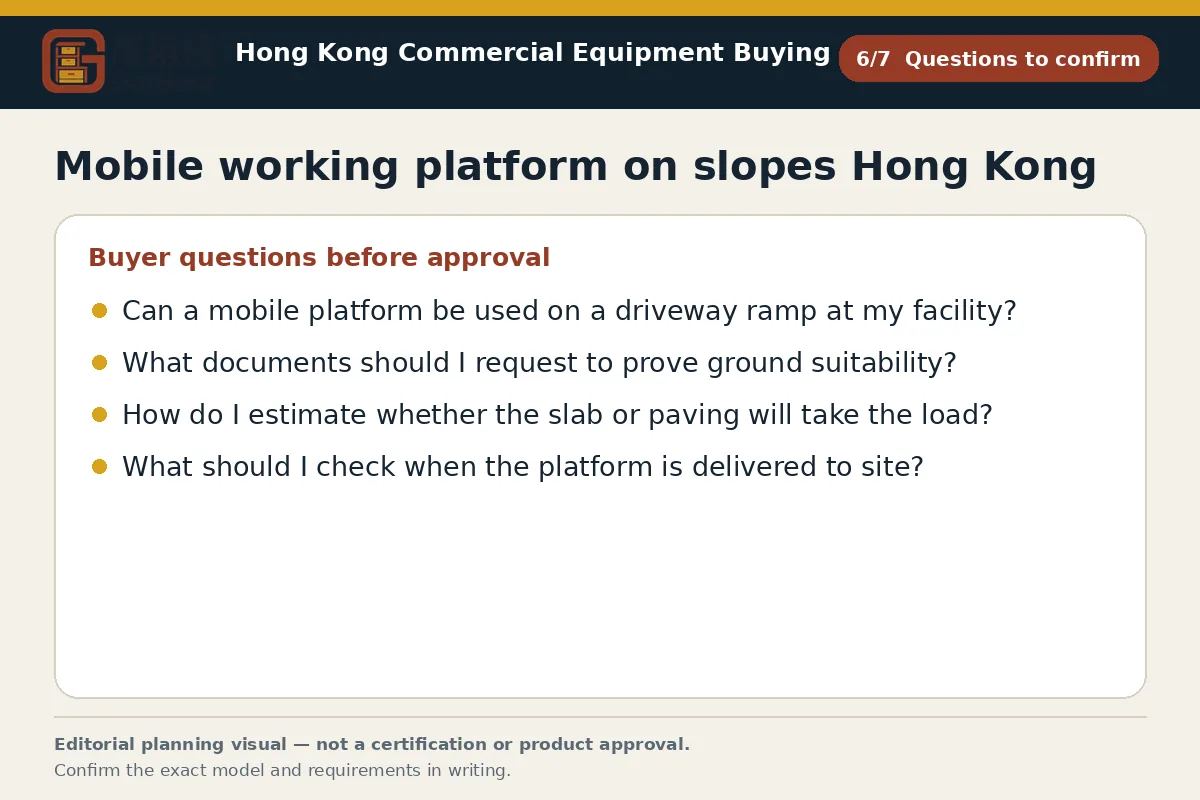
Can a mobile platform be used on a driveway ramp at my facility?
Possibly, if the measured gradient and crossfall are within the exact limits stated in the model manual and quotation. Verify how levelling jacks, brakes and chocks must be used, and whether orientation matters. Obtain building-management acceptance for the location, especially where run-off, pedestrians or vehicle movements are present. If the instructions are unclear, request written confirmation from the manufacturer before proceeding.
What documents should I request to prove ground suitability?
Ask for the current manual, footprint drawings for all permitted configurations, levelling range, and wheel or outrigger load tables. Request written limits for slope, crossfall and local unevenness, plus any required soleboards, chocks or restraint devices listed in the quotation. Bilingual instructions help with on-site controls in Hong Kong. Where ground capacity is uncertain, seek confirmation from the building manager or a competent adviser.
How do I estimate whether the slab or paving will take the load?
Use the supplier’s wheel and outrigger load data to compare with what is known about your slab or paving. Where values are not provided, ask for them in writing. If capacity is unknown, request guidance on load-spreading boards and consult the building manager or a competent adviser. Treat any example calculations as a starting point only and confirm them with the responsible parties.
What should I check when the platform is delivered to site?
Verify the identification labels, serial number and that bilingual instructions match the quoted model. Inspect jacks, castors and brakes for positive locking and damage, and confirm the supplied footprint and accessories match the drawings. Check that chocks, soleboards or restraint devices are present if quoted. If any item is missing or differs from the quotation or manual, stop and seek clarification before use.
Continue with closely related procurement topics
These pages share equipment, operating or decision-stage signals with this guide.
Mobile working platform safe working load Hong Kong
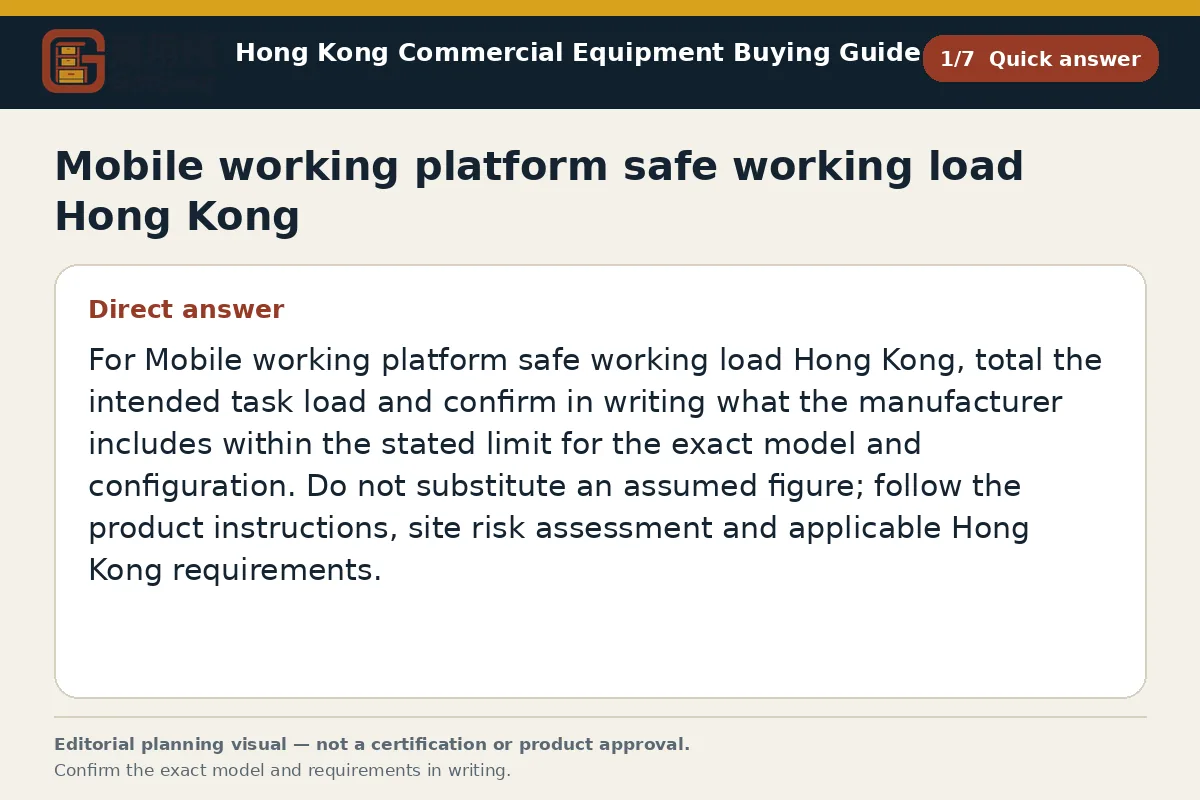
Mobile working platform safe working load Hong Kong must be verified by assessing users, tools, materials and the total task load. Confirm the manufacturer's limit for your configuration and seek guidance from GotGear.
Read the guide
Step-up platform Hong Kong
Compare Step-up platform Hong Kong with Mobile two step stool Hong Kong for reach, standing area, movement and footprint. Review dimensions and controls and consult GotGear for full product details.
Read the guide
Aluminium work platform for narrow spaces Hong Kong
When considering an Aluminium work platform for narrow spaces Hong Kong, measure the access route and compare transport and deployed footprints, door and lift dimensions and operator clearance. Contact GotGear for assistance.
Read the guide
Fiberglass step platform Hong Kong
Compare height, standing area, footprint and access between a Fiberglass step platform Hong Kong and a Fiberglass hop-up platform Hong Kong. Choose the option that suits your task with GotGear in Hong Kong.
Read the guideRelated topic indexOpen more English procurement pages1 topics
Browse additional equipment families, applications and procurement questions relevant to a wider buying brief.