
For Mobile working platform safe working load Hong Kong, total the intended task load and confirm in writing what the manufacturer includes within the stated limit for the exact model and configuration. Do not substitute an assumed figure; follow the product instructions, site risk assessment and applicable Hong Kong requirements.
Build the task load for Mobile working platform safe working load Hong Kong
Start by defining the maximum simultaneous mass that will be on the deck at one time. Count people actually on the platform, plus their clothing and PPE, and list tools and materials that will be there together. When verifying Mobile working platform safe working load Hong Kong, use real figures from your task plan rather than assumptions. If loads are moved in stages, identify the peak “all-on-deck” moment and build the number from that point.
Measure where possible. Weigh typical tool bags and sample boxes of materials on a site scale, or use manufacturer data sheets if weighing is impractical. Record if loads may absorb moisture (e.g., humid-store cartons) and note a higher wet mass as a working example to be confirmed in writing. State the maximum number of persons expected on the deck at once, the heaviest single item to be placed, whether loads are spread or concentrated, and whether any deck extension is required. Put this task-load statement into your written enquiry and ask suppliers to confirm compatibility in the exact configuration. Cross-reference with your Work platform procurement specification Hong Kong so that bidders address the same, comparable scenario.
Users, tools and materials for Mobile working platform safe working load Hong Kong
People, tools and materials should be itemised using the same counting rule: only what is simultaneously on the deck. For users, set a site standard weight approved by your organisation and apply it consistently. For tools, list the heaviest power tool likely to be used together with its batteries, chargers (if they are brought onto the deck), and accessory boxes. For materials, state package type, count, and condition (e.g., sealed cartons, part-used tubs). If a point load (such as a compact machine component) is placed, note its footprint size as well as weight.
Request these fields in quotations: number of persons permitted on deck, maximum deck load, any limit on single-item point load, and any reduction when deck extensions, additional guardrails or out-riggers are fitted. In Hong Kong’s humid months, allow for potential moisture uptake in porous materials as an example to be confirmed by your competent adviser. For aluminium towers, keep to factory-approved kits; see Aluminium work platform original accessories Hong Kong for context on why add-ons can change capacity. Ensure the supplier responds in bilingual terms if your workforce or records require it.
What should buyers compare for Mobile working platform safe working load Hong Kong?
| Criterion | Straightforward requirement | More complex requirement | Evidence to provide |
|---|---|---|---|
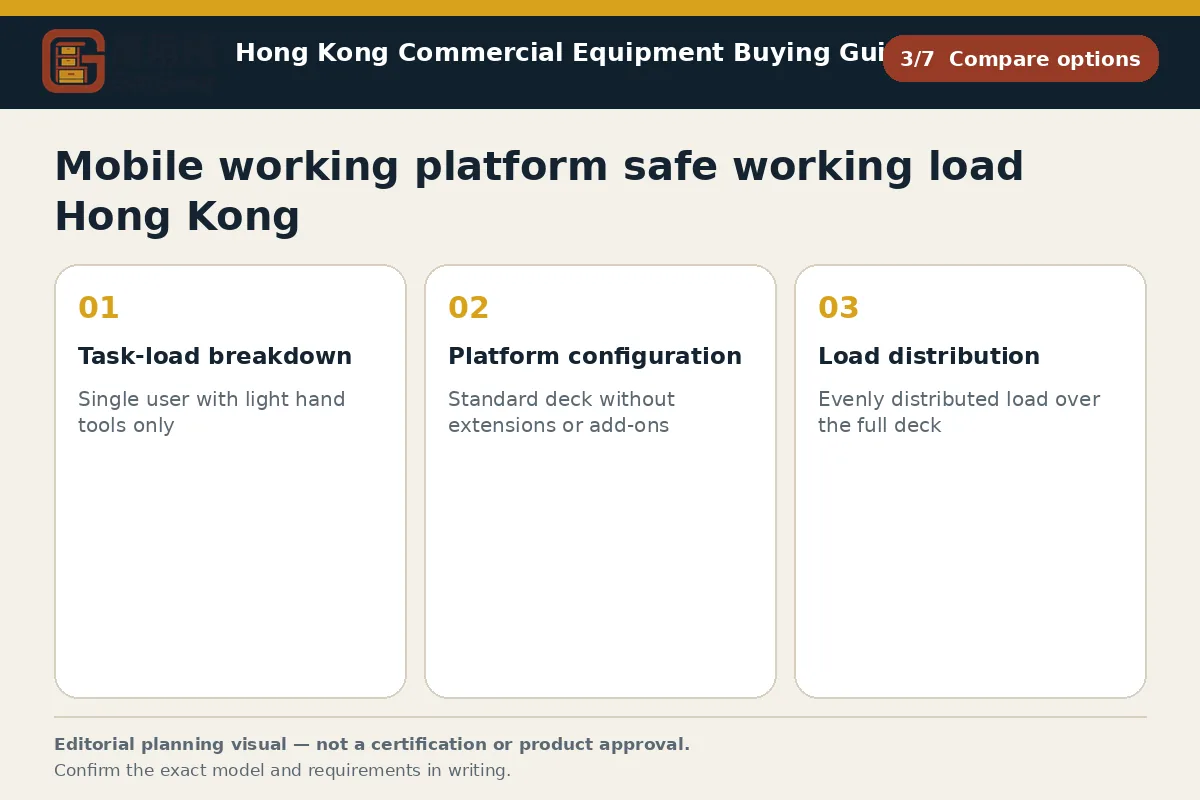
| Task-load breakdown | Single user with light hand tools only | Multi-user team with mixed tools and staged materials on deck | List persons, tools and materials with weights and simultaneous counts |
| Platform configuration | Standard deck without extensions or add-ons | Deck extensions, out-riggers or cantilever sections fitted | State model code, accessories, intended height and any extensions |
| Load distribution | Evenly distributed load over the full deck | Concentrated point load or small-footprint item on deck | Provide item weight, footprint size and placement drawing for approval |
| Access route constraints | Ground-floor access with wide doors and no lifts | Tight goods-lift, low door headers and timed loading windows | Measured door/lift clearances, photos and a planned movement route |
| Documentation and records | Manual and capacity plate photo on file | Bilingual set plus written capacity confirmation for configuration | Attach manuals, confirmation email/letter, delivery note and serials |
This framework helps buyers create comparable written enquiries. Final model specifications, availability, delivery and commercial terms must be confirmed in a formal quotation.
What the stated limit covers in Mobile working platform safe working load Hong Kong
A platform’s stated limit typically applies to the deck as an evenly distributed load and may also cap the number of persons. It might exclude suspended loads from guardrails, and it rarely permits point loads beyond values stated in the manual. Some accessories or configurations (e.g., deck extensions, out-riggers, cantilever frames) can reduce the allowed deck load or persons count. Confirm whether the limit already includes the self-weight of fitted accessories, or if a derating applies when they are installed.
Ask the supplier to confirm in writing, for the exact model and configuration, what the stated limit covers: persons, tools, materials, and any point-load constraints. If you plan tall builds, remember that stability constraints can govern allowable use before load limits are reached; see Mobile working platform height-to-base ratio Hong Kong for the related consideration. Indoor versus outdoor use, wind exposure on an open loading bay, and dynamic actions such as manual handling can all affect real tasks. Where your building manager or venue imposes stricter rules, those written controls take precedence together with the model specification and the formal quotation.
Capacity documents to retain for Mobile working platform safe working load Hong Kong
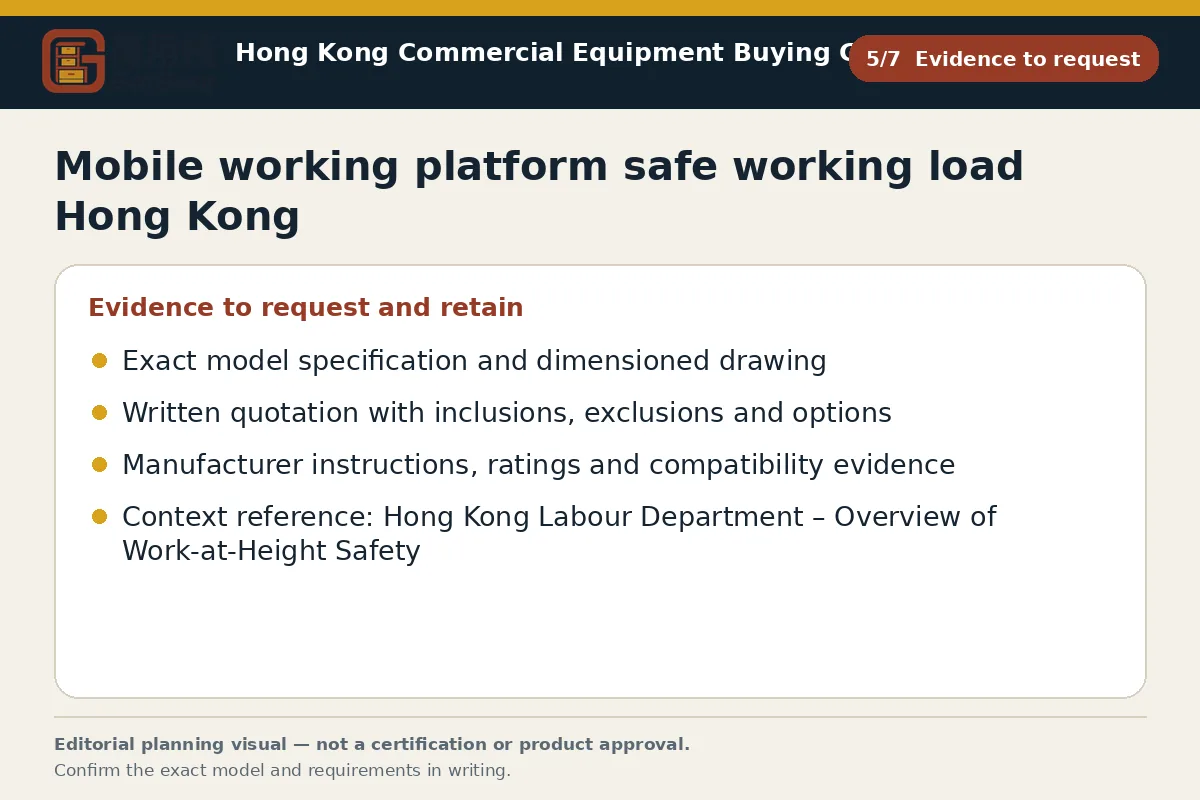
Retain the specification sheet, operating instructions, and a supplier or manufacturer letter or email confirming the safe working load for the selected configuration, including any derating for accessories or extensions. File photographs of the model identification and capacity plate after delivery, plus the delivery note that states the exact model code, configuration and serial number. Keep your task-load calculation with the Working platform risk assessment Hong Kong so reviewers can see how capacity was verified for the job.
If your organisation or insurer requires bilingual records, collect Chinese and English documentation and ensure labels are legible. On receipt, inspect that the deck, frames, guardrails and castors match the ordered configuration; check that any included accessories correspond to the written quotation. Log a simple site-acceptance record and store documents where supervisors can access them at the point of use. For institutions needing management-office approval, attach the confirmation to your Work platform procurement specification Hong Kong so future orders can be compared easily against an approved baseline.
Mobile working platform safe working load Hong Kong decision checklist
Write a task-load statement that totals the simultaneous mass of persons, tools and materials. Confirm the number of persons and any point loads. Measure access constraints, including lift car and doorway sizes, floor loading notes from the building, and any height limits. Specify the intended configuration, naming deck extensions, out-riggers and guardrails. Ask suppliers to confirm, in writing, the safe working load and persons permitted for that configuration, plus any derating. Request bilingual manuals where needed. Compare quotations line by line against your task-load statement and configuration. On delivery, verify model code, serial numbers, capacity plate and included accessories against the quotation. File photos, manuals and the written capacity confirmation with your risk assessment and site acceptance record.
- Operating use, quantity and expected frequency
- Dimensions, capacity, material and accessory requirements
- Delivery address, floor, goods lift and loading window
- Required documents, acceptance checks and after-sales arrangements
Key points for Mobile working platform safe working load Hong Kong
Hong Kong sites often involve tight goods lifts, narrow corridors and controlled loading bays. Measure access routes end-to-end, including lift car depth and door clearances; for example, note an internal width and height as a starting point only and confirm with the building manager. Many buildings require booking windows and permits for movement of equipment. Humid conditions can add mass to packaging, and bilingual instructions are commonly requested. This page gives practical procurement pointers, not legal advice; follow your model specification, venue controls and competent guidance.
Questions about Mobile working platform safe working load Hong Kong
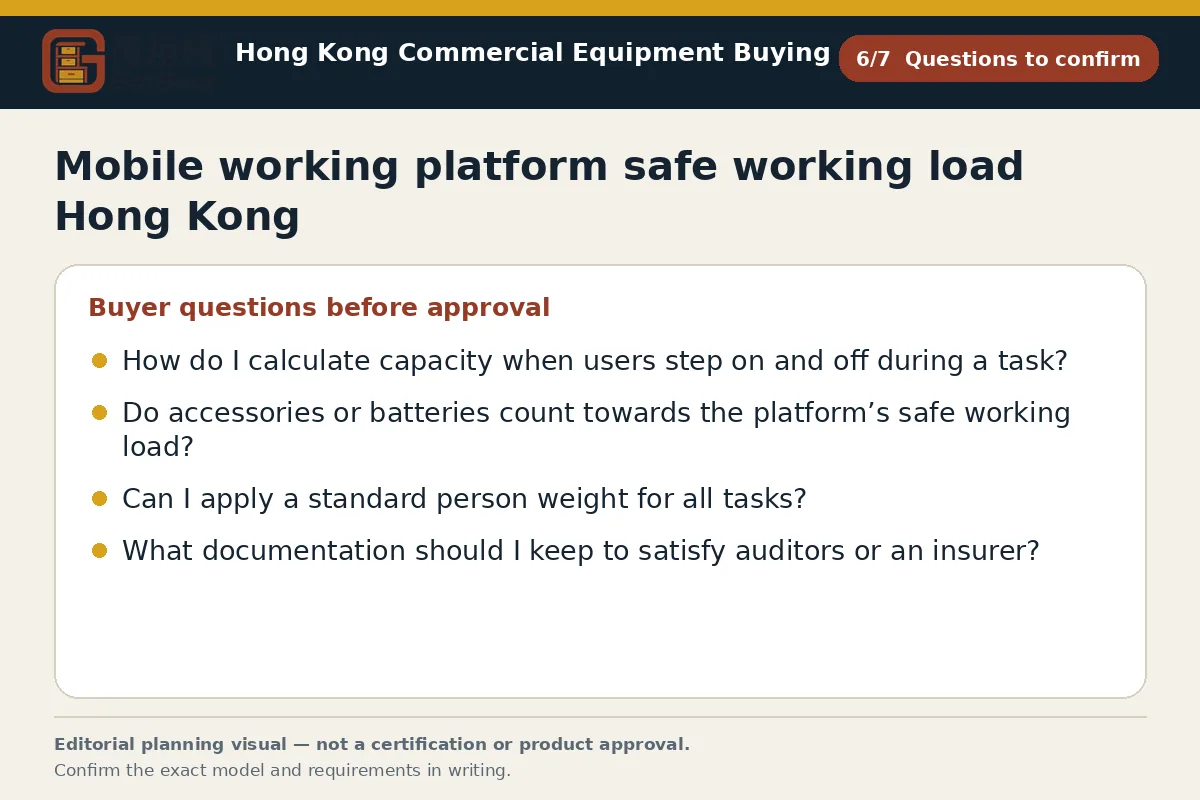
How do I calculate capacity when users step on and off during a task?
Count only the maximum number simultaneously on the deck and the peak combination of tools and materials at that same moment. Build the task timeline and identify the heaviest stage, then size the platform accordingly. If in doubt, ask the manufacturer to confirm allowances for dynamic handling, and align the final figure with your site risk assessment and written quotation.
Do accessories or batteries count towards the platform’s safe working load?
Count anything placed on the deck: batteries, toolboxes and material packs. Fixed components supplied as part of the approved assembly are typically accounted for in the rating, but certain add-on accessories may require a derating. Request written confirmation for the exact configuration you will use, and do not assume an allowance unless the instructions explicitly say so.
Can I apply a standard person weight for all tasks?
Use a site-approved standard person weight to make planning consistent, then confirm that your worst-case combination still fits the platform’s stated limit. For example, set an internal figure and test it against real staff and PPE if needed. The supplier’s model specification and your competent adviser’s guidance should govern the final documented approach.
What documentation should I keep to satisfy auditors or an insurer?
Keep the manual, specification sheet, written confirmation of safe working load for the chosen configuration, and photos of the capacity plate. Add the quotation, delivery note with serial numbers, your task-load calculation and the signed risk assessment. If bilingual records are required, store Chinese and English copies. Always let the model specification and formal quotation prevail.
Continue with closely related procurement topics
These pages share equipment, operating or decision-stage signals with this guide.
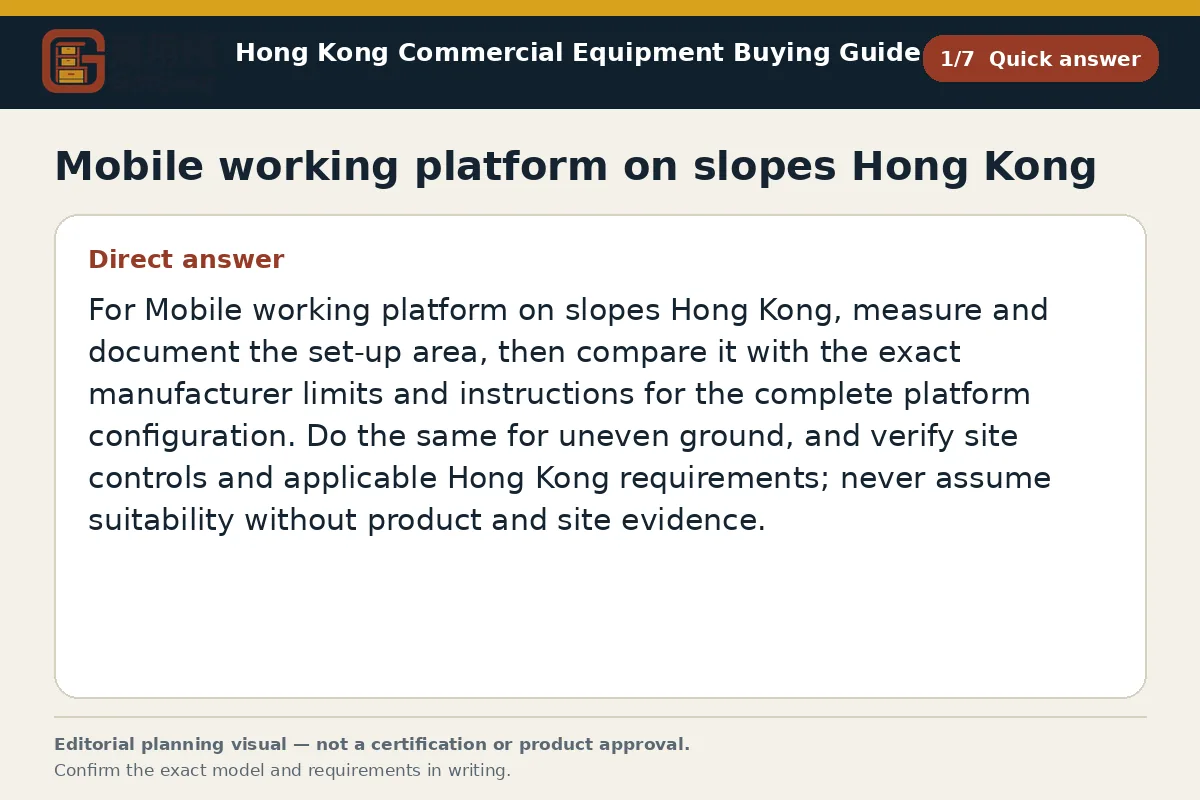
Mobile working platform on slopes Hong Kong
Note gradient and surface before using Mobile working platform on slopes Hong Kong and review limits for Mobile working platform on uneven ground Hong Kong. Check Working platform suitable ground conditions Hong Kong with GotGear.
Read the guide
Aluminium work platform for narrow spaces Hong Kong
When considering an Aluminium work platform for narrow spaces Hong Kong, measure the access route and compare transport and deployed footprints, door and lift dimensions and operator clearance. Contact GotGear for assistance.
Read the guide
Fiberglass work platform with guardrail Hong Kong
GotGear assesses Working platform electrical hazards Hong Kong and advises whether a Fiberglass work platform with guardrail Hong Kong or a Non-conductive work platform Hong Kong best suits the task and site controls.
Read the guide
Step-up platform Hong Kong
Compare Step-up platform Hong Kong with Mobile two step stool Hong Kong for reach, standing area, movement and footprint. Review dimensions and controls and consult GotGear for full product details.
Read the guideRelated topic indexOpen more English procurement pages1 topics
Browse additional equipment families, applications and procurement questions relevant to a wider buying brief.