
When selecting wet mop and handle Hong Kong, record the floor surface and area, the type of soil or liquid present, the wringing process, and the operator handling requirements. Compare dust and Kentucky formats only against their intended routines, and verify head-to-handle compatibility before ordering.
Match floor and liquid load to wet mop and handle Hong Kong
Start with the floor. Smooth vinyl, sealed terrazzo and ceramic tiles shed slurry differently from textured safety flooring or unfinished concrete. Record the finish, grout width, and whether grease, sanitiser residue or construction dust are typical. In Hong Kong’s humidity, drying times are longer, so pair absorbency with a fibre that releases liquid cleanly through the chosen wringer. When specifying a wet mop and handle Hong Kong, facilities teams should note the daily and peak liquid loads, then match head material: microfibre for fine soil and faster drying; cotton or blended yarn for bulk pick-up; looped-end to reduce linting.
Measure workable widths around fixtures and confirm the narrowest corridor, lift car and storeroom entrance that equipment must pass. As an example starting point, teams often shortlist heads or frames in the 400–600 mm range, then confirm the final dimension in the written brief. Request manufacturer data for fibre content, head mass or area weight, recommended wringer type, launderability and colour-coding options. Ask suppliers to state handle length, grip style, and tip/attachment type in writing, and to confirm if buckets, presses or clips are included or quoted separately. On receipt, inspect stitching or bond lines, yarn security and label legibility before first use, and keep packing notes for asset records and approval routing.
Wet mop and handle Hong Kong and Kentucky mop Hong Kong: Compare capacity
Capacity planning is central to any Kentucky mop comparison in Hong Kong. Kentucky heads carry and release more liquid, making them effective for back-of-house degreasing, stairwells, loading bays and post-event recovery. They require a compatible press and often a trolley to manage weight safely. In exchange for higher throughput on heavy soil, expect increased operator fatigue and slower drying, so schedule ventilation or signage accordingly in customer-facing areas.
Detail the wringing method in your enquiry. If you use a Kentucky press, specify the press make or model, the clip/jaw format, and the target head mass. As an example starting point only, buyers might trial heads in the 12–20 oz band and settle once handling feedback is logged; the final size must be confirmed by the responsible supplier. State whether a Kentucky mopping trolley in Hong Kong that your facilities team already owns will be reused, including wheel diameter and lift access constraints. Compare written quotations for head fibre, looped vs cut ends, tailband type, and stitch quality. Request manufacturer documentation for launder cycles, chemical compatibility and any slip-risk notes. On delivery, test-fit to the press, check clamp bite, and perform a short wet run to verify wring-out and operator control before wider rollout.
What should buyers compare for wet mop and handle Hong Kong?
| Criterion | Straightforward requirement | More complex requirement | Evidence to provide |
|---|---|---|---|
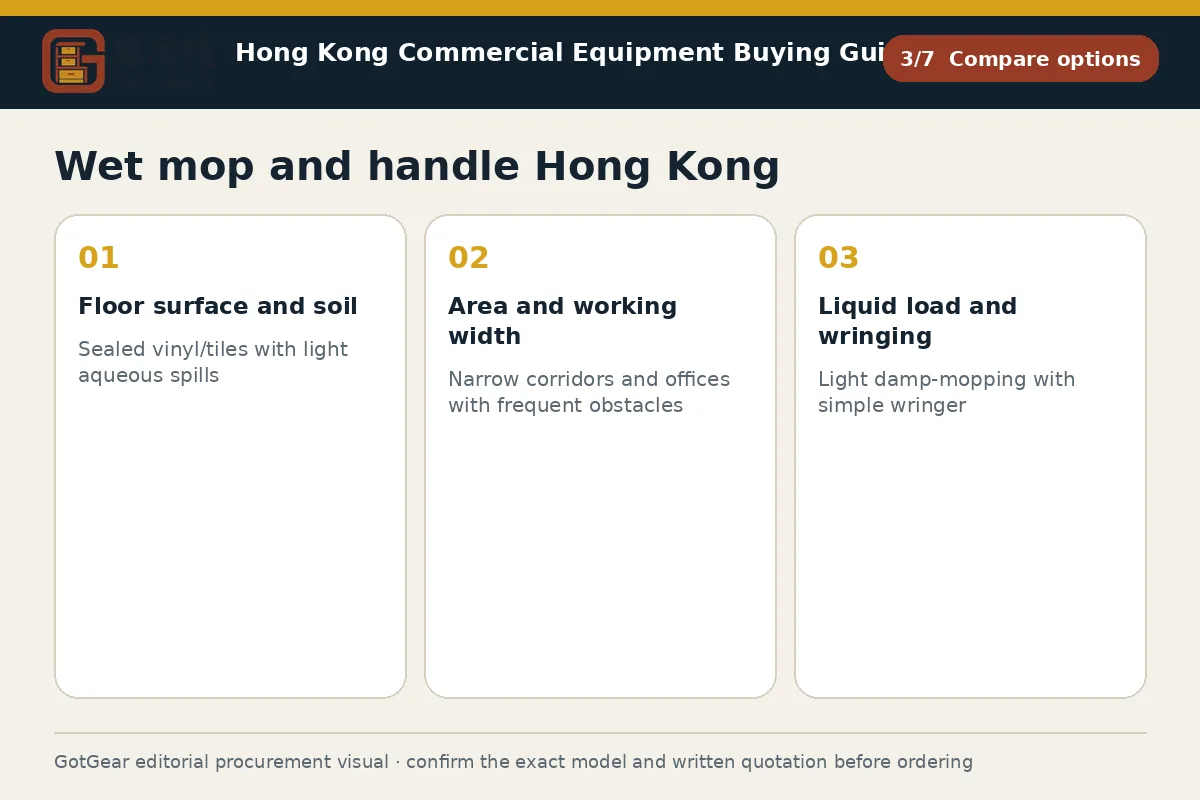
| Floor surface and soil | Sealed vinyl/tiles with light aqueous spills | Porous stone, textured safety flooring or greasy particulate soils | List floor finish, grout lines, typical soils and any anti-slip treatments |
| Area and working width | Narrow corridors and offices with frequent obstacles | Large concourses or halls needing wide passes and swivel frames | Provide measured aisle widths, obstacle map, and the tightest lift/door dimension |
| Liquid load and wringing | Light damp-mopping with simple wringer | Heavy spill pick-up or recovery using Kentucky press and trolley | State expected liquid volumes (example only), wringer type and trolley footprint |
| Head material and format | Microfibre flat or looped-end for general maintenance | High-absorbency cotton/blend, colour-coded and launderable for zones | Request fibre content, head mass/area weight, loop style and launder cycle data |
| Handle attachment and fit | Matching standard thread or push-fit cone | Jaw/clamp or Kentucky clip with specific press compatibility | Quote part codes, handle diameter, thread/clip type and maker’s compatibility note |
This framework helps buyers create comparable written enquiries. Final model specifications, availability, delivery and commercial terms must be confirmed in a formal quotation.
Wet mop and handle Hong Kong and dust mop and handle Hong Kong: Separate dry and wet duties
Dry dusting is a separate routine. A dust mop removes fine debris prior to any wet work, protecting the finish and reducing sludge. Specify the dust mop and handle that hallway teams in Hong Kong need by working width, swivel range and frame profile for toe-kicks and under‑furniture passes. Microfibre lifts fine particles without treatment; acrylic or cotton may be used with pre‑treatment if the venue permits. Avoid wet use; keep dust frames out of buckets to preserve glide and maintain hygiene zoning.
Define zones and time windows with building management, especially for malls and campuses where public access is controlled. If litter or grit is present, pair the frame with a commercial broom that buyers in Hong Kong already deploy, then follow with the dust pass. For large concourses, shortlist frames that accept launderable sleeves and confirm the laundry process can dry them reliably in humid weather. If you later add damp tasks, consider a flat mop system that operators in Hong Kong can clip to the same handle, but only if the attachment type matches. In RFQs, request frame material, sleeve fibre, launder count, swivel joint design, and whether replacement sleeves are standard catalogue items.
Check head attachment and handle fit for wet mop and handle Hong Kong
Attachment and fit determine whether tools work as specified. State clearly whether you need an internal or external thread, a push-fit cone, a jaw/clamp, or a Kentucky clip. Confirm the handle diameter, tip material and thread pitch as stated by the manufacturer; do not assume cross-compatibility. For corrosion resistance in plant rooms or coastal estates, compare aluminium, fibreglass and stainless-steel handles, and note grip texture for gloved use. If teams mix formats, catalogue each attachment style to avoid mis-mating in store rooms.
In your enquiry, quote the exact head and handle part codes you plan to pair, and ask the supplier to confirm compatibility in writing. Where swap-out is routine, request details on mop replacement heads Hong Kong stockists carry for the selected attachment. On receipt, check tip concentricity, thread integrity, clamp/jaw alignment, and that ferrules have no sharp burrs. Trial-fit one head per handle type, apply moderate wringing torque as a handling check, then tag the matched sets. Keep bilingual instructions and exploded diagrams for institutional approval files, and log any unique spares such as replacement cones or jaw screws for future orders.
Wet mop and handle Hong Kong decision checklist
Define your floors, soils and liquid loads, then select head fibre and format matched to wringing. Record the narrowest corridor, lift and doorway, and confirm trolley and handle lengths pass. State attachment type, handle diameter and thread or clip style exactly as the manufacturer describes. Separate dry dusting from wet mopping and list both routines in the same enquiry only for comparison, not interchange. Ask for written confirmation of compatibility, launderability and chemical tolerance. Compare quotations line by line for head size, fibre, looped ends, tailbands, handle material, included wringers and spares. On delivery, test-fit, perform a short wet run and file bilingual instructions for approval.
- Operating use, quantity and expected frequency
- Dimensions, capacity, material and accessory requirements
- Delivery address, floor, goods lift and loading window
- Required documents, acceptance checks and after-sales arrangements
Key points for wet mop and handle Hong Kong, dust mop and handle Hong Kong, Kentucky mop Hong Kong
Hong Kong sites face practical limits that influence mop and handle choice. Tight goods-lift cars, narrow fire doors and shared loading bays mean trolleys, presses and long handles must be measured against the smallest access point before ordering. Humidity slows drying and can degrade cotton if storage is poor, so plan ventilated racks and rotation. Coordination with the management office for delivery slots, dock passes and cleaning windows is routine. Bilingual documentation helps maintenance teams, contractors and auditors align on model codes and safe-use notes. This summary highlights operating constraints and is not legal advice.
Questions about wet mop and handle Hong Kong
When should I choose a Kentucky head over a flat or looped wet head?
Choose Kentucky for heavy spills, degreasing back-of-house work or post-event recovery when you need carry capacity and a press. It is heavier and slower to dry than lighter formats, so plan signage and airflow in public areas. Always confirm that the head, press and trolley are compatible with, and manageable for, the operator group.
Which handle material suits Hong Kong’s humid environments?
Aluminium and fibreglass resist corrosion and are light to manoeuvre; stainless steel offers durability for harsher sites but adds weight. Match material to exposure, storage conditions and operator preference. Request the manufacturer’s care guidance and confirm grip texture, handle length and tip type in writing before purchase to avoid incompatibility.
How do I confirm a new head fits an existing handle or press?
Record the existing handle’s diameter, attachment type (thread, cone, jaw, clip) and any stamped part codes, then request written confirmation from the head manufacturer that the pairing is approved. Where possible, ask for a sample photo or drawing showing the interface. Trial-fit one unit on delivery and document the result for approvals.
What supporting equipment should I plan for wet mopping routines?
Match the wringer to the head format and include a stable bucket or trolley sized to fit lifts and doors. Specify wheel type for building surfaces and note storage height for racks. If you use Kentucky heads, confirm press rating and trolley footprint. Request chemical-compatibility notes for detergents and sanitisers used on your site.
Continue with closely related procurement topics
These pages share equipment, operating or decision-stage signals with this guide.
Floor squeegee Hong Kong
Compare floor squeegee Hong Kong and window squeegee Hong Kong by surface, blade material, width, edge contact, handle fit and drainage to choose the right tool. Find the right model at GotGear.
Read the guide
Commercial broom Hong Kong
Commercial broom Hong Kong: GotGear compares bristle stiffness, head width and handle length. Dustpan and brush Hong Kong: Review lip and storage options.
Read the guide
Decorative refuse bins Hong Kong
Compare decorative refuse bins Hong Kong with lobby litter bins Hong Kong to assess capacity, opening style, finish, liner concealment and cleanability, and to confirm required floor area with GotGear, Hong Kong.
Read the guide
Hooded waste bins Hong Kong
GotGear compares hooded waste bins Hong Kong and wall mounted waste bins Hong Kong by aperture, floor clearance, fixings and cleaning access to help foodservice buyers assess suitability.
Read the guideRelated topic indexOpen more English procurement pages1 topics
Browse additional equipment families, applications and procurement questions relevant to a wider buying brief.