
To specify requirements, include details for microfiber cleaning cloth Hong Kong: list the surfaces to be cleaned, the cleaning agents to be used, the colour assignments, expected daily quantities and the wash-and-return process. Confirm textile-care instructions and chemical or surface compatibility, then calculate a sufficient number of cloths or pads to cover the full cycle.
Assign surfaces and tasks to microfiber cleaning cloth Hong Kong
For a microfiber cleaning cloth Hong Kong, prepare a purchasing brief by first mapping every surface and task by area: guestroom glass and mirrors, vanity tops and taps, stainless kitchen equipment, lacquered or sealed wood, display cases, lift panels, and POS screens. Note the cleaning method (dry dust, damp wipe, disinfection, polish), chemical families already approved on site, and finish sensitivities such as anti-fingerprint coatings or soft acrylics. From this, shortlist weave types (plush, waffle, glass-smooth), pile height, edge finish (ultrasonic, bound, overlock) and typical cloth size to fit staff hands and fold patterns.
Record site constraints before asking for quotations: storage space in pantries, humid back-of-house conditions, and lift/doorway sizes that influence case pack handling. Ask vendors to state fibre composition, backing or edging materials, linting control, snag resistance, and care instructions in bilingual format. Request small samples to wet-test on the most delicate finish and to check for dye bleed with your approved chemicals. For contamination control, separate tasks likely to encounter food proteins, body fluids or heavy grease; vendors should confirm chemical and surface compatibility in writing. Finally, estimate daily quantities by zone and shift, then add a full wash-and-return buffer so operations are never short while items are in transit or drying.
Plan colour coding and handling for microfiber cleaning cloth Hong Kong
Fix colour coding and handling before scaling up. Align colours with existing housekeeping and kitchen SOPs and avoid clashing with venue signage or event branding. Publish a simple matrix by zone and task, with bilingual labels on wall charts, trolleys and storage bins. Pre-fold to a repeatable pattern so each fold reveals a clean panel, and set rules for when to change cloths during high-occupancy or banquet turnover. If trolleys are used, plan holders and bins with housekeeping cart accessories Hong Kong so clean and used textiles never mix.
Handling must support traceability and hygiene. Specify soil-segregated, leak-resistant bags labelled by colour and area, plus a staging location that does not obstruct narrow corridors or goods-lift lobbies. In humid weather, include breathable containers for short-term holding and quick transfer to laundry. Ask the supplier to confirm dye fastness against your detergents and sanitisers, and provide written guidance on pre-wetting versus spray application by task. During trials, supervisors should log any cross-over errors between colours and refine training. Ensure all documentation in quotations and delivery notes is bilingual where required by the operator or property manager.
What should buyers compare for microfiber cleaning cloth Hong Kong?
| Criterion | Straightforward requirement | More complex requirement | Evidence to provide |
|---|---|---|---|
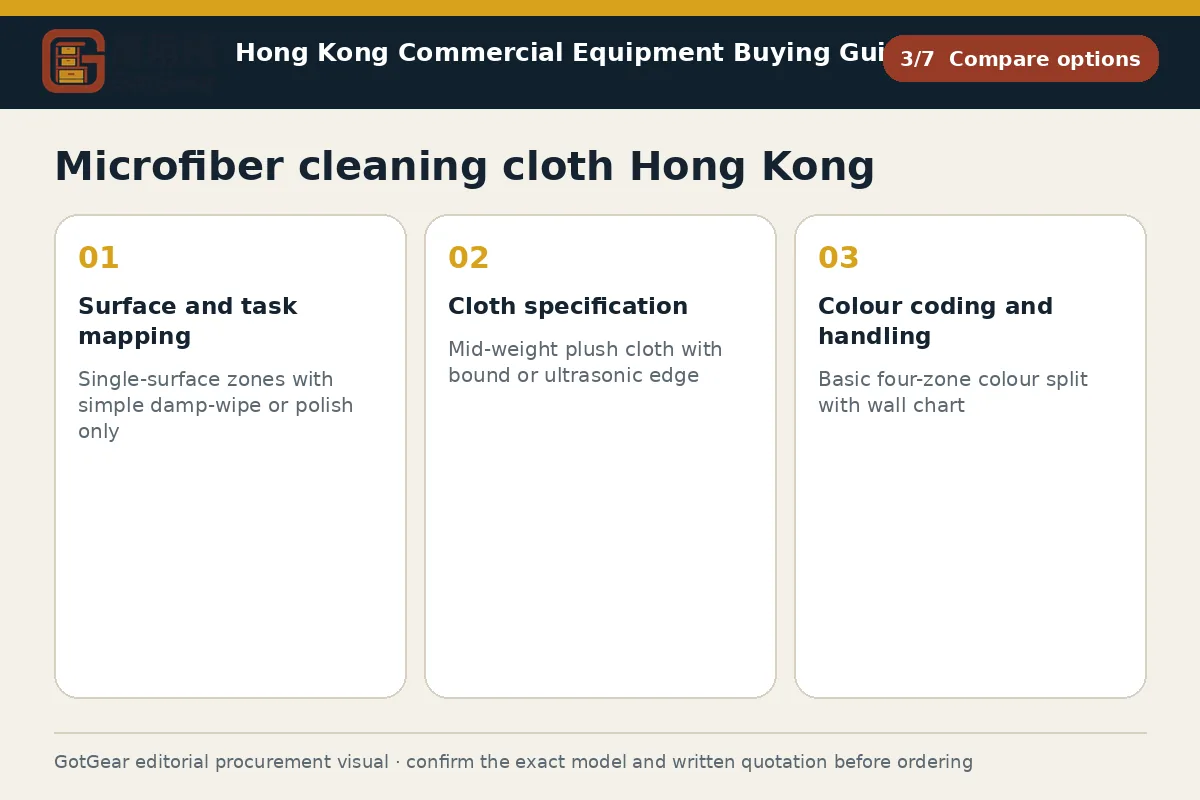
| Surface and task mapping | Single-surface zones with simple damp-wipe or polish only | Mixed finishes (glass, coated metals, stone, wood) with disinfection steps | Room-by-room surface list, chemicals in use, finish sensitivities, cleaning method per task |
| Cloth specification | Mid-weight plush cloth with bound or ultrasonic edge | Mixed weaves (glass-smooth, waffle, high-pile) and snag-resistant edges | Requested fibre split, weave, pile/texture, edging type, size tolerance, linting notes |
| Colour coding and handling | Basic four-zone colour split with wall chart | Multi-site programme with bilingual charts and soil-segregated bagging | Colour map by task/area, handling SOPs, training materials and labelling requirements |
| Flat-mop integration | One frame width with Velcro pads for standard corridors | Multiple widths, pocket and Velcro mix, and varied handle threads | Frame type and widths, pad backings, handle fitting, hallway measurements, turning space |
| Laundering and logistics | In-house wash with stated care instructions | Outsourced laundry, booking windows and humidity-limited drying | Manufacturer care guide, laundry parameters, par-level calculation, return lead time |
This framework helps buyers create comparable written enquiries. Final model specifications, availability, delivery and commercial terms must be confirmed in a formal quotation.
Microfiber cleaning cloth Hong Kong and microfiber flat mop Hong Kong: Plan care and replacement
Where floor care is significant, a microfiber flat-mop package can extend the same colour-coded logic from cloths to hard floors. Begin by mapping floor types, room sizes, corridor widths and obstruction points. Select pad formats (Velcro or pocket), and choose frame width and articulation to reach under beds and banquettes; confirm handle-thread compatibility with any existing wet mop and handle. If frames vary by area, capture this in the enquiry so pad backings and widths are correct across all zones.
Define work method and logistics early. For pre-dosed cleaning, establish pad consumption by running a supervised trial in one wing and scaling the result, then request the model specification and a formal written quotation to reflect that assumption. Identify storage and drying space; in humid plant rooms, ask for vendor recommendations on airing racks and pad backing that tolerates slow drying. When comparing offers, match frames, pads and any flat-mop system accessories line by line, including spare clips, Velcro strips and mop replacement heads. Check that cartons fit goods-lift dimensions and that delivery can be booked with the management office within permitted loading windows. Document any required bilingual floor-care SOPs and site-induction needs for contractors.
Set laundering and replacement rules for microfiber cleaning cloth Hong Kong
Laundry and replacement rules must come from the manufacturer’s care instructions and your site method. Ask for written guidance on maximum wash temperature, detergent types, and prohibitions such as fabric softeners or chlorine where specified. Confirm whether thermal or chemical disinfection is permitted for the model. Define a full-cycle flow: point-of-use bagging by colour, transport to the laundry, sorting, washing, drying with adequate airflow in Hong Kong’s humidity, and sealed return to clean storage.
Calculate par levels with a practical buffer. As an example starting point, some teams model a three-stage cycle (in use, in wash, in store) and validate the quantities during a live trial; confirm counts and intervals in writing with your laundry provider and supplier. Set replacement triggers based on absorbency loss, visible thinning, detached edging, Velcro fatigue, or persistent staining after approved rewash. On receipt, inspect carton labelling, fibre composition, size tolerances, stitching or ultrasonic cuts, and colour consistency batch to batch. Maintain a register by colour and area, and review laundry records for shrinkage trends. Coordinate deliveries with building access controls and bilingual paperwork where your institution requires it, and let the model specification and formal written quotation prevail in any tie-break.
Microfiber cleaning cloth Hong Kong decision checklist
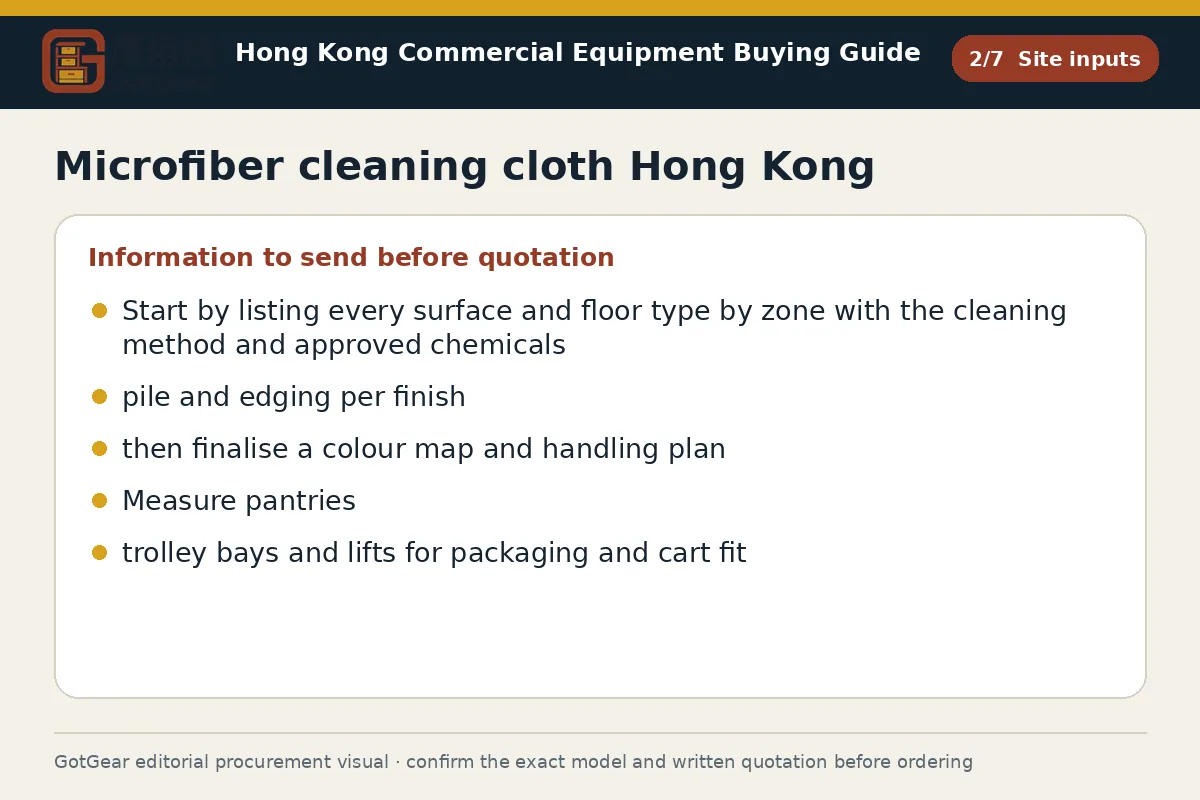
Start by listing every surface and floor type by zone with the cleaning method and approved chemicals. Choose weave, pile and edging per finish, then finalise a colour map and handling plan. Measure pantries, trolley bays and lifts for packaging and cart fit. Decide pad/frame formats and handle compatibility. Request quotations that state fibre split, weave, edging, size, pad backing, care instructions and bilingual labelling. Run a supervised trial to validate daily quantities and pad consumption, then calculate par levels for the full wash-and-return cycle. Confirm laundry parameters and return lead times. On receipt, check batch colour consistency, dimensions, edging quality, backing adhesion and dye fastness notes. Document anything that could affect loading windows, contractor induction or institutional sign-off.
- Operating use, quantity and expected frequency
- Dimensions, capacity, material and accessory requirements
- Delivery address, floor, goods lift and loading window
- Required documents, acceptance checks and after-sales arrangements
Key points for microfiber cleaning cloth Hong Kong, microfiber flat mop Hong Kong
Hong Kong buyers should plan around tight back-of-house circulation, restricted goods-lift sizes, and management-office booking for loading bays. Building rules may limit delivery hours, contractor access and temporary staging locations, so align carton sizes and palletisation with those constraints. Humidity slows drying; allow extra airing capacity for cloths and pads, or confirm materials that tolerate slower dry times. Many institutions request bilingual SOPs and labels; verify what your venue, client or insurer expects. The above points are operational guidance only, not legal advice—confirm site-specific requirements with property management and competent advisers.
Questions about microfiber cleaning cloth Hong Kong
How many cloths and pads should we budget per day?
Set a baseline with a supervised trial in one representative area, then scale up. As an example starting point, a guestroom turn may consume several cloths across glass, bathroom and surfaces, and corridors require multiple flat-mop pads per run. Validate counts with your team, laundry return times and supplier guidance, and let the written quotation reflect the agreed cycle.
Can one cloth type handle both glass cleaning and disinfection tasks?
Often you’ll need different weaves or colours to protect finishes and avoid cross-contamination. Smooth, low-lint cloths suit glass, while higher pile can lift soils before disinfectant contact. Check manufacturer chemical-compatibility and dye fastness in writing for your chosen model, trial on your surfaces, and keep the colour map clear to staff in bilingual formats where required.
Are flat-mop frames and pads interchangeable across brands?
Not reliably. Pocket versus Velcro backings, frame widths, and handle threads vary, and mismatches reduce performance or safety. Specify frame type, articulation and handle fitting in your enquiry, request samples for a fit test with your existing gear, and seek confirmation in the vendor’s written quotation that pads and frames delivered are fully compatible.
What should we compare in vendor quotations to make a fair decision?
Ask each vendor to quote against the same details: cloth size, weave, pile, edging, fibre composition, colour set, pad backing type, frame width and handle fitting, plus care instructions and packaging. Request bilingual documentation if needed, sample pieces for trials, and confirm delivery booking, access constraints and laundry parameters so total lifecycle fit can be compared line by line.
Continue with closely related procurement topics
These pages share equipment, operating or decision-stage signals with this guide.
Flat mop system Hong Kong
Flat mop system Hong Kong: GotGear compares frame design, pad attachment, trolley compatibility, preparation, separation, laundering and pad quantities.
Read the guide
Telescopic cleaning pole Hong Kong
When choosing a telescopic cleaning pole Hong Kong, consider safe working reach, collapsed length, attachment compatibility and storage rather than maximum extension alone. See the GotGear checklist for guidance.
Read the guide
Flat mopping trolley Hong Kong
Compare a flat mopping trolley Hong Kong and a Kentucky mopping trolley Hong Kong across pad preparation, water handling, storage, footprint and lift or door clearances, with insights from GotGear.
Read the guide
Floor squeegee Hong Kong
Compare floor squeegee Hong Kong and window squeegee Hong Kong by surface, blade material, width, edge contact, handle fit and drainage to choose the right tool. Find the right model at GotGear.
Read the guideRelated topic indexOpen more English procurement pages3 topics
Browse additional equipment families, applications and procurement questions relevant to a wider buying brief.