
For hooded waste bins Hong Kong, check that the aperture and hood arrangement suit the intended material and can be cleaned without obstructing circulation. If a wall-mounted alternative is considered, verify the substrate, manufacturer instructions, site conditions and applicable Hong Kong requirements before any fixing decision.
Match hooded waste bins Hong Kong to the waste and cleaning routine
Start by mapping waste types to handling and cleaning routines. Food scraps, wet wipes and mixed packaging create different splash, odour and pest risks, so the hood design and aperture shape should match the stream. Hooded waste bins Hong Kong are often chosen where covered presentation, drip control and quieter operation matter, such as corridors near classrooms, canteens and production lines. In humid plant rooms or dishwash areas, request materials and finishes that resist corrosion and staining, and confirm that the hood can be washed down without trapping water.
For specification, record the daily uplift frequency and an example bag volume starting point (for instance, 30–50 litres) to be confirmed in the written brief. Note the footprint available and door swing clearance, especially in tight Hong Kong service corridors. Ask for overall height, aperture size and hood-clearance drawings, liner-retention method, base protection, and whether touch points are smooth-edged. Confirm compatibility with waste bin liners Hong Kong and the site’s colour or bilingual labelling scheme. If aisles are narrow, compare with slim waste bins Hong Kong for like-for-like dimensions. For front-of-house, you may also evaluate decorative refuse bins Hong Kong. Where heavy bags are expected, plan safe transfers and consider bin dollies Hong Kong for back-of-house movement between the disposal point and compactors without blocking circulation.
Check aperture height and bag access on hooded waste bins Hong Kong
Aperture height, opening geometry and hood reach strongly influence usability and hygiene. In counter-service areas, check whether the aperture aligns with tray height to avoid tipping and spills; in schools, confirm a comfortable reach for younger users. Request the aperture height, width, edge radius and any baffle measurements on scaled drawings. If an example datum helps trials, start with a notional 850–1,000 mm aperture height and refine to suit your site and user profile, then confirm in the model specifications and written quotation. Ensure signage is visible on approach and that the hood does not hide labels.
Bag access needs the same scrutiny. Specify whether the hood is lift-off or hinged, how far it opens, and the vertical and lateral clearance needed for bag removal. Check that there is space to knot liners without compressing contents under the hood. In wash-down areas, confirm that the hood can be cleaned without trapping debris at hinge points. Ask the manufacturer for exploded diagrams or maintenance instructions that show disassembly and reassembly steps. On receipt, inspect that the hood seats squarely, hinges move freely, and no sharp edges or burrs remain on the aperture lip that could tear liners or injure hands.
What should buyers compare for hooded waste bins Hong Kong?
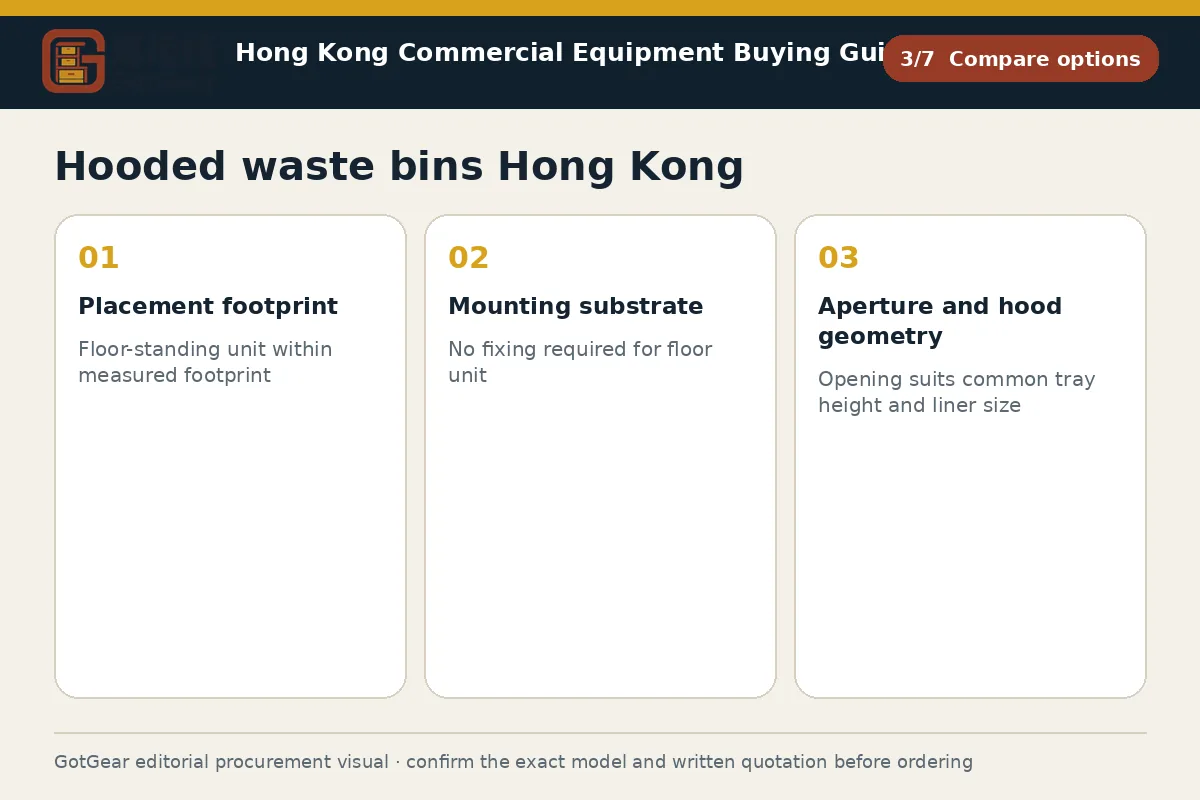
| Criterion | Straightforward requirement | More complex requirement | Evidence to provide |
|---|---|---|---|
| Placement footprint | Floor-standing unit within measured footprint | Tight corridors requiring traffic modelling and turning clearances | Scaled plan with footprint, approach widths and door swings |
| Mounting substrate | No fixing required for floor unit | Wall unit fixed into verified substrate and approved anchors | Photos, wall build-up note, manufacturer’s fixing schedule |
| Aperture and hood geometry | Opening suits common tray height and liner size | User mix needs specific height, baffles and edge profile | GA drawing with aperture height/width and hood-clearance data |
| Servicing and bag removal | Bag can be lifted and tied off in place | Route includes lifts/doors and knotting space under the hood | Servicing route sketch, lift/door dimensions, tie-off clearance |
| Cleaning and signage | Smooth surfaces, visible labels on approach | Wash-down, corrosion resistance and bilingual panels required | Cleaning statement, material data sheet, sample signage artwork |
This framework helps buyers create comparable written enquiries. Final model specifications, availability, delivery and commercial terms must be confirmed in a formal quotation.
When wall mounted waste bins Hong Kong differ from hooded waste bins Hong Kong
Wall mounted waste bins Hong Kong free up floor area for mopping and reduce trip hazards, which suits tight washrooms, corridors and platform edges. They can give consistent mounting heights, improving accessibility and wayfinding. However, they rely on suitable substrates, approved fixings and service access, and usually offer smaller capacities than large floor units. In multi-tenant Hong Kong buildings, confirm management-office approvals for drilling, permitted working hours and any noise restrictions before scheduling works. For public events, check if tamper-resistant fixings and lockable lids are requested by the venue or insurer.
When comparing against hooded waste bins Hong Kong, list the servicing steps: how the front opens, where the bag is supported, and whether the cleaner can tie off and remove the liner without spilling. Require the manufacturer’s mounting instructions, fixing kits matched to your substrate, and a statement of the recommended maximum loaded weight (to be validated by your competent party). Ask for a wall template to verify penetrations against concealed services. Note the clearance below for mops and skirting. Compare written quotations for inclusion of fixings, installation guidance, delivery to floor, and any bilingual signage panels so the total package is like-for-like.
Verify site conditions before specifying hooded waste bins Hong Kong
Before you specify, walk the route and record constraints. Measure doorways, lift cars and turning spaces that the assembled bin or its largest component must pass through; for example, note the narrowest door clear width and goods-lift dimensions, then confirm fit in the supplier’s drawings. Check the floor area where the unit will stand for levelness, drain locations and wash-down spray patterns so the hood, seams and base can be cleaned without splashing users or blocking evacuation routes. If floor slopes or heavy loads are expected, include a note on stability and whether bin dollies Hong Kong will be used.
Environmental and documentation checks reduce rework. Hong Kong’s humidity favours stainless steel or UV-stabilised plastics for some sites; ask for material data sheets and cleaning compatibility statements. If your venue or insurer requires particular flame-spread or pest-control considerations, request written confirmation for the proposed model. Confirm available colours or labelling for bilingual messaging. For receipt inspection, note hood alignment, fastener completeness, liner-ring integrity and finish quality, then reconcile against the model specifications and the formal quotation. Where mounting is planned, capture photos of the substrate, visible cracks or tiles, and any nearby services to brief the installer accurately.
Hooded waste bins Hong Kong decision checklist
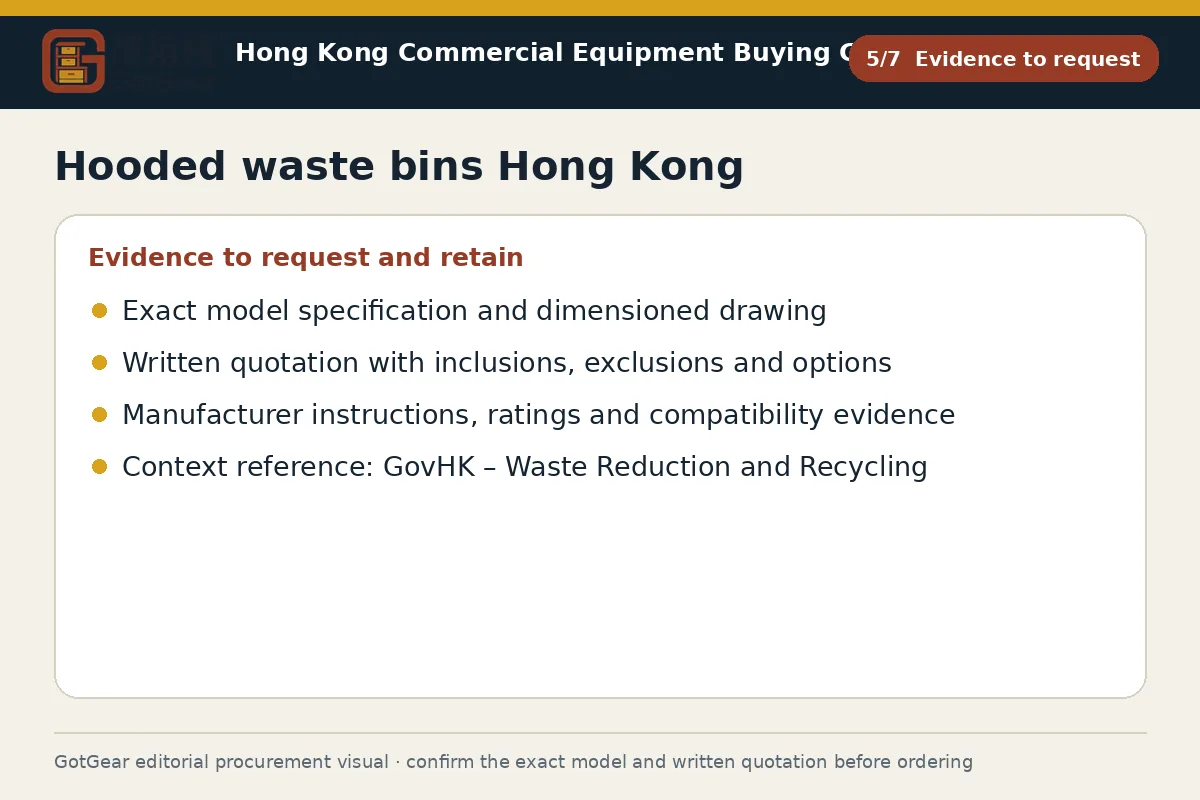
Define the waste stream, uplift frequency and an example capacity starting point, then confirm with the chosen model. Measure available footprint, approach routes, and any lift and doorway constraints for delivery and servicing. Record floor levelness, drain locations and splash zones that affect cleaning. For wall fixing, photograph the substrate and note management-office permissions and working-hour limits. Request scaled drawings, hood and aperture dimensions, liner retention details, and recommended loaded weight. Ask for mounting instructions, fixing kit descriptions and bilingual signage options. Compare written quotations for inclusion of fixings, templates, delivery-to-floor and documentation. On receipt, inspect finish quality, hood alignment and absence of sharp edges.
- Operating use, quantity and expected frequency
- Dimensions, capacity, material and accessory requirements
- Delivery address, floor, goods lift and loading window
- Required documents, acceptance checks and after-sales arrangements
Key points for hooded waste bins Hong Kong, wall mounted waste bins Hong Kong
Hong Kong sites often blend tight back-of-house corridors with strict building-management controls. Expect lift bookings, delivery windows and noise limits for drilling that require coordination with the management office. Substrates vary from solid concrete to tiled stud walls; mounting choices should be verified against the actual wall build-up, not assumptions. Humid conditions, frequent wash-downs and bilingual visitor flows favour corrosion-resistant finishes and clear signage. This page compares formats and procurement evidence; it is not legal advice and model specifications and the formal written quotation prevail.
Questions about hooded waste bins Hong Kong
How do I choose capacity for front-of-house versus back-of-house use?
Match capacity to uplift frequency and waste type, then confirm with the supplier’s model specifications. As an example starting point, a smaller front-of-house unit may suit frequent empties, while back-of-house may justify larger volumes. Validate choices with a short site trial, review spill and odour observations with cleaners, and ensure the final requirement is captured in the written quotation.
Can I mount a bin on tiled partition walls in older buildings?
Possibly, if the underlying structure and fixings suit the load and use. Verify the wall build-up, not just the tile finish, and obtain the manufacturer’s mounting instructions. A competent party should confirm anchor type and positions relative to joints and services. Management-office permission and drilling-time restrictions commonly apply in Hong Kong and should be scheduled in writing.
What should I ask suppliers to include in a quotation for comparison?
Request the exact model code, capacity, aperture and hood dimensions, materials and finishes, liner-retention method, recommended loaded weight, and cleaning guidance. For wall units, ask for the fixing kit description and a mounting template. Include delivery-to-floor, any bilingual signage panels and documentation. Compare like-for-like scope, and treat the formal written quotation as prevailing over drawings or emails.
How do we clean hoods without blocking corridors or wetting users?
Specify cleaning that suits your traffic pattern and splash zones, and confirm the hood’s disassembly method. In narrow corridors, plan off-peak wash-down and use tools that fit under or around the hood. Ask the manufacturer for maintenance instructions showing hinge access and water-shedding details. Trial a small area first and adopt the method only after the site manager signs off.
Continue with closely related procurement topics
These pages share equipment, operating or decision-stage signals with this guide.
Decorative refuse bins Hong Kong
Compare decorative refuse bins Hong Kong with lobby litter bins Hong Kong to assess capacity, opening style, finish, liner concealment and cleanability, and to confirm required floor area with GotGear, Hong Kong.
Read the guide
Slim waste bins Hong Kong
Select slim waste bins Hong Kong by considering footprint, lid movement and easy liner removal. Compare swing top waste bins Hong Kong with push top waste bins Hong Kong for clearance and staff access with GotGear.
Read the guide
Waste bins with ashtray Hong Kong
Compare waste bins with ashtray Hong Kong and cigarette butt bins Hong Kong for placement, waste separation, emptying and hot-ash risk at local sites. Find guidance and options from GotGear.
Read the guide
Cabinet cleaning trolley Hong Kong
This guide summarises access, route width, load and lift limits and door clearances for cabinet cleaning trolley Hong Kong. Compare roll top cleaning trolley Hong Kong and compact cleaning trolley Hong Kong with GotGear.
Read the guideRelated topic indexOpen more English procurement pages1 topics
Browse additional equipment families, applications and procurement questions relevant to a wider buying brief.