
To shortlist slim waste bins Hong Kong, record the maximum footprint and check how people will reach the opening without blocking a route. Compare swing and push mechanisms by operating clearance, contact points and the way staff access the liner.
Measure aisles and door swings before choosing slim waste bins Hong Kong
Start by mapping the circulation zone, not just the nominal gap. Measure the narrowest point of the aisle under handrails and fixtures, and trace the full door-swing arc for fire doors, store rooms and service corridors. Note the approach path from both directions, including trolley turning lines and lift thresholds. Photograph the proposed position and mark obstructions such as skirting, floor channels, sockets and low signage that could foul a lid or base.
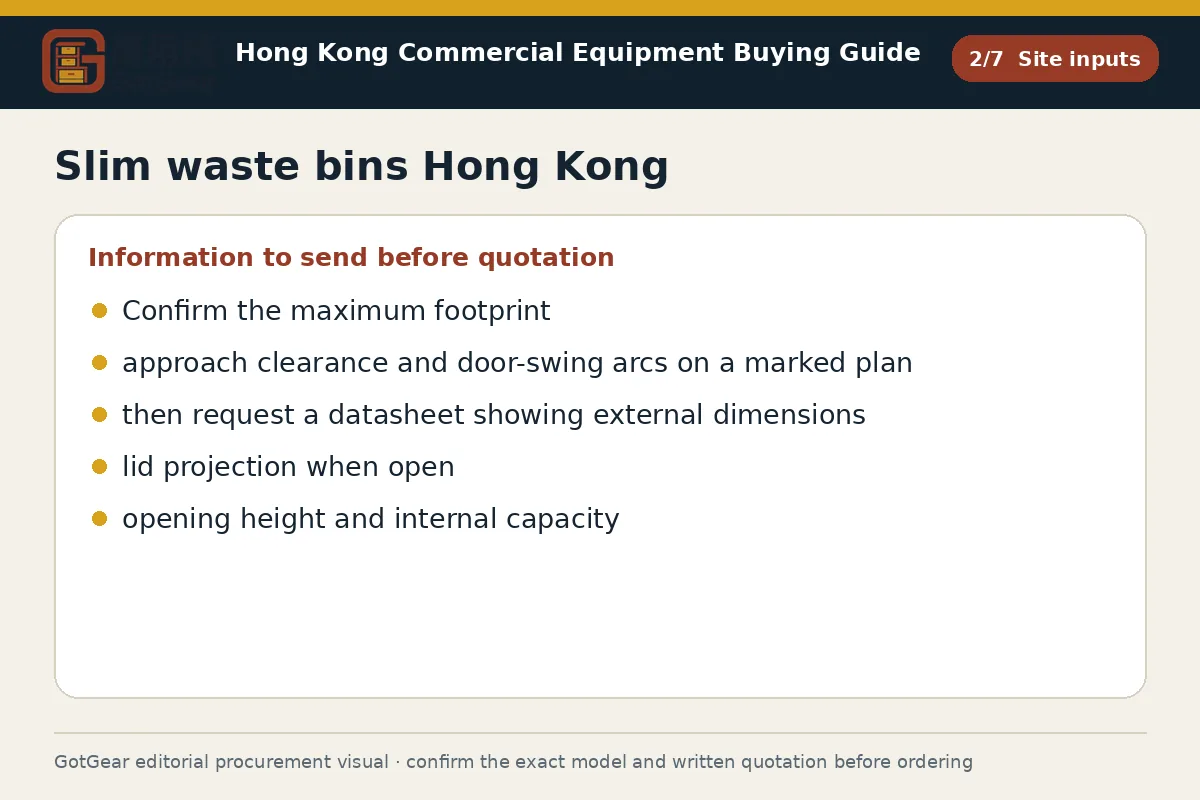
When requesting quotations for slim waste bins Hong Kong, ask for external width and depth, lid overhang when closed, and lid projection when fully opened against a wall. Specify the height to the opening, total internal capacity, recommended liner size, and whether there is a bag-retaining ring or rim clamps. Record the maximum footprint you can accept, plus the minimum clearance in front for safe use without blocking a route. If bins must pass through goods-lift doors, include packed dimensions and turning radius as a condition in the written enquiry. Request drawings or a datasheet that shows the opening geometry and any required wall clearance. On receipt, verify dimensions with a tape and confirm anti-slip feet, wall-bumper strips and any fixing points match the approved plan before the units enter service areas.
When push top waste bins Hong Kong change the case for slim waste bins Hong Kong
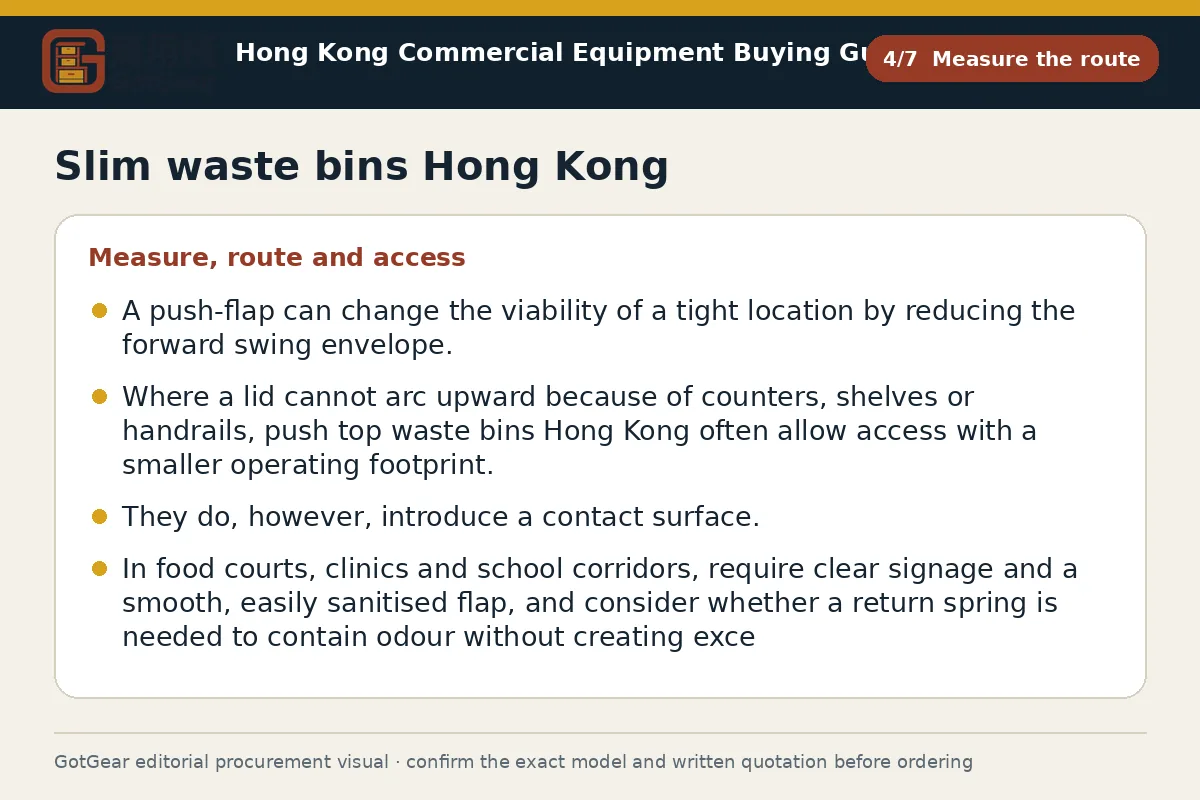
A push-flap can change the viability of a tight location by reducing the forward swing envelope. Where a lid cannot arc upward because of counters, shelves or handrails, push top waste bins Hong Kong often allow access with a smaller operating footprint. They do, however, introduce a contact surface. In food courts, clinics and school corridors, require clear signage and a smooth, easily sanitised flap, and consider whether a return spring is needed to contain odour without creating excessive opening force for users.
In procurement, request a technical sheet detailing flap material, hinge type, removable components and the maximum outward projection during operation. Ask for evidence that parts can be stripped for cleaning and that spares are available; reference waste bin replacement lids Hong Kong in your enquiry so vendors confirm compatibility by model code. Where hygiene is scrutinised, ask the manufacturer for cleaning and disinfectant compatibility guidance in both English and Chinese. For high-traffic venues, seek information on indicative life-cycle testing (e.g., cycles to wear under typical use, to be confirmed in writing). On delivery, check that the flap sits square, returns reliably, and does not pinch the liner during closure.
What should buyers compare for slim waste bins Hong Kong?
| Criterion | Straightforward requirement | More complex requirement | Evidence to provide |
|---|---|---|---|
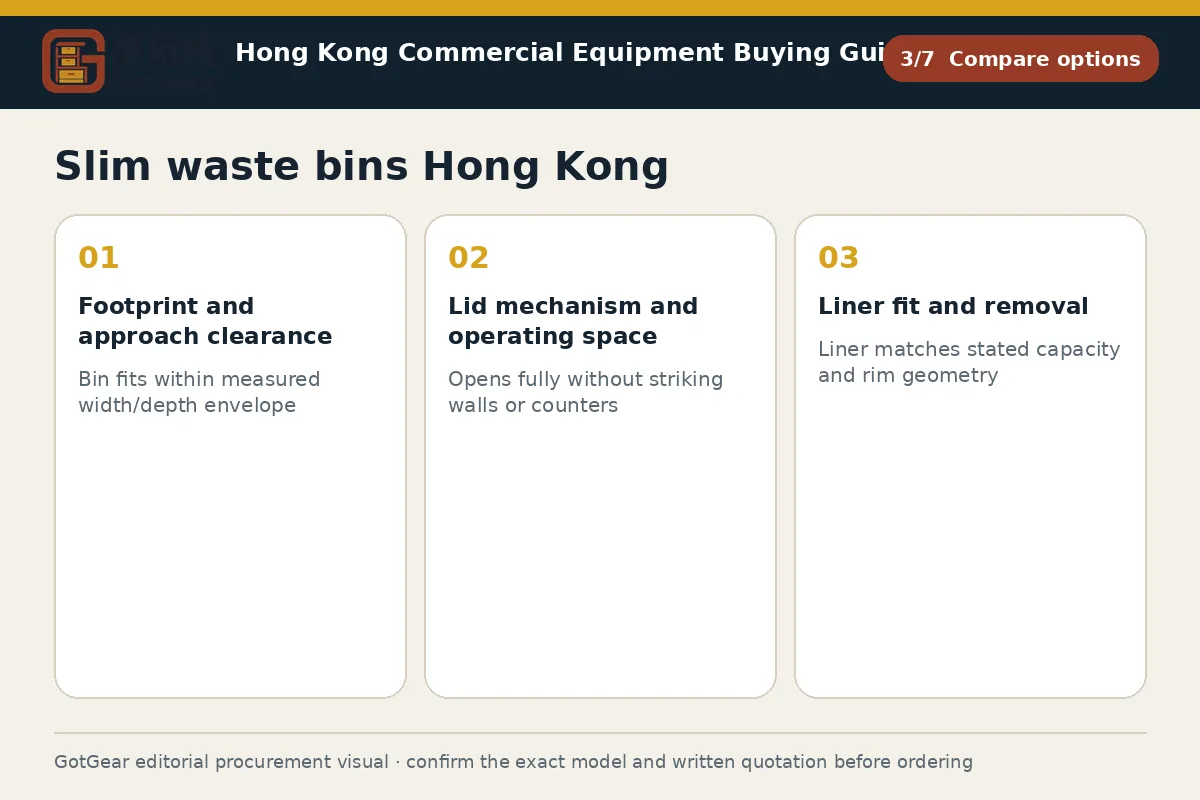
| Footprint and approach clearance | Bin fits within measured width/depth envelope | Allows for door arcs and two-way traffic with bin in place | Annotated plan with dimensions, obstruction photos, and maximum footprint noted |
| Lid mechanism and operating space | Opens fully without striking walls or counters | Accounts for user hand path and bin lean when full | Supplier’s lid arc/projection, opening height and any return-spring details |
| Liner fit and removal | Liner matches stated capacity and rim geometry | Tie-off and vertical lift-out possible in the exact location | Liner code, gauge and filled height; staff trial notes and timings |
| Materials and hygiene | Corrosion-resistant, smooth, easy-clean surfaces | Compatibility with site disinfectants and UV if semi-outdoor | Datasheet, materials statement, care instructions and cleaning guidance |
| Delivery and building constraints | Packed size passes smallest door and lift | Booking aligns with management-office and loading window rules | Packed dimensions/weight, route photos and booking confirmation in writing |
This framework helps buyers create comparable written enquiries. Final model specifications, availability, delivery and commercial terms must be confirmed in a formal quotation.
Slim waste bins Hong Kong and swing top waste bins Hong Kong: Compare access and cleaning
When comparing swing-top waste bins for use in Hong Kong with slim-profile bodies, consider the three clearances: lid travel, user hands and passing traffic. A balanced swing lid helps minimise touchpoints and can visually obscure contents, but its arc may intrude into tight aisles or strike adjacent walls. Request the lid-arc dimension beyond the body footprint and the height clearance required above the rim. Where litter is bulky, confirm the throat opening size and whether the lid can be latched open during servicing.
Front-of-house needs differ from back-of-house. If aesthetics and guest experience dominate, decorative refuse bins for front-of-house areas in Hong Kong may better match finishes while still providing narrow footprints. If weather protection or odour control is the priority at semi-outdoor loading bays, hooded waste bins with side apertures for Hong Kong locations might outperform a swing panel by containing rain ingress and directing smells upward. In bids, ask for material specifications, edge radiusing and noise-damping features, plus any optional bumpers to prevent wall scuffing. During trials, observe whether the lid motion impedes trolleys or causes drips when the liner is near full, and document staff feedback on ease of use at peak times for comparison across models.
Check bag removal and cleaning clearance around slim waste bins Hong Kong
Capacity on paper is not the whole story; ensure there is room to lift, tie and remove a full liner without snagging on counters, shelves or door frames. Measure vertical headroom from the bin rim to any overhead obstruction and the lateral clearance needed to angle the bag out. Specify the target fill height and the liner gauge you expect to use so suppliers can advise on tear risk when lifting. Reference waste bin liners Hong Kong in the enquiry to standardise sizes and drawstring or banding options across sites.
Cleaning needs the same forethought. Check there is space to wheel or carry the bin to a wash area and to tip, rinse and dry without contaminating adjacent storage. If splash control or odour screening matters near food pickup points, a hooded top can reduce exposure during service; confirm whether optional shrouds are compatible with slim bodies. Ask for the manufacturer’s cleaning instructions, including chemical compatibility and any removable drip trays, and confirm that labels are durable in humid conditions. On receipt, inspect internal corners for wipe-through access, ensure castors or skids do not trap dirt, and verify that water does not pool in the base after a test rinse before deploying units to the floor.
Slim waste bins Hong Kong decision checklist
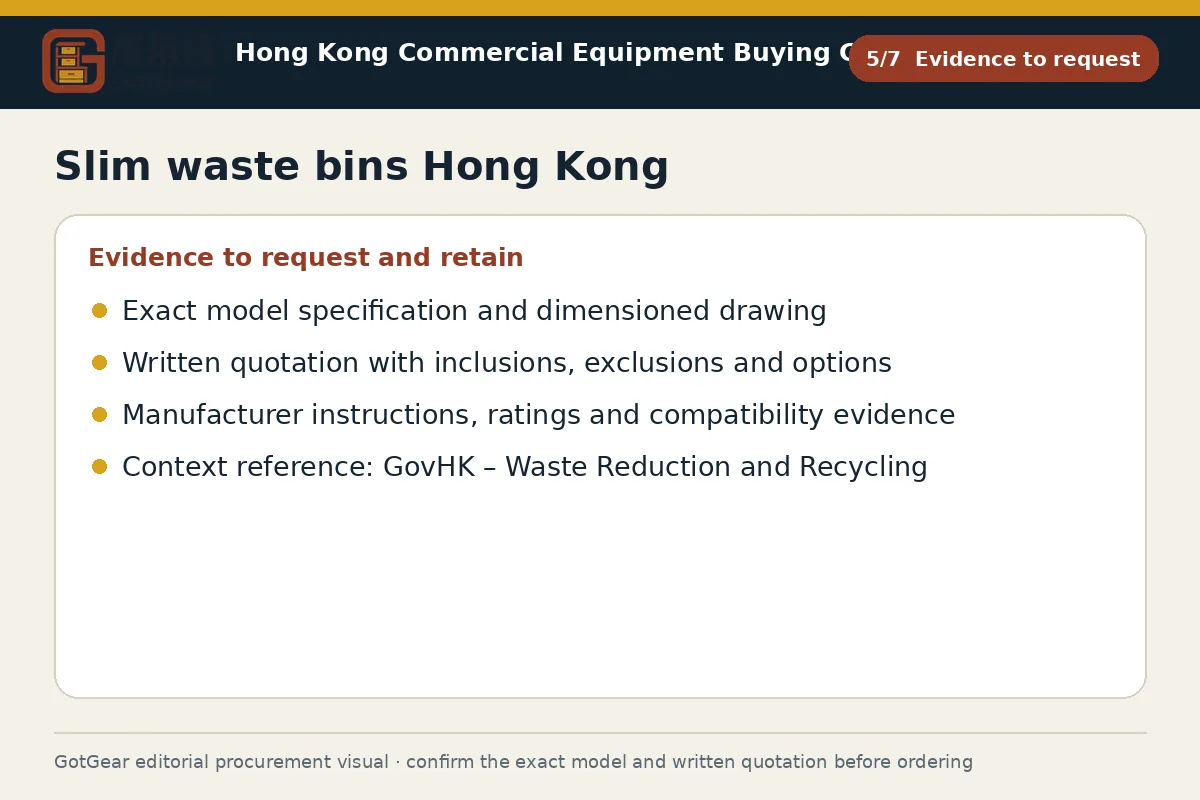
Confirm the maximum footprint, approach clearance and door-swing arcs on a marked plan, then request a datasheet showing external dimensions, lid projection when open, opening height and internal capacity. State the liner size, gauge and target fill height you intend to use so vendors confirm compatibility. Ask for material specifications, cleaning guidance and spare-part lists, including flap or hinge assemblies. Require packed dimensions and weight to verify lift and doorway access, and agree delivery booking procedures with the building office. Where hygiene, fire safety or waste-handling rules may apply, ask the responsible venue manager or authority to confirm requirements for closed lids or labels, and request the manufacturer’s written statements accordingly. On receipt, measure, test the lid action, and document any discrepancies before acceptance.
- Operating use, quantity and expected frequency
- Dimensions, capacity, material and accessory requirements
- Delivery address, floor, goods lift and loading window
- Required documents, acceptance checks and after-sales arrangements
Key points for slim waste bins Hong Kong, swing top waste bins Hong Kong, push top waste bins Hong Kong
Hong Kong buildings often combine tight goods-lift cars, narrow service corridors and managed loading windows. Before ordering, confirm the packed size will pass the smallest doorway and lift opening on your route, using an example starting point such as 900 mm clear width that must be verified against your site’s actual constraints. Coordinate delivery booking with the management office and check whether refuse rooms require lidded containers or bilingual safety labels. Humid summers can amplify odour and corrosion risks, so ask for materials and care instructions suitable for local conditions. This guidance is operational, not legal advice.
Questions about slim waste bins Hong Kong
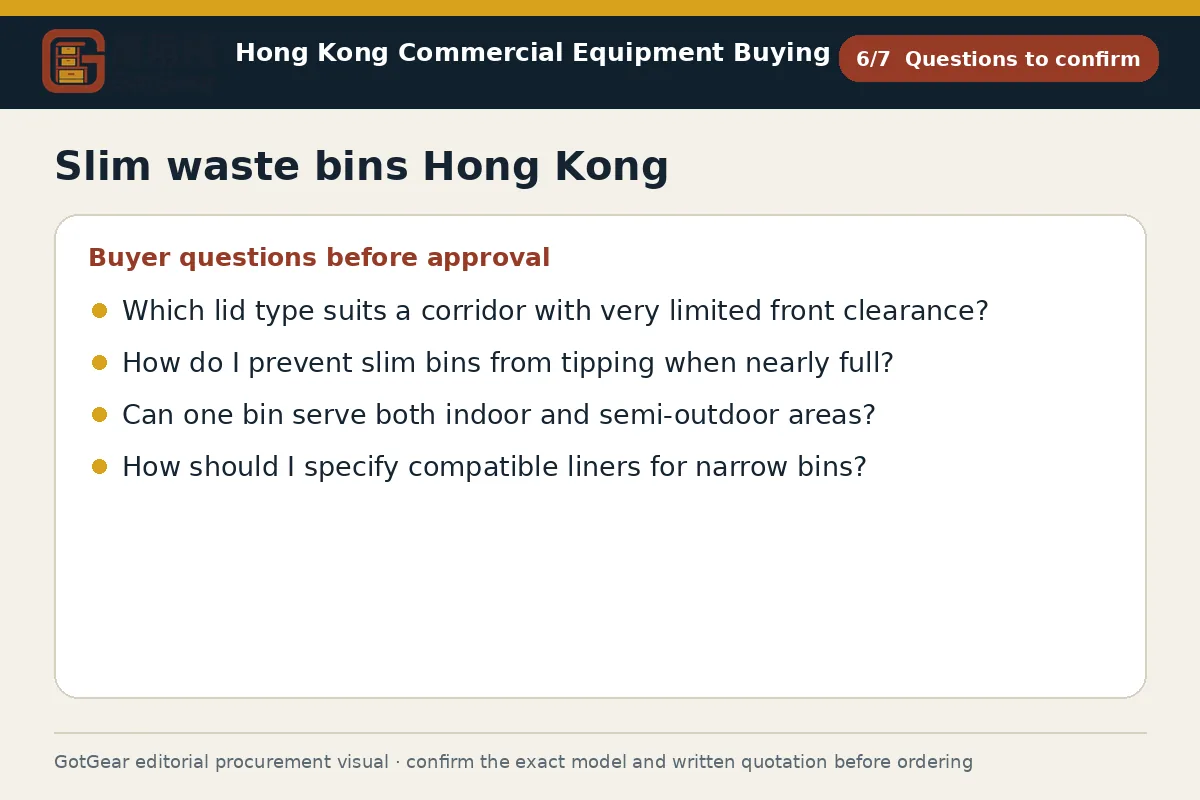
Which lid type suits a corridor with very limited front clearance?
A push flap typically needs less forward operating space than an upward-swinging panel, so it can suit shallow approaches. Always confirm the supplier’s stated projection with a site mock-up and check that the user’s hand path and any door swings are still unobstructed. If odour control or touch reduction is critical, compare spring-return flaps against alternatives in a supervised trial.
How do I prevent slim bins from tipping when nearly full?
Choose a model with a stable base, optional wall clip or bumper and a liner-retaining system that stops weight shifting forward. Ask the supplier for a datasheet specifying base dimensions, anti-slip feet and any ballast options. Trial a representative bag load before approval, and confirm the quoted stability features in the formal documentation for your exact model.
Can one bin serve both indoor and semi-outdoor areas?
Possibly, if the body and lid materials are corrosion-resistant, UV-stable and designed to shed rain. Verify the manufacturer’s recommendation for the exposure level at your site. Sheltered arcades and covered loading docks differ from open areas; confirm drainage, cleaning access and signage durability in humidity before committing to a single model across locations.
How should I specify compatible liners for narrow bins?
Match the liner width and length to the bin’s internal dimensions and add allowance for tie-off and lift-out. Provide your expected fill height and waste type so the vendor can advise gauge and seal style. Request a written liner recommendation by model code and verify fit during a trial load before placing a multi-site order.
Continue with closely related procurement topics
These pages share equipment, operating or decision-stage signals with this guide.
Decorative refuse bins Hong Kong
Compare decorative refuse bins Hong Kong with lobby litter bins Hong Kong to assess capacity, opening style, finish, liner concealment and cleanability, and to confirm required floor area with GotGear, Hong Kong.
Read the guide
Hooded waste bins Hong Kong
GotGear compares hooded waste bins Hong Kong and wall mounted waste bins Hong Kong by aperture, floor clearance, fixings and cleaning access to help foodservice buyers assess suitability.
Read the guide
Waste bins with ashtray Hong Kong
Compare waste bins with ashtray Hong Kong and cigarette butt bins Hong Kong for placement, waste separation, emptying and hot-ash risk at local sites. Find guidance and options from GotGear.
Read the guide
Cabinet cleaning trolley Hong Kong
This guide summarises access, route width, load and lift limits and door clearances for cabinet cleaning trolley Hong Kong. Compare roll top cleaning trolley Hong Kong and compact cleaning trolley Hong Kong with GotGear.
Read the guideRelated topic indexOpen more English procurement pages2 topics
Browse additional equipment families, applications and procurement questions relevant to a wider buying brief.